Free email delivery
Please sign up for email delivery in the subscription area to the right.
No salesman will call, at least not from us. Maybe from someone else.
News from the West Coast Snowy Plover Meeting
Every year in January a number of professionals and amateurs concerned with the fate of the threatened Western Snowy Plover meet at a West Coast site to exchange information and give reports on the status of those little birds we see eight months of the year at Malibu Lagoon.
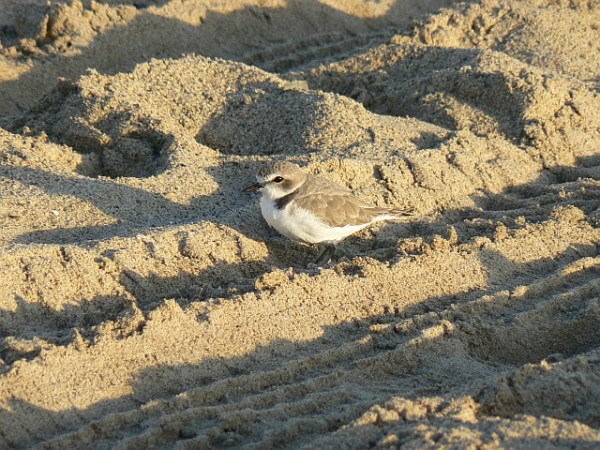
- Tire tracks are a preferred roosting spot (L.Plauzoles)

Nearly ninety interested stakeholders attended the January 19-20 meeting at the Museum of Natural History in Pacific Beach. This is the twelfth such meeting to my knowledge. Of the three I have attended, this was by far the best focused with a trove of technical knowledge, volunteer stories and pointed discussion. Welcome to Plover Tech!
Most locations of winter season roosts and breeding sites on the West Coast have been reliably mapped over the past ten years. To add to this knowledge base a report from Jim Lyons of US Fish and Wildlife presented the first North American survey to estimate the size of the inland and Gulf Coast populations of Snowy Plovers. The largest US breeding population is in Oklahoma! An early estimate of the total number of birds is in the range of only 26,000 for the entire continent. This report was closely followed by an enlightening exposé from Eduardo Palacios of CICESE in Mexico who managed the Mexican survey. San Quintin in Baja California seems to be the largest reliable site for the plovers in Mexico. The official results of this survey should be published next year.

How many Snowy Plovers can you find? Answer at bottom. (C.Almdale)
As is traditional in these meetings, each region (or Recovery Units in the Recovery Plan) of the Pacific Coast gave a short synopsis of the status of the birds, breeding, survival and variations in populations. For our Los Angeles County, in short, the population seems to be recovering from a radical decline on most beaches in Spring 2007. The exception is Zuma Beach which recently was counted at 90 birds, versus some 200 in 2005. Malibu Lagoon with 86 birds in early January, and Santa Monica with 58 birds last week have reached record levels for the ten-year period. Dockweiler Beach and Redondo have over 20 birds at each of three sites since October. Many of the areas north and south of us which have had some success in breeding continue to face predation problems, especially from Common Ravens and other avian species. Many of the regions have established or about to set up camera systems to monitor predator attacks and develop appropriate defenses.
The conference was hosted at the Museum by Monterey Audubon and organized by

Monterrey's unlucky denizens are forced to live in such surroundings (L.Plauzoles 1/11)
Point Reyes Bird Observatory (PRBO) and the Fish and Wildlife Service (USFWS). Significantly both Gary Page and Lynne Stenzel of PRBO who co-authored the seminal study on West Coast Snowy Plovers in 1981 addressed the audience with long-term statistics and trends about the Monterey area flocks that they have studied for years and whose members are almost all banded to allow detailed behavioral study. Gary Page addressed the changes in predation in some detail and Lynne focused on the sex lives of the little birds.
The liveliest discussions were about adult survival, especially over-winter survival which Humboldt State University Professor Mark Colwell considers key to the survival of the species—more important than breeding productivity. Other “hot” discussion subjects centered on “take” permits that allow stewards of nesting sites to haze or dispose of ravens and other predators, stable isotope studies that gave us insight into the methods and habits of ravens, and a new validation study that is used to extrapolate from the bi-annual “window” surveys to come up with a reliable census figure for the species. Also of interest were the experiences of CA State Parks’ experiments in removing European Beach Grass and the SF Bay Bird Observatory program to restore the wetlands that had previously been Cargill’s salt ponds. The area is now the largest California Gull breeding ground.
An entire afternoon session was occupied by a considerable number of examples of experiences by groups and individuals in successfully protecting plovers. The upcoming US Park Service rule concerning dogs in National Parks and Monuments was a climax. Look for it soon on your NPS website! It is announced at nearly 2500 pages, mostly due to the ongoing conflict between San Francisco leash-free advocates and Golden Gate Audubon Society. GGAS requests your comments to NPS as soon as the 60-day comment period is open.
My presence at the meeting was subsidized in part by Santa Monica Bay Audubon and I will be glad to share any of the information that I obtained with our members, those of other Audubon entities or various agencies. The opportunity to meet with other concerned plover activists and professionals will certainly add to our efforts on the LA County coast. [Lucien Plauzoles] [Answer: Six]
Malibu Lagoon Field Trip Report: 23 January, 2011

The male American Avocet's bill is longer and straighter than the female's (L.Johnson 1/11)
Yikes! 75° at the lagoon in January? Ridiculous. Equally absurd is the evil rumor going around that we might not get any more rain this season. After what was probably the wettest December on record we’ll have the driest January through March ever? They (the ever-mysterious them) must be messing around with our weather again. Moving on…bird species at the lagoon were below the January normal; numbers were up, mostly due to the large flocks of gulls. Unfortunately, most of them flew away – the result of rambunctious toddlers and oblivious strollers – before I could get a good count, so Ring-bills, Western and California Gulls totals are an educated guess.
We actually have two bird walks on our Malibu Lagoon field trips. Chuck leads the early one for (mostly) adults, leaving the 10 AM walk to those who are better with children. Here is a report from one such person on what it was like.
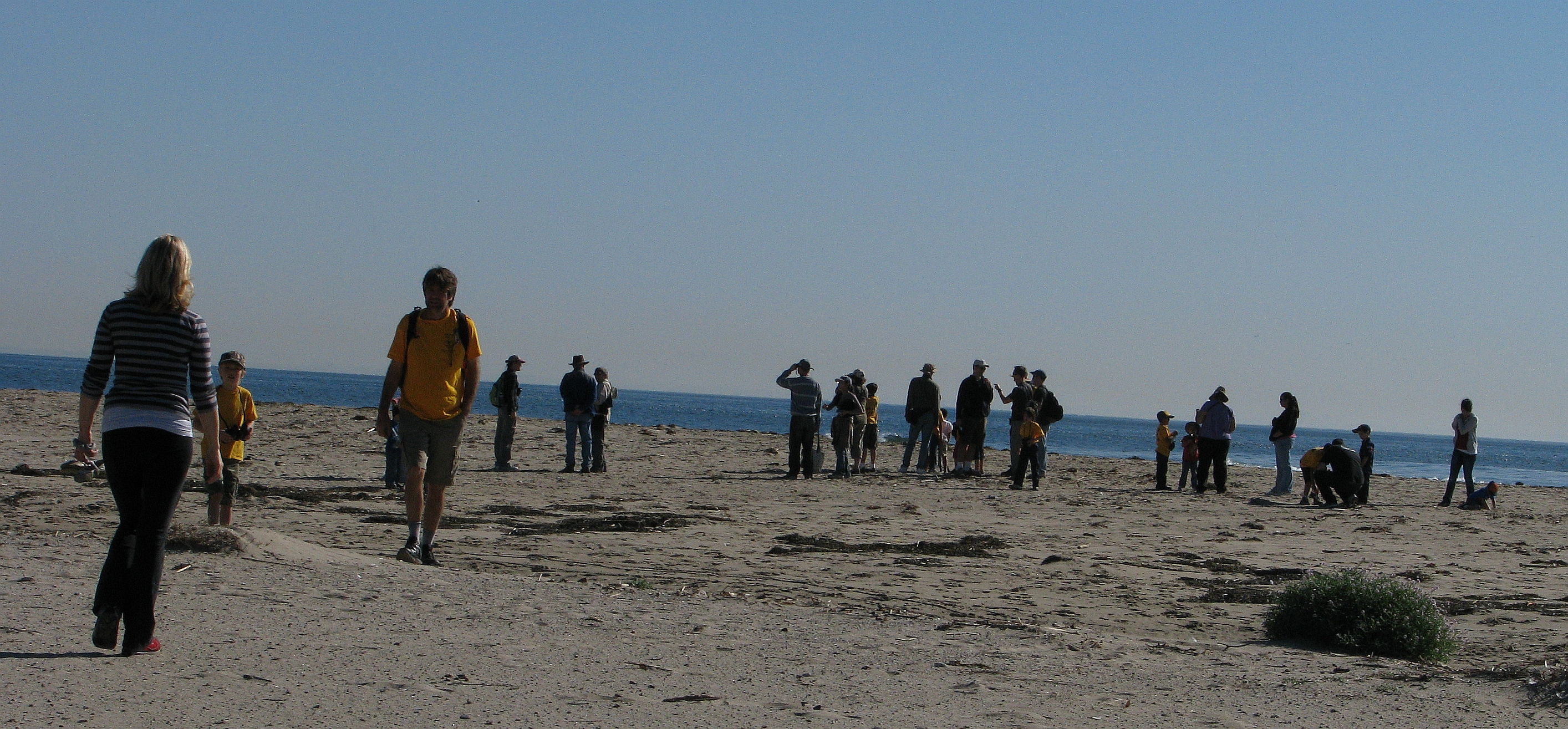
A warm day for Cub Scouts and family (L.Johnson 1/11)
This month we hosted a Cub Scout Troop from Grant Elementary in Santa Monica. Between the boys, their parents and their siblings, we had around 30 people….no one is sure how many; too busy to count. The boys liked the “big” birds: herons, egrets, pelicans, but more than the birds, they liked being out on the beach. Although we list this as a “children’s” walk, it is also for the parents. It’s a chance to get out, enjoy the birds and not have to worry about the kids distracting other birdwatchers. So if you have kids and would like to spend time outdoors some Sunday morning, come join us.
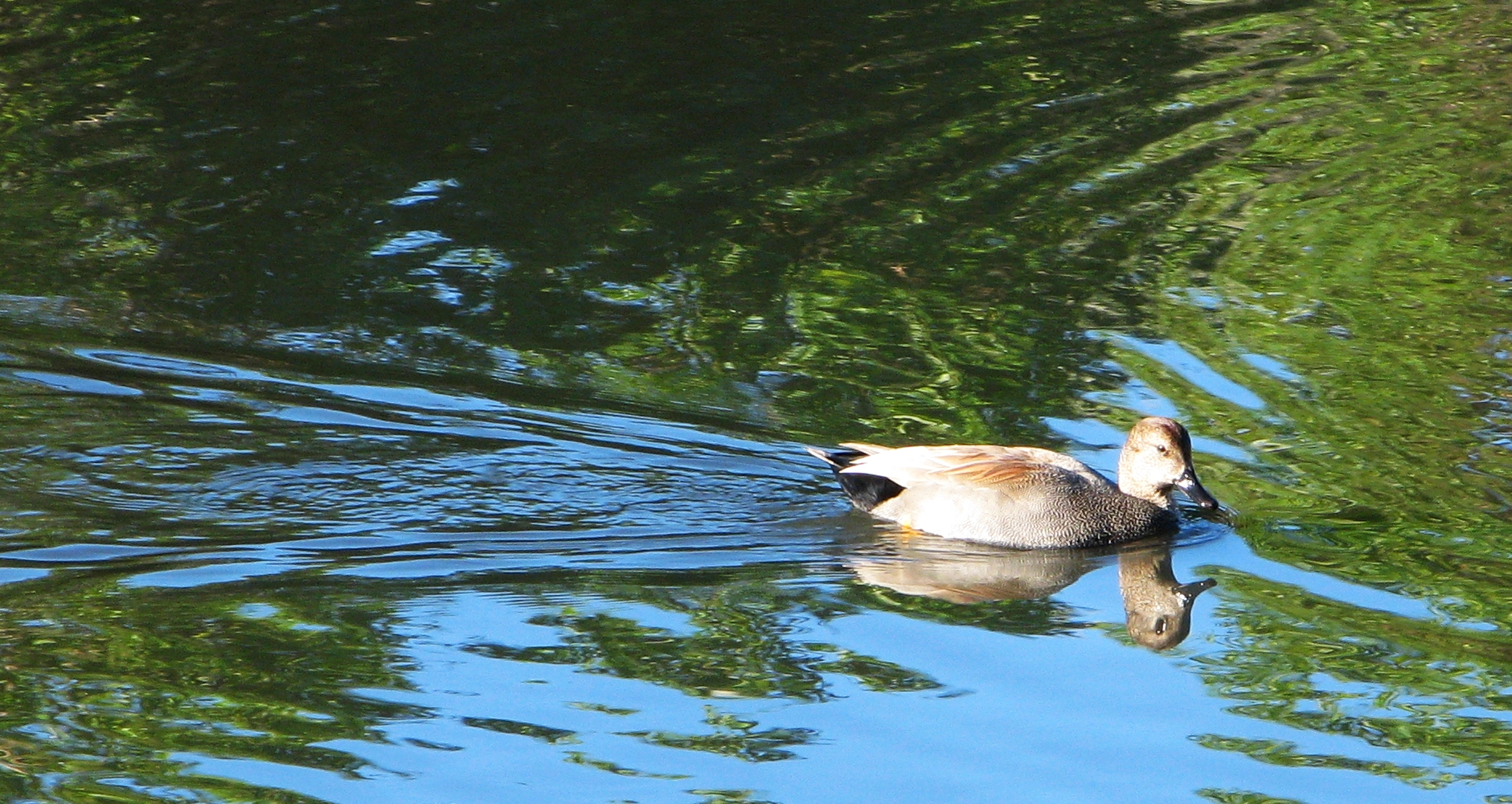
Male Gadwall cruising (L.Johnson 1/11)
Check out our other blog created especially for Unusual Birds at Malibu Lagoon, the permanent location for pictures of our uncommon birds. For prior period bird lists, follow these links to July-Dec ’10, Jan-June ’10, Jul-Dec ‘09, and Jan-June ‘09. For an aerial photo of the lagoon, go here. [Chuck Almdale & Lillian Johnson]
| Malibu Census 2011 | 23-Jan |
| Temperature | 68-75 |
| Tide Height | +4.94 |
| Low/High & Time | H:1117 |
| Gadwall | 15 |
| Mallard | 24 |
| Northern Shoveler | 4 |
| Green-winged Teal | 12 |
| Bufflehead | 5 |
| Red-brstd Merganser | 6 |
| Ruddy Duck | 40 |
| Pacific Loon | 1 |
| Pied-billed Grebe | 3 |
| Horned Grebe | 1 |
| Eared Grebe | 3 |
| Western Grebe | 6 |
| Dble-crstd Cormorant | 57 |
| Pelagic Cormorant | 4 |
| Brown Pelican | 42 |
| Great Blue Heron | 2 |
| Great Egret | 1 |
| Snowy Egret | 8 |
| Osprey | 1 |
| Red-tailed Hawk | 1 |
| Virginia Rail | 1 |
| Sora | 4 |
| American Coot | 145 |
| Blk-bellied Plover | 1 |
| Snowy Plover | 60 |
| Killdeer | 3 |
| American Avocet | 4 |
| Spotted Sandpiper | 2 |
| Willet | 1 |
| Whimbrel | 1 |
| Least Sandpiper | 10 |
| Heermann’s Gull | 62 |
| Ring-billed Gull | 120 |
| Western Gull | 100 |
| California Gull | 2500 |
| Herring Gull | 1 |
| Glaucous-wingd Gull | 2 |
| Rock Pigeon | 5 |
| Mourning Dove | 2 |
| Anna’s Hummingbird | 3 |
| Allen’s Hummingbird | 6 |
| Belted Kingfisher | 1 |
| Black Phoebe | 4 |
| Say’s Phoebe | 1 |
| American Crow | 6 |
| Tree Swallow | 8 |
| Barn Swallow | 1 |
| Bushtit | 9 |
| Bewick’s Wren | 2 |
| House Wren | 1 |
| Northern Mockingbird | 1 |
| Yellow-rumpd Warbler | 6 |
| Common Yellowthroat | 4 |
| Song Sparrow | 8 |
| White-crwnd Sparrow | 4 |
| Red-winged Blackbird | 1 |
| Great-tailed Grackle | 1 |
| House Finch | 5 |
| American Goldfinch | 8 |
| Totals by Type | Jan |
| Waterfowl | 106 |
| Water Birds-Other | 267 |
| Herons, Egrets | 11 |
| Quail & Raptors | 2 |
| Shorebirds | 82 |
| Gulls & Terns | 2785 |
| Doves | 7 |
| Other Non-Pass. | 10 |
| Passerines | 70 |
| Totals Birds | 3340 |
| Total Species | Jan |
| Waterfowl | 7 |
| Water Birds-Other | 11 |
| Herons, Egrets | 3 |
| Quail & Raptors | 2 |
| Shorebirds | 8 |
| Gulls & Terns | 6 |
| Doves | 2 |
| Other Non-Pass. | 3 |
| Passerines | 17 |
| Totals Species | 59 |
Bird Articles from the Science Press
Here’s another collection of interesting tidbits.
http://www.sciencenews.org/view/generic/id/61677/title/For_ducks%2C_penis_length_depends_on_the_other_guys
Male genitals grow longer with more competition from other males.
From Science News Online 8/28/10.
****************************
Bullied booby chicks end up OK
http://www.sciencenews.org/view/generic/id/61777/title/Bullied_booby_chicks_end_up_OK
In a seabird nest, abuse by older siblings doesn’t hamper fitness.
From Science News Online 8/3/10.
****************************
Robins reject red glowing grub
http://www.sciencenews.org/view/generic/id/68343/title/Robins_reject_red_glowing_grub
Parasitic worms induce a color change in their caterpillar victims that’s literally repulsive to predators. From Science News Online 1/3/11.
****************************
Arkansas birds died of trauma
http://www.sciencenews.org/view/generic/id/68363/title/Arkansas_birds_died_of_trauma
Necropsies suggest loud noises caused panic, killing thousands.
From Science News Online 1/3/11.
****************************
Quantum compass for birds
http://www.sciencenews.org/view/generic/id/68484/title/Quantum_compass_for_birds
Robins may use strange physics to migrate.
From Science News Online 1/7/11.
****************************
Penguins tracking bands hurt the birds
http://news.yahoo.com/s/ap/20110112/ap_on_sc/us_sci_penguin_harm
Metal bands on the flippers slow them down, make them work harder, and increases mortality. From Yahoo News 1/12/11.
****************************
One of the difficulties of birding has to do with the problems and vagaries of lighting, shading, whether you’re looking into or away from the sun. In short, light and vision. Our vision and nervous systems do not so much perceive the world as modelthe world. Our brain developed it’s method of modeling over millions of years as the result of our peculiar evolutionary history. It works adequately most of the time, but can be misled under certain circumstances. When such events are visual, we call them “optical illusions”.From an interesting discussion on BirdChat titled “It’s hard to notice when moving objects change“, here’s an interesting experiment from Harvard which you can do at home, right now. http://visionlab.harvard.edu/silencing/
And here’s a similar example of the illusions of our color vision, from David Sibley’s website. http://www.sibleyguides.com/2010/05/color-illusion-and-thrush-identification/
And finally, here’s some interesting comments from Consumers Reports Greener Choices website on “Winter Heating Myths“, something which everyone here in the frigid climes of Southern California needs to fret about.
http://www.greenerchoices.org/products.cfm?product=1210energymyths&pcat=homegarden&EXTKEY=NG0N01012 [Chuck Almdale]
Field Trip Report: Antelope Valley, 8 January, 2011
We exited Hwy 14 at on Ave. P (Palmdale Blvd/Rt. 138) and went east. After a brief stop (where we tried hard to ignore some Rock Doves, Starlings, Brewer’s Blackbirds & House Sparrows), we drove east on Ave. P and turned north onto 10th St. E. We made several brief stops along the road where we found:
American Kestrel — 1
Eurasian Collared-Doves — 4
Loggerhead Shrike — 1
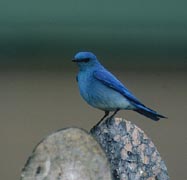
Mountain Bluebird (D. Paulson)
About 1 block south of Blackbird Lane, we parked and birded along the road before walking into the mixed Joshua Tree and shrub habitat. There seemed to be Cactus Wrens everywhere. They were displaying, singing, and perching in full view. Although the area has been described as a good site for Le Conte’s Thrashers, we neither heard nor saw any Le Conte’s. However, in addition to at least 8 Cactus Wrens, we found:
Anna’s Hummingbirds – 2
Say’s Phoebes – 2
Northern Mockingbird – 1
Mountain Bluebirds – 6
White-crowned Sparrows — 6
House Finches – a few
We returned to Palmdale Blvd. and drove east to the Desert Aire Golf Course. A scan of the trees and surrounding area produced only a single Northern Flicker. From the Country Club, we drove north along the short section of 40th St. E, which turns right and becomes Ave. N. In this area, we saw:
Say’s Phoebe
Loggerhead Shrike
Horned Larks – flock of 30 or more
We turned left and drove north on 50th St. E and as we drove, we saw:
Ravens – the first few of many seen during the day
Horned Larks – small flock
Brewer’s Blackbirds– flock
We stopped at the side of 50th St. E just south of Ave. L, to scan the fields in hopes of finding Mountain Plovers. Unfortunately, the only plovers we could see were Killdeer. At that site, we saw:
Killdeer – 75+
Northern Harrier — 1
European Starlings
Yellow-rumped Warblers — 12
Savannah Sparrows — 6
When we reached Ave. K we turned left and drove west a short distance to check the farm fields on either side of the road. The newly-harrowed field on the south side of the road was not productive but a large mulch dump on the north side of the road produced:
American Pipits – 15
Yellow-rumped Warblers – 4

Singing LeConte’s Thrasher (L.Johnson)
We returned to 50th St. E and went north to Ave K. We went east on Ave. K for about 1 mile and stopped at Little Rock Wash where we parked and walked south along the east side of the wash. We did not go down into the wash, preferring instead to remain above it where we could look down into it. We walked less than ¼ mi. and stopped where the wash curves east and looked down into the wash where we spotted a pair of Le Conte’s Thrashers that had been singing. After we all had scope views, we walked back to our cars. In addition to the thrashers, we saw:
Red-tailed Hawk
American Kestrel
Sage Sparrows – a few
From there, we continued east on Ave. K and turned north on 70th St. E. As we went north, we saw a flock of Western Meadowlarks one of the fields we passed.
At Ave. J, we turned east. As we drove, we saw:
Red-tailed Hawks – 8 or more
Northern Harrier – 1
Horned Larks – several flocks, est. 500+ birds
Savannah Sparrows – 20 or so
We continued east on Ave. J until we crossed 110th St. E. The farmland on the north side of the road just past this intersection is the area where we have found wintering Ferruginous Hawks in previous years. Although we were disappointed at first, we finally spotted 2 light morph birds in the farm fields on the north side of Ave. J. A few moments later, we had good looks at a dark morph juvenile as it flew toward us from the south. It flew over the road near us and continued north. As in past years, there were Mountain Plover in the field. We were, however, limited to scope views of the flock of 40+ birds because they were in the northern part of the field. Unfortunately, we were not able to view those fields from the north because 110th St. E was closed to traffic between Aves. J & I for road repairs. Since Saddleback Butte State Park is close by, we decided to have lunch in the park. As we drove east along Ave. J toward the park, we saw:
Horned Larks – 500+ birds
European Starlings
After lunch, we made our way to the west side of the valley, crossing over Hwy. 14 on Ave. E. There were large numbers of Horned Larks (300+) along Ave. E.
In a farm field near the corner of Ave. B & 60th St. W we found:
Canada Geese — 6
Tundra Swans — 2
Killdeer – 50
In the same area, we spotted a Ferruginous Hawk. As we were getting into our cars to drive on, we spotted an immature Golden Eagle in flight. This proved to be the only eagle we saw all day.
From there, we headed north and turned left onto Gaskell Ave. and drove west. In past years, Gaskell Ave. has been a good area for raptors so it was disappointing to see neither additional eagles nor any falcons. However, as we drove west, we did find:
Red-tailed Hawks – several, including 1 dark morph bird
American Pipits –100+
Western Meadowlarks – 12
Horned Larks – 100+
Mountain Bluebirds – 12 (beautifully illuminated by the afternoon light)
We stopped along Gaskell near 130th St. W when we noticed several Ferruginous Hawks. As we scoped the area, we counted 6 or 7 birds in a single farm field, prompting a discussion of the habits of Ferruginous Hawks. Some time later, I checked the species account in Raptors of Western North America, B. K. Wheeler, 2003, Princeton U. According to Wheeler, Ferruginous Hawks are wary during the breeding season and pairs are solitary but at other times of year, these birds are relatively tame and somewhat gregarious. They nest in trees in open country but will build nests on boulders or rock piles in areas that lack trees. If disturbed, they often abandon their nests. According to Wheeler, although Ferruginous Hawks perch on the ground as well as various natural and man-made objects, they never perch on wires such as power lines. They hunt on the wing and from perches. When perched on the ground, they grab prey such as rodents that emerge from their burrows or tunnels. They are opportunistic hunters, preying on a variety of mammals, birds, reptiles and large insects such as Lubber Grasshoppers. The large gape is presumed to help prevent overheating, especially in juveniles that spend long hours in hot areas with little shade.
When we left Gaskell Road, we drove south to Lancaster Rd. and started west. The Poppy Preserve was closed but we turned off on a dirt road south of 190th St. W and drove to the top of the rise. A brief scan for raptors was not productive so we returned to Lancaster Rd. and drove to Quail Lake. During the drive, we saw another Northern Harrier.
It was late in the day, the wind had increased and viewing conditions were not ideal at Quail Lake but we did see the following:
Aechmophorus grebes – a few in the distance
Greater Scaup — 1
Lesser Scaup — several
Bufflehead — several
Common Goldeneye – 1
Common Merganser – 3 or 4
After a short time, we drove west to I-5 and returned to Los Angeles. The trip list shown is shown below. [I]- Introduced. [Chuck Almdale]
| Antelope Valley Trip List | January 8, 2011 |
| Canada Goose | Branta canadensis |
| Tundra Swan | Cygnus columbianus |
| Gadwall | Anas strepera |
| American Wigeon | Anas americana |
| Mallard | Anas platyrhynchos |
| Northern Shoveler | Anas clypeata |
| Green-winged Teal | Anas crecca |
| Greater Scaup | Aythya marila |
| Lesser Scaup | Aythya affinis |
| Bufflehead | Bucephala albeola |
| Common Goldeneye | Bucephala clangula |
| Common Merganser | Mergus merganser |
| Ruddy Duck | Oxyura jamaicensis |
| Pied-billed Grebe | Podilymbus podiceps |
| Eared Grebe | Podiceps nigricollis |
| Western Grebe | Aechmophorus occidentalis |
| Double-crested Cormorant | Phalacrocorax auritus |
| Great Blue Heron | Ardea herodias |
| Great Egret | Ardea alba |
| Turkey Vulture | Cathartes aura |
| Northern Harrier | Circus cyaneus |
| Cooper’s Hawk | Accipiter cooperii |
| Red-shouldered Hawk | Buteo lineatus |
| Red-tailed Hawk | Buteo jamaicensis |
| Ferruginous Hawk | Buteo regalis |
| Golden Eagle | Aquila chrysaetos |
| American Kestrel | Falco sparverius |
| American Coot | Fulica americana |
| Killdeer | Charadrius vociferus |
| Mountain Plover | Charadrius montanus |
| Ring-billed Gull | Larus delawarensis |
| California Gull | Larus californicus |
| Rock Pigeon [I] | Columba livia |
| Eurasian Collared-Dove [I] | Streptopelia decaocto |
| Mourning Dove | Zenaida macroura |
| Anna’s Hummingbird | Calypte anna |
| Allen’s Hummingbird | Selasphorus sasin |
| Downy Woodpecker | Picoides pubescens |
| Northern Flicker | Colaptes auratus |
| Black Phoebe | Sayornis nigricans |
| Say’s Phoebe | Sayornis saya |
| Cassin’s Kingbird | Tyrannus vociferans |
| Loggerhead Shrike | Lanius ludovicianus |
| Western Scrub-Jay | Aphelocoma californica |
| Common Raven | Corvus corax |
| Horned Lark | Eremophila alpestris |
| Cactus Wren | Campylorhynchus brunneicapillus |
| Bewick’s Wren | Thryomanes bewickii |
| Ruby-crowned Kinglet | Regulus calendula |
| Mountain Bluebird | Sialia currucoides |
| Northern Mockingbird | Mimus polyglottos |
| Le Conte’s Thrasher | Toxostoma lecontei |
| European Starling [I] | Sturnus vulgaris |
| American Pipit | Anthus rubescens |
| Yellow-rumped Warbler | Dendroica coronata |
| California Towhee | Melozone crissalis |
| Lark Sparrow | Chondestes grammacus |
| Sage Sparrow | Amphispiza belli |
| Savannah Sparrow | Passerculus sandwichensis |
| White-crowned Sparrow | Zonotrichia leucophrys |
| Red-winged Blackbird | Agelaius phoeniceus |
| Western Meadowlark | Sturnella neglecta |
| Brewer’s Blackbird | Euphagus cyanocephalus |
| House Finch | Carpodacus mexicanus |
| Lesser Goldfinch | Spinus psaltria |
| American Goldfinch | Spinus tristis |
| House Sparrow [I] | Passer domesticus |
| Total Species | 67 |
Field Class in Bird Identification
[Note: We have taught this class annually for the past five years. It will likely be offered again in February 2012. Watch for the announcement in late fall or early winter.]
This spring, SMBAS will offer a five-session field course in bird identification.The course is designed to help new or novice birders improve their observational skills while learning how to identify some of the species commonly found in the Los Angeles basin.
Beginning in February, 2011, the Saturday morning classes take place outside among the birds. Each class meets in a different local park or natural area so that participants may gain experience with the relationship between habitats and the species that rely on them.
Enrollment is limited to 8. A donation of $50 per SMBAS member or $75 per non-member will be requested. For further information, please contact Chuck at webinfo49 [AT] att.net or 310-617-8904. [Chuck Almdale]



 SANTA MONICA BAY AUDUBON SOCIETY BLOG