Field Trip Report: King Gillette Ranch, 13 March 2010
If your winter was one of discontent, fear not, for springtime is icumen in, glaidly sing coucou.

Fearless Leader Lu Plauzoles
The trees are beginning to leaf and flower, the bees are up and about their business, and the birds just wanna dance and sing, they know not why. I don’t think any of us ever did spot any of the House Wrens, but their singing was always within earshot. A California Thrasher had selected the small parking as part of his territory and he was busily burbling and chortling whenever we sauntered past, trailing our fearless leader.

Phainopepla female L.Johnson 3/13/10)
A female Phainopepla was in the same area, indicating that they are beginning to move from the deserts to the coast for their 2nd breeding season.
The day quickly warmed after a chilly start and we took our time wandering around the native planting area, sorting out a Northern Mockingbird’s songs from his thrasher cousin, House Finch songs from possible Purples, and Lesser Goldfinch plaintiveness from the slightly less mournful American Goldfinch. California Quail called in the distance as we wandered through fields of sage and grass.

Lewis's Woodpecker - resting from his pursuits (J.Kenney 3/13/10)
After finding only Mallards on the small pond, we checked out the large sycamores at the west end of the large ranch house and among the many busy Acorn Woodpeckers we found a solitary Lewis’s Woodpecker, previously reported on the LA County Birding Hot Line. Compared to his Melanerpes congener, he is almost crowlike – larger and darker, lacking all the Acorn’s patches of white plumage. He seemed intent on driving away all of the Acorns – a hopeless ambition – leaving him barely any time to hawk insects from the treetops between his swoops and lunges at the other woodpeckers. This is a relatively good winter for Lewis’s in SoCal. They are an irruptive wintering species and some years there are few or none around.
Onwards into the woods, Oak Titmice were singing everywhere, Ruby-crowned Kinglets were busily gleaning and the occasional Yellow-rumped Warbler in winter plumage was still present. A large flock of Band-tailed Pigeons startled us, suddenly flushing from a large sycamore when we got too close for their comfort. On the margins of the fields, Western Bluebirds were a common sight, flycatching from the trees and fence posts. Several of our group were busily taking photos at every opportunity: some of their results follow. If you are on the website, double-click the image to make it larger and see additional (if any) information.
-

- Fearless Leader Lu Plauzoles
-

- California Thrasher – between songs (J.Kenney 3/13/10 King Gillette)
-
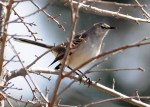
- Northern Mockingbird (J.Kenney 3/13/10)
-
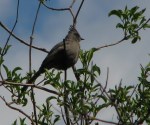
- Phainopepla female (L.Johnson 3/13/10 King Gillette)
-
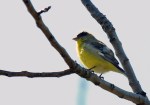
- Lesser Goldfinch male molting into breeding plumage (J.Kenney 3/13/10)
-
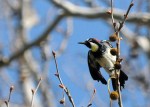
- Acorn Woodpecker. King Gillette Ranch (J.Kenney 3/13/10)
-
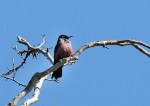
- Lewis’s Woodpecker – resting from his pursuits (J.Kenney 3/13/10 King Gillette)
-
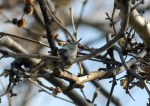
- White-breasted Nuthatch (J.Kenney 3/13/10)
-
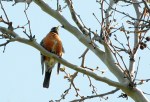
- American Robin still molting into breeding plumage (J.Kenney 3/13/10)
-
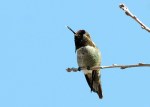
- Anna’s Hummingbird male (J.Kenney 3/13/10)
-
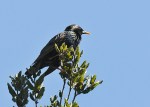
- European Starling – noted cavity nester (J.Kenney 3/13/10)
-
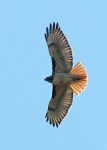
- Red-tailed Hawk (J.Kenney 3/13/10)
-

- Red-shouldered Hawk soaring (J.Kenney 3/13/10 King Gillette)
-

- Ground Squirrel (J.Kenney 3/13/10)
Trip List – 44 Species (H – heard only)
| Mallard | 15 |
| California Quail | H |
| Great Blue Heron | 2 |
| Black-crowned Night-Heron | 1 |
| Turkey Vulture | 4 |
| Cooper’s Hawk | 2 |
| Red-shouldered Hawk | 2 |
| Red-tailed Hawk | 4 |
| Rock Pigeon | 12 |
| Band-tailed Pigeon | 30 |
| Mourning Dove | 20 |
| Anna’s Hummingbird | 8 |
| Allen’s Hummingbird | 2 |
| Lewis’s Woodpecker | 1 |
| Acorn Woodpecker | 25 |
| Nuttall’s Woodpecker | 1 |
| Northern Flicker | 1 |
| Black Phoebe | 25 |
| Cassin’s Kingbird | 1 |
| Western Scrub-Jay | 2 |
| American Crow | 20 |
| Common Raven | 4 |
| No. Rough-winged Swallow | 1 |
| Violet-green Swallow | 1 |
| Bushtit | 10 |
| White-breasted Nuthatch | 4 |
| House Wren | 8H |
| Ruby-crowned Kinglet | 12 |
| Western Bluebird | 12 |
| American Robin | 2 |
| Wrentit | 4H |
| Northern Mockingbird | 4 |
| California Thrasher | 2 |
| European Starling | 20 |
| Orange-crowned Warbler | 2 |
| Yellow-rumped Warbler | 10 |
| Spotted Towhee | 4 |
| California Towhee | 6 |
| Song Sparrow | 3 |
| White-crowned Sparrow | 4 |
| Dark-eyed Junco | 30 |
| House Finch | 30 |
| Lesser Goldfinch | 12 |
| American Goldfinch | 3 |
Discover more from SANTA MONICA BAY AUDUBON SOCIETY BLOG
Subscribe to get the latest posts sent to your email.



 SANTA MONICA BAY AUDUBON SOCIETY BLOG