Ballona Fresh Water Marsh field trip, 11/11/23
[Text by Jean Garrett & Chuck Almdale, posted by Chuck Almdale]

Black Phoebe flycatching from a conveniently bent reed (Ray Juncosa 11-11-23)
After a slow start, the birds began appearing and we finally were glad the wind earlier in the week did not chase all the birds away. Our first hawk was quite distant and we thought it was a red-tailed but Ann Flower blew up her picture and it was a Red-shouldered Hawk.

Red-shouldered Hawk (Ann Flower 11-11-23)
The bushes have grown a little too thick on the East side so we walked quickly to find breaks in the landscape. In a clearing there was a large collection of Coots but with continued searching we found some Gadwalls, Cinnamon Teals, and American Wigeons.

Teal female (Ray Juncosa 11-11-23)
The above female teal was seen at a distance and was not associating closely with males of Green-winged, Blue-winged or Cinnamon, all of which were in the vicinity on the pond. Green-winged, although that’s the most common teal in the area (Blue-winged is the least common) seems unlikely, so we’re focusing on the other two. We don’t agree on which of the two it is, or if it’s a hybrid Blue-winged x Cinnamon. We sort out the characteristics as follows:
Blue-winged: head shape (rounded), bill-shape (slight upper curve), larger bill nail, bill-color (no yellow edge), white at base of bill, dark line thru eye (disagreement), mantle & scapulars (not warmish)
Cinnamon: longer bill, nail (smaller), tertials (larger dark area), dark line thru eye (less bold)
With the above in mind, the order of likelihood seems to be: Blue-winged, hybrid, Cinnamon. Feel free to send in comments, but please explain your choice.
The Yellow-rumped Warblers were busy feeding and we could hear and finally see White-crowned Sparrows on the pathway.

Yellow-rumped Warbler in basic (winter) plumage (Ray Juncosa 11-11-23)
Lurking in the trees was a Downy Woodpecker and a noisy Marsh Wren was in the bushes. The best leafbird I have ever seen had us looking at several angles until we all agreed it was…a leaf. One of the most exciting birds was the male Blue-winged Teal. They are so uncommon now days.
Great-tailed Grackles are considered to be one of the most successful avian invaders (or range extenders) in the U.S. Historically, they’ve been in Mexico for ages, showed up in Central Texas in the 1890’s and southwestern Louisiana between 1938 and 1959. They’re now found across the central and eastern north from South Dakota to Nova Scotia. Out west, they came from Mexico into New Mexico in 1913 and Arizona in 1935. They were first recorded in California in 1964, and for many years were difficult to find in California outside of the Imperial Valley and (for some odd reason) the city park in California City, Kern County. They’ve since spread — a lot. On 11 April 2023 one showed up in Vancouver, B.C., the 311th for that city and the 418th for British Columbia. In SoCal they’re likely to be resident and breeding in nearly any park that has water and reeds.

Adult Great-tailed Grackles have a yellow eye. This one looks quite fierce. (Ray Juncosa 11-11-23)
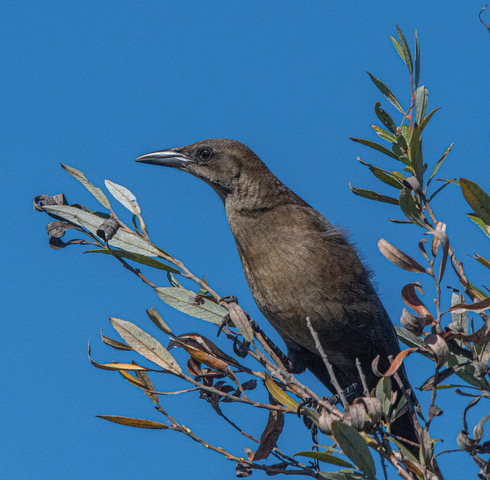
Juvenile Great-tailed Grackles have a dark eye. The hair-like feathers on the sides of the breast look a bit odd. (Ray Juncosa 11-11-23)
Then we ended the marsh walk with another controversy.

Some sort of raptor in the tree. What is it? A falcon? Where’s the vertical dark cheek stripe? (Ann Flower 11-11-23)
The falcon was backlit but I thought I saw 2 parallel black stripes on one side of the head.

Looks like a falcon. Is that 2 vertical cheek stripes or one? They’re very short stripes. But the white eyebrow streak is very Merlinish. (Ray Juncosa 11-11-23)
Then when we came back to one tree away from the original spotting, there was a Merlin. Now was it the same bird? This second bird was sitting in good lighting.
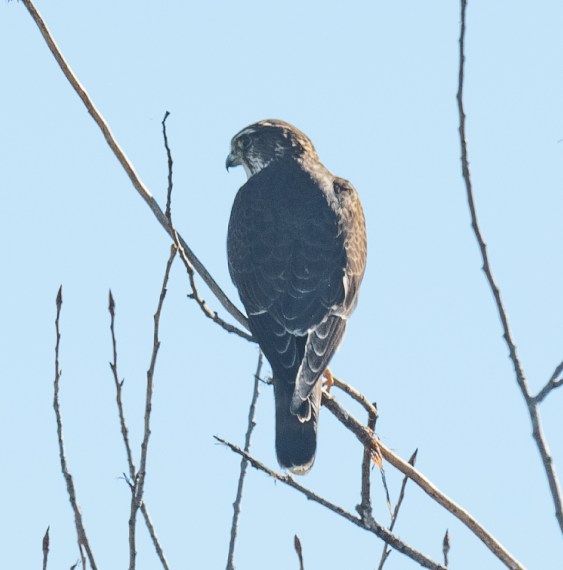
Now we can see the white eyebrow streak and the vertical dark cheek stripe. Definitely a Merlin. Were these two the same individual bird? Go back and look at the first two photos. In the top photo the head is twisted sharply to its right which distorts the cheek stripe diagonally backwards. In the second photo, the bird is looking down which also distorts the cheek stripe by “shortening” it. (Ann Flower 11-11-23)

Red-winged Blackbird females often elicit the question “What sparrow is that?” (Ray Juncosa 11-11-23)
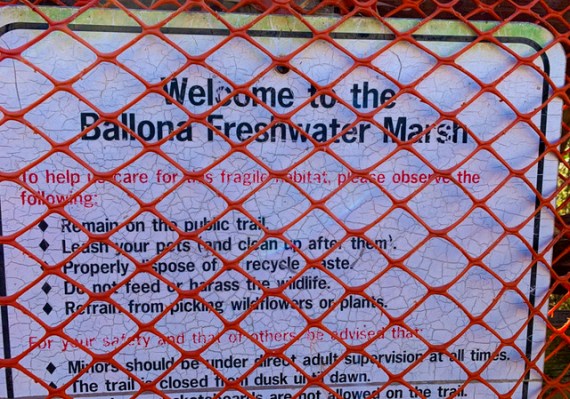
A well protected sign (Ray Juncosa 11-11-23)
For those who kept wanting to bird, we went over to Del Rey Lagoon and along the Ballona Creek jetty. It was not crowded with birds but we did pick up a Bonaparte’s Gull along with a Heermann’s, California, and Western Gull. We also got to see several Willets, some Wimbrels, Buffleheads, an Eared Grebe and of course one Double-crested Cormorant.
| Ballona Fresh Water Marsh 11/11/23 |
| 55 species |
| Canada Goose |
| Gadwall |
| American Wigeon |
| Mallard |
| Cinnamon Teal |
| Northern Shoveler |
| Blue-winged Teal |
| Green-winged Teal |
| Lesser Scaup |
| Bufflehead |
| Ruddy Duck |
| Pied-billed Grebe |
| Eared Grebe |
| Double-crested Cormorant |
| Brown Pelican |
| Snowy Egret |
| Great Egret |
| Northern Harrier |
| Cooper’s Hawk |
| Red-shouldered Hawk |
| Red-tailed Hawk |
| American Kestrel |
| Merlin |
| Sora |
| American Coot |
| Black-bellied Plover |
| Killdeer |
| Willet |
| Greater Yellowlegs |
| Whimbrel |
| Least Sandpiper |
| Long-billed Dowitcher |
| Bonaparte’s Gull |
| Heermann’s Gull |
| Calif. Gull |
| Western Gull |
| Mourning Dove |
| Allen’s Hummingbird |
| Downy Woodpecker |
| Black Phoebe |
| Cassin’s Kingbird |
| American Crow |
| Common Raven |
| Bushtit |
| Marsh Wren |
| Blue-gray Gnatcatcher |
| Northern Mockingbird |
| Yellow-rumped Warbler |
| Common Yellowthroat |
| Song Sparrow |
| White-crowned Sparrow |
| Common Grackle |
| Red-winged Blackbird |
| House Finch |
Discover more from SANTA MONICA BAY AUDUBON SOCIETY BLOG
Subscribe to get the latest posts sent to your email.



 SANTA MONICA BAY AUDUBON SOCIETY BLOG