A Padelynge of Dookysse: Back Bay Newport & San Joaquin Marsh, 9 Dec 2023
[By Chuck Almdale]
The weather was fine and it was a great day for a Padelynge of Dookysse (the 1452 AD collective noun expression). In fact we had a great many swich padelynges, all down and up the upper bay, at San Joaquin Marsh as well.
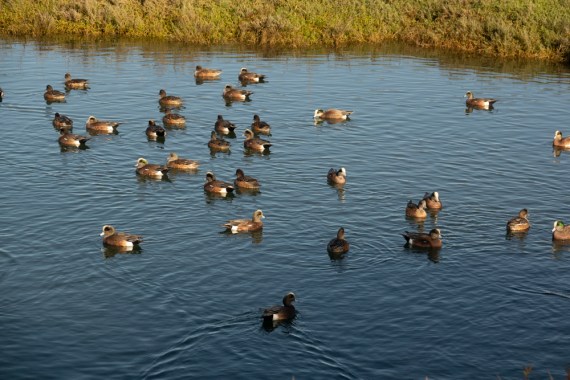
Our first paddling of ducks!
If you find anything other than American Wigeons above, give yourself an extra point. There’s always a group of ducks at the foot of San Joaquin Hills Rd. where it junctions with the one-way walk-run-bike-drive-bird road with the succinct name “Mountains to the Sea Trail and Bikeway.” It’s often a good spot for less common ducks such as Cinnamon Teal, Blue-winged Teal, Canvasback, Eurasian Teal. We didn’t find those species there this time, but we located some of them elsewhere.
As the tide dropped from a high of 5.55 ft. @ 0612, and low of 0.18 ft. @ 1318, birds kept dropping in and flying about as water receded and mud became exposed. Can you ID this species before it hits the water?
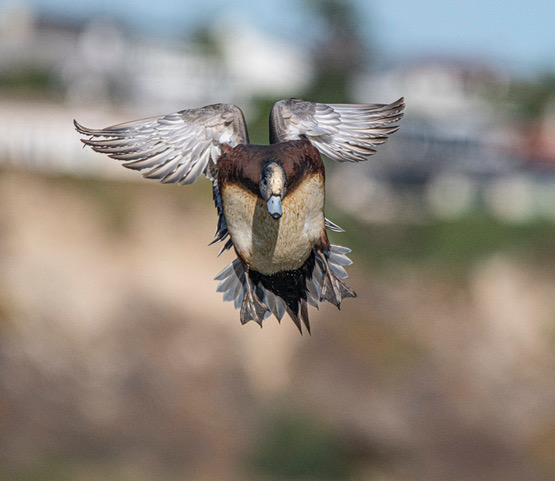
The ducks of the world are highly sexually dimorphic. Of the 128 species (here’s a list) called “duck” I can’t find any that are monomorphic (males & females look alike). On the other hand the 36 species of “geese & swans”)” are nearly all monomorphic (the Upland Goose isn’t, there may be others). Among the ducks it’s always the male that’s more colorful while the female is a mélange of brown & gray colors, occasionally spicing it up with some white or black. She sits on the eggs; he doesn’t. If you’re stuck sitting on a nest full of eggs on the ground for weeks on end, it helps to be cryptically plumaged. If you aren’t, predators notice you and eat you and/or your eggs. So it goes. If your male mate is brightly colored and out wandering around well away from the nest, his attractive bright colors may distract predators away from the cryptic females, nests and eggs. If anyone gets chased and eaten, it’ll be the male. So (again) it goes. At least his progeny are more likely to live on. Voilà! Natural selection in a nutshell.

What this means for birders is that it’s often hard to tell female ducks apart. The males are (generally) easy. You can narrow down the species for the females because 1) they’re the same shape and size as the males (whom you’ve already figured out, of course), and 2) they tend to stay near the males of their species. The wigeons above illustrate this very nicely by considerately positioning themselves at the same angle and distance to the camera. Their bills are also identical in color and pattern.
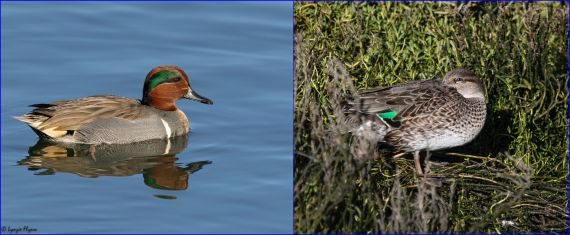
The Green-winged Teal weren’t as cooperative. At least you can see the green in the wing of this female attempting to snooze.
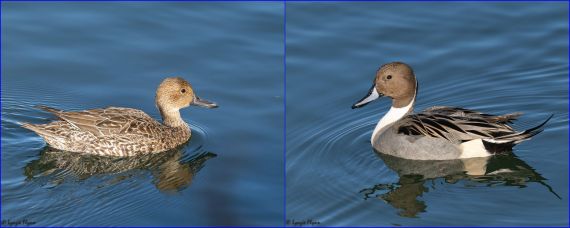
The tail of the male Pintail is very long and pointed, the female not so much. The bill is the same shape and length (the female above was a bit farther away), but the patterns differ. The female bill is all black; the male’s is baby blue bordered in black. Both sexes are sleek with slender necks and smallish heads. We spent some time trying to figure out these females who were out swimming around by themselves among the wigeons, and finally settled on the bill-neck-head shape and proportions as most useful.
Here’s two other swimmers: one is a duck, one isn’t. Which is which?
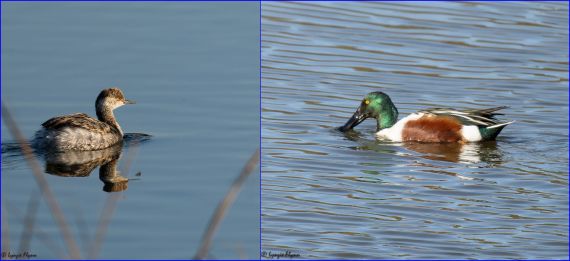
I hope that wasn’t too difficult. The one with the big duck bill is…the duck. The Northern Shoveler has about the biggest bill in the duck world. Guess what color the female plumage is? The left bird is an Eared Grebe in an order of birds distantly related to ducks. Grebes generally have pointed bills, often long, and their legs are far back on their body. If you think ducks walk poorly, you should see a grebe walk, except you’ll probably never see a grebe try to walk as they hate solid land. If they’re on land, they’re likely to be sick or wounded. They don’t even like to nest on land, preferring to build floating nests of reeds, cattails, aquatic grasses. There are several species of flightless grebes in the world living on lakes with lots of reeds. “Who needs to fly anymore!” their ancestors “decided.” Everything we need is right here.” As far as I know all grebe species (22, depending on whom you ask) are sexually monomorphic. Unlike the ducks, both male and female sit on the eggs and take care of the young, even carting them around on their backs, tucked between their wings.
The Greater and Lesser Scaups is a species pair where the males are hard to tell apart. Generally speaking the Lessers are more common in SoCal, but not always. Based on the bump on the head (more towards the front than the back), the slight whitish ear patch (absent in Lesser) and what might be a wider black nail at the end of the upper bill (narrow in the Lesser), the bird below seems to be a female Greater Scaup.
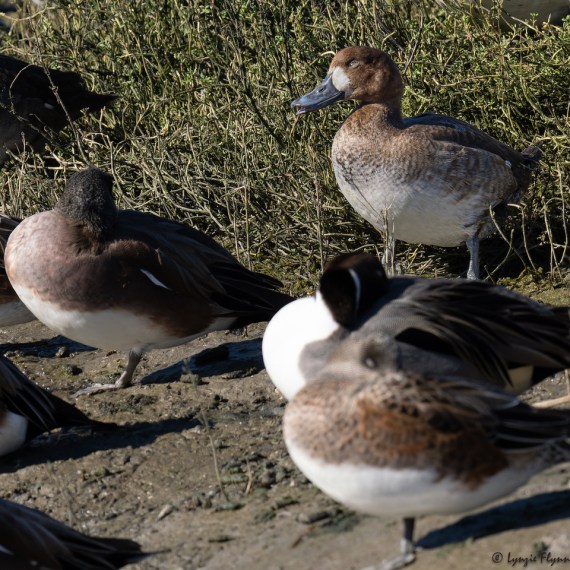
We saw a flotilla of scaup of both species near the Jamboree bridge at the north end of the bay, a goodly distance afar.
Our last pair of of floaters are the grebes below, Clark’s and Western Grebes. Which is which?
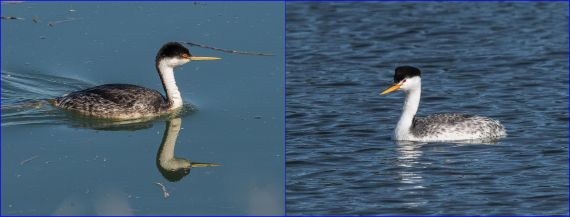
Western Grebes outnumber Clark’s about 99 to 1 in SoCal, so when in doubt, Western is the default. Their slightly offshore flocks can number well into the 1000’s in winter and if you’re looking for a Clark’s, you’ll have to comb through them bird by bird. Or go to Upper Newport Bay and San Joaquin Marsh: they’re fewer in number but closer. The Clark’s is the right grebe above: bill is orange, not dull yellow-green; the white cheek extends around the eye, often with a dark line connecting eye downward to bill gape, and paler flanks. Keep reading to the end of this posting and you’ll find a special treat.
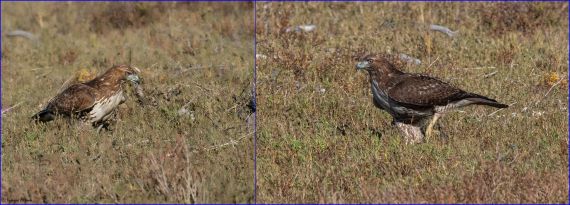
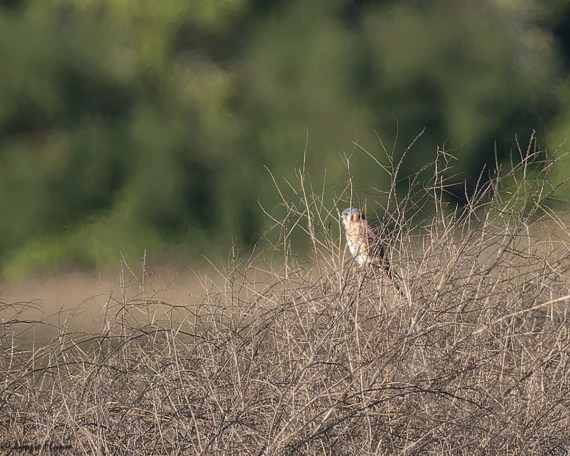
The hawk above was in a damp field with a small rodent (zoom in on left photo). Far far away, nearly all the way across the bay we spotted this American Kestrel which – judging by his blue-gray crown – is male.
The herons and egrets were scattered around the bay, with no significant concentrations. We had four species.

Are the two photos below the same species, perhaps the same bird?
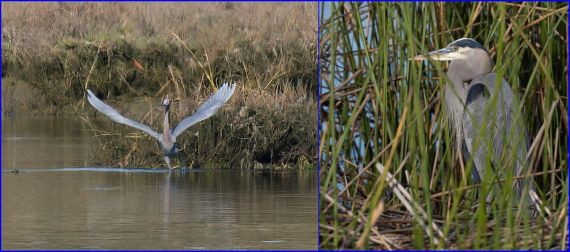
Nope. The left-hand bird, all the way across the bay, was noticeably smaller than a nearby Great Blue Heron, and had an odd reddish neck. Reddish Egrets are 30″ tall while GB Herons are 46″, a noticeable difference. This particular Great Blue Heron (above right) was seen later, tucked into the reeds at San Joaquin Marsh. Reddish Egrets are still uncommon in SoCal and it’s always a surprise and a treat to find one, but they seem to be slowly growing in numbers and locations every years.
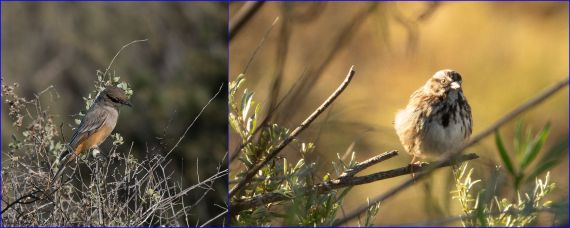
We didn’t have a huge number of passerines. Most common around the bay were Black & Say’s Phoebes, Song and White-crowned Sparrows. San Joaquin Marsh had a lot of Blue-gray Gnatcatchers and Yellow-rumped Warblers.
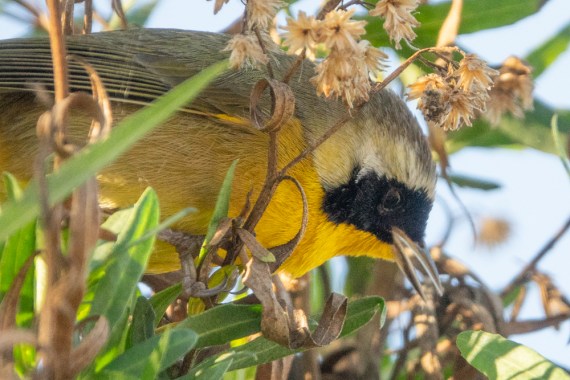
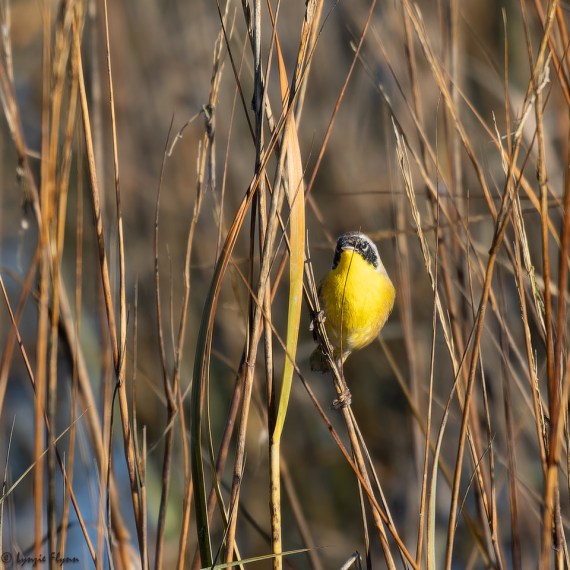
At one point we heard a huge rustling of leaves and snapping of twigs behind us. Turning around we discovered this enormous Common Yellowthroat plowing through the brush like a tank run amok.
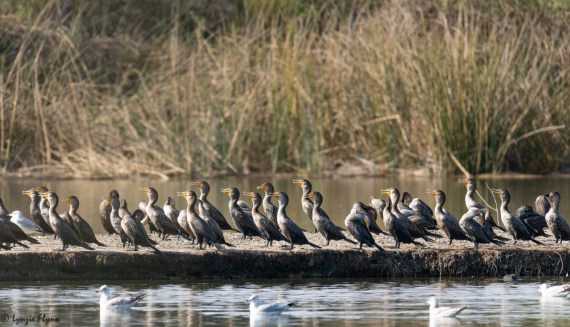
Double-crested Cormorants were present on the bay, but we didn’t see many until we came upon this group on a mud embankment at San Joaquin Marsh. It wasn’t particularly hot but they were practicing their gular fluttering, perhaps for when they really need it next summer.
As the water hadn’t receded much from high tide, we didn’t see many “peeps” until several hours had passed and mud began to become exposed. Photographer Flynn captured this nice comparison of Least and Western Sandpipers, the most common of the shorebirds, although Willets and Whimbrels were also in good numbers, with fair numbers of Marbled Godwit, and naught but a single Dunlin resting among the smaller peeps.
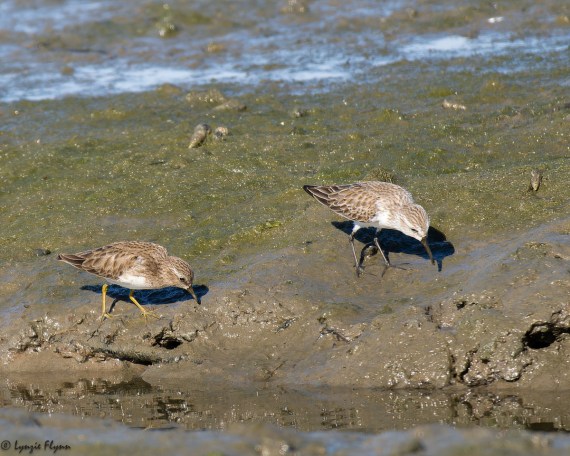
The field marks differentiating these two species are so blindingly obvious in the above photo that I won’t bother you with the tedious details.

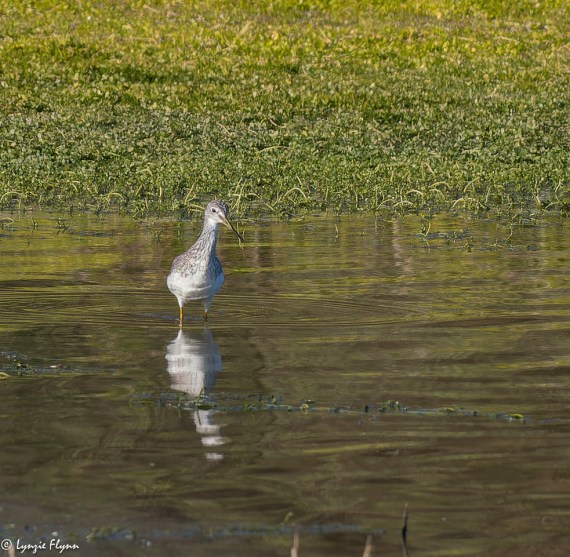
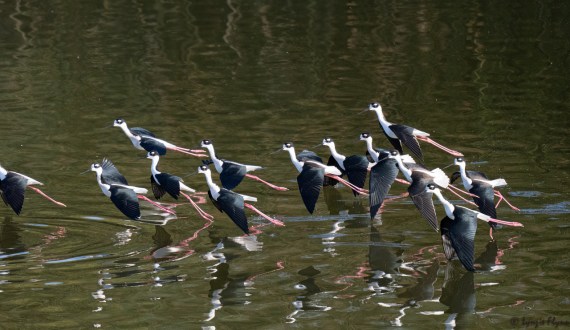
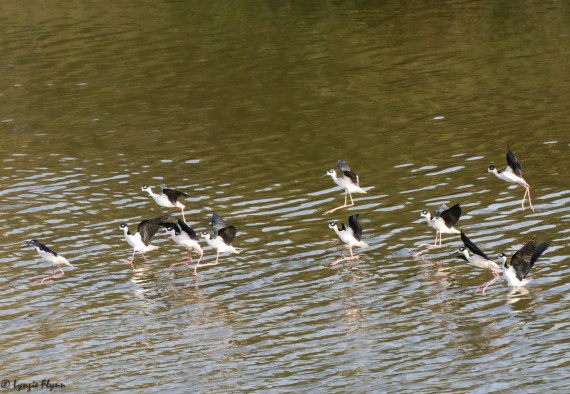
I don’t believe I’ve ever seen Black-necked Stilts in this lovely sway-backed posture before, moments before landing.
At San Joaquin Marsh we saw two smaller-but-perfect versions of a Clark’s Grebe following one (maybe two) of the adults around. December is normally really late to see young birds. They were probably still unable to fly as most birds are full- or nearly-full-sized by the time their flight feathers grow out and their muscles develop and they finally capable of taking flight. So this was a bit mystifying. Were they miniature grebes, or aberrant Red-necked Grebes? Afterwards I received the photo below from Lynzie.
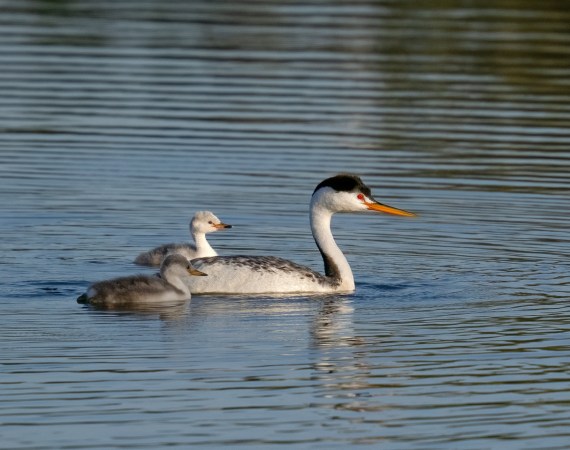
Clark’s Grebes obviously bred at San Joaquin Marsh, which I had not known. Lynzie says some think they might be hybridizing here with the Western Grebes.
The drive home was surprisingly good, not much longer than the morning drive despite (or perhaps because of) the numerous police cars on the freeways.
Many thanks to our photographers Chuck Bragg, Lynzie Flynn, Ray Juncosa
The trip list for San Joaquin Marsh is below the Back Bay Newport list. Our combined trip list for both locations was 65.
| Back Bay Newport | 12/9/23 | 12/10/22 | 12/14/19 | 12/8/18 | 11/4/17 |
| Canada Goose | X | X | X | X | X |
| Gadwall | X | X | X | ||
| American Wigeon | X | X | X | X | X |
| Mallard | X | X | X | X | X |
| Blue-winged Teal | X | X | X | ||
| Cinnamon Teal | X | X | X | ||
| Northern Shoveler | X | X | |||
| Northern Pintail | X | X | X | X | X |
| Green-winged Teal | X | X | X | X | X |
| Canvasback | X | X | |||
| Redhead | X | X | X | X | |
| Greater Scaup | X | X | |||
| Lesser Scaup | X | X | X | X | |
| Surf Scoter | X | X | |||
| Bufflehead | X | X | X | X | X |
| Hooded Merganser | X | ||||
| Red-Breasted Merganser | X | ||||
| Ruddy Duck | X | X | X | X | X |
| Pied-billed Grebe | X | X | X | X | X |
| Eared Grebe | X | X | X | ||
| Western Grebe | X | X | X | X | |
| Clark’s Grebe | X | X | |||
| Rock Pigeon | X | X | X | X | |
| Mourning Dove | X | X | X | X | X |
| Anna’s Hummingbird | X | X | X | X | |
| Allen’s Hummingbird | X | X | X | ||
| White-throated Swift | X | ||||
| Virginia’s Rail | 10 | ||||
| Ridgway’s Rail | 12 | 1 | 15 | ||
| Sora | 1 | X | |||
| American Coot | X | X | X | X | X |
| American Avocet | X | X | X | ||
| Black-bellied Plover | X | X | |||
| Killdeer | X | ||||
| Whimbrel | X | X | X | ||
| Long-billed Curlew | X | X | X | X | |
| Marbled Godwit | X | X | X | X | X |
| Sanderling | X | ||||
| Dunlin | X | ||||
| Least Sandpiper | X | X | X | X | |
| Western Sandpiper | X | X | |||
| Long-billed Dowitcher | X | X | |||
| Spotted Sandpiper | X | X | |||
| Lesser Yellowlegs | X | ||||
| Willet | X | X | X | X | X |
| Greater Yellowlegs | X | X | X | ||
| Ring-billed Gull | X | X | X | X | X |
| Western Gull | X | X | X | X | X |
| California Gull | X | X | X | ||
| Forster’s Tern | X | ||||
| Double-crested Cormorant | X | X | X | X | X |
| Am. White Pelican | X | ||||
| Brown Pelican | X | X | X | X | |
| Great Blue Heron | X | X | X | X | X |
| Great Egret | X | X | X | X | X |
| Snowy Egret | X | X | X | X | X |
| Little Blue Heron | X | ||||
| Tricolored Heron | X | ||||
| Reddish Egret | X | ||||
| Green Heron | X | ||||
| Turkey Vulture | X | X | X | X | X |
| Osprey | X | X | X | X | |
| Northern Harrier | X | X | X | X | |
| Cooper’s Hawk | X | X | X | ||
| Bald Eagle | X | X | |||
| Red-shouldered Hawk | X | ||||
| Red-tailed Hawk | X | X | X | X | X |
| Belted Kingfisher | X | X | X | X | |
| Northern Flicker | X | ||||
| American Kestrel | X | X | X | X | X |
| Peregrine Falcon | X | ||||
| Black Phoebe | X | X | X | X | X |
| Say’s Phoebe | X | X | X | X | X |
| Cassin’s Kingbird | X | X | X | ||
| California Scrub-Jay | X | ||||
| American Crow | X | X | X | X | X |
| Common Raven | X | ||||
| No. Rough-winged Swallow | X | ||||
| Bushtit | X | ||||
| House Wren | X | ||||
| Marsh Wren | X | H | X | X | |
| Bewick’s Wren | X | X | |||
| Blue-gray Gnatcatcher | X | X | X | ||
| California Gnatcatcher | H | X | |||
| Ruby-crowned Kinglet | X | ||||
| Wrentit | H | ||||
| California Thrasher | X | H | |||
| Northern Mockingbird | X | X | X | X | X |
| House Finch | X | X | X | X | X |
| California Towhee | X | X | X | ||
| Savannah Sparrow | X | X | X | X | |
| Song Sparrow | X | X | X | X | X |
| Lincoln’s Sparrow | X | ||||
| White-crowned Sparrow | X | X | X | X | X |
| Orange-crowned Warbler | X | ||||
| Common Yellowthroat | X | X | X | X | |
| Yellow-rumped Warbler | X | X | X | ||
| Western Meadowlark | X | ||||
| Lesser Goldfinch | X | X | |||
| Total Species – 99 | 54 | 68 | 59 | 65 | 52 |
| X – Seen | |||||
| H – Heard only | |||||
| 1, 15 – Number seen | |||||
| San Joaquin Marsh | 12/09/23 |
| Canada Goose | X |
| American Wigeon | X |
| Mallard | X |
| Northern Shoveler | X |
| Northern Pintail | X |
| Green-winged Teal | X |
| Surf Scoter | X |
| Bufflehead | X |
| Pied-billed Grebe | X |
| Eared Grebe | X |
| Western Grebe | X |
| Clark’s Grebe | X |
| Rock Pigeon | X |
| Mourning Dove | X |
| American Coot | X |
| Black-necked Stilt | X |
| Black-bellied Plover | X |
| Whimbrel | X |
| Marbled Godwit | X |
| Willet | X |
| Greater Yellowlegs | X |
| Ring-billed Gull | X |
| Western Gull | X |
| California Gull | X |
| Double-crested Cormorant | X |
| American White Pelican | X |
| Great Blue Heron | X |
| Great Egret | X |
| Snowy Egret | X |
| Turkey Vulture | X |
| Osprey | X |
| Red-tailed Hawk | X |
| Nuttall’s Woodpecker | X |
| Black Phoebe | X |
| Say’s Phoebe | X |
| Cassin’s Kingbird | X |
| California Scrub-Jay | X |
| American Crow | X |
| Tree Swallow | X |
| Bushtit | X |
| Marsh Wren | X |
| Northern Mockingbird | X |
| House Finch | X |
| Song Sparrow | X |
| White-crowned Sparrow | X |
| Common Yellowthroat | X |
| Yellow-rumped Warbler | X |
| Lesser Goldfinch | X |
| Total Species | 48 |
| Total Back Bay & Marsh | 65 |
| X – Seen | |
| 1, 15 – Number seen |
Discover more from SANTA MONICA BAY AUDUBON SOCIETY BLOG
Subscribe to get the latest posts sent to your email.



 SANTA MONICA BAY AUDUBON SOCIETY BLOG
Thank you for posting this.
LikeLike