Bette Davis Picnic Park and Glendale Narrows Riverwalk | Trip Report 13 Jan 2024
[Text by Chuck Almdale, photos by Chris Tosdevin]
“Fasten your seatbelts; it’s going to be a bumpy night.”
Bette Davis in All About Eve

Nestled between the low mountains of Griffith Park, the eastern San Fernando Valley city-suburbs of Grandview and Glendale, the Los Angeles River, Riverside Drive, Victory Blvd, and – last but not least – the #134 and I-5 freeways, what could be a more quintessentially Los Angeles birding spot than Bette Davis Picnic Area, named for the major film star of not so long ago. The park was a gift to the public, carved out of her property of roughly one square mile. Jutting eastward from the southeast corner of the park is the Glendale Narrows Riverwalk. The narrows refers to the purportedly narrowish bend in the Los Angeles River where the bottom is unpaved, making it popular with diving ducks and wading birds, especially Black-necked Stilts. You can vaguely see it in the Google satellite view above. The paved sidewalk runs alongside the river for about 1.5 miles before the path turns east alongside the Verdugo Wash. [All following quotes are BrainyQuote]
Old age is no place for sissies. — Bette Davis
A small group of intrepid birders – some of us old enough to know full well the truth of the above statement – gathered at the crack-of-dawn 8am starting time. We were almost immediately knocked out of our socks by really loud squawks. We quickly determined that it was a pair of parrots – Lilac-crowned Parrots Amazona finschi – investigating a potential next hole, located at the end of a snaggy trunk in a large sycamore tree. It featured two entrances, one below and to the side of the other. The parrots might have thought this a defect, as eggs have a way of rolling. We noted the way that all Amazona parrots fly – fast wingbeats in a narrow vertical range of motion – and that (generally speaking) parakeets have long pointed tails, parrots have flat blunt tails. This species turned out to be a life bird (countable by rule-conscious listers) for some of us. Awk! Beautiful plumage, eh, eh?

If you’ve never been hated by your child, you’ve never been a parent. — Bette Davis
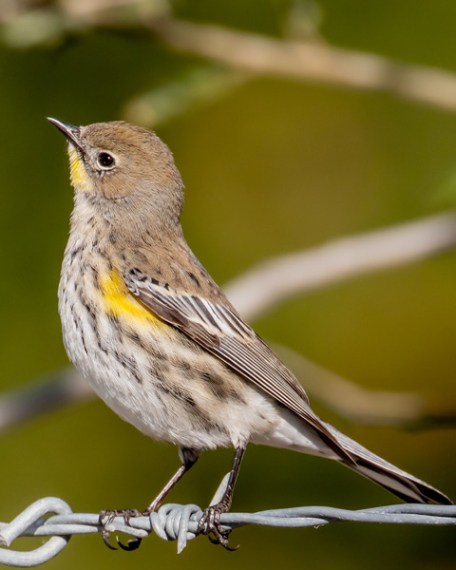
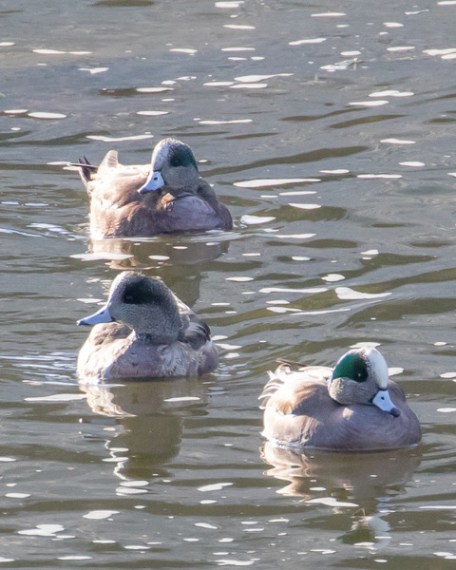
We birded our way through the trees, finding a lot of Yellow-rumped Warblers, then went to the river through one of the many gaps in the fence. Here we found a nice assortment of ducks and two geese, along with a lot of Black-necked Stilts, herons and egrets and a few passerines in the trash-laden river islets.


Sex is God’s joke on human beings. — Bette Davis


We passed a lot of Black-necked Stilts. The list below records only 100, but off in the distance at both ends of the walk we could see many, many more.
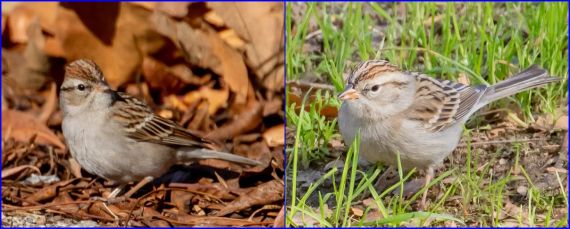
Along the chain-link fence line, we ran across several of a lesser-seen sparrow species, feeding on grass seeds. In alternate plumage their caps are rustier and their supercilium whiter.
On our way back to the cars, we spotted this raptor, well hidden in a tree in a home’s front yard across the street. Chris snapped this photo while it was in the process of dropping onto a hapless mammal on the lawn.

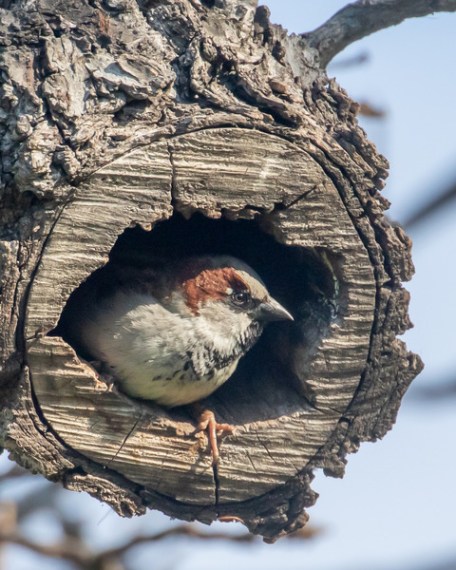
We hopped in our cars and drove the immense distance of nearly 1/4 mile over to the southeast corner of the park, across Victory and to the south end of Garden St. This is the major access point to the Riverwalk. As small as the portion of the picnic park located here is, it had even more birds than the larger section we’d just left. House Sparrows are typically the opposite of a big deal to birders, and I doubt that 1% of field trips reports anywhere, ever, bother including a photo of one, but this bird was doing something interesting.
We had four species of woodpecker in this section: Acorn, Nuttall’s, Northern Flicker and Downy, the smallest of our American woodpeckers. At 6 1/2″, it’s not much larger than the diminutive Chipping Sparrow we’d just seen.
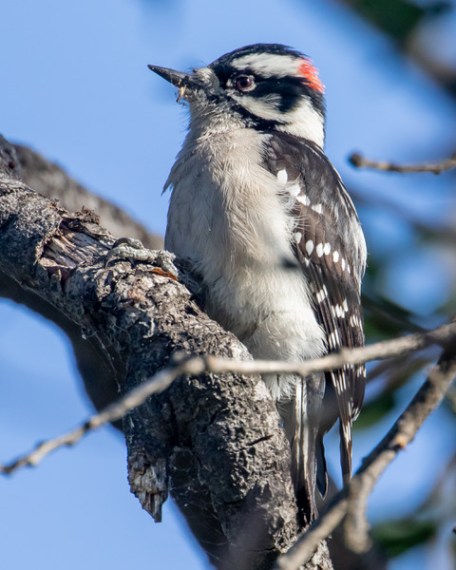
The best way to separate them from the very similar Hairy Woodpecker is the tiny bill, noticeably shorter than the front-to-back width of the head. The Hairy’s bill is about the same length as its head, front-to-back.
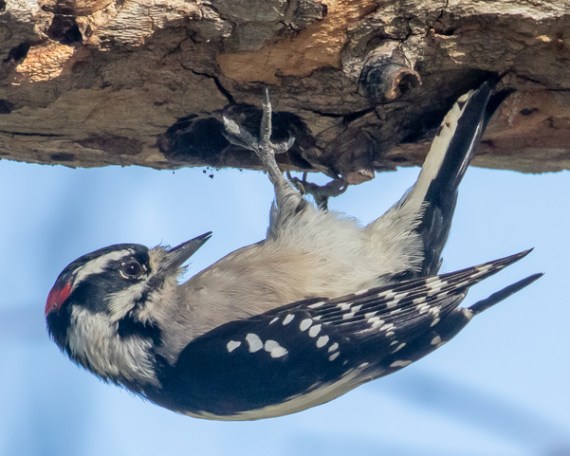
As you can see from the photo above, Downy Woodpeckers are lighter-than-air, like tiny feathered dirigibles, and could walk upside down on your ceiling if they had a mind to. Well…maybe not. Maybe it’s those clawed toes.
This has always been a motto of mine: Attempt the impossible in order to improve your work. — Bette Davis
Just before we got onto the Riverwalk proper, we found some sparrows on the shady ground, pecking away. Among them were several Lark Sparrows, one of our fancier LBJ’s (Little Brown Jobs).

In response to a query – “Is it a lark or a sparrow?” – we briefly discussed the presence of the word “lark” in a bird’s name. It means it has white outer tail feathers, as do the mostly Old World family of Larks (Alaudidae). Hence Lark Sparrows, Lark Buntings and Meadowlarks are not Larks, but are respectively members of families Passerellidae, Passerellidae (New World Sparrows) and Icteridae (Blackbirds).
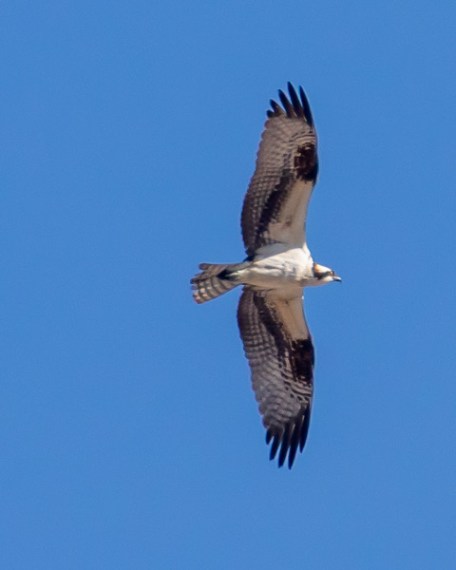
We had the occasional raptor overhead and sitting on the very high electric wire pylons, usually at enormous distance from us. I’d hate to see this Osprey take a dive at a fish in this part of the river. It’s pretty shallow.
We crossed underneath the I-5 or Golden State Freeway. The sound of the cars overhead – and I have omitted until now the fact that it’s actually quite noisy throughout the park due to the adjacent freeways – was like walking through the now-closed tunnels under Niagara Falls (really loud and echoing). In both directions we spotted another Cooper’s Hawk, the first time on one of the overpasses’ supporting cables.

For a special and final treat we hopped into our cars and drove several miles uphill into Griffith Park to where several rare birds had been spending the winter. Off of Griffith Park Drive, near the golf courses, we parked and walked all of 100 yds. up a curvy dirt trail and spotted the bird below, in a bare tree, catching passing flies in an interesting circular manner.

The only place in the U.S. where one might expect to find this species is in southeast Arizona, so it’s well out of its usual range.
We also looked for the Hepatic Tanager which was frequently seen in the same area, but it was elsewhere.
As you’ll see from the list below, we saw 58 species at the picnic park and Riverwalk, a quite respectable number for a small area surrounded by city and road.
Bette Davis Picnic Area, Los Angeles, California, US
Jan 13, 2024 8:00 AM – 10:30 AM
Protocol: Traveling
1.5 mile(s)
Checklist Comments: Some birds also (but not only) seen at Glendale Narrows Riverwalk.
58 species
Canada Goose 3
Egyptian Goose 1
Gadwall 2 Seen by Chris Tosdevin
American Wigeon 20
Mallard 25
Ring-necked Duck 12
Bufflehead 5
Rock Pigeon (Feral Pigeon) 18
Eurasian Collared-Dove 4
Mourning Dove 6
White-throated Swift 15
Anna’s Hummingbird 3
Allen’s Hummingbird 1
American Coot 25
Black-necked Stilt 100 Many more seen upstream & downstream but not counted.
Killdeer 6
Spotted Sandpiper 2
Greater Yellowlegs 1 With the BN Stilts
Ring-billed Gull 1
Western Gull 5
Double-crested Cormorant 3
Great Egret 2
Great Blue Heron 1
Turkey Vulture 2
Osprey 1
Cooper’s Hawk 2
Red-tailed Hawk 2
Acorn Woodpecker 8
Downy Woodpecker 1
Nuttall’s Woodpecker 1
Northern Flicker 1
Lilac-crowned Parrot 2
Black Phoebe 6
Hutton’s Vireo 1 Seen by Chris Tosdevin
California Scrub-Jay 2
American Crow 6
Common Raven 5
Oak Titmouse 3
Bushtit 6
Wrentit 1 Seen by Chris Tosdevin
Ruby-crowned Kinglet 4
White-breasted Nuthatch 1
European Starling 20
Western Bluebird 4
House Sparrow 5
American Pipit 1
House Finch 8
Lesser Goldfinch 4 Seen by Chris Tosdevin
Chipping Sparrow 6
Lark Sparrow 3
Dark-eyed Junco 6
White-crowned Sparrow 4
California Towhee 1
Brewer’s Blackbird 8
Orange-crowned Warbler 1 Seen by Chris Tosdevin
Common Yellowthroat 3
Yellow-rumped Warbler 20
View this checklist online at https://ebird.org/checklist/S158925929
Discover more from SANTA MONICA BAY AUDUBON SOCIETY BLOG
Subscribe to get the latest posts sent to your email.



 SANTA MONICA BAY AUDUBON SOCIETY BLOG
wow
lovely report and great pictures of common species 😎
LikeLike
<
div dir=”ltr”>Ok WOW!! This stellar report left me melancholy for missing the trip and grateful for your incredib
LikeLike