Golden-crowned Kinglet
[By Chuck Almdale, photos by Chuck Gates]
There are only six species in the small passerine family (of small passerines) of Regulidae (Birds of the World Family Link). Five species, including the Golden-crowned Kinglet, are in genus Regulus; Ruby-crowned is in genus Corthylio. The genus and family name “Regulus” is Latin for “little king.” The species name “satrapa” is from Greek “satrapes” for “a ruler” [yes, it’s a bit redundant]. All six species are quite small (3.75-4.5″) and all have a brightly colored crown, often concealed, which led to the allusion to “king.” The information below is adapted from Birds of the World.
We do get a few Golden-crowned Kinglets in SoCal, particularly in the higher mountain conifers, but they are vastly outnumbered by the Ruby-crowned, a species remarkable for having the largest clutch – up to 12 eggs – for its size of any North American passerine.
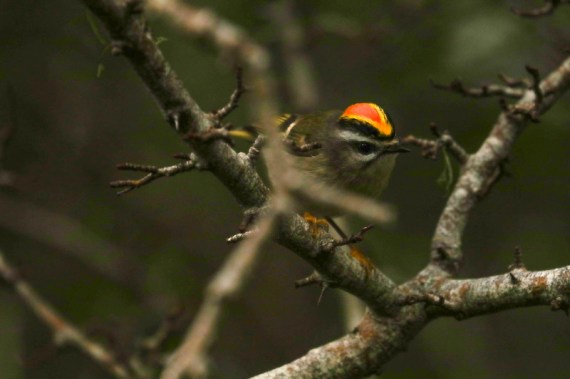
Photographer Chuck Gates lives in the Prineville region of Eastern Oregon, 25 miles northeast of Bend in the high desert, and has birded the area for decades. A few years ago he formed Prineville Bird Club which attracted the area’s avid birders. The four photos below – sent to me by a relative and which I thought especially nice – came from a recent trip he led over to the Pacific Coast of Southern Oregon. I’ve never seen the crest so brightly displayed. He is happy to share them with us.
Golden-crowned Kinglet Regulus satrapa: 3.25-4.25″ Photo link
Subspecies: 6
Range: So. Alaska to Newfoundland to No. Florida to No. Mexico.

Breeding: Breeds primarily north of Canadian border and the high mountain ranges extending south into the U.S., migrates for winter as far south as northeastern Mexico. Nest building begins as early as early May. Nest site probably chosen by the female, often high up in dense foliage. Nests average 3″ in diameter and may be suspended from stems, in twigs in the fork of a conifer tree or under foliage near end of a branch, height is 2-18 m, averaging 15 m. Overhanging foliage protects it from the elements and hides it from view from the side or above, but it can sometimes be partially seen from below. Clutches can be large (5-11 eggs) and most pairs lay two clutches per year. Eggs are 0.4″ x 0.5″. Eggs hatch on the same day, usually day 14-15, and the young fledge from the nest 18-19 days later.

Did you notice the feet?
Habitat: Breeds in boreal & spruce-fir forest, pines, aspens; prefers old-growth & mature forest between 250-3500m depending on region.
Diet: Arthropods, some vegetation & fruit; forages on branches, leaves, bark, mosses, lichens, also on ground. Frequently hovers and gleans in canopy from 2–10 m height.

In the not-too-distant future we’ll take a look at this small and interesting family in an installment of our Family Focus series, yet to be written.
Discover more from SANTA MONICA BAY AUDUBON SOCIETY BLOG
Subscribe to get the latest posts sent to your email.



 SANTA MONICA BAY AUDUBON SOCIETY BLOG