Mt. Piños midsummer birding: 20 July 2024
[By Chuck Almdale]

Northeastern view of Mt. Piños, 8,843 ft. high; 109 miles to horizon (Shuttle Radar Topography Mission 2-16-00)
We had some difficulty finding a date to do this trip and July 20 was the earliest available. This is the latest we’ve ever been there, and it is a bit too late. There were still Irises blooming in Iris Meadow, but most had lost their blossoms and their seed pods were a-swellin,’ a la Sweet William and Barbry Allen.

Wallflowers roadside (Roxy Seidner 6-10-18)
The day began quite warm and instead of birding around the parking triangle at the bottom of the hill, (intersection of Cuddy Valley Rd. and Mt. Piños Rd., twelve miles west of I-5, elevation 5500 ft.), we drove almost to the top where we stopped at a roadside pullout overlooking a small stream. Here’ we spotted a few birds coming in for a drink and bath, among them Mountain Chickadees, Dark-eyed Juncos and Orange-crowned Warblers. A pair of Ravens perched on the snaggy top of a nearby conifer.

Mountain Chickadee (Roxy Seidner 6-10-18)
We’ve noticed in past years in this area that when there’s a lot of rain during the preceding spring, the birds don’t concentrate as much at the known, easy-to-get-to-and-see-birds water spots, as there are plenty of other water spots not so easy-to-get-to for humans. I think this was the case this year.
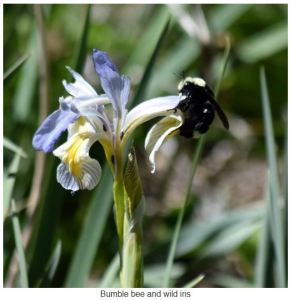
Wild Iris & Bumble Bee in Iris Meadow, Mt. Piños Photo: BAGSC
At road’s end next to Iris Meadow several dozen cars were parked. We wandered over to the meadow and found a small number of blooming Irises scattered over the meadow. Most had gone to seed but bees and bumblebees were still as busy as…well, you know what. There were not a lot of birds around despite the relatively early 8:30 am hour. The first bird we spotted was a Townsend’s Solitaire at meadow’s edge in a conifer, a rear view which kept us stumped for a while as the important field marks are visible only from the side or front. Still, there was something solitaire-ish about it – mostly that long tail and innocent bluebird-like facial expression. Then we all finally saw the eye-ring and orangish wing patch.
Solitaires are aptly named, as you rarely see more than one at a time. They’re one of those species that makes you wonder how they reproduce – binary fission, perhaps.
After that we had a group of four identical brown-gray birds busily gleaning small gray-winged insects from the cracks in a conifer’s gray bark. They turned out to be a group of young Brown-headed Cowbirds with nary a head of brown. As cowbirds are hatched and raised by birds of other species (aka obligate nest-parasitism), their parents never show them how to “make their way in the world.” Obviously they figure it all out themselves quite quickly.
This was followed by more Dark-eyed Juncos, which prompted a discussion of the many subspecies and ranges of this bird. These were all “Oregon” Juncos, the breeding subspecies in our area. It’s almost entirely during winter that other subspecies might drop in. If you ever want to while away a few hours sorting out 5-6-7?…however many subspecies of DE Junco there are – I highly recommend the bottom of Cave Creek Canyon in SE Arizona in January. There’s a fine lodge with good food there and lots of birds and I’m fairly confident that every subspecies of DE Junco is there, plus the special bonus of the Yellow-eyed Junco, a Mexican bird at the north end of its range. [Now we return you to our regularly scheduled field trip report.]

Liz saw a Green-tailed Towhee near the meadow. (J. Waterman 6-10-17)
House Wrens popped out of the bushes. We headed past the campground (bathrooms!) which was full of a camping contingent of Bakersfieldians, where we were buttonholed by a girl who looked about 10 or 13 who wondered if we were “birdwatchers,” which we admitted was true. We discussed birds likely to be seen around the meadow and I showed her pictures in my field guide (one of the main reasons I carry one).
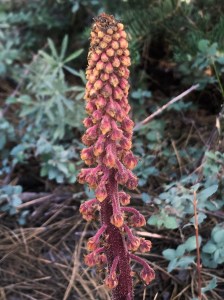
Woodland Pinedrops (Pterospora andromedea). Photo: Leptonia Source: iNaturalist
One of the most interesting things we saw was a plant called Pinedrops. Although some people think it a chlorophyll-lacking saphrophyte which gets its sustenance from sucking the nutrients out of dead matter, it’s actually a chlorophyll-lacking mycoheterotroph which feeds on the fungi that grow intertwined with the roots of a conifer. It’s in subfamily Monotropoideae of the heath (or heather) family Ericaceae. It’s widespread across Canada and the western and northeastern U.S. to Mexico.
I <snipped> the map below from iNaturalist–Alister Caddy for the plant Woodland Pinedrops Pterospora andromedea. This is closely related to the Snow Plant Sarcodes sanguinea which we’ve also seen on Mt. Piños and nearby Mt. Abel and another member of the Heath family Ericaceae. The plant, which had two or three tall stems, each looking very much like this photograph, was within 100 yds. of the two red spots just north of Mt. Piños Nordic Base on the map below.


Snow Plant for comparison, Mt. Piños (Roxy Seidner 6-9-18)
We continued downhill on this trail looking for blooming flowers upon which Calliope Hummingbirds might feed. Alas, the currents where – when I find Calliopes at all, which is not often – they are usually feeding, were no longer in bloom.

Lodgepole Chipmunk, Mt. Piños (Dan Seidner 6-9-18)
Finding a chipmunk but few birds, we returned to the meadow, crossed through the dark green flower leaves and went to the trail on the other side. At the juncture where you either go uphill, go downhill or back to the parking lot, we discovered none of us wanted to go uphill, so downhill we went. I pointed out that when hiking in the mountains, “what goes down must come up,” but we continued anyway. Here we added a few birds and found some butterflies patronizing the flowers, a few whites too lively to view, a Sulphur which Trevor identified and a Checkerspot, unidentified. By this time lunch sounded good. We decided to drive halfway back downhill to McGill Campground, as the meadowside Chula Vista walk-in campground picnic tables were fully occupied.

Variable or Chalcedon Checkerspot male, Euphydryas chalcedona; flower probably Eriodictyon crassifolia, Mt. Piños (Grace Murayama 6-9-18)
At McGill we commandeered a reserved campsite nicely shaded by trees and surrounded by bushes and needle-covered ground, calculating (correctly, we learned) that the reserverer would not appear within the hour it might take us to eat (shoots and leaves). McGill is often birdier than the environs of Iris Meadow, and I think that remained true. While we ate and discussed odds and ends and in-betweens a few more birds came and went: more Townsend’s Solitaires, all looking a bit youngish, equally young-looking Cassin’s Finches and one Purple Finch, An adult male White-headed Woodpecker, a Western Wood-Pewee, Anna’s Hummingbird, Western Bluebird, Steller’s Jays, More Juncos, a few youngish Fox Sparrows, Yellow-rumped and Orange-crowned Warblers, and some Ravens cruising by.
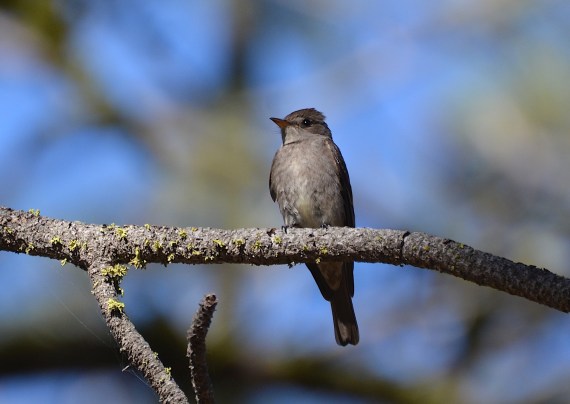
Western Wood-Pewee, partially vested. Mt. Piños (Grace Murayama 6-9-18)
When we got back to the bottom of the mountain we found the temperature had risen well into the 90’s.
In case you’re wondering why all the different dates for photographs, I didn’t receive any usable photos this trip so I substituted a few from prior trips. Thanks to those photographers.
The following birds were seen on Mt. Piños on the listed trips, not including the parking triangle and Mt. Abel locations. “X” records presence, number not counted.
| Trip List | 2011 | 2016 | 2017 | 2018 | 2024 |
| Species | Jun 18 | Jun 11 | Jun 10 | Jun 9 | Jul 20 |
| Mountain Quail | 2 | ||||
| California Quail | 2 | ||||
| Band-tailed Pigeon | 12 | X | 2 | 1 | |
| Eurasian Collared-Dove | 1 | ||||
| Mourning Dove | 8 | 2 | 2 | ||
| Black-chinned Hummingbird | 1 | ||||
| Anna’s Hummingbird | 1 | ||||
| Black-chinned Hummingbird | |||||
| Red-tailed Hawk | X | 1 | |||
| Downy Woodpecker | 1 | ||||
| Hairy Woodpecker | 1 | ||||
| White-headed Woodpecker | 2 | X | 1 | 3 | 1 |
| Northern Flicker | 2 | ||||
| Olive-sided Flycatcher | 1 | ||||
| Western Wood-Pewee | 10 | X | 5 | 4 | 1 |
| Steller’s Jay | 12 | X | 8 | 4 | 6 |
| Clark’s Nutcracker | X | 1 | |||
| Common Raven | 4 | 37 | 5 | 5 | |
| Violet-green Swallow | 30 | X | 26 | 18 | 1 |
| Mountain Chickadee | 7 | 19 | 2 | 5 | |
| Red-breasted Nuthatch | 4 | 1 | 1 | ||
| White-breasted Nuthatch | 4 | 4 | 1 | ||
| Pygmy Nuthatch | 15 | X | 7 | 15 | 1 |
| Brown Creeper | 1 | 1 | 1 | ||
| Bewick’s Wren | 1 | ||||
| House Wren | 15 | ||||
| Western Bluebird | 2 | X | 12 | 12 | 3 |
| Townsend’s Solitaire | 5 | ||||
| American Robin | 1 | X | 5 | 1 | |
| Purple Finch | 4 | X | 2 | 3 | 2 |
| Cassin’s Finch | 10 | 4 | 12 | ||
| Green-tailed Towhee | 4 | X | 7 | 2 | 1 |
| Spotted Towhee | 2 | 1 | |||
| Chipping Sparrow | 18 | X | 6 | 16 | |
| Fox Sparrow | 6 | X | 10 | 5 | 3 |
| Dark-eyed Junco | 2 | X | 5 | 8 | 15 |
| Brown-headed Cowbird | 1 | 10 | |||
| Orange-crowned Warbler | 2 | 1 | 6 | ||
| Yellow-rumped Warbler | 1 | 1 | 2 | ||
| Lazuli Bunting | X | 2 | |||
| Totals – 40 | 23 | 16 | 28 | 24 | 22 |
Discover more from SANTA MONICA BAY AUDUBON SOCIETY BLOG
Subscribe to get the latest posts sent to your email.



 SANTA MONICA BAY AUDUBON SOCIETY BLOG