Bette Davis Park & Glendale Narrows Riverwalk, 18 Jan. 2025
[Chuck Almdale; photos by Chris Tosdevin, Ray Juncosa, Ann Flower and Marquette Mutchler]
It was a cool morning, somewhat gray, with temperature at 49°F, rising to 59° by about 11 am. The breeze was light and occasional, and the air was clear and didn’t smell like smoke or burnt rubble, unlike other parts of Los Angeles. Species variety was not tremendous (47 species plus “peeps”) but there was always something worth looking at.
We had no photographers present, so the photos in this posting are from previous postings, most by Chris Tosdevin at our prior Bette Davis & Riverwalk field trip on 13 Jan. 2024.
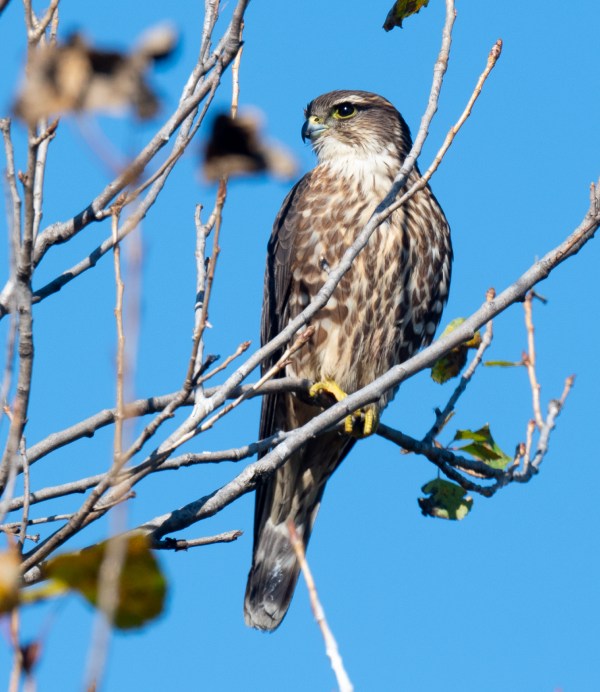
Nearly the first bird of the morning – after we sorted out a flock of Red-winged and Brewer’s Blackbirds mixed with Starlings – was a Merlin perched at the top of a tall sycamore near Rancho Drive, eating something small. After that it began calling with a series of high chirps, and for those with good hearing, he received a reply from off to the east.
Several times we heard or saw (or both) Lilac-crowned Amazons (formerly Lilac-crowned Parrots in genus Amazona). Last year they were investigating potential nest-holes, but today they were mostly flying around and loudly calling, as parrots nearly always do. They share with the rest of the Amazona genus the behavior of flying with rapid shallow wingbeats, unlike the other parrots in our area, so it’s easy to ID them as Amazonas, which leaves you with the remaining problem of seeing what colors are or aren’t on their head and body in order to nail down the species.

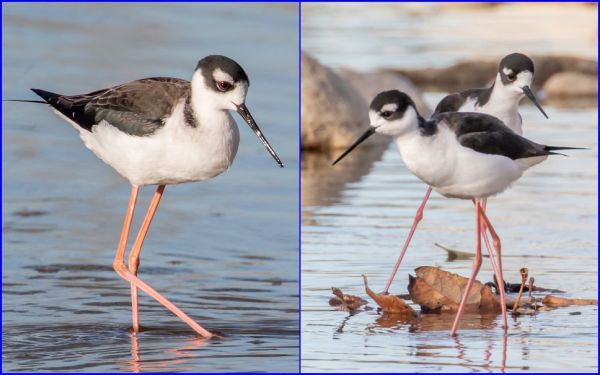
This portion of the L.A. River channel does not have a cement bottom and a lot of birds appreciate the dirt bottom; the channel islands are well rooted, making it much birdier than most other sections of the river channel which are entirely cement. Black-necked Stilts are quite reliable here and are scattered up and down the channel, although about 75% were downstream of the long brushy sand island at the Glendale Narrows Riverwalk section which goes under the #5 freeway.

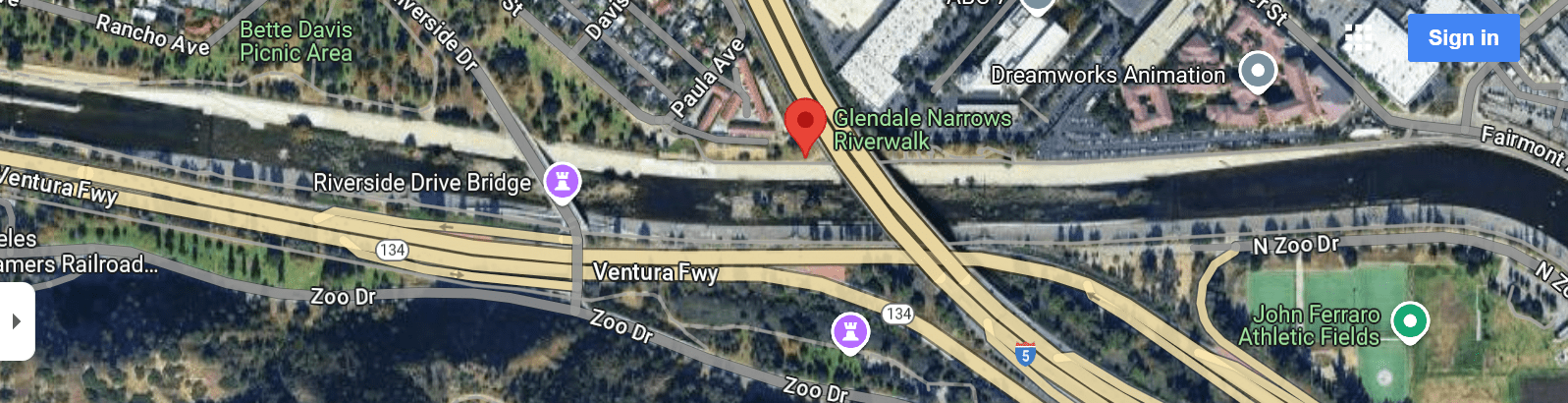
Using the satellite photo below, we walked along the upper (north) riverbank from the east end of a narrow strip of mid-channel concrete to the east end of the long thin island that passes under the #5 freeway. Birds in the channel tended to stay close to these two long islands, and the east (downstream) ends of these islands were particularly good for birds. The two yellowlegs species were at the east end of the island running under Riverside Drive while some of the ducks (Cinnamon Teal, Bufflehead and Ring-necked Duck) were only at the east end of the island under the #5 freeway. The three Wilson’s Snipe were near the west end of the Riverside Drive island, poking about in the floating vegetation.
The freeways provide a constant background of traffic, a rushing roar with few discernible individual sounds, just a rushing “wall of sound” such as Phil Spector used for the records he produced. Imagine that you’re birding next to a major waterfall – Niagara or Iguazú for example – and the sound just becomes part of the background. You can still hear plenty of birds. One tree with a lot of holes had become an apartment house for House Sparrows who were all busily chirping away. The blackbirds and starlings were constantly whistling and croaking, ravens and crows croaked [could the crow be the origin of the word ‘croaked’?, or vice-versa?], the Amazons constantly call as they fly, and the ducks in the river whistled and quacked. The birds were quite vocal.

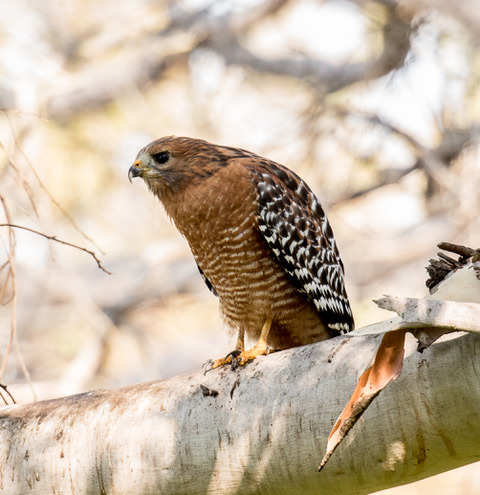
We studied a hawk perched in a river treetop for quite a while as I let (or perhaps forced) the group, using my NGS field guide (6th Ed.) to narrow it down to a juvenile Red-shouldered Hawk. It had a lot of reddish color over it’s head, neck and shoulders, and the white feather-tips that provide the scaling effect on the back had not yet fully grown in, so it looked only somewhat like the pictures in the field guide.
We walked down to the eastern tip of the island under the #5 freeway, largely to see if any Neotropic Cormorants might be there, which there weren’t. A few hundred yards more would bring us to a large flock of “peeps” and several hundred Black-necked Stilts, but it was getting late and some of us were tired. So “peeps, spuh” they remained.

We could actually see a hint, a tinge, of the neck-ring, a near-impossible feat in the field.
This is a good birding spot for a place surrounded by city and “freeway-close.” I suspect that in the spring it functions as a small oasis for passerines, and the L.A. River channel provides a migration route for waterbirds in both fall and spring.
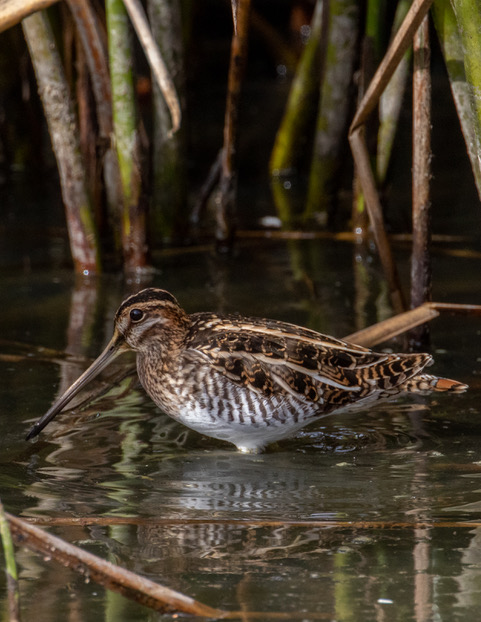
Very distinctive back stripes and long thick straight bill.
eBird – when you bother to enter the sightings and email them to yourself – cranks out a nice little report. I wonder if you can do one with multiple years? Does anyone know?
Bette Davis Picnic Area, Los Angeles, California, US
Jan 18, 2025 8:00 AM – 11:30 AM
Protocol: Traveling; 1.5 miles
Checklist Comments: Bird walk of Santa Monica Bay Audubon Society. Temp 49 to 59°F. First gray, then sunny, little breeze. Birded parkland and along LA River from W end of park to middle of Glendale Narrows (S end of long brushy island) & adjacent park.
47 species (+1 other taxa)
Canada Goose 2
Egyptian Goose 4 Fly-by in river channel.
Blue-winged Teal 3
Cinnamon Teal 3 S. end of Riverwalk brushy island.
American Wigeon 200
Mallard 30
Green-winged Teal (American) 2
Ring-necked Duck 1 S. end of Riverwalk brushy island.
Bufflehead 6 S. end of Riverwalk brushy island.
Rock Pigeon (Feral Pigeon) 30
Eurasian Collared-Dove 20
Mourning Dove 6
White-throated Swift 10
Anna’s Hummingbird 2
American Coot 70
Black-necked Stilt 400 Huge flock by Glendale Riverwalk S of long brushy island, about 100 elsewhere.
Killdeer 4
Wilson’s Snipe 3 Fairly close to each other among river channel plants mid-Bette Davis park
Spotted Sandpiper 5
Lesser Yellowlegs 1 Both Yellowlegs species near N end of Glendale Riverwalk, always close together.
Greater Yellowlegs 1
peep sp. 100 With huge flock of Black-necked Stilts, too far away to identify.
Western Gull 1
Pied-billed Grebe 6
Double-crested Cormorant 7 No Neotropic Corm. which are occasionally reported from here.
Black-crowned Night Heron 16 Eleven in one tree on trail to Riverwalk.
Snowy Egret 1
Great Egret 1
Great Blue Heron 6
Turkey Vulture 2
Red-shouldered Hawk 1
Acorn Woodpecker 8
Nuttall’s Woodpecker 1
Merlin 2 1 seen calling at treetop in Bette Davis Park, 2nd bird heard replying but not seen.
Lilac-crowned Amazon 3 Not searching for nest holes as they were last year.
Black Phoebe 10
Say’s Phoebe 1 Exceptionally yellowish-ochre breast/belly
American Crow 6
Common Raven 4 One had a large hook at tip of upper bill.
Ruby-crowned Kinglet 8
European Starling 40
House Sparrow 10
Song Sparrow 3 Heard only
California Towhee 1 Heard only
Red-winged Blackbird 80 Several large mixed flocks with Brewer’s B.
Brewer’s Blackbird 40
Common Yellowthroat 5
Yellow-rumped Warbler (Audubon’s) 40
Discover more from SANTA MONICA BAY AUDUBON SOCIETY BLOG
Subscribe to get the latest posts sent to your email.



 SANTA MONICA BAY AUDUBON SOCIETY BLOG