After the Fires: Ideas, Information and Resources
[Compilation, comments and posting by Chuck Almdale]
Progression of Embers – A Portrait
“…we tend to describe these conflagrations in ways that make us forget the way in which these fires actually spread and these embers which become ambassadors to more distant fire…my wife and I live in El Segundo, and the morning of the fires we were [outside] early…seven and half miles from the fire front and there were live embers landing on our street…we are invited to think about the way in which these fire-fed systems actually move.
–– Eric Strauss, PhD, “After the Fires” a Video

Above: Embers carried by strong winds enable fire to leap from one spot to another. (Credit: Getty Images) BBC 9-Jan-25: Five images that explain why the LA fires spread so rapidly; Martha Henriques, Jocelyn Timperley and Richard Gray. LINK
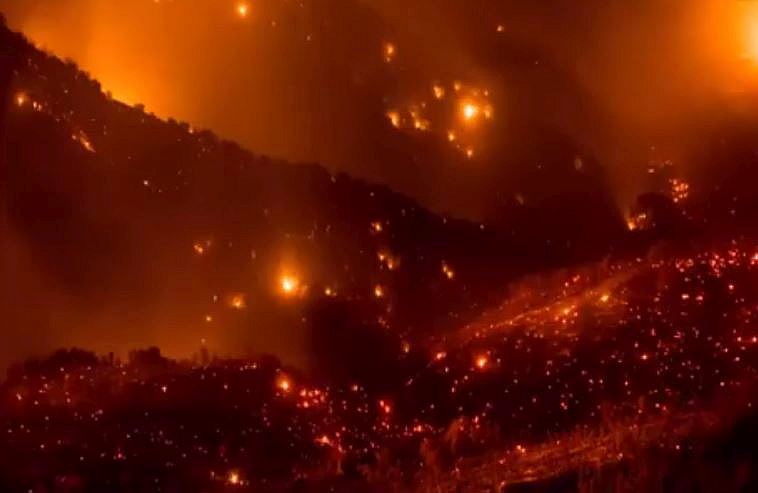
Above: “Embers moving across the landscape well ahead of the ‘wall of fire’ that the press talks about.” – Dr. Eric Strauss, Zoom video “After the Fires” (at video time: 43:15)

Above: The ravage of ember-spread fire amid high winds in the Pacific Palisades neighborhood of Los Angeles, January 7, 2025. Ethan Swope / APAtlantic. The Atlantic: 8-Jan 25: The Palisades Fire Scorches Parts of Los Angeles; Alain Taylor. LINK

Above: Wind-blown embers rapidly spread fire widely, exacerbated by hilly terrain. (Credit: Getty Images/ Maxar. BBC 9-Jan-25: Five images that explain why the LA fires spread so rapidly; Martha Henriques, Jocelyn Timperley and Richard Gray. LINK
Calling the January fires “unprecedented” doesn’t get us anywhere….A few years ago a fire in Colorado was described as a “300-foot tsunami of flame.” Fire doesn’t spread that way. It spreads only if specific ignition and combustion requirements are met, and unfortunately most homes meet those requirements. We pay more attention to visible flames…than we do to the principal structure ignition mechanism: burning embers.
–– Jack Cohen, retired research scientist with U.S. Forest Service, quoted in Los Angeles Times article “What fires can teach L.A.,” 2/16/25 by Thomas Curwen.
Introduction
This article is not an end in itself, but a compendium of resources, photos, maps, quotes, reports and links to videos, reports and websites to which you can refer repeatedly. There is something to discover and learn here for everyone living in a fire zone, whether it be replacing the $10 soffit in your house wall, planting a tree, or rebuilding your home. Bookmark it.
SECTIONS and DIVISIONS
- LINK “Design for Disaster”: L.A. Fire Dept. Film
- LINK After the Fires: Straus & Fimiani Video
- LINK Protecting Structures From Wildfire Embers and Fire Exposures – FEMA
- LINK Two Things You Can Do Today – Soffits & Calking
- VEGETATION AND FIRE
- LINK L.A. Times Opinion: After the fires, rethink L.A.’s landscapes
- LINK California Native Plant Society – Wildfire
- LINK Articles, Books and Videos on Fire (by Lisa Fimiami)
- LINK Additional Links: Cal-Fire & IIBHS
- LINK Wildfires are Systems!
- LINK Wildfire and the “Chimney Effect”
- LINK Here’s How the Los Angeles Wildfires Are Affecting Animals, From Fish to Snakes to Birds: Smithsonian Mag. Feb, 2025
- LINK Fires in Australia – How the Aussies deal with it
- LINK Brush Clearance, Dead Trees, Building Permits & Insurance: LA Times Readers Comments
- ALTADENA: PREAPPROVED DESIGNS, FOUNDATIONS, KIT HOMES
- REBUILDING SUGGESTIONS
- LINK Take LAFD Community Emergency Response Team Training
Design for Disaster: L.A. Fire Dept. film
Unless we scrape all vegetation from the soil of Southern California, we will continue to have wildfires. Because of our climate, weather patterns and location, local vegetation evolved over many millennia to burn every 15-35 years. Many of our native plants must periodically pass through fire to thrive and reproduce. Some species of birds such as Lazuli Bunting prefer to nest, feed, and breed in recently burned areas. We can and must learn to live with fire and adapt our structures to its inevitability. Fires will happen but we need not lose our homes and lives because of them. We’ve known and ignored this fact for decades. Watch the LAFD 26-minute film below.
YouTube blurb: This 1962 documentary film produced by the Los Angeles Fire Department, describes the historic Bel Air / Brentwood wildfire that started on November 5, 1961 in the Bel Air community of Los Angeles. Over the course of three days, the wind-driven fire destroyed 484 homes, damaged 190 others, and burned over 16,000 acres. Amazingly, there was no loss of life attributable to the blaze. The then-$30 million disaster led to new laws in the City of Los Angeles to eliminate wood shingle roofs, and to clear dry brush away from homes. The film is narrated by actor William Conrad. There is a written transcript on the YouTube site.
After the Fires
The following Zoom program was presented by Pasadena Audubon Society on 22-Feb-2025. Dr. Eric Strauss is the Executive Director of the Center for Urban Resilience (CURes) at Loyola Marymount College. Lisa Fimiani is the Drollinger Environmental Leadership Fellow at CURes. They discuss the impacts of wildfires on our region and how we can best mitigate those impacts in the future. Their presentation begins at 7:36 minutes into the recording and ends an hour later, followed by 25 minutes of Q&A. It touches on many aspects of fire causes and human reactions, well worth your investment of viewing time. The crux of the discussion: Wildfires are Systems.
Dr. Strauss uses the slide below in his classroom lectures.
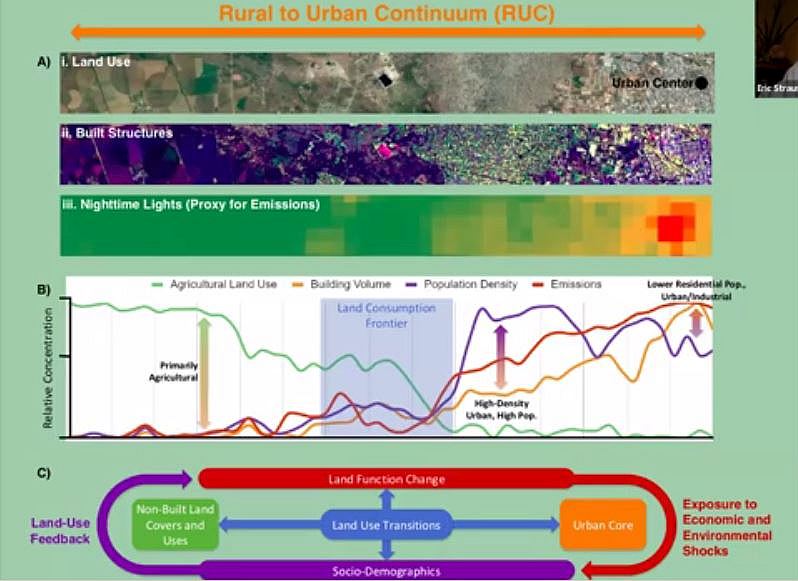
[LINK] Lisa Fimiani’s compilation of Articles, Books and Videos on Fire (with the Palisades and Altadena Fires in Mind), mentioned in the above video at time 1:03:03 can be found further down this article.
Protecting Structures From Wildfire Embers and Fire Exposures
This report [LINK] comes from U.S. Fire Administration division of Federal Emergency Management Agency (FEMA). The outline below is merely a summary. Read the entire document which contains many useful links.
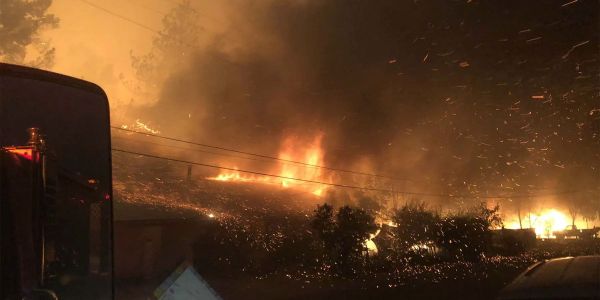
[LINK] Community members and business owners must understand the importance of protecting their structures from ember and fire exposures (radiant, conductive and convective heat).
Posted: Sept. 1, 2022. Updated: Sept. 17, 2024.
What your community needs to know
- Wildfires spread primarily by:
- Ember generation,
- Radiant heat,
- Conduction,
- Convection.
- How embers cause structure ignition:
- Landing on nearby fuels (fences, sheds, woodpiles, etc.)
- Landing on the structure
- Entering the structure
- Landing on the landscape surrounding the structure
- “I recently examined an ember generated by the Marshal Fire in Colorado. The ember, part of a child’s plastic playhouse, was 3 feet wide. It landed in vegetation surrounding a business in Superior, Colorado, one-quarter mile away from the wildfire and started a fire in the mulch.”
- What you can do today:
- Help your community members understand the threat that embers represent, even to areas miles away from a wildfire. Residents and business owners cannot control the number of incoming embers from wildfires, but they can control their exposure by hardening their property, structures and other interdependent factors against the embers.
- Replacing window screens with metal screens
- Caulking or sealing all openings in the structure
- Using metal or stone fence materials where a house and wooden fence meet
- Limit fire pathways (e.g. Ember to gutter to roof to building)
- “Implementing current knowledge of hardening for embers, if done in conjunction with addressing fire hazards, will very significantly reduce structure losses.”
Two New Apps Can Raise Wildfire Risk Awareness in Your Community
[LINK] Wildland Urban Interface (WUI) Fire Property Awareness Explorer
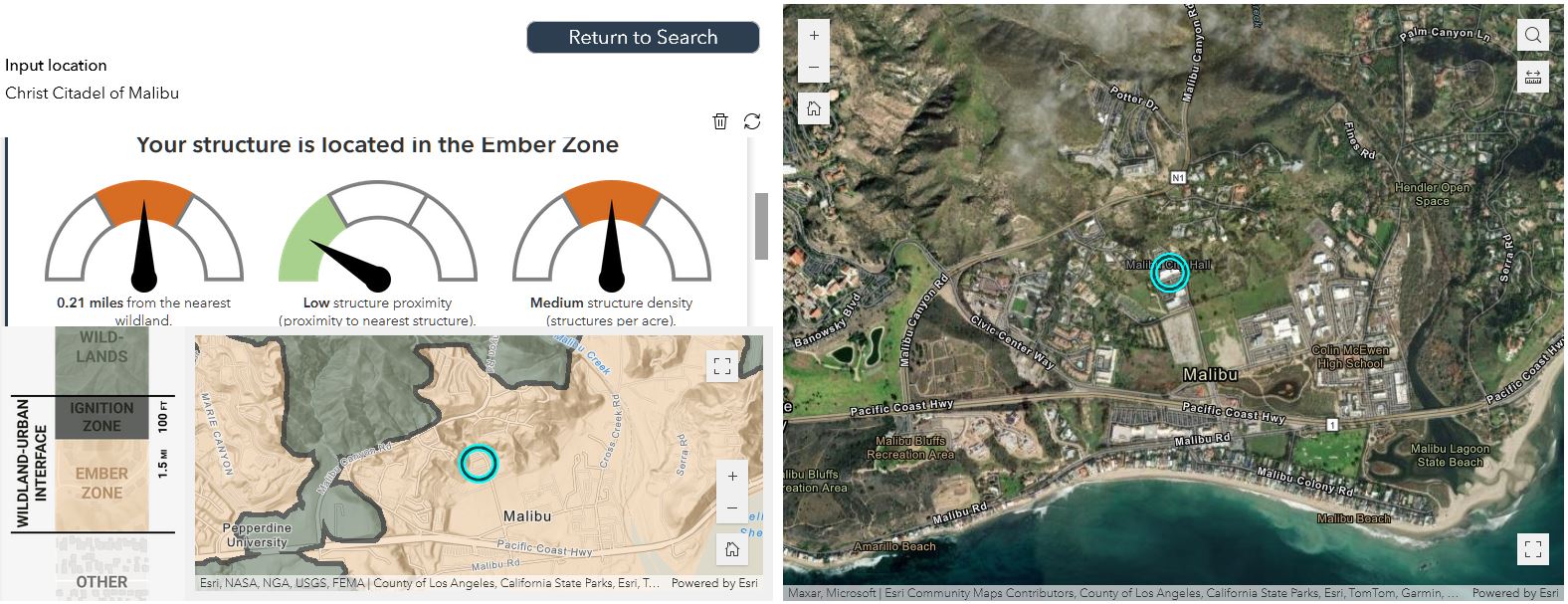
[LINK] WUI Fire Community Awareness Explorer

Two Things You Can Do Today
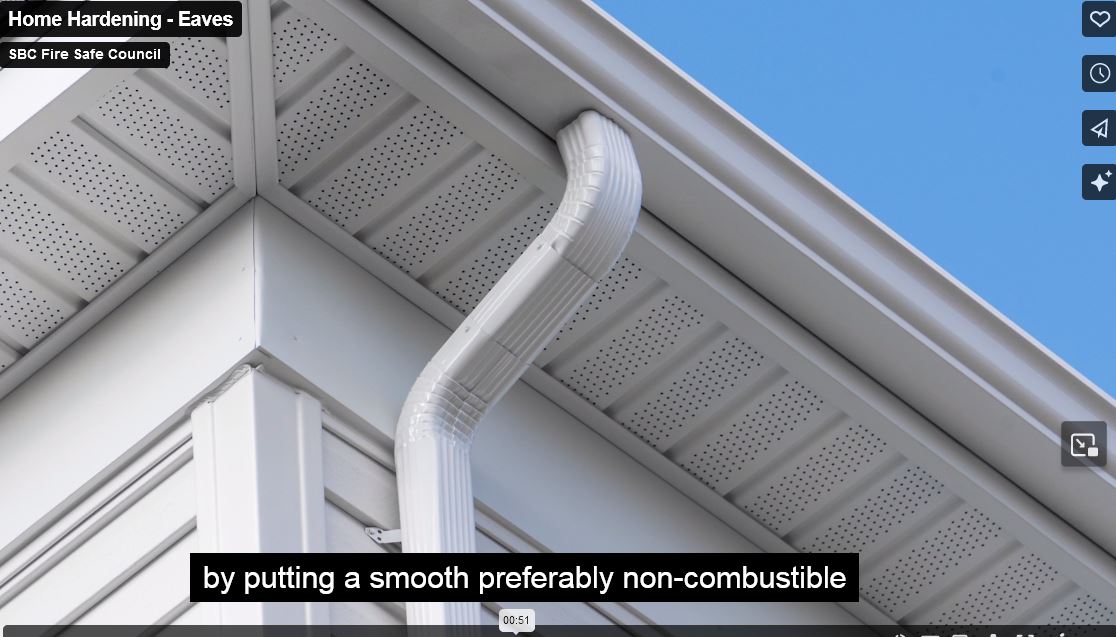
1. Replace your Soffits. These allow air into your attic or crawl space under the house. They also allow embers to pass through. Visit this SBC Fire Safe Council website and short film. SBC Fire Safe Council [LINK]

SBC Fire Safe Council
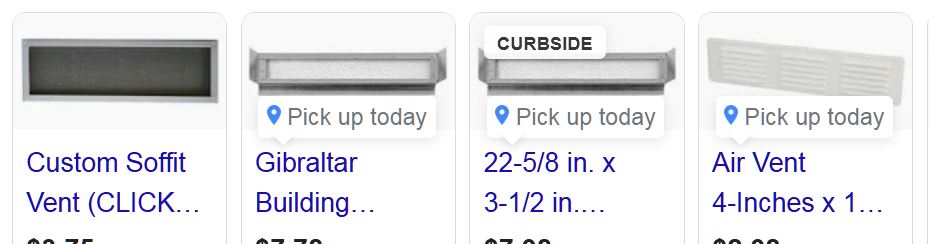

2. Calk or cover the cracks and grooves in your eaves. They’re a major lodging place for tiny flying embers.


And while you’re at it…..
3. Check your window screens. Most newer screens are made of fiberglass which melts at 2,732°F., hotter than your average house fire, but the binding material it’s in contact with can melt or char at high temperatures.
4. …and your drapes and curtains. Window glass melts at 2500-2900°F. Many homes have been lost because cloth curtains and drapes touching the inside of the window will burst into flame long before the windows break or melt, and the flames spread to carpets and furniture. Double-pane glass reduces but does not eliminate heat transfer. At the very least, get the cloth away from the glass. Consider installing fire-resistant windows, such as those with tempered glass or multi-layered laminates, in areas prone to wildfires or fire incidents.
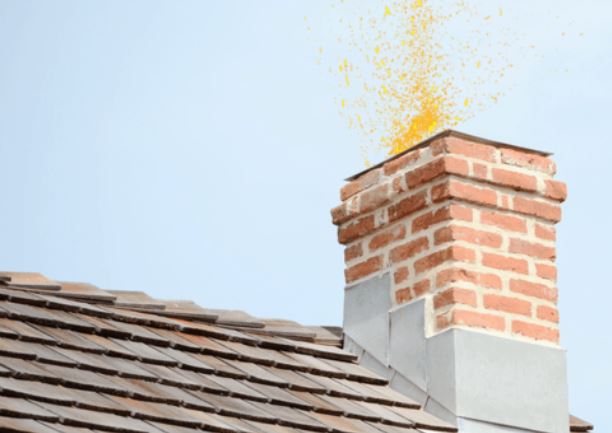
5. Install or check your chimney spark arrestor. A problem is that the arrestor mesh is large, typically 1/2-3/4 inch. Fast moving wildfire embers might blow down your chimney into your living room. Other than that, this site [HY-C] has what you need to know about chimney caps and spark arrestors.
Vegetation and Fire
L.A. Times Opinion 1/22/25. [PressReader LINK]
After the fires, rethink L.A.’s landscapes. Not every flammable plant must go, but we should carefully consider how we replant in burned areas.
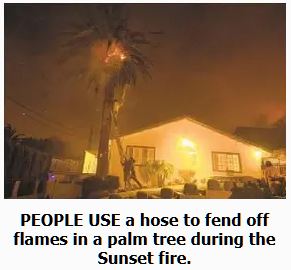
“If you do one thing, plant oaks….They are like the grocery store of native plants….They support insects, birds, and squirrels. They can survive some wildfires, and if they do burn to the ground they may sprout back from their base. Sumacs, California Lilacs and Western Redbud are all native species that thrive here.
— Nick Jensen, conservation program director of California Native Plant Society.Among desirable non-natives that do well in Los Angeles are citrus and other fruit trees, such as cherry, peach, and plum, which are fairly fire-resistant….Think creatively about what flora to plant and how to rebuild, and figure out what is doable and what is too expensive. But the rebuilt and relandscaped L.A. shouldn’t just be a recreation of what burned.
California Native Plant Society – Wildfire

In addition to libraries filled with information on California native plants and regular field trips, CNPA has lots of information on dealing with wildfires, including:
- [LINK] CNPS Fire Recovery Guide
- [LINK] Creating a Fire-Resilient Home while supporting wildlife and native plants
- [LINK] Firewise Garden Designs
- [LINK] Native Gardening 101: Firescaping video
- [LINK] This Old House: Wildfire Mitigation 23-minute Video
- [LINK] Explore Regional Resource Kits and Regional Profiles
- [LINK] Learn from the CNPS Wildfire Research Database
- [LINK] Read Fremontia, the CNPS Scientific Journal
Articles, Books and Videos on Fire
(with the Palisades and Altadena Fires in Mind)
Compiled by Lisa Fimiami (from After the Fires at video time 1:03:00)
A. [LINK] Slow the spread of fire? We have to get rid of the palm trees. L.A. Times column 2/6/25 by Steve Lopez. [LA Times – may have paywall]
B. [LINK] Design by Fire – Resistance, Co-Creation and Retreat in the Pyrocene. American Society of Landscape Architects Fund.
C. [LINK] Expert Perspective: Wildland Fuels Management Would Not Have Saved Us from the January 2025 LA Fires. UCLA Sustainable L.A. Grand Challenge.
D. [LINK] Fire Prevention Landscapes with Greg Rubin; Garden America Podcasts & Radio. (1/25/25)
E. [LINK] Fire-smart Landscaping with Native Plants with Greg Rubin.
F. [LINK] Using Native Plants for Fire Resistant Landscapes with Greg Rubin (2/8/25).
G. [LINK] Fire-Resilient Landscaping with Native Plants. Calif. Native Plant Society – East Bay.
H. [LINK] The Inconvenient Truth of Smokey Bear (PBS Origins 1/17/24).
I. [LINK] What trees survived in our terrible fires? And why didn’t they burn? By Jeanette Marantos, L.A. Times 2/1/25.
J. [LINK] Melinda Adams: Flame Keeper – On Indigenous fire, Cultural Healing and not giving up on a warming world. By Kat Kerlin, UC Davis 8/8/22.
K. [LINK] When will Eaton Canyon recover? Sooner than you think. By Jaclyn Cosgrove, L.A. Times 1/16/25.
L. [LINK] Why clearing the brush around Los Angeles won’t reduce the wildfire danger. By Lauren Sommer, NPR 2/11/25.
Additional Links: Cal-Fire & IIBHS
- [LINK] Cal-Fire ReadyforWildfire.org.
- [LINK] IIBHS Living with Wildfire (Insurance Institute for Business & Home Safety)
- [LINK] IIBHS 20 more Reports (e.g. Fire-retardant Gels, External home sprinklers)
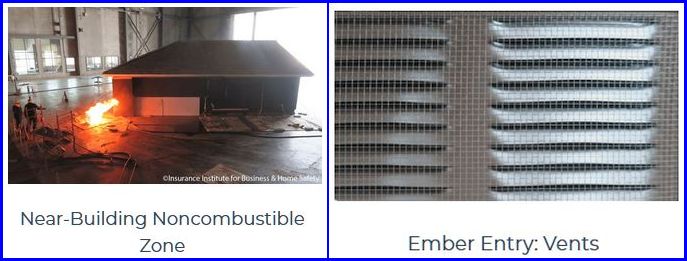
From IIHBS Living with Wildfire:
Wildfires become catastrophes when they enter our communities and a built environment conflagration unfolds. As our built environment continues to push into areas that were wildlands with fire as vital part of their ecosystems, an estimated 45 million residential buildings are now in high-risk wildfire areas across the United States. This study examines the wildfire readiness across the Western United States at both the state and county level.
Wildfires are Systems!
[LINK] L.A. Times Article 1/9/25.
Tiny burning embers flew miles, causing L.A. fire destruction on historic scale. By Grace Toohey, Alex Wigglesworth and Rong-Gong Lin II.
The life-threatening windstorm that prompted several days of dire warnings exploded into a crisis even worse than firefighters predicted, with embers flying an estimated two to three miles ahead of the established fire and in every direction.
[LINK] L.A. Times Article 1/11/25.
Inconvenient truths about the fires burning in Los Angeles from two fire experts. By Thomas Curwen.
For decades, Jack Cohen and Stephen Pyne have studied the history and behavior of wildfires. The magnitude of destruction this week in Los Angeles and Altadena, they argue, could have been mitigated. Society’s understanding and relationship to fire has to change if the conflagrations like these are to be prevented.
[LINK] L.A. Times Article 2/16/25.
The way L.A. thinks about fires is all wrong, two experts say. They explain how to do better. By Thomas Curwen. [Also found under title “What fires can teach L.A. Destructive blazes are a social and systemic problem, experts say, not a seasonal one. ] [Also available from Yahoo News.]
Synopsis of Pyne and Cohen’s 2/16/25 argument: Adapted from Dr Eric Schwartz’s video presentation After the Fire (at video time 40:40 minutes).
- It is simplistic and unhelpful to ascribe risk to one issue such as climate change, fuel loads, fire breaks, response capabilities, etc.
- Pacific Palisades and Altadena burned because of an ignition problem, not climate change. Homes caught fire.
- Fire is a socio-ecological phenomenon – think of hurricanes and tornadoes.
- The last century taught us: rigorously enforce fire and building codes; zone to break up large sweeps of fuel; install fire protections systems adequate to actual risks; create an environment in which insurance can function.
- We talk about fires in apocalyptic terms: vaporizes, a tsunami wall of fire, unprecedented.
- We can fix the problems. Berkeley banned wood shingles after their 1923 fire, but re-permitted them during the post-WW2 boom. Post-fire reforms are too late, often piecemeal and sometimes reversed.
- Such metaphors create a hopeless sense of inevitability.
- Is the pain of fire now sufficient to address fundamental issues? Changing housing so it is not fuel is better than developing new technology to suppress fires as they burn. Fire spreads like contagion and requires a community-wide response. We currently lack the process to achieve that.
- Victimization is an obstacle to problem solving.
- Most fires start from airborne embers moving far ahead of the fire.
- They start numerous, simultaneous small ignitions. A home’s ignition vulnerabilities – in relation to burning embers and burning materials surrounding the home – lead to destruction. Reduce that vulnerability and you reduce community ignition potential.
- Community risk related to adjacent ignition potential.
- Reduce each home’s ignition vulnerabilities and you reduce community ignition potential.
- Fireproofing houses and removing nearby brush are key.
- Primary ignition vulnerabilities: small flying embers adhering to flammable material; adjacent brush, wood and detritus; heat transmission through glass; cliff-edge chimney effects.
- Each landscape is unique; community engagement must fit that landscape.
Wildfire and the “Chimney Effect”
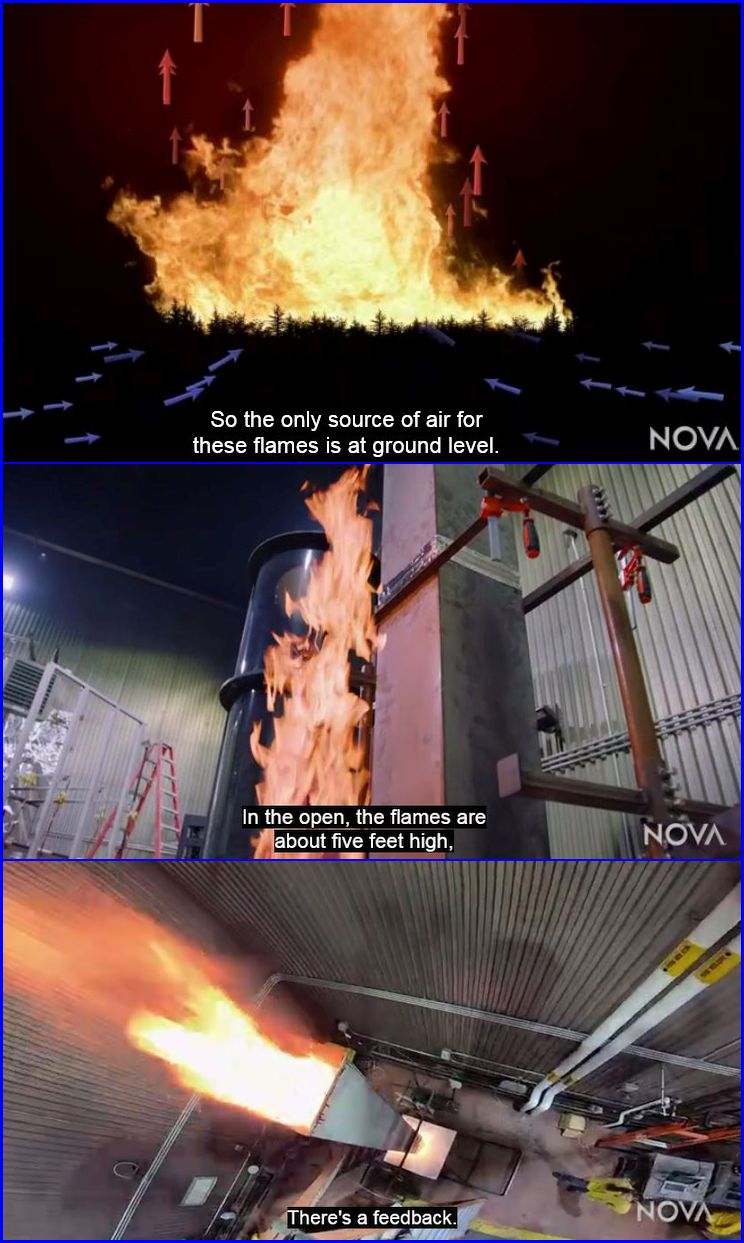
Hot air rises as do hot gasses from a fire. In a chimney, that draws smoke away from the fire and draws fresh air into it. Fires inside structures exhibit this “chimney effect” when they draw cooler air in from below while venting at a higher level. This can cause fire to spread upward and out along ceilings. Wildfires in canyons demonstrate this “chimney effect” at the bottoms of cliffs and in box canyons. Flames shoot up the cliffs, igniting anything flammable at the top of the cliff, such as brush, fences, decks and houses.
The photo sequence below, and the video from which it comes, shows a laboratory demonstration of the chimney effect in which placing a burning wooden object under a chimney cause the flame height to triple.
[LINK] to video The Physics of Large Wildfires (PBS Learning Media).
Below Top: Flames at the middle of a forest fire can’t get oxygen from above or below as the outer flames block those paths, so their air must come from below. Air coming from below creates the “chimney effect,” forcing the flames much higher.
Below Middle: A lit block of wood doused in isopropyl alcohol shoots flames about 5 ft. high.
Below Bottom: The wood block is placed under a chimney blocking air from above and sides; now fed by oxygen only from below, flames shoot three times higher (15 ft.)
[LINK] Los Angeles Times Article 5/11/22.
Fire destroys at least 20 homes in Laguna Niguel amid drought conditions. By Gregory Yee, Hannah Fry, Anh Do, Alejandra Reyes-Velarde and Christopher Goffard. Photos by Wally Skalij.
Ridgetop homes burn due to “clifftop chimney effect.” Contains many photos and two short films.
This letter-to-the-editor refers to the above fire.
Los Angeles Times 2/11/25 Letters. Re: “A failure to learn from mistakes.” Feb 9.
Letter from AC, Laguna Beach, landscape architect & former mayor of Laguna Beach.
In May 2022, some residents of Laguna Niguel lost their homes in the Coastal fire which started in Aliso Canyon. It was as it they had witnessed a rerun of the LA Fire Dept’s film about the 1961 Bel-Air fire, “Design for Disaster,” cited in Jenny Jarvis’ excellent article.
I first saw that film in the early 1970’s at an Orange County Planning Commission hearing, where development was being considered for the ridgetops south of Aliso Canyon. A fire-fighter veteran of the Bel-Air inferno showed the film and pleaded with the commission to not approve development on the ridgetops.
He said this was the most dangerous place to put homes and warned of the “chimney effect,” where fires burning up slopes increase in height and danger.
His warning was ignored. Ridgetop development was approved.
Despite the promised 100-foot irrigated setback, the houses were built out to the edge. Thinning the vegetation on the slopes would supposedly reduce the fire danger, but it didn’t prevent losses from the Coastal fire. Even a fire access road below the homes made no difference. The chimney effect pushed flying embers into the air, setting houses along the edge ablaze.
Developers made a lot of money from having more lots to sell with better views. The buyers, unaware of the warnings and voided protections, relied on the government to approve safe building sites. The homeowners paid a terrible price.
Political compromises with fire realities have proved tragic time after time.
Here’s How the Los Angeles Wildfires Are Affecting Animals, From Fish to Snakes to Birds.
While scientists were able to save and move some creatures in the aftermath, researchers are worried about the prospects for other species.
[LINK] Smithsonian Magazine. 5-Feb-25. By Anton Sorokin.
Opening paragraph:
On January 23, dozens of biologists laden with electrified backpacks, nets and buckets marched into the smoldering moonscape that the Palisades Fire had created in the Santa Monica Mountains. A rescue mission was afoot, with no time to waste—rain was coming. While moisture would help quell the fires that had been burning for weeks, water flowing over denuded slopes would wash toxic ash into Topanga Creek, suffocating much of the life within. This waterway was home to precious steelhead trout, the genetically unique southern population that persists in only a few creeks in Southern California—hence this massive and heroic deployment by the Resource Conservation District of the Santa Monica Mountains, the California Department of Fish and Wildlife, California State Parks and others. Before the day was done, the fish rescue teams trekked over miles of creek, used electrofishing and nets to nab as many fish as possible, put them in buckets, and climbed up steep slopes to trucks waiting to take the fish to safety.
Fires in Australia – How the Aussies deal with it
[LINK] Los Angeles Times Article 17-Jan-25.
Fire lessons from the Australian capital, where a 2003 inferno changed everything. By Max Kim.
Synopsis: This fire was similar to L.A.’s Jan 2025 fire. It started as brush fire, burned for 18 days, 480+ homes were lost, 34 people died. Part of their strategy: If a house is burning, leave it and save other not-yet-burning homes nearby. Embers can be really small and get into small places. Fire departments now audit and enforce “asset protection zones” between houses and vegetation and bushfire abatement zones. Crews remove dead leaves, sticks, branches and they do carefully controlled burns. Outdoor decks are of fireproof plastic, not timber. Grazing goats reduce brushy fuel loads. Owners must prepare their property: clean gutters, remove combustibles from around house, cover cavities from embers, have a fire plan. They don’t do forced evacuations: residents must have hoses, buckets, a water supply and personal protection. They believe climate change is shrinking fire intervals: areas that previously burned 20-30 years apart now burn 15 years apart. This may further decline to 7 years or less.

[LINK] Los Angeles Times Article 17-Feb-25
After this Australian town burned down, experts warned against rebuilding. Nobody listened. By Max Kim & Maria Petrakis.
Synopsis: “Black Saturday” in Marysville, 2/7/09; 150-ft flames, 80 mph winds. Of the population of 500+, 39 people dead, 486 of 500 buildings destroyed. Two problems of rebuilding were the surrounding dense forests and the shortage of escape routes. The well-insured got payments and could move. Buyouts were offered for those living within 100 yds. of significant forest. The uninsured and underinsured could not afford to rebuild and were offered only a small stipend from the government. A commission of experts recommended against building anew in high-risk areas but by then reconstruction had already begun. The Boston Consulting Group, brought in by the government, thought Marysville had “potential to be a showcase environmentally sustainable place.” Sleek urban style new structures were built. No one liked them. “Post-Disaster Attachment Trauma” caused by the government’s refusal to let displaced residents return for weeks exacerbated their grief and anxiety. Fifteen years later, forests around Marysville are again lush and thick. Most buildings have been replaced. 60% of residents left, but population in 2021 was back up to over 450. Some residents can’t recall that there had ever been a fire. Some experts think it will burn again due to winds, forest, brush. Engineering can’t change the winds.
Brush Clearance, Dead Trees, Building Permits, and Insurance Industry: Comments from Los Angeles Times Readers
(Emphasis added)
Los Angeles Times 1/13/25 Letters. Re: “Was poor brush clearance a factor?” Jan 14.
Letter from BR, Orange.
Several people are quoted as saying that poor brush clearance was among the reasons the Palisades fire and others have been so bad.
Although preventing huge firestorms is not as simple as implied, elimination of brush can lead to other major problems. Erosion and landslides that can result from “climate whiplash” also cause tremendous damage.
Without a decrease in the concentration of greenhouse gases in the atmosphere, we can expect more firestorms and more damaging atmospheric rivers. Those who continue to publicly deny the global warming that is cause by burning fossil fuels should help pay for the recovery from this destruction.
Los Angeles Times 1/13/25 Letters. Re: “Fires happen. Change building codes.” Jan 9.
Letter from DS, North Hollywood, landscape architect.
It’s not a matter of “if” but rather of “when.”
If you live in a fire-prone area, you can take all the fire precautions available – brush clearance 100 feet from a structure, irrigation and planting fire-retarding vegetation, for example. But “when” is still possible at any time.
Why an insurance company would ever sell policies for these areas is confusing. Why the City or County of Los Angeles or any other similar jurisdiction allows homes to be built in these areas is outrageous.
Wood burns and steel melts, and if you’re lucky enough to have a concrete home with a tile roof, even that type of structure will last only so long in an inferno.
Los Angeles Times 1/22/25 Letters. Re: “How did some homes survive?” Jan 19.
Letter from SH, Altadena.
Here are two undeniable facts: First, there will always be wildfires in California, and second, wood burns.
When people rebuild their homes this time, will they avoid the use of wood and other combustibles? Not likely unless they are forced….The most likely push to end the use of combustibles will come from the insurance industry. By offering deep discounts or simply refusing to insure, companies can save not only our rebuilding communities, but also our forests. They can also save themselves from bankruptcy.
One more thing: If you already have a wood house in a fire-prone area, stucco it. That’s what saved my Altadena house from the firestorm that leveled my neighborhood.
Los Angeles Times 2/11/25 Letters. Re: “A failure to learn from mistakes.” Feb 9.
Letter from JS, Newport Beach.
Like they did in Santa Rosa after their disastrous wind-driven fire in 2017, you can rebuild with nonflammable home materials and succulents. But driving through Bel-Air and Brentwood recently – and it’s the same elsewhere in Southern California – I noticed dead or emaciated palm, eucalyptus and pine trees near homes.
With climate change increasing the likelihood of wind-driven fires, what is the solution to avert an almost certain disaster?
It’s an unimaginable, unrealistic goal to simply remove all of these trees. Simply having clearance around these homes is not enough when there is a wind-driven firestorm.
I wish I had a simple answer.
Build Low-Cost Housing?
[LINK] Los Angeles Times Opinion 1/26/25.
After the fires, L.A. needs to build more homes even faster. This is a moment for officials to speed up housing everywhere across the city and county.
Synopsis: The housing crisis, here before the fires, is now worse. We need to build more fire-resistant housing in the burn areas as well as continue to focus on building desperately needed housing. We already have a 500,000 unit shortage; over half of county residents spend over 1/3rd of their income on rent. Price gouging is reported despite state law. Low income people are now more at risk. Help is needed for those who can’t afford to rebuild or buy new.
Abundant Housing LA suggests: “expedite and waive discretionary review for all multiunit housing” outside of severe fire risk zones. Build more housing near transit lines & commercial corridors.
Abundant Housing LA: https://abundanthousingla.org/
Abundant Housing LA Housing Help: https://abundanthousingla.org/housing-help-page-xxxx/ Affordable housing, rental assistance, cash assistance, eviction resources, finding housing, homelessness resources.
Los Angeles Times Article 1/30/25 [PressReader Link]
Activists oppose shortcut to rebuild housing. County leaders are criticized for asking the state to lift affordability rules. By Rebecca Ellis.
Synopsis: A request to LA County officials to temporarily waive state housing laws while rebuilding in burned areas is attacked by housing advocates seeking to boost affordable housing. County Supervisors Kathryn Barger and Lindsey Horvath put forward a 41-steps motion to speed up the recovery process; this included an exemption from parts of Senate Bill 330 which intended to preserve affordable housing, as well as the Density Bonus Law which encourages developers to build new units. County Planner Amy Bodek says that state laws incentivizing density can hamper people wanting to rebuild what they had, and she asks for 5-year waiver. Nolan Gray of California YIMBY states: “This is just totally going in the wrong direction.” Mark Pestrella, head of County public works dept. expects that repairs and rebuilding will cost the county billions of dollars; they’re hoping to get help from the federal govt. White House says Tues. Jan 28 that it’s freezing trillions in federal grants and loans that don’t align with Trump administration priorities. Their order was immediately blocked by a federal judge and the next day the administration rescinded the directive, but said “a review of spending would continue.”
Los Angeles Times 2/11/25 Letters. Re: “A failure to learn from mistakes.” Feb 9.
Letter from EL, Los Angeles.
Please remind me why anyone thinks it is a good idea to encourage and promote the building of accessory dwelling units on properties in hillsides and canyons.
In my humble opinion, less density, not more, is what we need in these areas.
Miracle Mansion of Malibu Survives Fire
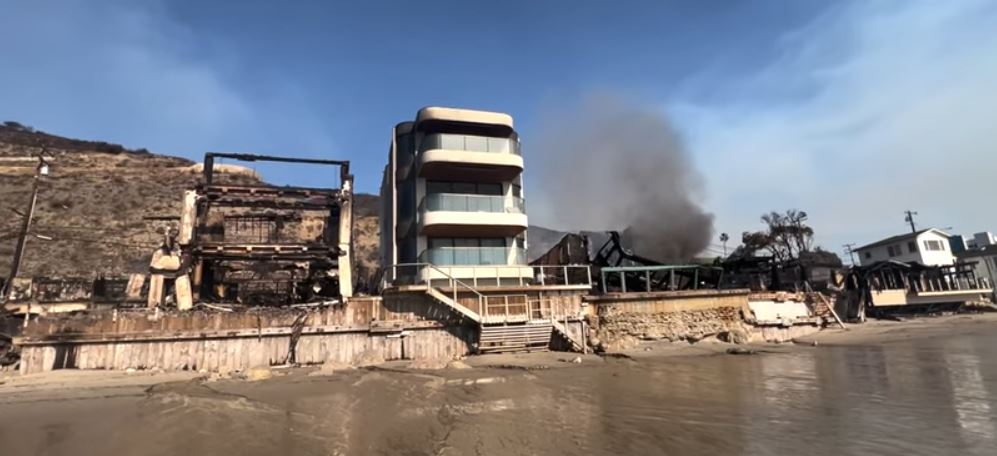
[LINK] Los Angeles Times Article 1/19/25
How did some homes Survive? By Alex Wigglesworth and Joseph Serra.
Synopsis: This is a concrete structure with fire-resistant roof and tempered, double-paned windows. Firefighters watered his neighbor’s houses from his balcony. Fortuitous timing and a lucky wind shift may have helped. “Fire-hardened homes with good defensible space have a double-digit increase in chances of surviving. Home-hardening efforts are absolutely critical.”
Hardening: keep flames and heat away from home; reduce likelihood of embers finding a weak spot to enter & burn from the inside.
Can include: use fire-resistant building materials; add mesh screening to vents & chimneys; close gaps around exposed rafters; clear vegetation & debris from around home.
Additional steps: steel-reinforced walls, metal roof, no eaves or roof vents, walls trimmed in cinderblock to protect seams where wall meets ground, brush cleared weekly.
The fire destroying neighbors homes. One home’s $75,000 sprinkler system clogged and perched on the canyon edge was destroyed by “chimney effect.” Other concrete-hardened houses were taken by embers of plastic, fabric and other materials that spread house to house. One or two mitigations are insufficient says Steve Hawks of the Insurance Institute for Business & Home Safety. The Palisades and Eaton fires are “a textbook worse-case conflagration scenario in which volatile winds aligned with major roads, pushing flames along privacy hedges and fences that connected properties.” And some houses survived because they were tucked away from prevailing winds.
Los Angeles Times 1/22/25 Letters. Re: “How did some homes survive?” Jan 19.
Letter from AC, San Diego.
So, David Steiner’s concrete home is the sole survivor in a destroyed Malibu neighborhood. I find that predictable, but apparently insurance companies don’t.
My home is an entirely concrete structure with a dirt-over-concrete roof. Recently our insurance was canceled because we are in a fire zone. True, but they did not cancel our neighbor’s late-1950s wood-frame home in the same zone.
We hear that insurers in California are mandated to consider a home’s fire-resistant elements. It seems you get credit for screening vents but punished for building an essentially fireproof structure.
Yes, California’s natural disasters make it very hard for insurers. What would it take to get them to actually look at the fire-related elements of a house rather than, as they do now, put homes into categories and deny those that fail to fit in one of those boxes.
Foothill Catalog Foundation supports Pre-approved Design Plans
[LINK] Los Angeles Times Article 2/18/25.
People used to buy homes through catalogs. Could that idea help Altadena? By Colleen Shalby.
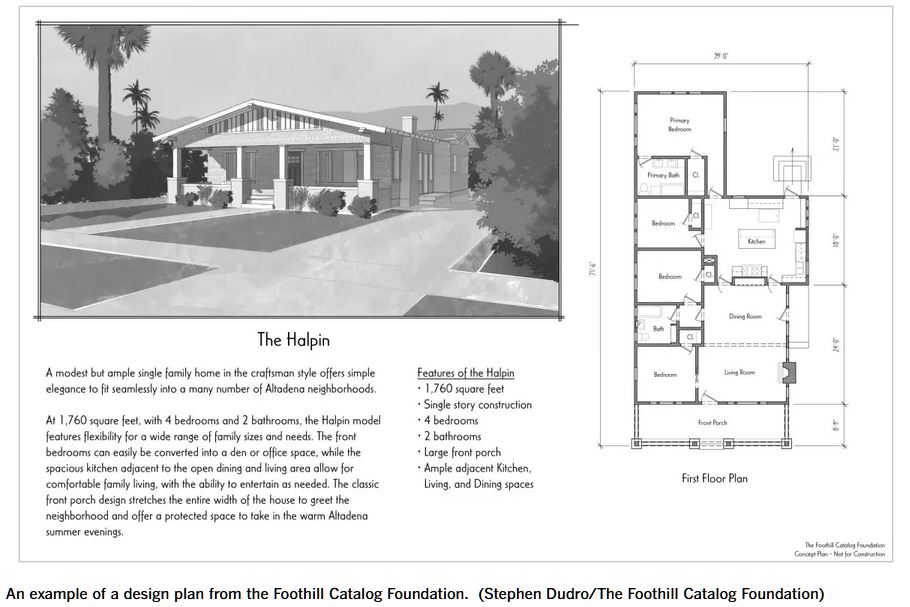
Synopsis: Homes in Altedana were varied: English Revival, Spanish Colonials, Calif bungalows, Janes Cottages. Local architects – inspired by early-20th century Sears catalogs pick-a-kit-design – founded Foothill Catalog Foundation nonprofit, with preapproved plans that reflect Altadena’s history. Designs so far include: Mediterranean, Craftsman, mid-century, (Elisha P.) Janes Cottages. Cynthia Sigler, Altadena resident and co-founder of the nonprofit “…a lot of people who might be underinsured or just not insured at all, will likely not have the resources or the emotional bandwidth to go through the process of doing a custom rebuild.” They are now connecting with residents, engineers, builders, local government & community groups. Callum Hanlon was building an ADU for his in-laws: “I would rather have that [preplanned design] than be going back and forth with the county and spending upwards of $60,000 on an architect in a year of revisions to get the perfect home.” He recently coordinated a Zoom webinar for interested residents, in which he explained the general concept and answered questions related to mission and price. Sigler: “If something gets built multiple times, then you can start to think about prefabricating and bulk-ordering, which are all things that can chip away at that cost. While I can’t give a specific cost for these homes, we’re confident that given all of those factors, it will be a more affordable option.” Nonprofit members have met with L.A. County planning and building and safety departments and are figuring out what requirements insurers may have. Altadena residents opine that a successful rebuild must be community-driven in order to protect the legacy of the town and residents aren’t pushed out. Altadena Heritage and Pasadena Heritage are seeking input from locals. Freddy Sayegh spearheads a coalition of locals with different expertise and backgrounds to create a plan. “We know what we want, we know how to build” he said at a zoom meeting. He believes that those rooted in Altadena will shape its future. “What makes this place special is its people. We definitely don’t want to be a group of architects telling the community how we think they should rebuild – we’ve always really felt that it should be the other way around.”
Los Angeles Times 2/25/25 Letters. Re: “Altadena’s future may take a page from the past.” Feb 18.
Letter from CK, Malibu.
We are installing a manufactured on our property in Malibu that burned in the 2018 Woolsey fire.
While I strongly believe that manufactured homes with good designs are the way to rebuild after a fire, local agencies need to think outside the box about streamlining the process.
Why not have pre-approved foundations for the manufactured homes? For soil-sample requirement, why not have cost-efficient and streamlined process to get that done?
If the fire agency responsible for Altadena has special requirements, it should have sufficient staffing and updated procedures to assist residents. For example, why require the homeowner to obtain water pressure data to put on a form to be submitted to the fire department? Shouldn’t the fire department have that information?
Also, the utilities need to be readily available to connect the new structures to services. And by the way, this would be the time to put all utilities underground.
Manufactured homes are a great tool for rebuilding quickly, but there must also be an immediate rethinking of our antiquated building bureaucracy.
Los Angeles Times 2/25/25 Letters. Re: “Altadena’s future may take a page from the past.” Feb 18.
Letter from BR, Long Beach.
Kudos to the Foothill Catalog Foundation for coming up with the concept of rebuilding Altadena with house kits similar to those offered long ago by Sears.
I’d be willing to bet the Craftsman bungalow where I live in Long Beach was a kit house. Its floor plan mirrors those of other houses in our neighborhood. Each takes on the personality of its owners, yet their similarities give the neighborhood a historic charm.
And the fact that a kit would greatly reduce the cost to rebuild? Why not use this option? Figure out fire-resistant materials for those houses, and you’ve got a winner.
Real Sears Kit Houses

These were real houses you could buy from the Sears Catalog (delivered to your door by a government agent), and the many still standing do not look like hovels or cobbled-together do-it-yourself kits. SearsHouses.com tracks down, documents and authenticates these houses. According to their website, Sears kit houses were built from 1908-1942 (see this blog post for substantiation of the 1942 date, and this follow up article), and the models offered by Sears followed the design trends of those decades. Not every house in a community of 1920s-era houses, is a Sears house, for example… far, far from it, in fact, as only about 2% of houses built in the kit era, were built with kits from Sears. A Sears house is:
- not a Pre-fab house
- not a steel panel house (those are usually Lustron houses)
- not every Craftsman, bungalow, or Dutch Colonial style house you come across (though Sears did offer many Craftsman, bungalow, English cottage, Dutch Colonial, and Colonial style houses… as did every other house company)
- not a house built after 1942 (or before 1908)
- not the only brand of kit house that existed (other companies include Gordon-Van Tine, Aladdin Homes, Bennett Homes, Wardway homes, and others)
Tilt-up Construction with Cement Panels

The impetus for this entire blog came from reading the following letter. There are innumerable experienced people in our community, I said to myself, and they have comments and suggestions perhaps obvious to themselves but not so obvious to the rest of us. Let’s spread these ideas around. You have been reading the result.
Los Angeles Times 1/09/25 Letters. Re: “Fire rages in L.A. coastal enclave.” Jan 8.
Letter from DMC, Santa Ana, landscape architect.
Right now in Los Angeles , we are seeing what happens when we build homes with wood framing instead of tilt-up steel reinforced cement walls that would be more fire-resistant.
We citizens are too stupid to insist on building codes that are truly fire-resistant. Of course, we would still need to meet earthquake standards, which could be done with steel-reinforced cement materials even better than wood-frame structures.
If we are smart, we should encourage those who are losing their homes now to rebuild fire-resistant. Insurance companies should welcome that approach. As experience is gained with fire-resistant homes, they will probably be less expensive.
One of the companies I worked for years ago was in a tilt-up cement facility that I believed was very safe and surely fire-resistant. The technology exists; we just need to revise our building codes to encourage more fire-resistant structures.
I’d long thought that building with reinforced cement instead of wood was the smart thing to do. Southern California chaparral evolved to burn every 15-35 years and we cannot avoid that. The idea of cement structures poured on-site on level ground, then tilted up into place struck me as a good – and probably cost effective – idea.
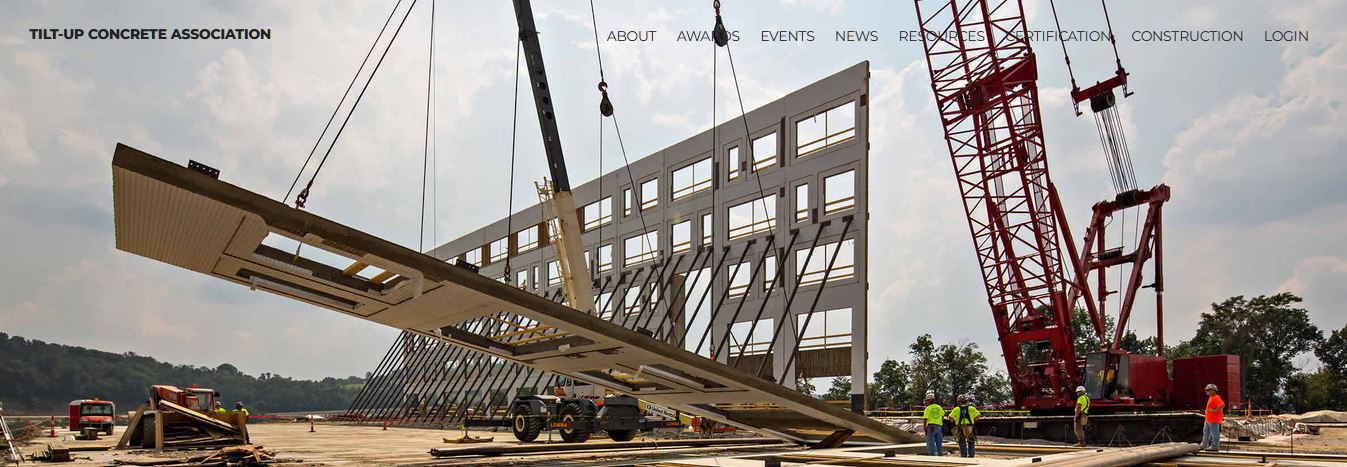
This link to the Korte Co. has lots of information including a 2-minute video explaining the process of tilt-up construction with concrete panels poured on-site. The floor is laid, wall forms with rebar within are built, cement is poured in 1 day, curing takes 3-4 days, and erecting the walls 2 days.

There are many dozens of companies that do this type of construction. The Tilt-up Concrete Association will tell you much more, plus it has an 11-minute video. Anyone with an appreciation of engineering will find this very interesting, thought-provoking and fun to watch.
3-D Printed Cement Walls
Don’t like the tilt-up idea? You can have the cement walls poured onsite directly in place using computer-controlled 3D-printing. Yes, cement, not plastic.
YouTube Blurb: 9,125 views, Jul 25, 2024. We explore the cutting-edge technology of 3D concrete printing and its impact on the construction industry, specifically in house building. We’ll cover the benefits of this innovative technique, including reduced construction time, lower costs, and increased design flexibility. Discover how architects and engineers are using 3D printing to create customized, sustainable homes with intricate designs that were once difficult or impossible to achieve. Whether you’re a technology enthusiast, an architect, or simply curious about the future of housing, this video provides an insightful look into the transformative potential of 3D concrete printing. Don’t miss out on this groundbreaking technology that is shaping the future of construction!

From the video (at time 3:00).
A Concrete Plan for Sustainable Cement
Ryan Gilliam | TED Countdown: Overcoming Dilemmas in the Green Transition
And while we’re on the topic of building with cement, it wouldn’t hurt to know something about what cement is, how it’s made, why limestone (the major ingredient in cement) is 44% carbon dioxide (CO2), that making cement releases billions of tons of CO2 into the atmosphere every year, and that there are ways of capturing that CO2 and utilizing it. Watch this 6-minute TED Talk.

TEDTalk blurb: Cement is one of the most-consumed materials on Earth — second only to water — and it accounts for a whopping eight percent of the world’s carbon pollution. What if we could turn this climate villain into a hero? Clean tech innovator and serial entrepreneur Ryan Gilliam reveals his company’s surprisingly simple process for transforming waste from the cement-making process back into limestone using existing infrastructure, creating a competitive and eco-friendly product that could pave the way for gigaton-scale climate solutions.
But wait! That’s not all. This is a conversation with many voices. A few days later…
Are Concrete Houses Too Solid to Withstand Earthquakes?
Los Angeles Times, 1/09/25 Letters. Re: “Fires, Happen. Change building codes,” letters, Jan 9.
Letter from AJ, Seal Beach, certified welding inspector, former member of American Welding Society’s committee on structural welding.
While there is a need to upgrade the building codes to more fire-resistant practices, the kind of tilt-up concrete buildings suggested by one letter writer is not necessarily the answer. Those buildings are more rigid and might suffer more from earthquakes.
After the Northridge earthquake in 1994, the Seismic Addendum was added to the American Welding Society’s Structural Welding Code to address the rigidity of steel-frame buildings that fractured in the quake. Wood-frame buildings can move to a degree for survivability.
There are practices available to reduce the chances of embers entering structures and causing ignition. Those would be advised as a way to reduce a fire’s severity.
Ah, yes…earthquakes. Fires aren’t our only problem. Maybe there’s some way of introducing flexible joints between walls, floors and ceilings. It turns out that the Japanese have been working on this for centuries, living as they do in one of the most earthquake-prone countries in the world.

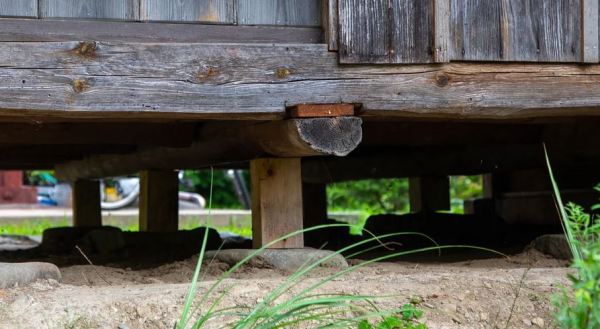
Ancient buildings such as shrines and pagodas were build of wood with “loose joints” (for lack of a better term). Tall pagodas survived many earthquakes due to “shinbashira” design, where everything is suspended from a central pillar made from straight trunks of Japanese cypress (hinoki), running the entire vertical length of the pagoda and jutting from the top. Many large modern buildings have adopted this central pillar concept. Foundations that use “ball-bearings” of metal or rubber, or shock-absorbing systems, can be used with or without the central shinbashira, allowing the entire building to sway and move during earthquakes.

Here’s a few links to interesting articles:
1. Architects of Resilience: The Secret of Japanese Anti-seismic Construction. (8-minute video, shinbashira at 6:30)
2. Earthquake Proofing: (CNN link) How Japan spent more than a century earthquake-proofing its architecture.
3. Recovery – Creating Earthquake-Resistant Buildings (Univ. of Tokyo link)
4.Design for Impact (CNN link) A series spotlighting architectural solutions for communities displaced by the climate crisis, natural disasters and other humanitarian emergencies.
5. Tokyo’s Skytree Tower: Tokyo has the tallest tower in the world, built combining ancient shinbashira pagoda design and tuned fluid damper design from NASA’s Apollo space program. [Popular Mechanics LINK includes 3-min video]
(Univ of Tokyo link)
And finally…
Building with Earth
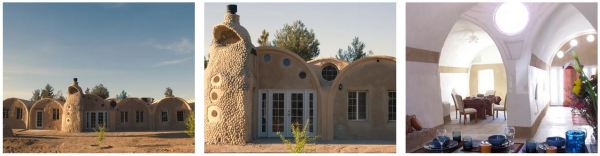
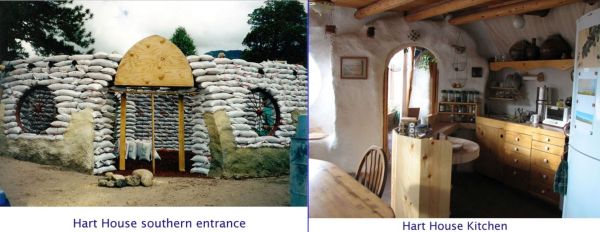
There are many companies and websites devoted to building with adobe. Los Angeles Times has published two articles about Cal Earth, located in Hesperia in the high desert north of San Bernardino. EarthBags is similar in style and purpose. They both use plastic bags filled with moist earth. Cal Earth sells the SuperAdobe bag as very long tubes 250-1000 yds. which you cut to length as needed, thus an entire layer of the circumference of a round house can be done with a single bag. [Spoiler alert: You fill it.] EarthBags sells 18×30″ bags. For both systems: Two strands of 4-point barbed wire are laid on top of each layer of bags. Long strands of plastic string may be used to encircle each 3 layers of bags, then move up 1 layer and encircle the next three layers. These sites claim that structures built this way are far more earthquake-resistant than ordinary housing. From CalEarth:
“The city [of Hesperia] conducted tests, under the supervision of the [International] conference [of Building Officials, ICBO], and found that Superadobe stood up to twice the amount of weight that would crush a pitched-roof house.”
I think that because one of the best ways to die during an earthquake is to be inside an unreinforced masonry building, I’d like to see a little more detail on how they arrived at this opinion about the safety of adobe, but I could not easily locate it. The structures themselves can be quite lovely.
Cal Earth SuperAdobe Structures

[LINK] Los Angeles Times Article 3/03/25.
Why some are looking to build ‘SuperAdobes. By Jessie Schiewe.
Since the L.A.-area fires in January, interest has increased in earthen architecture that’s resistant to disasters.
[LINK] Los Angeles Times Article 5/31/19.
CalEarth, champion of inexpensive architecture for the poor, reopens this weekend. By Marissa Gluck.

Building with EarthBags
EarthBagsBuilding has a ton of information on their website: manuals, videos, tools, sales, slide shows. You could easily spend a day on this single website.
But, as always, there’s more.
Engineering for Change: How to Build an Earthquake-Resistant Home: An Earthbag Construction Manual. – Their Blurb: This building manual is designed to show builders the right way to build with Earthbags, using best practices and time-tested engineering and construction techniques.
[LINK] Legal Adobe In California: A Pathway for Building Permits. From Verdant Structural Engineers.
[LINK] Research Paper: A study on feasibility of super adobe technology –an energy efficient building system using natural resources in Bangladesh. Razia Kamal and Md. Saifur Rahman. 2018.
Abstract. The inspiration and concept for the Superadobe system originates not from the modern architecture design experience, but from the influence of traditional rural buildings and landscape, together with a 13th-century Persian poet named Jala Ad-Din Muhammad Balkhi, Rumi. The poetry spirit of Rumi, connects and enlightens the architectural theme of Nader Khalili with natural resources that anybody in the world should be able to build a home for his or her family with the simplest of elements: Earth, Water, Air and Fire. Therefore, to build a human shelter that will give maximum safety with low financial budget and minimum environmental impact with natural disaster resilient a Superadobe Technology has been adopted. The Superadobe, a form of earth bag construction using sandbag and barbed wire technology, is an economical, time efficient, energy efficient and ecologically friendly system developed by Iranian-born architect “Nader Khalili”. The system connects the natural materials and rural traditions to create a new way to use natural materials such as mud, water, air and fire which can be finished in a short time without any large construction equipment. The goal of this study is to introduce the building system, analyse the ventilation, lighting and insulation of the prototype of Superadobe system replacing the contextual earth house in Bangladesh.
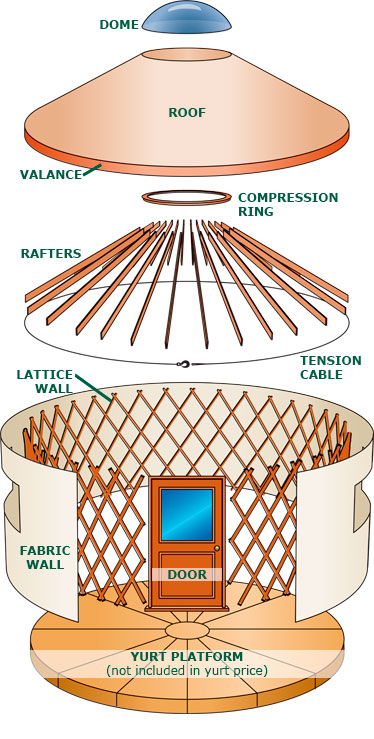
Maybe what we need are inflammable houses of concrete built with flexible joints or on movable foundations, ball-bearings, shock absorbers, floating in sealed pools of oil or with fluid dampers and the like. Perhaps build our house of on-site earth or cover our rooftops with earth or live altogether underground. We could then place TV cameras on the roof and watch the sea roll in, the clouds tumble by and the hummingbirds sip nectar from our rooftop garden flowers. And, perhaps, there are a few other, smaller things we can do to prepare ourselves. Personally, I prefer gers (yurts) which you can assemble or disassemble in an hour and have the wonderful attribute of being round. Four millennia in the perfection of the design; Five million Mongols can’t be wrong.
Take Community Emergency Response Team Training
Los Angeles Times 1/11/25 Letters. Re: “In Altadena, residents step into breach.” Jan 9.
Letter from JR, Costa Mesa.
The unprecedented fire emergency that has engulfed Los Angeles is a dress rehearsal for “the Big One” (earthquake) that will come sooner or later. Except the Big One will also come with collapsed buildings, mass casualties and near-total communications break-downs (dead cellphones, no internet and spotty or non-existent TV and radio coverage).
Take heed, folks: The Big One will totally overwhelm first responders. You will be on your own for days or weeks.
Here’s my advice: Join your local Community Emergency Response Team chapter. Get trained on how to fight small fires, perform light search and rescue, render first aid and effectively communicate with radios.
The cavalry won’t be coming to help you immediately when the Big One hits.
That sounds like a good idea for just about anyone. The CERT program of the L.A. Fire Dept. originated 40 years ago, when a fire dept. group visited Japan to learn how they responded to disastrous earthquakes. When the deadly Kyoto Earthquake struck during their visit, they experienced first hand that community participants played a significant role in post-disaster support and response.
Among other things, the CERT program includes:
- Learning to suppress small fires
- Basic first aid, including ABC treatment, treatment for shock, and related techniques
- Evacuation tactics and how to collaborate with city agencies to support neighborhood exit
- Search tactics; communications, including the use of radios.
You receive 17 ½ hours (one day a week for seven weeks) of initial training, after which you attend bi-annual full-day refresher drills and an opportunity to assist the LAFD at local incidents. CERT training is provided free of charge within the City of Los Angeles to anyone 18 or over. Classes are taught mornings, afternoons and evenings continually throughout the year in locations all over Los Angeles.
Website: https://www.cert-la.com/
Email requests: lafdcert@lacity.org
Their program calendar.
CERT Unit, Los Angeles Fire Department, Homeland Security Division
201 N. Figueroa St., Suite 1225, Los Angeles, CA 90012 213.202.3136 [Direct Line] 213.202.3187 [Fax]

If this article sparked some ideas, then it served its intended purpose. There are a lot of knowledgeable people in our community and we should gather as much input and listen to as many voices as possible. None of us know everything and a better solution may be in the next person’s offhand comment.
Discover more from SANTA MONICA BAY AUDUBON SOCIETY BLOG
Subscribe to get the latest posts sent to your email.



 SANTA MONICA BAY AUDUBON SOCIETY BLOG