Sepulveda Basin Wildlife Reserve in late winter: 15 March 2025
[By Chuck Almdale; Photos by Ray Juncosa, Armando Martinez, Emily Roth]
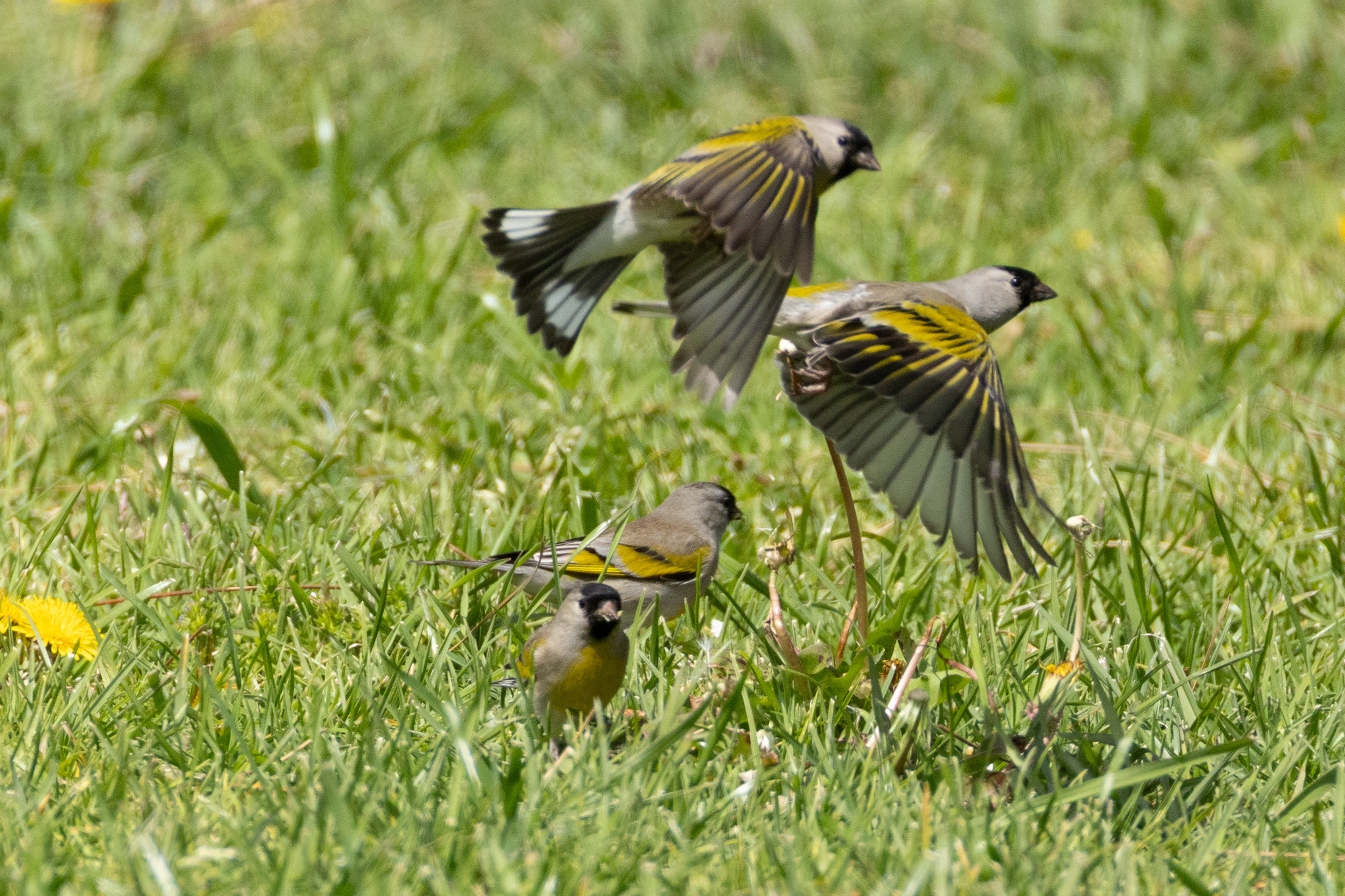
It’s always a treat to see Lawrence’s Goldfinches, the least common of our three Goldfinch species. We had a dozen flitting from tree to grass to tree to grass, depending on perceived threats.
It had rained earlier in the week, a whopping 1.2″ spread over three days. The morning was cool, the grass was damp from dew with an occasional remaining rain puddle, but the paths were dry.

The wildlife area surrounds the pond which is officially and descriptively named “Wildlife Lake.” We walked from just south of the archery range down the west side of the lake to the south end, and returned north via the path just west of Haskell Creek. There are view points of the pond along its west side and the creek has lots of trees and brush, although they’re somewhat reduced by recent fires.
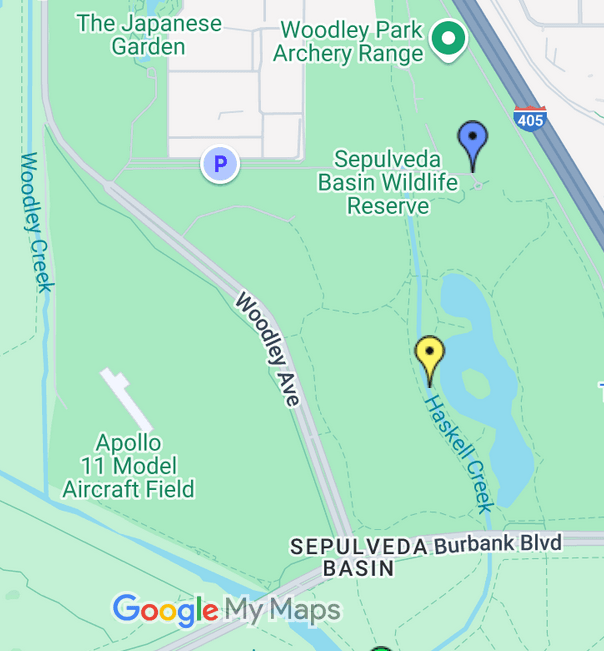
Below: Aerial view looking northwest from above the Santa Monica Mountains. The wildlife area surrounds the lake with the perfectly circular island in the middle, left (west) of the Santa Monica Fwy (#405). This island has become popular with cormorants ducks, egrets and herons. Until quite recently it had a lot of trees over 30′ tall, but they burned in a fire and most were recently removed.

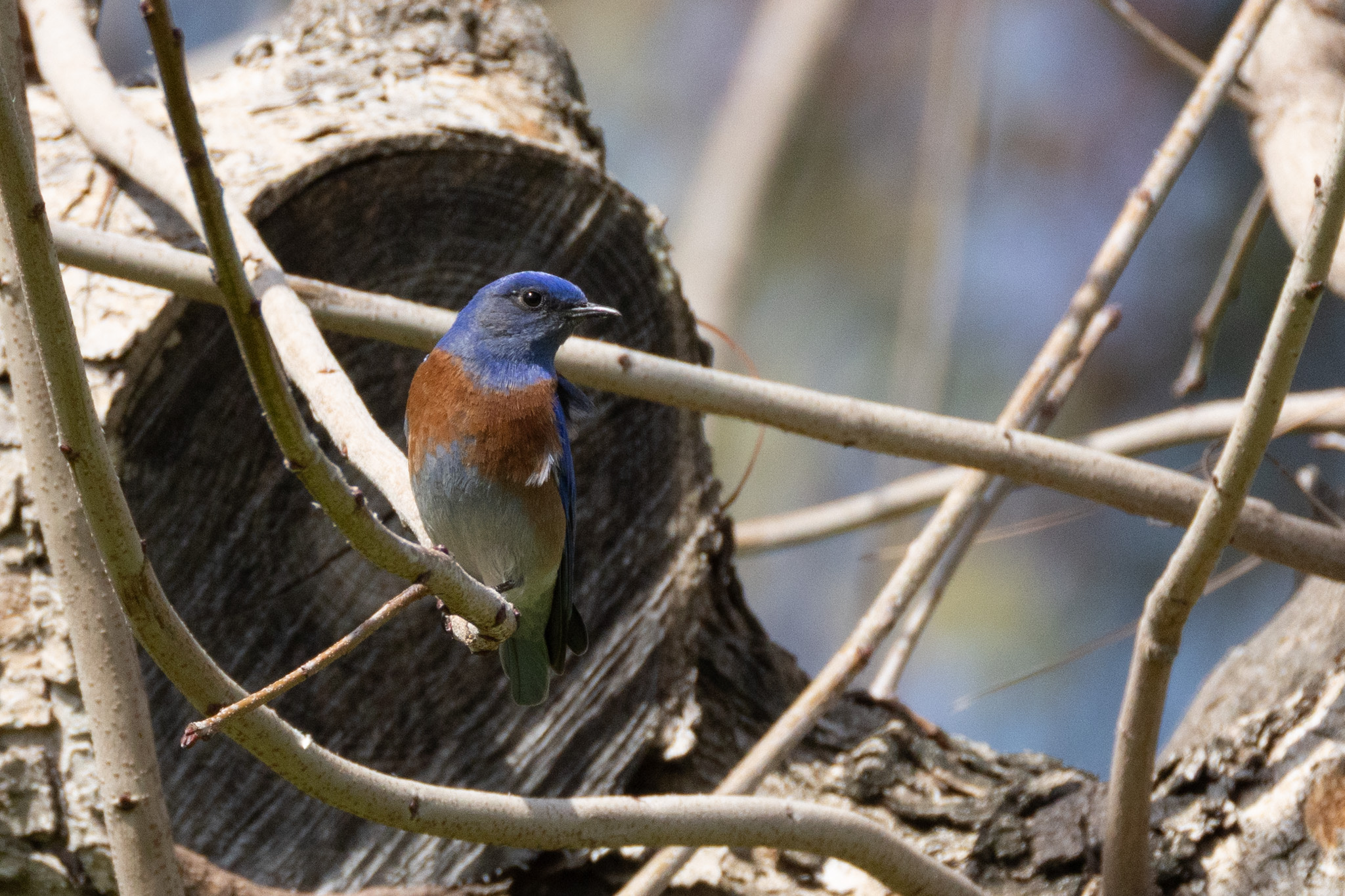
We tromped over the lawn towards the wildlife area, checking the trees for warblers and the grass for sparrows. Several pairs of Western Bluebirds were flycatching from the oaks.
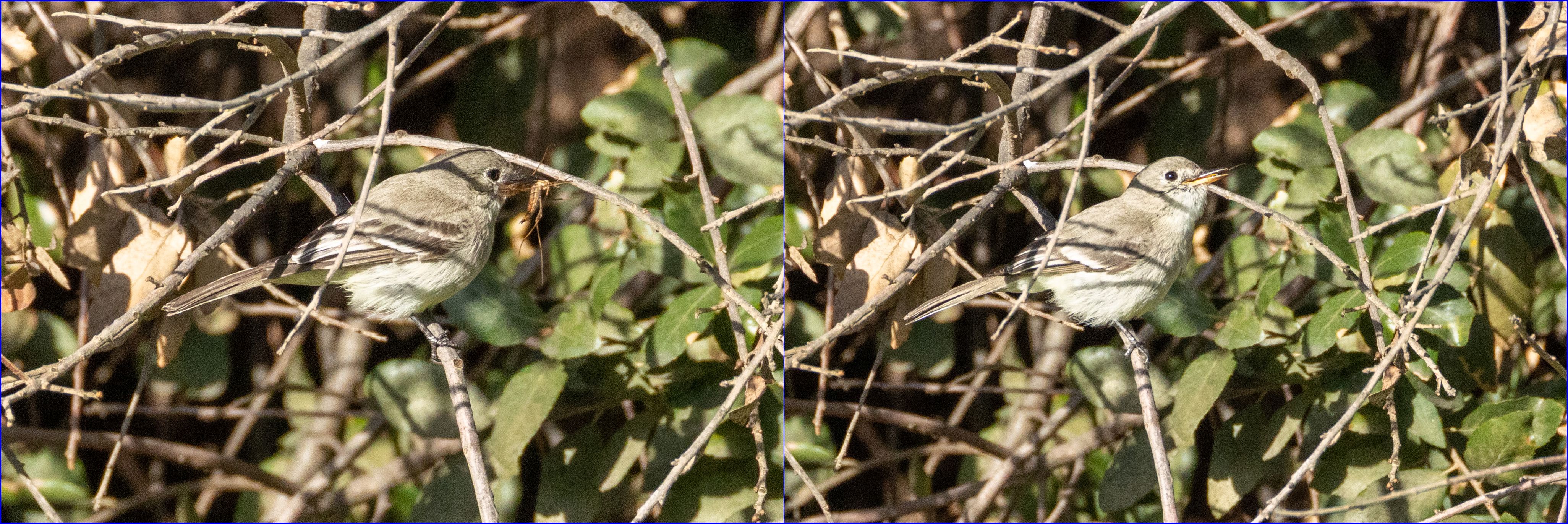
At one point Chris Lord alerted us that he had just seen (he thought!) a Gray Flycatcher which is rare here in March and April, so we went back to search the oaks for it. We actually had two (I’m 90% sure) as the first we saw – and which quickly disappeared – was quite yellowish in comparison to the later bird we photographed.

Not much (none really) yellow on this fellow. The Gray Flycatcher is one of those annoyingly difficult-to-differentiate empids (Empidonax wrightii). They have very little eyering, but some paleness in the lores. All empid upper mandibles are dark(ish). The Gray’s lower mandible is pale at the base and dark at the tip; the amount of dark varies. The bill is long. The primary extension (how much the primary wing flight feathers stick out from below the secondaries, see the right photo above) is quite short. The tail is long and the bird habitually drops the tail from its “rest point” parallel with the back (again, see right photo above) downward, then raises it a bit more slowly back to its rest point. The empid species are variable and terms such as long, short, gray, yellow are all relative to the other empid species and not to some abstract value.

There’s a hint of yellow on the belly shown above. The left photo below shows the bird doing what it does best, catching flies. The fly is all gone by the right photo.
Finally, it flew off to another tree where perhaps humans weren’t so abundant and abundantly nosy.

Again, a hint of yellow on the rump visible as the bird flies.

There were swallows over the pond most of the time, in five species: Tree, Violet-green, Northern Rough-winged, Barn and Cliff.

There was a very beautiful Green Heron in the reeds, not looking particularly green as is usual.

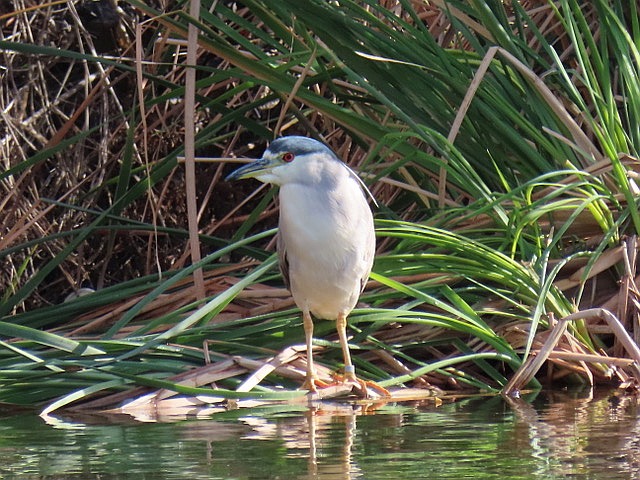
This adult Black-crowned Night Heron (they recently lost their hyphen) has a metal band.
Nearly all of the cormorants were Double-crested. Notice the orange flesh above the front part of the eye, and the lack of significant white border by the gular pouch.

Ray Juncosa 3/15/25)
Now look at the front bird below, compared to the two behind. These were on the north side of the island.

The white border is clearly seen on this bird below, located on the west side of the island. The angle at the gape is also more acute in the Neotropic.

The first Neotropic Cormorant I saw in Los Angeles was in Oct. 2018, farther downstream on the L.A. River next to Bette Davis Picnic Park. My first one in California. in 1986, was at the Salton Sea at the northwest corner where the Whitewater River flows in. They’ve been slowly expanding their range northward from Mexico. So far they prefer freshwater rivers and lakes.
We had a bit of a kerfuffle over what I temporarily called a Western Cassin’s Oriole-Kingbird (an exciting new hybrid!), resolved when I later learned that the Bullock’s Oriole Chris & Femi saw was in a different tree, later in the morning. Some of us briefly & barely saw this kingbird (below) directly overhead through foliage before it flew away. The chin looks like a Cassin’s, but you can’t see the breast color for comparison. However, the outer tail feathers do look white(-ish), so we decided to call it a Western, which arrive in SoCal a tiny bit earlier in March than do Cassin’s, although many Cassin’s winter here. There’s always some sort of although, but, yet or however to make it complicated.

In the far distance we saw a falcon chasing a hawk, but we couldn’t see it as well as the photo below by Armando Martinez shows. The falcon was barely more than a dot – perhaps a dash.

The falcon gave up the pursuit and flew off to a tree.

Again, the tree was distant and we could not see the bird well. As a result we bounced around between American Kestrel, Merlin and Prairie Falcon, failing to arrive at a consensus. But once we saw the photos you’re now looking at, all questions were resolved. Two “sideburns” on each side of the head, among other field marks, nail it as an American Kestrel.

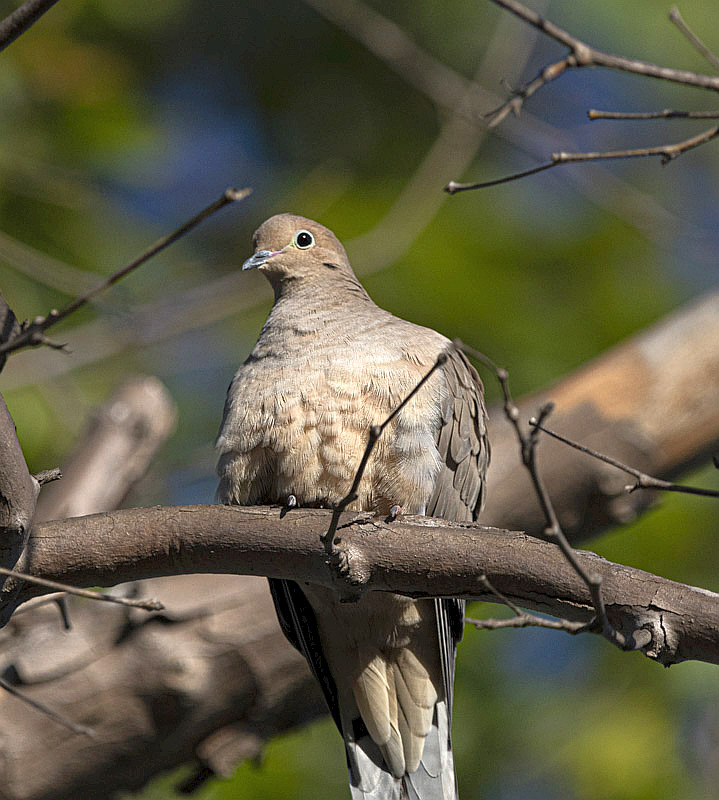
We saw only 15 Mourning Doves. If you want to see a lot more than that, cross under Burbank Blvd. and walk through the fields down to the Los Angeles River. Sometimes there are dozens in a single tree.
Spot the birdie below!

The warblers weren’t really coming through yet, but by the time you read this there are probably many more in the trees and bushes along Haskell Creek. 63 species for a morning of birding not far from two freeways in the middle of the very well-settled San Fernando Valley is a respectable total. Good birding is closer than you think.
| Sepulveda Basin Field Trips | ||||||
| English Name | 3/15/25 | 3/9/24 | 3/11/23 | 3/10/18 | 2/11/17 | 2/13/16 |
| Canada Goose | 35 | 30 | E | X | X | X |
| Egyptian Goose | 2 | A | X | X | X | |
| Muscovy Duck | X | |||||
| Mallard | 20 | 25 | B | X | X | X |
| Hooded Merganser | A | X | X | |||
| Pied-billed Grebe | 12 | 4 | B | X | X | X |
| Feral Pigeon | 8 | D | X | |||
| Eurasian Collared-Dove | 1 | |||||
| Mourning Dove | 15 | 25 | C | X | X | X |
| White-throated Swift | X | |||||
| Anna’s Hummingbird | 6 | 8 | A | X | X | X |
| Rufous Hummingbird | X | |||||
| Allen’s Hummingbird | 10 | 12 | B | X | X | X |
| American Coot | 3 | 10 | D | X | X | X |
| Killdeer | X | |||||
| Gull sp. | 10 | |||||
| Western Gull | X | |||||
| Double-crested Cormorant | 30 | 15 | D | X | X | X |
| Neotropic Cormorant | 4 | 2 | 1 | |||
| American White Pelican | 20 | C | X | X | ||
| Snowy Egret | 2 | 1 | A | X | X | |
| Black-crowned Night-Heron | 4 | 6 | B | X | X | X |
| Green Heron | 2 | 3 | A | X | X | X |
| Great Egret | 1 | 5 | B | X | X | X |
| Great Blue Heron | 2 | 1 | A | X | X | X |
| White-faced Ibis | 1 | |||||
| Turkey Vulture | 10 | 4 | C | X | X | X |
| Osprey | 1 | 2 | A | X | X | X |
| Cooper’s Hawk | 1 | A | X | X | ||
| Red-shouldered Hawk | 1 | A | ||||
| Red-tailed Hawk | 3 | 2 | A | X | X | |
| Great Horned Owl | 1 | X | ||||
| Belted Kingfisher | 1 | 1 | X | X | X | |
| Acorn Woodpecker | H | 3 | A | |||
| Red-breasted Sapsucker | X | |||||
| Downy Woodpecker | 2 | X | X | |||
| Nuttall’s Woodpecker | 2 | A | X | X | X | |
| Northern Flicker | A | X | X | |||
| American Kestrel | 2 | 2 | ||||
| Merlin | 1 | |||||
| Yellow-chevroned Parakeet | H | X | X | |||
| Ash-throated Flycatcher | X | |||||
| Cassin’s Kingbird | 4 | A | X | X | ||
| Western Kingbird | 1 | |||||
| Gray Flycatcher | 2 | |||||
| Black Phoebe | 4 | 8 | A | X | X | X |
| Western Scrub-Jay | 2 | X | X | |||
| American Crow | 10 | 4 | X | X | ||
| Common Raven | B | |||||
| Tree Swallow | 20 | 15 | D | X | ||
| Violet-green Swallow | 3 | A | X | |||
| N. Rough-winged Swallow | 5 | C | X | X | ||
| Barn Swallow | 1 | 3 | ||||
| Cliff Swallow | 6 | B | ||||
| Bushtit | 2 | 8 | C | X | X | |
| Wrentit | 1 | |||||
| Ruby-crowned Kinglet | 4 | A | X | X | ||
| White-breasted Nuthatch | 1 | 1 | A | |||
| Blue-gray Gnatcatcher | 1 | X | X | |||
| Bewick’s Wren | 4 | 2 | X | X | ||
| Northern House Wren | X | |||||
| California Thrasher | X | |||||
| Northern Mockingbird | 1 | 1 | A | X | X | |
| European Starling | 25 | 8 | C | X | X | |
| Western Bluebird | 8 | 9 | B | X | X | X |
| Mountain Bluebird | D | |||||
| Hermit Thrush | X | |||||
| American Robin | A | |||||
| American Pipit | 1 | |||||
| House Finch | 35 | 20 | D | X | X | X |
| Lesser Goldfinch | 20 | 3 | D | X | X | X |
| Lawrence’s Goldfinch | 12 | D | ||||
| American Goldfinch | X | |||||
| Lark Sparrow | X | X | ||||
| Chipping Sparrow | 10 | 4 | B | X | X | |
| Dark-eyed Junco | 2 | X | ||||
| White-crowned Sparrow | 25 | 10 | D | X | X | X |
| Savannah Sparrow | 4 | X | X | |||
| Song Sparrow | 10 | 16 | C | X | X | X |
| California Towhee | 4 | 3 | B | X | X | X |
| Spotted Towhee | 3 | 3 | X | X | X | |
| Western Meadowlark | 6 | A | ||||
| Bullock’s Oriole | 1 | |||||
| Red-winged Blackbird | 20 | 3 | D | X | X | X |
| Brown-headed Cowbird | 30 | 10 | ||||
| Great-tailed Grackle | 2 | 2 | C | X | X | |
| Orange-crowned Warbler | 2 | X | X | |||
| Common Yellowthroat | 6 | 8 | B | X | X | X |
| Yellow-rumped Warbler | 20 | 80 | D | X | X | X |
| Total Species – 88 + 1 taxa | 63 | 48 | 56 | 44 | 51 | 51 |
| X – Seen | ||||||
| H – Heard only | ||||||
| 1, 15 – Number seen | ||||||
Discover more from SANTA MONICA BAY AUDUBON SOCIETY BLOG
Subscribe to get the latest posts sent to your email.



 SANTA MONICA BAY AUDUBON SOCIETY BLOG