Several mysteries from the Kingdom of Whydah
[By Chuck Almdale, all photos by Trish Oster]
Some of you may have seen this LBJ (little brown job, a birder’s term for an as-yet unidentified sparrow-looking bird) here or there around the greater Los Angeles area. Not quite a White-crowned or Golden-crowned Sparrow – two of our more common stripey-headed sparrows – is it?
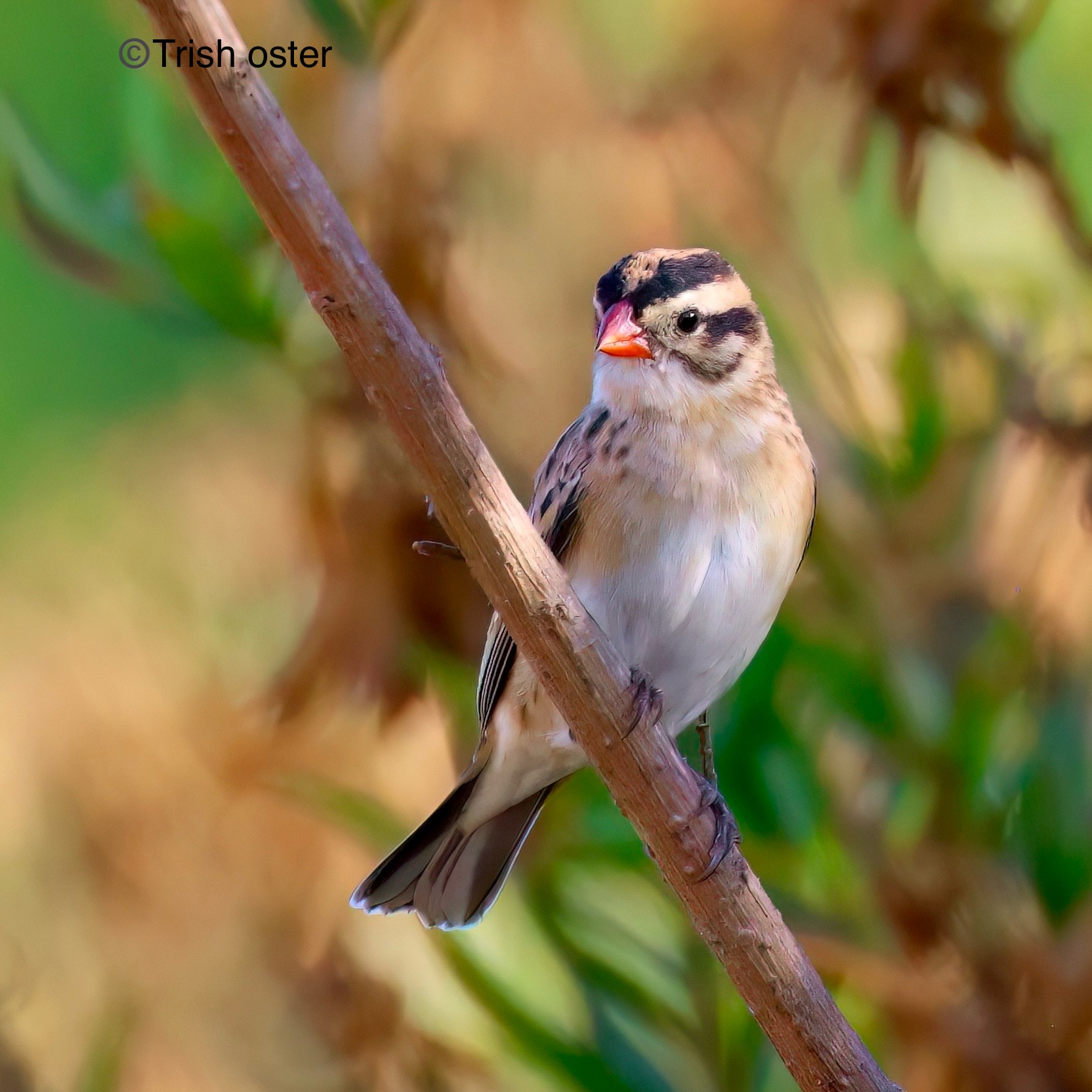
Not the less-common White-throated Sparrow either. Or Chipping, Brewer’s, Lark, Savannah, Grasshopper; no, none of those. How about something from farther afield, say Saltmarsh, LeConte’s or Nelson’s? Hmmm. A little more like it, perhaps, but…still not right. Certainly not Lincoln’s, Song or Swamp. And then there’s that reddish bill. What is this bird?
If nothing else, now you know why these species I listed are collectively called LBJ’s.
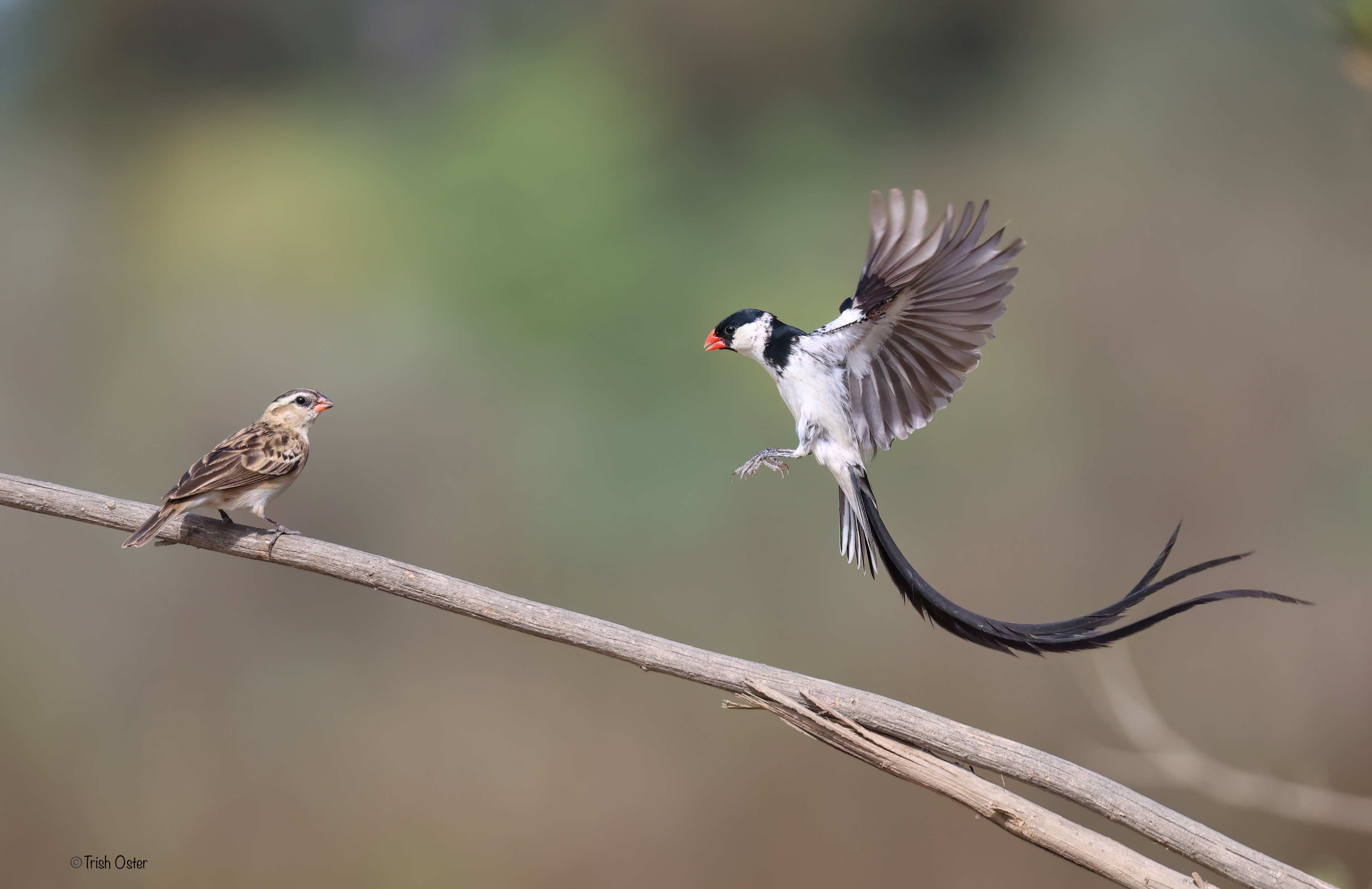
If it were you, all alone in some obscure patch of woodland in Los Angeles County, looking at this bird, there are two things that might help you identify it. The first would be seeing the bird below, trying to get your first bird’s attention, or keeping it company.
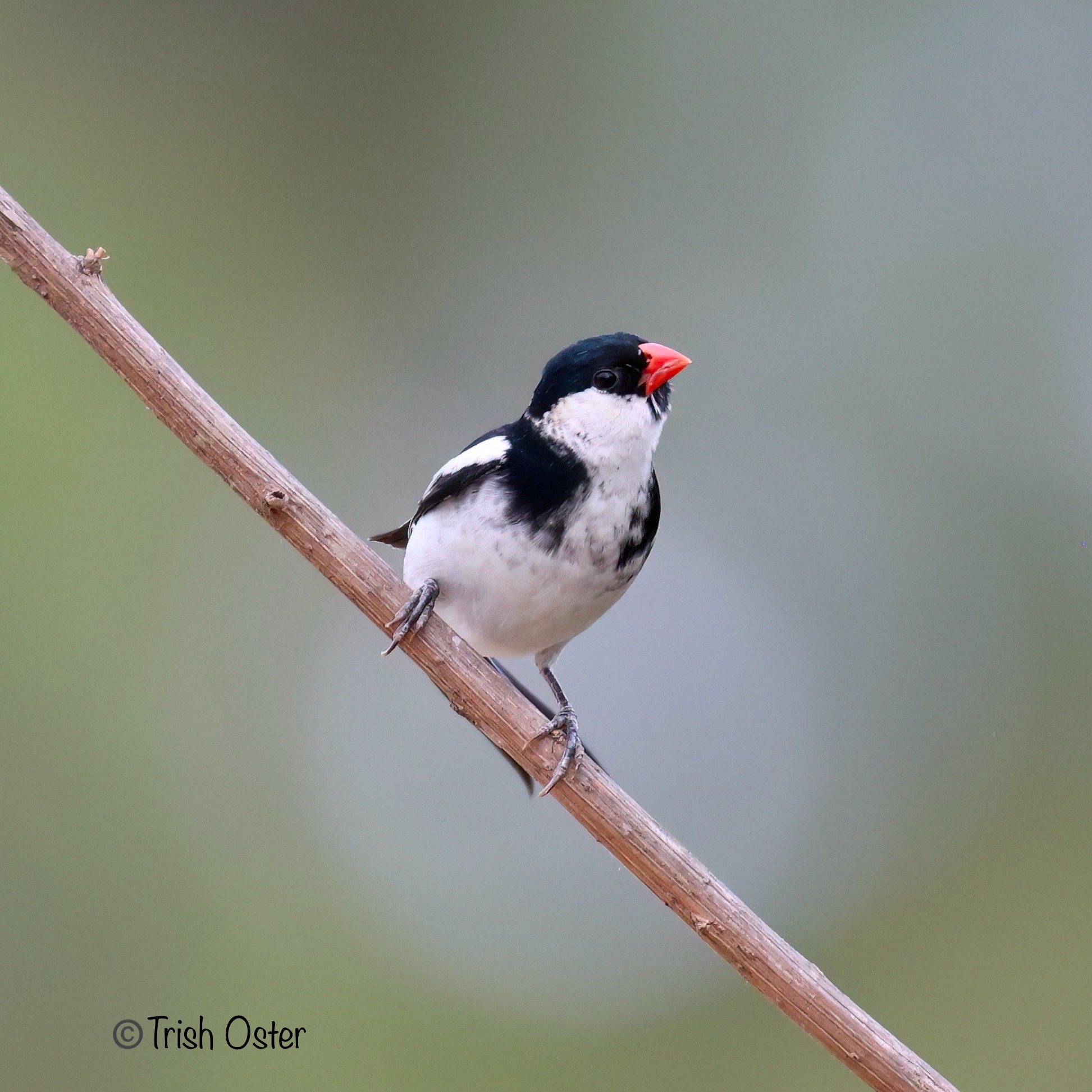
You can go through an entire North American field guide and see very few birds that look like this. Solidly black-and-white? And that relatively enormous and RED bill? The Northern Cardinal is about the only North American bird I can think of off the top of my head that has a big honker of a red bill like that. [Gulls and Tropicbirds need not apply.] But this bird has zero red plumage, so…not a Cardinal.
And then it turns sideways and the tail comes into view.
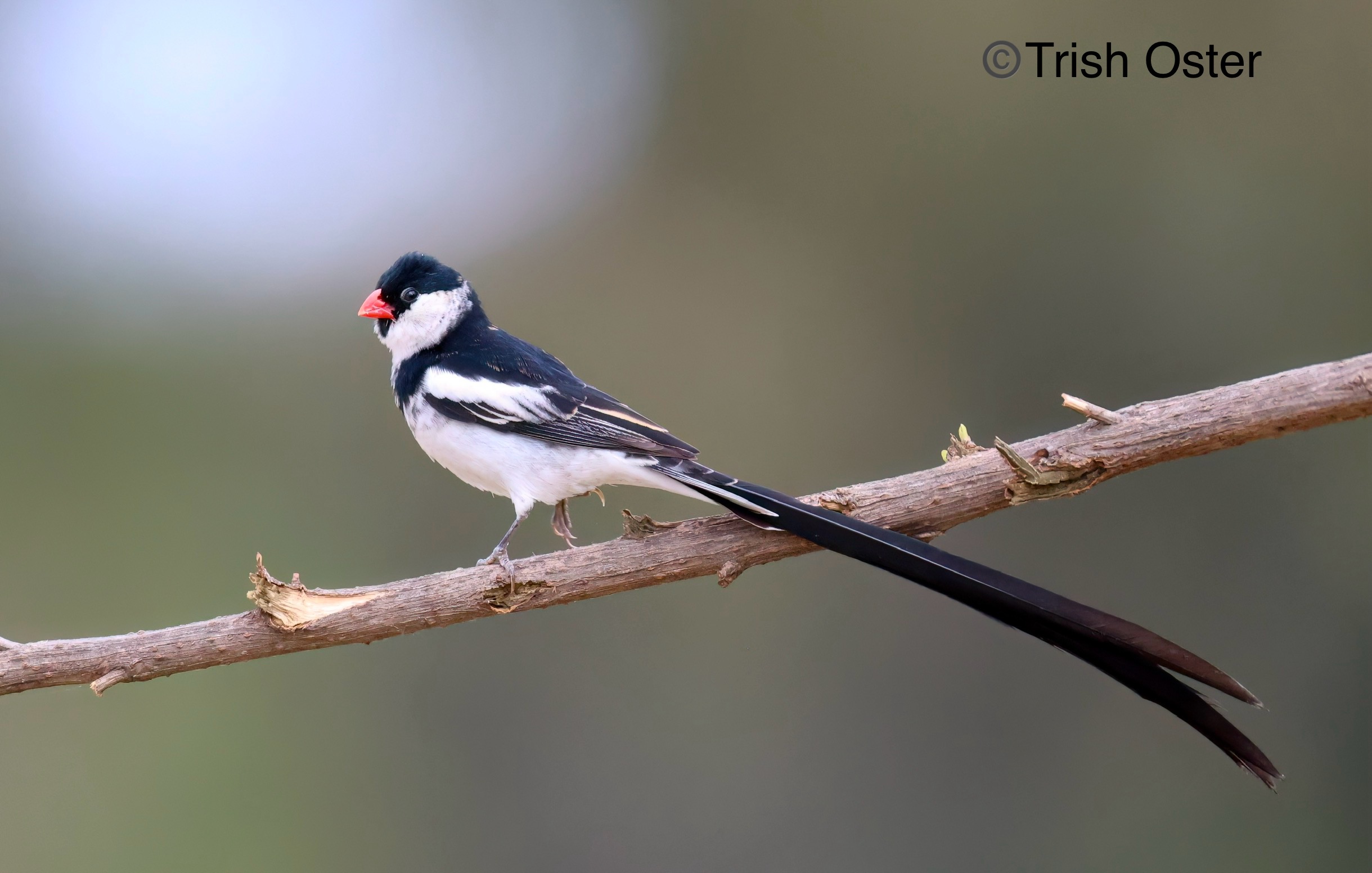
Now that’s just ridiculous. What kind or sparrow or finch has a tail like that, twice as long as the body?
And it’s definitely interested in our stripey-sparrow LBJ, hovering over like that.
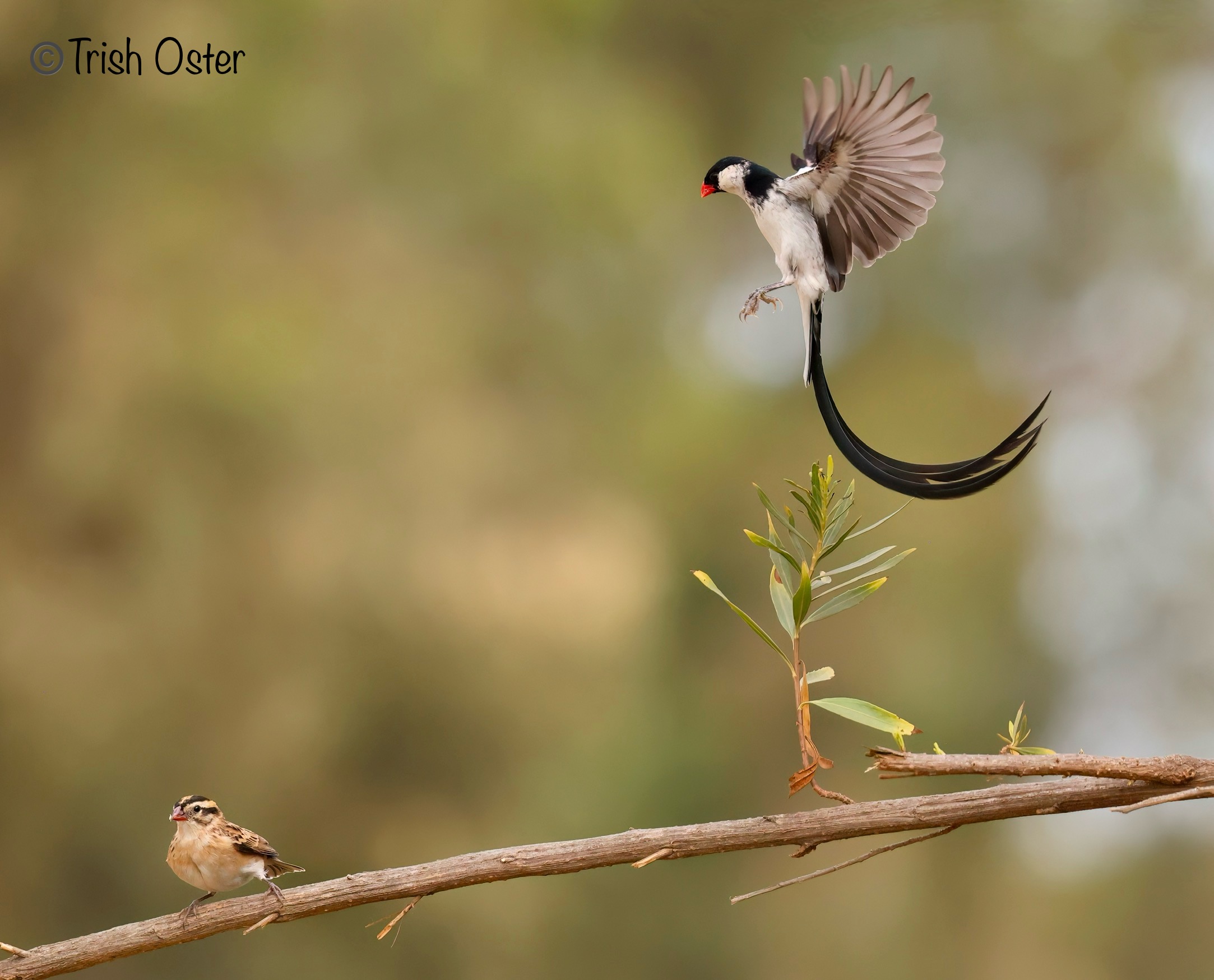
And she – let’s assume now that our LBJ is the female and tail-monster is the male of the species – definitely seems interested as well.
On the very last page of my National Geographic Field Guide to the Birds of North America, 6th Edition (2011), there are two birds that are similar in body and bill shape – but not in plumage – to our Los Angeles pair: Orange Bishop, Euplectes franciscanus, member of the Weaver family Ploceidae, and Nutmeg Mannikin, Lonchura punctulata, an Estrildid Finch in family Estrildidae. Both of these species are widely introduced around the world. Both of these birds also have had name changes or species splits over the past 14 years: the Orange Bishop is now Northern Red Bishop (still E. franciscanus), and the Nutmeg Mannikin is now Scaly-breasted Munia (still L. punctulata). Bishops are native to sub-Saharan Africa; Estrildid Finches are widespread all across the Old World. What’s the chance that our pair are related to one of these two species?

He looks like he’s thinking about that question of relatedness.
Pretty darn good, it turns out.
If you have a field guide to African birds handy (doesn’t everyone?) and you flip through the plates you’ll eventually hit upon the Widowbirds and Whydahs, mostly black-plumaged males with long tails and striped brownish sparrowlike females. It turns out that Widowbirds and Bishops share the same genus Euplectes in the Weaver family Ploceidae, located right next to the Estrildid Finches, and Whydahs are in the Indigobird family Viduidae, also next to the Estrildid Finches but on the other side. So, relatively speaking, Bishops, Widowbirds, Munias, and Whydahs are all fairly close relatives. And, looking at the African field guide, our bird is quite obviously a Pin-tailed Whydah, Vidua macroura. If only figuring these things out were always so easy.
[Note: I mentioned all the above species similarities and ID difficulty because way back in 1995 we at SMBAS went through nearly the exact same problem. We thought our bird at Malibu Lagoon might be what was then the Sharp-tailed Sparrow, not at all locally common and which didn’t seem quite right anyway, but which Kimball Garrett of the Natural History Museum later informed us was the Orange/Red/Northern Red Bishop in it’s sparrow-like non-breeding plumage, which wasn’t in any of our field guides and the internet was next-to-nonexistant at the time. We had the same bird on four occasions between 10/22/95 and 6/23/96, and haven’t seen it there since then.]

Even a Mourning Dove might be a threat.
I mentioned there was another way to figure it out. Take a photo and send it to iNaturalist or eBird and let some algorithm or another human figure it out. But that’s cheating. If Sherlock Holmes had operated that way, who would ever have read and enthused about any of Sir Arthur Conan Doyle’s stories, Doyle would have had to stay in medicine, poking people with small instruments, never to be knighted a ‘Sir,’ and we would never have had three Sherlock Holmes series running concurrently on TV. What a loss!
Here’s the range map for Pin-tailed Whydah in the Old World. Sub-Saharan Africa all the way. Two range maps for introduced Pin-tailed Whydahs in California and Los Angeles County are at bottom.

These are really small birds: the female is 4″ and the male 14″, 10 inches of that is tail. For comparison, our smallest resident sparrow in the west, the Grasshopper Sparrow, is 5″. Anna’s Hummingbird is 4″! If the male Pin-tail is flying, it’s pretty obvious, but a streaky brownish 4″ female sitting quietly in a bush surrounded by leaves, not so much.
Who could resist a display like this?

Their history is interesting and the origin of their name is a bit convoluted.
There once was the Kingdom of Xwéda on the southern coast of West Africa and extending inland from the Bay (or Bight) of Benin. The local residents called themselves and their language Xwéda Gbe. The town of Ouidah on the Xwéda seacoast became a major port for European slave-traders, including the British, who of course Anglicized many local words and names, including Xwéda to Whydah. (Other spellings used were: Hueda, Whidah, Ajuda, Ouidah, Whidaw, Juida, and Juda.) What were originally called Widowbirds (remember them, in the Weaver family?) throughout Sub-Saharan Africa became locally known by the similar sounding word Whydah. Only later were Whydahs determined to be not in the Weaver family but in the closely related family of Indigobirds, Viduidae. And the names for genus Vidua and family Viduidae are also related to Xwéda and Whydah and Ouidah. [An alternate and perhaps more likely explanation for this is that vidua is from Latin for ‘widow,’ in reference to the long black tail vaguely reminiscent of a widow’s long black train (or perhaps veil) worn to express her grief]. The Kingdom of Whydah (Xwéda) was founded in the 17th century, later overthrown in 1727 by the neighboring Kingdom of Dahomy, which itself lasted until 1904. Slave-trading in Ouidah ceased in the 1860’s and the area is now part of the Republic of Benin. [Sourced from Tampa Bay Times, Whole Earth Education, and Wikipedia here, here, and here]
That’s not all. There is also their breeding system.

The following information is from Birds of the World.
In Africa they breed during the rainy season which can occur in any month of the year depending on the location. After courting, the male leads the female to a feeding area with grass seeds where they feed together. Mating, which occurs only 8% of the time and only after feeding, depends largely on the quality of the feeding site, with availability of food and water a major factor.
They do not pair bond. Female visits several neighboring males, and several females visit and copulate with one male; one female mated with two nearby males within period of 3 minutes; as many as 16 females in a season visit an active breeding male, which displays and copulates all day, mean of 0.38 copulations per hour; less successful males may go days without a female visit.
Pin-tailed Whydahs are obligate brood parasites; they do not raise their own young, but – as with our local Brown-headed Cowbirds – lay their eggs in the nests of others. In their native Africa their target species are finches in family Estrildidae, primarily Waxbills in Genus Estrilda, but occasionally Bronze Mannikin (Spermestes cucullata), African Silverbill (Euodice cantans), Yellow-bellied Waxbill (Coccopygia quartinia), Swee Waxbill (Coccopygia melanotis), and Zebra Waxbill (Amandava subflava). After the young fledge they remain in their host family group for more than a week, then later join a Whydah flock. They seem to have no overall effect on the survival of host’s nestlings; in fact the Whydah young have lower survival rate to fledging than do their Waxbill nestmates. Ringed individual Whydahs have lived for at least 5.5 years.
So how are these obligate brood parasites getting on and spreading across Southern California?

Trish passed on to me this final interesting tidbit about their breeding behavior.
In our area and in an interesting urban nature twist, these introduced Whydahs are parasitizing another species of introduced bird. Scaly-breasted Munias from southeast Asia are playing host bird for the Whydahs, whether they like it or not. This novel relationship was documented recently by Pasadena Audubon member and [Los Angeles County Natural History Museum, NHM] volunteer John Garrett, NHM Ornithology Collections Manager Kimball Garrett (no relation), and photographer Jeff Bray.
The Scaly-breasted Munia, Lonchura punctulata, used to be the Nutmeg Mannikin and is the bird I mentioned many paragraphs back because it was in my 14-year-old NGS field guide and clued us where to look for our pair of mystery birds. In the Estrildidae family of 138 species this Munia is evolutionarily located between African Silverbill (Euodice cantans) and Yellow-bellied Waxbill (Coccopygia quartinia), both mentioned above as target parasitization species for the Pin-tailed Whydah in Africa.
So the Pin-tailed Whydahs, wherever they may be, seem to be selectin all their nest hosts from within the same family. And if you see Pin-tailed Whydahs out and about in California, more than likely there are Scaly-breasted Munia nearby, as at Madrona Marsh in Torrance.
The orange areas below are where they are found in Southern California. eBird map

And the same thing for Los Angeles County area. eBird map

Discover more from SANTA MONICA BAY AUDUBON SOCIETY BLOG
Subscribe to get the latest posts sent to your email.



 SANTA MONICA BAY AUDUBON SOCIETY BLOG