When in Bali, hang onto your hat (and your shoes & phone) | BBC World
[Posted by Chuck Almdale]
This story hit the Wall Street Journal a week ago, but that site and nearly every other site I checked that stole it or referenced it had it behind a paywall. Here’s a few that aren’t.
BBC Earth, with narration by none other than David Attenborough.
The U.S. Sun, source of this aerial photo below of the Uluwatu, Bali temple. Watch where you step.

The New Zealand Herald.
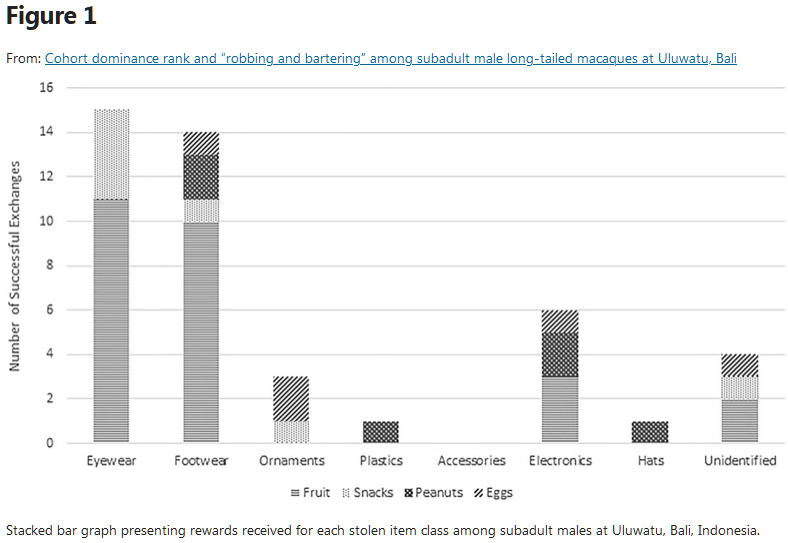
There were a few other sites I found, including TicToc, blahblah, ZzZz, etc., that didn’t add anything significant, just more of the same, but here’s a link to an open access scientific paper in Scientific Reports that discusses it in detail. Graph and abstract below. Look for the final comment.
Cohort dominance rank and “robbing and bartering” among subadult male long-tailed macaques at Uluwatu, Bali. [LINK] Jeffrey V. Peterson, Agustín Fuentes & Nengah Wandia. Scientific Reports, volume 12, Article number: 7971 (2022)
Abstract
Robbing and bartering is a habitual behavior among free-ranging long-tailed macaques (Macaca fascicularis) at a single site in Bali, Indonesia. The behavior consists of three main elements: (1) a macaque takes an item from a human; (2) the macaque maintains possession of the item; then (3) the macaque releases or hands off the item after accepting a food offer from a human. In this paper, we analyze data on individual variation in robbing and bartering among subadult males in relation to dominance rank. Using focal animal sampling we collected 197 observation hours of data on 13 subadult males from two groups (6 from Celagi; 7 from Riting) at the Uluwatu temple site from May 2017 to March 2018, recording 44 exchanges of items for food from 92 total robberies following 176 total attempts. We also measured dominance rank using interaction data from our focal animals. Dominance rank was strongly positively correlated with robbery efficiency in Riting, but not Celagi, meaning that more dominant Riting subadult males exhibited fewer overall robbery attempts per successful robbery. We suggest the observed variation in robbing and bartering practices indicates there are crucial, yet still unexplored, social factors at play for individual robbing and bartering decisions.
Thievery and extortion apparently go a long way back in the primate evolutionary tree. Then again, birds steal food and nesting material from each other all the time, so I guess we can blame our dinosaurian or reptilian ancestors; but then again, fish steal nests and food from each other, not to mention spending much of their time actually eating one other, the ultimate in theft; then again there are tens of thousands of obligate parasites species among the roundworms, tapeworms and flukes, so…I don’t know…don’t trust anybody or anything, I guess. Oh well.
Discover more from SANTA MONICA BAY AUDUBON SOCIETY BLOG
Subscribe to get the latest posts sent to your email.



 SANTA MONICA BAY AUDUBON SOCIETY BLOG