Janthina janthina, the Violet Sea-snail, now (or more like was) coming to a beach near you

[Posted by Chuck Almdale]
I was forwarded a very interesting article by the Los Angeles Times about the “rare purple sea creatures washing up on SoCal beaches”, but as usual the LA Times hid it behind a paywall, so successfully covering everything up with banner that you can’t read the title. If you subscribe but missed it, here’s the link. But there’s more than one way to shell a…shell. [This is kindness-to-cats month.]
So here’s a few links to other articles, videos and whatnots. But first, just a little Wikipedia info about Janthina janthina (this sounds like a song, first recorded in 1928 and a big hit in 1960 for Ray Peterson; even Bob Dylan sang it – uniquely styled, as usual – on his first album in 1963. Can you name it? Googling not allowed.)
Janthina janthina, is a marine gastropod mollusk in Family Epitoniidae, Subclass Caenogastropoda, Class Gastropoda, Phyla Mollusca. The large subclass Caenogastropoda contains about 60% of all gastropods, including: periwinkles, cowries, moon snails, murexes, cone snails, turrids and wentletraps, with the last the probable closest relative to our little violet snails. But these classifications have been shifting lately. Its common names include: violet sea-snail, common violet snail, large violet snail and purple storm snail.

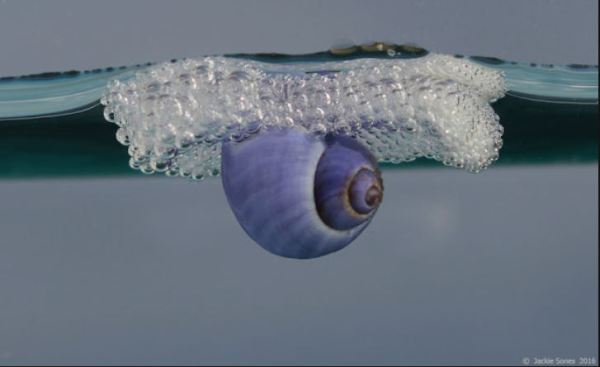
These Violet Sea-snails are pelagic (ocean-going) found worldwide in the warm waters of tropical and temperate seas, especially the Atlantic, Pacific and Indian oceans. They float at the surface, buoyed by trapped bubbles stabilized by their own secretions, feeding primarily upon hydrozoans such as Velella velella – the By-the-wind Sailor – and the Portuguese Man o’ war. They are often found in large groups and sometimes become stranded on beaches when they are blown ashore by strong winds. which is probably what’s happening now, up and down the California coast. The snails are an element of the neustron, organisms living on or near the surface of the water. Their larval form veliger are free-swimming, but adults cannot swim and can create their bubble rafts only at the water’s surface.
Their almost-smooth paper-thin shell is reverse countershaded because of its upside-down position in the water column, lightly purple shaded on the spiral of the shell, darker purple on the ventral side. The animal has a large head on a very flexible neck. The eyes are small, located the base of its tentacles. There is no operculum (door), shell height is up to 1.5″ high, and slightly wider. They begin life as a male, then change to female. Eggs are retained by the female until they develop into the larval form. No news on how they taste and if they are poisonous.
Some varied and interesting links:
The Natural History of Bodega Head – Great additional photos!
Greater Good – Rare Purple Snails Spark Climate Fears on California Shore
Marin Independent Journal has a sometimes-paywalled article, so they’ve been seen up there
Phys Org – Rare purple sea creature found on SoCal beach: Could warming waters be the reason why?
Two Videos:
ZZZZZ
Discover more from SANTA MONICA BAY AUDUBON SOCIETY BLOG
Subscribe to get the latest posts sent to your email.



 SANTA MONICA BAY AUDUBON SOCIETY BLOG