NGS Bird field guide followup
[By Chuck Almdale]
We received our copies of the National Geographic Field Guide to the Birds of the United States and Canada, both books autographed by the author on adhesive paper, one by “Ted Floyd” and the other apparently by “Ted Flogel”, so we know they weren’t printed signatures cranked out by the millions. I like it. It’s very well put together, I’m happy I bought it, and I think it will survive the unwarranted beating I give my hapless field guides. This is a very brief & incomplete comment/description.
Link to prior posting.
Uh…you may have heard rumors that this will be the last printed NGS bird field guide ever. I checked out some online comments to that effect and they were talking about the 7th. ed. being the last by Dunn and Alderfer. That’s true; this one is by Ted Floyd (or Flogel). However, I’d estimate that “most” (an exacting statistical term) of the material and artwork is unchanged.
My only warning. This is a larger book. If your current NGS fits very snugly into whatever you carry it in, you may be SOOL (look it up). This one is 6″ x 9″ x 1″ thick; my NGS 6th ed. is 5 3/8″ x 7 15/16″ x 1 3/8″ thick. Edition #8 is 26.6% larger. I gulped when I saw it, as I really like my book bag and wasn’t at all certain it would fit and then what would I do! [Cue copious tears.] But it fits, so no problemo.
Likes: This is in comparison to my 6th edition. Some of this is due to the larger size allowing for more info. per page.
- Most of it looks the same
- Front-flap quick-find index: 30% more alphabetized names, separated by lines
- Tough plasticized cover
- Colors and details seem slightly brighter and finer; perhaps due to wear on my 6th ed.
- Follows1 the new phylogenetic order
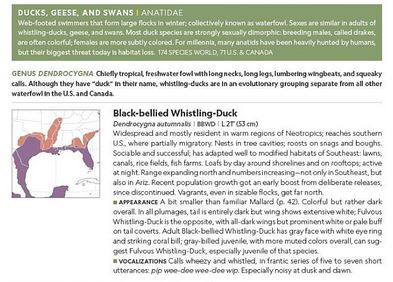
- Each family and genus gets an introduction3; in sparrows and warblers which have many genera with few species, a few genera are grouped
- Allen’s and Rufous Hummingbirds more extensively covered
- Glossary: About 120 terms, including rectrices & remiges
Meh…not-so-much:
- The pages seem slightly more flimsy, perhaps less plasticizer or waterproofing?
- Subspecies range maps at the back disappeared, just gone. Now that hurts.
- Range maps slightly smaller
- Some rarer birds (e.g. Baikal Teal, Key West Quail-Dove) were banished to the rearward 27-page “Rare Bird” collection
- Many small notes2 next to illustrations disappeared, another needless pain
Notes.
1. I didn’t come even close to checking all possible changes, but parrots and falcons are in the right place (between woodpeckers and flycatchers); and these thirteen are now next to each other in sequence as they should be: ducks, chickens, flamingos, grebes, doves, cuckoos, nightjars, swifts, hummers, rails, limpkin, cranes, stilts (yes, you read that right). I did a complete and up-to-that-date phylogenetic checklist last year of all 41 orders and 251 families (link) which you can check. If you didn’t read that posting, you will find surprises.
2. As the pages are larger, it’s not that there wasn’t room for these little comment/notes, and in many (perhaps most) cases they were not replaced by anything, just blank paper. Unless these comments were wrong, they should have remained, fer cryin’ out loud!
3. The page copied (very poorly) below is far clearer in the book, have no fear. Every family and nearly every genus gets a short description, which helps build bridges between the book layout and the recent changes in phylogenetic order. The more birders know about the latter, the better will be their understanding of the evolution of birds and their relationships, which is both fascinating and useful.
Discover more from SANTA MONICA BAY AUDUBON SOCIETY BLOG
Subscribe to get the latest posts sent to your email.



 SANTA MONICA BAY AUDUBON SOCIETY BLOG