The ABCs of California’s Native Bees | Book Suggestion
[posted by Chuck Almdale]
As with most people my knowledge of bees has long been slim and for many decades consisted of: a) they kindly make honey and give much of it to us, b) they unkindly sting us when we try to capture them in jars, and c) Killer Bees were really awful.
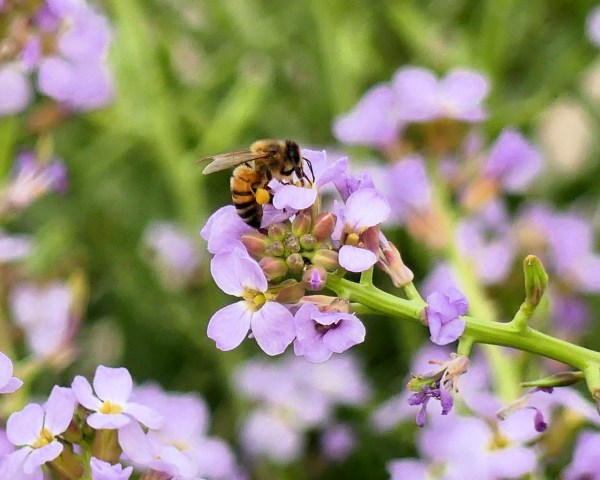
This solid base of knowledge changed when we decided that if we removed our water-guzzling lawn, we could plant drought-tolerant native California plants. When the plants grew and began producing bazoozles of flowers, bees by the thousands (truly!) arrived from somewhere and went to work on them. The terrific thing about these bees was that they paid no attention to us whatsoever! More importantly, they did not sting. Not ever. You could nudge them onto your finger and they’d just walk back onto the flower. Occasionally we’d see some gigantic bees [seemingly] the size of a thumb, but nearly all were small yellow bees, slimmer than a honeybee. I found out that they were solitary bees (maybe many species of them for all I know); they didn’t build group hives, they didn’t amass honey and – primarily for those two factors – have nothing to protect and defend and don’t bother stinging people. What great neighbors! And so far not a single Killer Bee among them. Too bad I still know next-to-nothing about them. But I recently garnered a couple of facts that enlarge the picture.
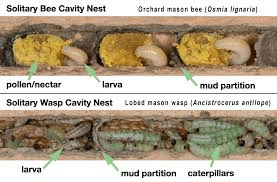
Honeybees are one species out of roughly 20,000 bee species in the world, 4,000 in North America, and 1,640 in California. Most of the rest are some sort of solitary bee, like the ones in our front yard. They also gather pollen and fertilize flowers, but don’t amass buckets of honey for their larvae.
Which brings me to Krystle Hickman. She developed a passion for bees. Lacking a official degree in bee-knowledge, she decided to go look at bees on her own and would drive out to the Mojave desert and suchlike places and look at bees and photograph bees. Sounds a lot like the typical birder in the throes of their passion, except with bees. When she discovered that some of her bee subjects were new to science, she decided she had a knack for this. One thing led to another, and in 2023 National Geographic Society gave her an Explorer Grant to “create a book that features original photographs and documents rare native bees throughout California.” That book is now out in the stores, even at REI, along with their trail maps, camp stoves and tins of foot fungus powder.
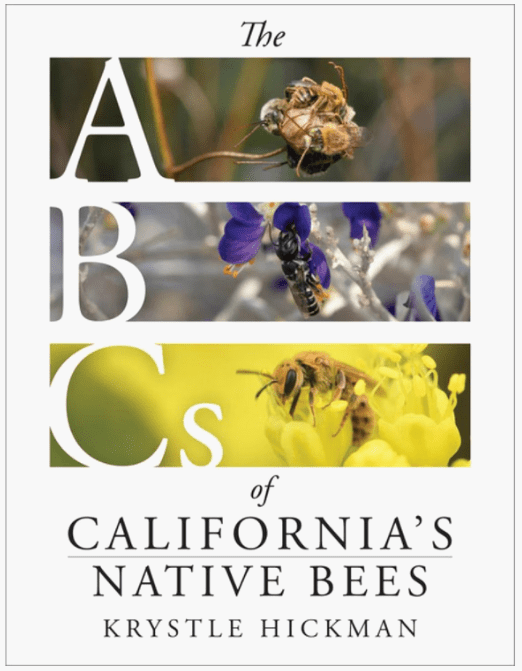
The ABCs of California’s Native Bees is a great introduction to our local world of non-honeybee bees, and introduces us to twenty-six of our California native bees, one for each letter of the alphabet, from Melissodes agilis, the Agile Longhorn Bee, to Calliopsis zonalis, the Zone-tailed Banded Mining-Bee. [I love these names.]
From the publisher’s blurb:
Journey through the world of California native bees, one letter at a time.
National Geographic Explorer Krystle Hickman has spent a decade capturing exquisitely detailed photographs of native bees and making exciting discoveries about their behavior in the field. In her debut book of natural history, she offers an intimate look at the daily habits of rare and overlooked native bees in California: those cloaked in green or black or red, that live alone in the ground or sleep inside flowers, that invade nests and pillage resources like infinitesimal conquerors, or that, unlike more generalist honeybees, are devoted exclusively to the pollen of a single type of flower. A committed conservationist and community scientist who knows all too well how precarious the wellbeing of these insects is, Hickman shares her adventures in local native plant gardens and throughout the far reaches of California to bring the beauty of such diverse ecosystems into wondrous bee’s-eye view. Meant for all curious readers, this collection of bee stories—one for each letter of the alphabet, matching the first letter of a bee’s scientific name—will leave you both wowed and compelled to help save these fascinating beings and the lands they call home.
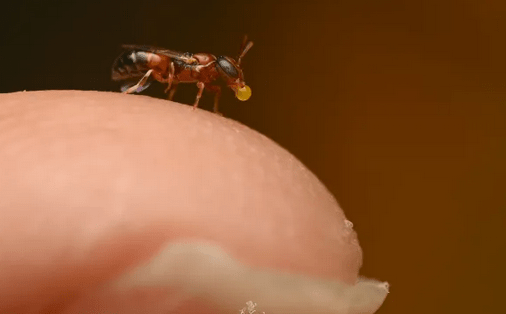
On her website, Beesip.com, Ms. Hickman has a gallery of about thirty of her favorite bees, such as this diminutive female Pachyprosopis purnongensis below.
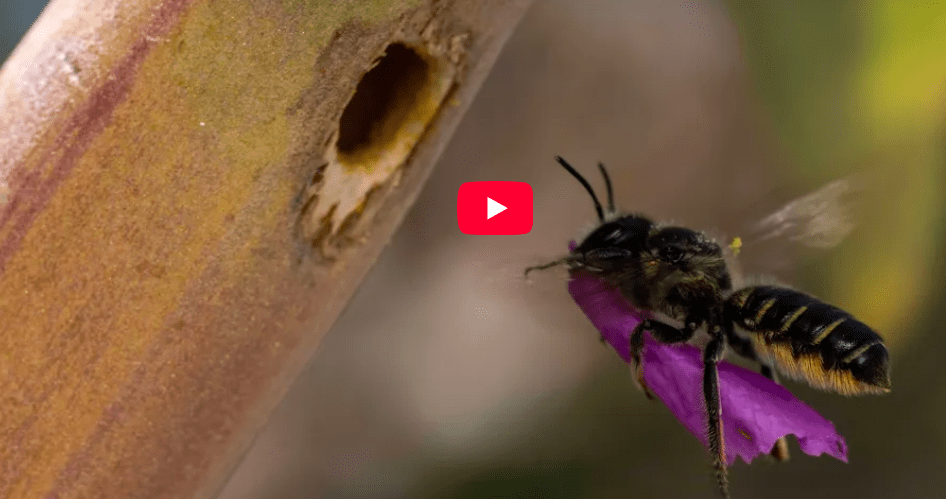
She also has a collection of short films, such as this one of a Megachile montivaga (Silver-tailed Petalcutter Bee) cutting and carrying a snippet of flower petal back to her nest.
There are also podcasts, interviews (Los Angeles Times) and links to articles by her and by others.

So if you thought that honeybees were the bee-all and end-all of bees, check out her website and read her book. If it inspires you to see more and learn more about our California native bees, remember that “Native Plants attract Native Insects.” If you want to put some native plants into your yard, Theodore Payne Foundation (in the central San Fernando Valley) is the place to get them. They probably also have The ABCs of California’s Native Bees for sale. If they don’t, they should get a stack of them. Native bees and native flowering plants go together better than…well, anything else I can think of.
Discover more from SANTA MONICA BAY AUDUBON SOCIETY BLOG
Subscribe to get the latest posts sent to your email.



 SANTA MONICA BAY AUDUBON SOCIETY BLOG