What were the first birds like? | NHM London
[Posted By Chuck Almdale]
The Natural History Museum of London is not merely one of the great natural history museums of the world, they also have a great website with a ton of information. And…they had a major exhibition last year on the evolution of birds, of which the following short article is a great overview.
What were the first birds like?
By Emma Caton
From the article:
Bird-like creatures have been around for more than 150 million years, since the Late Jurassic Period. But what about modern birds? The earliest animal that’s undisputedly considered a bird would be the most recent common ancestor of all living birds. We think this ancestor lived during the Late Cretaceous Period, around 100 to 85 million years ago. Although it may not have looked exactly like any species alive today, it would’ve had the hallmark features of a living bird, such as feathers, the ability to fly, hollow bones and a toothless beak.The earliest uncontroversial modern bird fossil discovered so far is Asteriornis maastrichtensis – more popularly called the wonderchicken. Fossils of the wonderchicken date to 66.7 million years ago, just 700,000 years before the mass extinction that killed off the non-avian dinosaurs. The wonderchicken is thought to have been a small, ground-dwelling bird that could reproduce quickly and fly, which may have helped it to survive the extinction event. “The wonderchicken seems to be the most unambiguous early representative of Neornithes – the group that includes all modern birds – that we’ve found so far,” says Daniel Field, Professor of Paleontology. “As it had the full complement of bird-like features that we see today, we know that all of these features must have evolved by the end of the Cretaceous.”
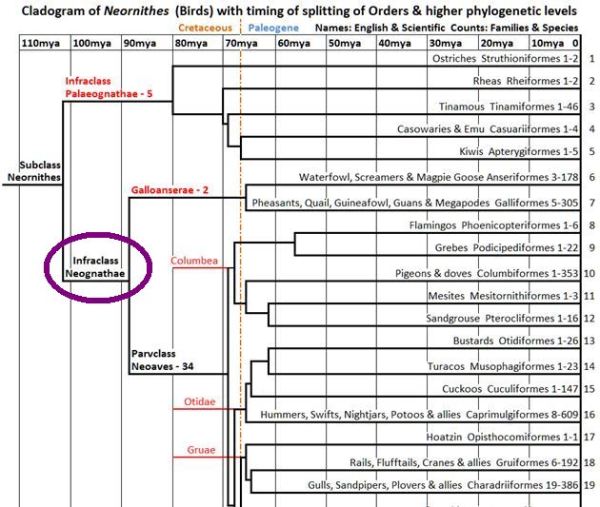
The model pictured below is the “wonderchicken,” the ancestor of all our modern birds except those in the oldest clade Paleognathes (“old jaw”), comprised of ostriches, rheas, tinamous, cassowaries, emu and kiwis. All other extant birds are members of the clade (currently infraclass) Neognathe (“new jaw”). See the partial cladogram farther below, illustrating the relationships.
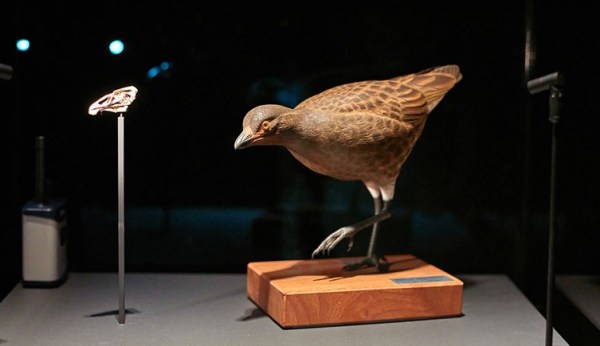
This bird is the ancestral Neognath, Asteriornis maastrichtensis, popularly known as the Wonderchicken. I love our current understanding that the ancestors of all birds were the dinosaurs. The idea that there are small dinosaurs in our back yard, prowling around and looking for seeds and fruit and small insects to eat, chirping and singing in our trees and building nests on the tree limbs and above our windows, delights me immensely.
When I look closely at Wonderchicken, I see elements of many later-appearing orders: certainly ducks and chickens, which were the first to split from the rest of Neognathe, and grebes and doves and sandpipers. Definitely the rails; it could almost pass for a Sora. But also the ground-dwelling species of passerines like the tapaculos and ant-thrushes, even the more-chunky of our sparrows, like the ones in our backyard.
The cladogram below illustrates the first 19 of our currently recognized 41 orders of birds, and the location of the beginning of the Neognathae is circled. The vertical red dashed line represents the extinction event separating the Cretaceous from the Paleogene era, approximately 66 million years ago. The complete cladogram of all 41 orders was presented in a blog I posted in September 2024. If you missed this blog series, it’s a good place to learn more about the evolution and taxonomy of birds.
Discover more from SANTA MONICA BAY AUDUBON SOCIETY BLOG
Subscribe to get the latest posts sent to your email.



 SANTA MONICA BAY AUDUBON SOCIETY BLOG