The Bedside Book of Birds| Book Review
[By Chuck Almdale, suggested by Emily Roth]
The Bedside Book of Birds: An Avian Miscellany
Graeme Gibson, 2005. Nan A. Talese, Doubleday, Random House. Hardbound, 345 pages plus bibliography and image acknowledgements. $10-$40.
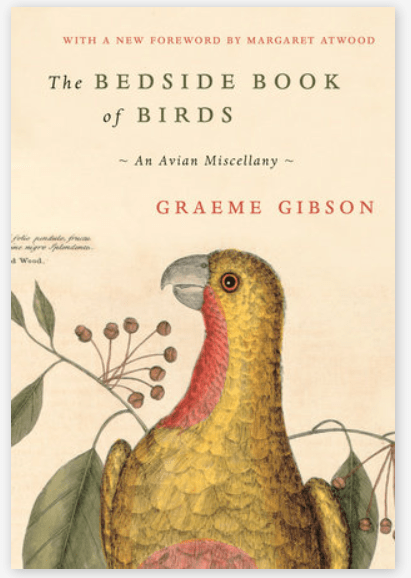
The title is absolutely accurate; this book has many dozens of very short ‘chapters,’ all of them about birds, written by a wide range of people from many different centuries and countries, each comes with an appropriate illustration, sometimes by well-known naturalist-artists, sometimes by unknown artisans. It is designed to be read while lying in bed; this is where I do all my reading, so this was just perfect for me.
If you like birds, if you like reading, if you like reading about birds and looking at a wide variety of illustrations of birds, this book is perfect for you. The Los Angeles Public Library has two copies but there was no waiting list as the book is over 20 years old. Put it on hold and you’ll have it within a few days. If you need more information than that, read on.
The book has nine themes, each of which may have several dozen entries, each entry 1-7 pages long: Birds observed and recorded; How long have we been enchanted by birds?; Folk tales and parables; Bird companions; Sinister auspices; Correspondences and transformations; Bird we use, eat, wear and sell; Avian defense and flying nightmares; Birds and the nostalgic human soul. The author introduces each theme with a 1-4 page comment.
Here’s the blurb from Thriftbooks, which has copies for $9.39.
In this stunning assemblage of words and images, novelist and avid birdwatcher Graeme Gibson offers an extraordinary tribute to the venerable relationship between humans and
birds.
From the Aztec plumed serpent to the Christian dove to Plato’s vision of the human soul growing wings, religion and philosophy use birds to represent our aspirational selves. Winged creatures appear in mythology and folk tales, and in literature by writers as diverse as Ovid, Thoreau, and T. S. Eliot. They’ve been omens, allegories, and guides; they’ve been worshiped, eaten, and feared. Birds figure tellingly in the work of such nature writers as Gilbert White and Peter Matthiessen, and are synonymous with the science of Darwin. Gibson spent years collecting this gorgeously illustrated celebration of centuries of human response to the delights of the feathered tribes. The Bedside Book of Birds is for everyone who is intrigued by the artistic forms that humanity creates to represent its soul.
I’m enclosing selections from three entries that caught my eye; the first is the complete entry, the next two are excerpts.
Floki Released A Raven
Armed with standard sailing directions, and with a comprehensive knowledge of navigational methods, supplemented by a well-developed instinctive skill, Norse navigators stood every chance of making successful passages even over the dark waters of the Western Ocean. These men were not casual venturers upon the sea; they were highly professional and very competent seamen of a kind whose like has now all but vanished from the earth, under the influence of mechanical propulsion and the electronic navigator.
They were also brilliant improvisors. In the Islendingabok we read of the exploit of one Raven-Floki who wished to make a voyage to Iceland but who did not have sailing directions for the voyage. Floki set out to go there anyway, and as navigation aids he carried a number of ravens. Ravens, as Floki evidently knew, are land birds—and nonmigratory. They do not have to make passages across large expanses of open water, and seldom do so voluntarily. When a raven is freed from a ship it will promptly make for the nearest land it can see. From a height of 5000 feet—at which altitude the big black bird is still easily visible from sea level—a raven can probably see land ninety miles away, and high land a great deal farther off.
It is recorded that on the first day out of sight of the Faeroes, Floki released a raven, which circled a few times and then struck off on the vessel’s back track, towards the Faeroes. On the second day another raven circled for a long time high in the pale sky, and finally returned to perch upon the vessel’s mast. But on the next day, the raven climbed to a great height and then flew purposefully off towards the west. Following it with their eyes until it vanished, the Norsemen set their course by that of the bird and in due time raised the coast of Iceland.
Some people deride this account as being apocryphal. There is no reason to think that it is anything of the sort. On the contrary, the use of ravens by the sailor who later came to be called Raven-Floki was no more than what one might have expected from a seafaring people who were very closely attuned to the world in which they lived.
—— From Westviking: The Ancient Norse in Greenland and North America, 1965. Farley Mowat (1921- ), Canada.
Farley Mowat is the author of many books including Never Cry Wolf, later made into a movie.
Using goose grease for the sort of thing described below was before my time, and I never heard of anyone keeping it in the medicine chest. But in the days before antibiotics and vaccines, it would have sounded wonderful. My mother would rub some concoction of petroleum jelly and eucalyptus on my chest. It did help one breathe more easily, but it stuck to anything nearby.
Goose Grease
In most farmhouses some goose grease is kept in the medicine chest and used in many ways. The old-fashioned hot poultice, so useful in relieving an old person’s bronchitis, or easing the “tight chest” of a child, is temporarily out of hospital fashion. Poultices do entail trouble and care, both in application and in easing them away, and substituting warm flannel to guard against chill—but they serve a useful purpose, especially in the country, and many a doctor, long delayed by snow or distance, has arrived to find pneumonia averted, a warmed and soothed child placidly asleep. For any fomentation, goose grease, being water-proof, is rubbed on to the skin beforehand, to prevent the moist heat unduly soaking the skin, and a little is often added to the linseed for the same reason.
Goose grease and fine lard are the only creams permitted in the dairy, both for the dairymaids’ hands and the churn fitments. It is also used, in east winds or snow, to anoint the udders of cows to prevent chapping. It was used by mothers with babies for the same reason, and later when children had colds in the head, noses and lips were rubbed with goose grease, before going out in the cold.
—— From Food in England, 1954; Dorothy Hartley (1892-1985), England
From the author’s introduction to this section.
Some Blessed Hope: Birds and the nostalgic human soul
A great many birdwatchers—from those who simply maintain feeders in their gardens to those, more obsessed, who wander the world in search of new and better birds—have stumbled onto a seductive truth: paying attention to birds, being mindful of them, is being mindful of Life itself. We seldom think of it this clearly, but sometimes, unexpectedly, we are overtaken by a sense of wonder and gratitude. Sure it is the encounter with a force much larger than ourselves that moves us.
Recently I was in the Canadian Arctic. We’d put ashore on the south coast of Hudson Strait and were walking in an expansively beautiful river valley when one of our party spotted a white phase gyrfalcon perched on a boulder high on the opposite hill. These are wonderful birds, fiercely majestic and much coveted by wealthy falconers. As we watched, it launched itself, dashing low over the ancient rocks in pursuit of a passing raven—whereupon the chase was on. Desperately twisting and turning, the raven seemed at each instant about to be caught. Then another raven appeared. This second one was clearly striving to position itself so it could help its companion should the gyrfalcon manage to seize it. As the pursuit went on, with the white bird hard on the black bird’s tail, I sensed something akin to the notion of fateful inevitability that drives classical tragedy. Raven, the Trickster and wolf-bird, is one of my favourite birds and yet the gyrfalcon is equally wondrous; furthermore, it needed to eat the Raven in order to survive. That’s the way things often are. But not this time.
—— Graeme Gibson
Read the book to find out what happens to Raven(s) and Gyrfalcon. I guarantee you cannot correctly guess.
Discover more from SANTA MONICA BAY AUDUBON SOCIETY BLOG
Subscribe to get the latest posts sent to your email.



 SANTA MONICA BAY AUDUBON SOCIETY BLOG