What an Owl Knows | Book Review
[by Chuck Almale]
Review: The Short Version
Excellent book. Read it.
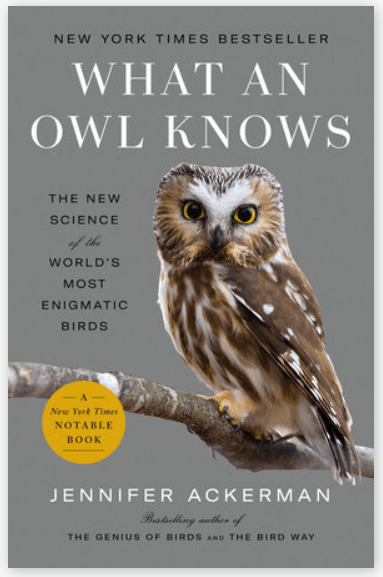
What an Owl Knows: The New Science of the World’s Most Enigmatic Birds, by Jennifer Ackerman, New York: Penguin Press (Penguin Random House), 2003. Hardcover, $30, paperback $19. 293 pages, plus preface, acknowledgements; further reading (aka references) 13 pages, illustration credits 4 pages, index 15 pages. ISBN 978-0-593-29888-6
Review: The Long Version
My assumption is that everyone likes owls. I also assume – based upon myself both before and after becoming a birder – that most people know very little about them, and some, maybe all, of what they think they know is wrong or at best, incomplete.
I like owls and I’ve never met a birder that a) does not like owls, b) does not enjoy hearing (but vastly prefers seeing) owls, and c) has seen very many owls. It’s really hard to locate owls and see owls; it amounts to a specialty within birding as well as a specialty within ornithology. And obviously this is because most owls are active only at night. Looking for owls in the dead of night is not just hard, but dangerous, particularly in an area you’re not familiar with such as mountain forest or tropical rainforest, the latter filled with things you don’t want to step on or bump into. And owls blend in with their surroundings really really well. Most of them most of the time look like tree bark or a knot in a branch. Even worse, they can see and hear you as you crash around through the bushes and trees far sooner and better than you can them.
Using myself as an example of one who has birded for decades, here are some sample numbers showing how it goes in regards to owls.
I have seen: 50% of the world’s roughly 11,000 species; 94% of the world’s 251 bird families; 82% of 174 species of ducks, geese & swans; 70% of 46 trogons; 55% of 241 antbirds; 35% of 156 bulbuls; 29% of 250 owls & barn-owls. The relative paucity of owls seen despite their ubiquity and diversity is probably representative of most birders everywhere.
If you want to know more than you thought possible to know about owls and gain new respect for and appreciation of both owls and the people dedicated to this research, read this book. It is excellently written: the writer did her homework, her traveling, her study, and she writes with enviable facility and style. She has also written many other very well-received books such as The Bird Way, Birds by the Shore, and The Genius of Birds, the last of which was a New York Times bestseller.
The Publisher’s blurb
A New York Times Notable Book of 2023.
Named a Best Book of 2023 by Publishers Weekly.
From the author of The Genius of Birds and The Bird Way, a brilliant scientific investigation into owls—the most elusive of birds—and why they exert such a hold on human imagination
With their forward gaze and quiet flight, owls are often a symbol of wisdom, knowledge, and foresight. But what does an owl really know? And what do we really know about owls? Some two hundred sixty species of owls exist today, and they reside on every continent except Antarctica, but they are far more difficult to find and study than other birds because they are cryptic, camouflaged, and mostly active at night. Though human fascination with owls goes back centuries, scientists have only recently begun to understand the complex nature of these extraordinary birds.
In What an Owl Knows, Jennifer Ackerman joins scientists in the field and explores how researchers are using modern technology and tools to learn how owls communicate, hunt, court, mate, raise their young, and move about from season to season. Ackerman brings this research alive with her own personal field observations; the result is an awe-inspiring exploration of owls across the globe and through human history, and a spellbinding account of the world’s most enigmatic group of birds.
Six excerpts:
Owls exist on every continent except Antarctica and in every form in the human imagination. Yet for all this ubiquity and interest, scientists have only lately begun to puzzle out the birds in deep detail. Owls are much more difficult to find and study than other birds. They are cryptic and camouflaged, secretive and active at a time when access to field sites is challenging. But lately researchers have harnessed an array of powerful strategies and tools to study them and unpack their mysteries. — pp. x-xi
They are indeed camouflaged and shy. And sometimes uncharacteristically quiet, too. In their efforts over the years to get accurate counts of Northern Spotted Owls, Hartman’s team ran into a glitch with the usual vocalization survey method. Barred Owls had invaded the home range of the spotted owls, and the presence of the aggressive invaders suppressed the smaller owls’ own hooting. If the spotted owls did vocalize, the Barred Owls would attack them, sometimes with lethal force. So the smaller birds started to go silent, and the traditional method of hooting to find Northern Spotted Owls stopped working. “The land managers were like, ‘Oh, we can’t hear them anymore, so there are no longer spotted owls here,” says [Jennifer] Hartman. “But we knew better. I had been surveying using the standard method, driving all night to specific call points, playing recorded calls from ridgetops. Often, I heard nothing at all. But I’d look down at the forest below and I knew there were owls, in there, being quiet. We just needed a different way of finding them.
The team decided to try a new owl-spotting technique, this one nose based. Enter Max, a “detective dog.” Hartman trained the blue healer mix to use his 250 million olfactory cells (more than twenty times the number we possess) for the highly specialized task of detecting the pellets owls eject at roosting spots. — pp. 48-49
The drone is also useful for checking nests. The [Blakiston’s] Fish Owl nests in the holes at the tops of broken trees, and they tend to use the same tree again and again, says Rada [Surmach]. But checking to see whether a nest is occupied is challenging. “We can take a huge stick and bang it on the tree and hope a nesting bird will flush. But if she’s sitting on eggs, she won’t move. The alternative is climbing up to the nest, which is often thirty feet up or higher.”
A drone eliminates this laborious and dangerous work. “It’s just vwoop, and it’s up there. You can check the nest remotely, and if there’s nothing, you can just move on.” It also eliminates the problem of leaving a scent trail to the nest that a mammalian predator like a bear could follow. — p. 56.
One bird does not a study make. In the following days, [Burrowing Owl expert David] Johnson shifts his strategy. He has recorded the [Burrowing Owl’s] territorial calls and listened closely to them. It’s clear they sound nothing like the calls of the owls in the Pacific Northwest. The Oregonian owls have a monotone two-note call, coo-coo. Here in Maringá [southeastern Brazil], the calls have quick up-and-down rhythms, more like coo-keeia, and more time between vocalizations.
If the calls are different enough, the males here may not recognize them, says Johnson. “The territorial call on the MP3 player “probably just sounds like some strange thing in their burrows. They recognize it as a bird, yes, but maybe a sparrow or some other species.” In other words, the Burrowing Owls here don’t speak the same language as their relatives in western Oregon. “Their last conversation was maybe four million years ago between their last common ancestors. That’s just a guess. But the amazing part is that we’re getting to witness this. If it plays out in the analysis, we’ll know how separate these owls are from their North American cousins in space, time, and evolution.” — pp. 74-75
In this [post-nestling brancher] stage, owl parents sometimes feed owlets to the point of groggy satiation, and chicks may eat until they fall into a deep sleep, sometimes lying on their stomachs crosswise over a branch, like a sloth. Like human babies, baby owls sleep a lot, and they spend more time than adults in rapid eye movement (REM) sleep, the type of sleep associated with vivid dreams. In 2022, scientists found that REM sleep in in mice involves a kind of cognitive processing that might help to shape behavior when the mice are awake, such as avoiding owls and other birds of prey. Its presence in baby owls may likewise have to do with thoughts that occur during dreams—reenactments or reinforcements of skills. The owls at the International Owl Center [Houston, Minn.] vocalize in their sleep, says Karla Bloem, chicks and adults alike. “It’s pretty hilarious when they wake themselves up.” — p. 160
“All these thoughts were going through my head while I had this [Elf Owl] in my hand, and I wanted to know, What are you thinking? I felt like I partially knew. She was so tiny and fragile, and we are so big (but also fragile, at least emotionally),” she [conservation biologist and photographer Day Scott] says with a laugh. “I was looking at her and feeling like we had some kind of connection, because I was trying to care for her in the best way I possibly could. And whatever the importance of life was, right then it came down to this one owl I was holding in my hand.” — p. 293
Discover more from SANTA MONICA BAY AUDUBON SOCIETY BLOG
Subscribe to get the latest posts sent to your email.



 SANTA MONICA BAY AUDUBON SOCIETY BLOG