Free email delivery
Please sign up for email delivery in the subscription area to the right.
No salesman will call, at least not from us. Maybe from someone else.
Webinar on Ballona Wetlands & Coastal Conservation | UCLA Ursus Environmental Symposium – 13 April 2021
[Posted by Chuck Almdale — Submitted by Larry Loeher]
| Glen MacDonald FRSC UCLA Endowed Chair in Geography of California and the American West Director, UC White Mountain Research Center Chair, UCLA Canadian Studies Program invites you to attend Ursus Environmental Symposium Ballona Wetlands and the Future of Southern California Coastal Conservation a panel discussion featuring Richard Ambrose Professor, UCLA Department of Environmental Health Sciences and Institute of the Environment and Sustainability David Jacobs Professor, UCLA Department of Ecology and Evolutionary Biology Shelley Luce President and Chief Executive Officer, Heal the Bay David McNeill Executive Officer, Baldwin Hills Conservancy  Tuesday, April 13, 2021 12:00 p.m. – 1:15 p.m. PDT Live streaming via Zoom Webinar Registration Please submit your questions in advance of the webinar via email to: hnadworny@support.ucla.edu (by Monday, April 12th at 12:00 p.m. PDT) Instructions to join the webinar will be provided once your registration has been confirmed. About the discussion: With almost all of Southern California’s coastal wetlands degraded or destroyed by development, and a need to provide the public with more opportunities to enjoy nature, the proposed restoration of Los Angeles’ Ballona Wetlands would appear to be a goal laudable to conservationists, and a potential model for similar efforts elsewhere in the State. However, scientific debates and sharp policy differences have arisen regarding the future course for the Ballona Wetlands. This Ursus Symposium will bring together top UCLA scientists with key figures involved in the Ballona Wetlands Restoration Project to offer their perspectives in a dialogue on this important issue and and wider implications. UCLA College 1309 Murphy Hall, PO Box 951413 Los Angeles, CA 90095-1413 |
Recycling Reimagined | Science News
[Posted by Chuck Almdale]
On January 18, 2021 we posted Plastics and other annoying ‘recyclables’ which drew from a May 2020 Discover Magazine article. Consider this — drawn from a Science News article — a companion piece. Recycling plastics is less efficient, less wonderful, than we think, than we hoped it would be.
Chemists are reimagining recycling to keep plastics out of landfills
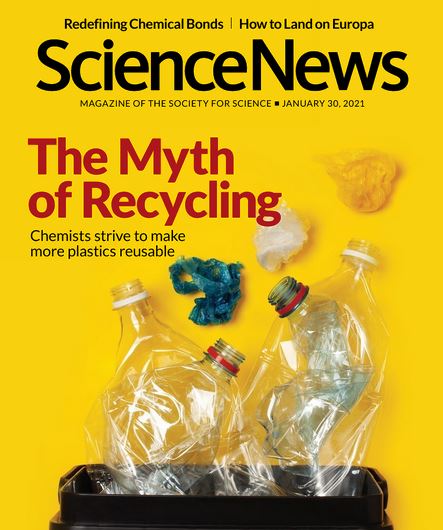
Too much of today’s plastic is impossible to recycle
ScienceNews.org | Maria Temming | 27 January 2021
It feels good to recycle. There’s a certain sense of accomplishment that comes from dutifully sorting soda bottles, plastic bags and yogurt cups from the rest of the garbage. The more plastic you put in that blue bin, the more you’re keeping out of landfills and the oceans, right?
Wrong. No matter how meticulous you are in cleaning and separating your plastics, most end up in the trash heap anyway.
Take flexible food packages. Those films contain several layers of different plastics. Because each plastic has to be recycled separately, those films are not recyclable. Grocery bags and shrink wrap are too flimsy, prone to getting tangled up with other materials on a conveyor belt. The polypropylene in yogurt cups and other items doesn’t usually get recycled either; recycling a hodgepodge of polypropylene produces a dark, smelly plastic that few manufacturers will use.
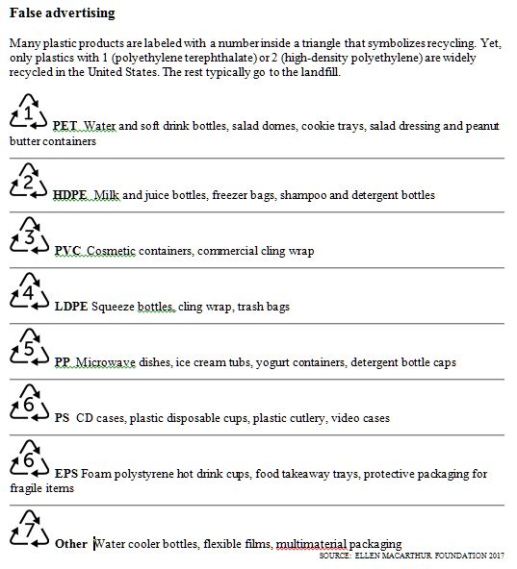
Only two kinds of plastic are commonly recycled in the United States: the kind in plastic soda bottles, polyethylene terephthalate, or PET; and the plastic found in milk jugs and detergent containers — high-density polyethylene, or HDPE. Together, those plastics make up only about a quarter of the world’s plastic trash, researchers reported in 2017 in Science Advances. And when those plastics are recycled, they aren’t good for much. Melting plastic down to recycle changes its consistency, so PET from bottles has to be mixed with brand-new plastic to make a sturdy final product. Recycling a mix of multicolored HDPE pieces creates a dark plastic good only for making products like park benches and waste bins, in which properties like color don’t matter much. More….
Headless sea slugs, or bodiless sea slug heads, take your pick | CellPress & N.Y. Times
[Posted by Chuck Almdale]
People sent me four links to this slugfest. I’ll pass on two of them.
Meet the Sea Slugs That Chop Off Their Heads and Grow New Bodies
Their severed heads get around just fine until they regenerate perfectly functioning, parasite-free new bodies, scientists say.
New York Times | Annie Roth | 8 March 2021
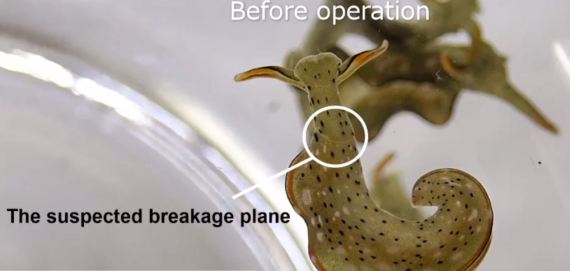
A few years ago, Sayaka Mitoh, a Ph.D. candidate at Nara Women’s University in Japan, was perusing her lab’s vast collection of sea slugs when she stumbled upon a gruesome sight. One of the lab’s captive-raised sea slugs, an Elysia marginata, had somehow been decapitated.
When Ms. Mitoh peered into its tank to get a better look, she noticed something even more shocking: The severed head of the creature was moving around the tank, munching algae as if there was nothing unusual about being a bodiless slug. More…
Now if you really want the details, here’s the original article published in Cell Press: Current Biology. This includes more photographs and a 2:46 minute film of the day-by-day progression of the process of losing one’s head…that is, losing one’s body.
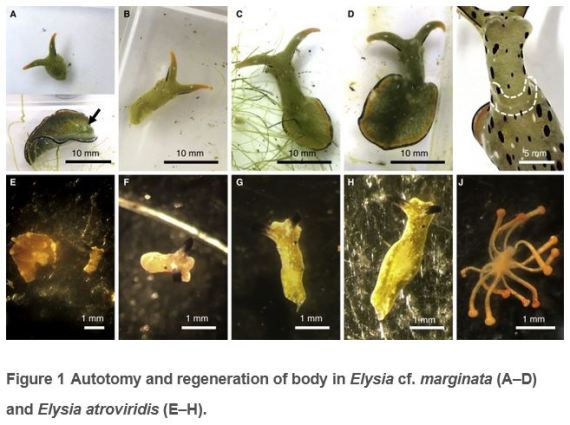
Extreme autotomy and whole-body regeneration in photosynthetic sea slugs
Current Biology | Sayaka Mitoh & Yoichi Yusa | 14 January 2021
Summary of Paper
Autotomy, the voluntary shedding of a body part, is common to distantly-related animals such as arthropods, gastropods, asteroids, amphibians, and lizards. Autotomy is generally followed by regeneration of shed terminal body parts, such as appendages or tails. Here, we identify a new type of extreme autotomy in two species of sacoglossan sea slug (Mollusca: Gastropoda). Surprisingly, they shed the main body, including the whole heart, and regenerated a new body. In contrast, the shed body did not regenerate the head. These sacoglossans can incorporate chloroplasts from algal food into their cells to utilise for photosynthesis (kleptoplasty), and we propose that this unique characteristic may facilitate survival after autotomy and subsequent regeneration.
Theodore Payne Poppy Hour, March 18 | Noriko Smallwood
[Posted by Chuck Almdale]
A message from our friends at Theodore Payne.

MARCH POPPY HOUR

| Poppy Hour: A Conversation with Noriko Smallwood Thursday, March 18, 5:30 PM -7:00 PM Free event via Zoom or YouTube Los Angeles is known worldwide as a sprawling city with palm tree lined streets and stunning sunsets. While those things are true, we are also home to an incredible variety of wildlife. Urban sprawl is changing the natural landscape, but is there hope? Noriko Smallwood has some answers for us. There will be a Q&A session. About Noriko Noriko is currently a Master’s student in Dr. Eric Wood’s lab at Cal State Los Angeles where she is studying the influence of native plants on wildlife in southern California residential yards. In particular, her research focuses on the interactions between birds and native plants, and the drivers behind those patterns. Though her research is ongoing, she has found that native yards host significantly more birds and bird species than traditional, lawned yards. Noriko is passionate about conserving the environment and enjoys learning how native landscaping can improve habitat for wildlife in urban environments. Website: The Wood Lab: www.ericmwood.org/noriko-smallwood Instagram: @noriko_in_nature Poppy Hour is our California native plant internet mashup. Part interviews, part garden tour, part happy hour, we explore the amazing diversity of people and ideas that connect to Southern California plants and landscapes. Join us! All previous episodes are archived on our YouTube channel. Thank you to an anonymous donor for making Poppy Hour Season 2 possible. Poppy Days Spring Sale March 25-27, 8:30 AM- 4:30 PM Create an at-home superbloom! We’ll have a great selection of colorful annuals and other beautiful spring wildflowers. Members receive a 15% discount and nonmembers receive a 10% discount on all plants, seeds, bulbs, and TPF gear. Click here to sign up for a Poppy Day Spring Sale shopping slot. |

Theodore Payne: Annual Garden Tours
[Posted by Chuck Almdale]
Springtime swiftly approaches. Some of our local birds seem to think it’s already here (I’m looking at you, mockingbirds). Perhaps it’s time to spruce up your native plant garden or plant a new bush or two to replace those beaten into submission by our recent hail storms. What? You don’t have any native plants? As Native Plant Representative to the SMBAS board Margaret Huffman always (yes, always) said:
Native plants attract native insects which attract native birds.

| 18th Annual Theodore Payne Native Plant Garden Tour Join us for an interactive at-home experience of California native plant gardens and landscapes through the seasons. Expanding from spring to an entire year of transformation, TPF’s 18th Annual Garden Tour will take you on an adventure through a select group of gardens with HD video and 360-degree views. Together, we’ll become immersed in the urban ecosystem and the native plant community which makes it thrive. Join us for stunning garden footage, landscape designer and homeowner interviews, expert panel discussions, live music, photo contests, native plant beer tasting, and a keynote address from Doug Tallamy, author of Bringing Nature Home. The 18th annual Theodore Payne Native Plant Garden Tour takes place from Friday, April 16th through Sunday, April 18th. The event will take place over Zoom. Friday, April 16, 6-9pm Panel Discussion — A Vision for Los Angeles Landscapes. Happy Hour — featuring a live tasting of Local Source (native plant beer created by Eagle Rock Brewery in collaboration with Theodore Payne Foundation) and live music from Daniel Riera. Saturday, April 17, 10am-2pm Live narrated Garden footage (spring and winter), featuring private and public gardens. Roundtable — Designing for the environment. Sunday, April 18, 10am-2pm Roundtable — Plant care through the seasons. Live narrated Garden footage (spring and winter), featuring private and public gardens. Keynote Address — Doug Tallamy, author of Bringing Nature Home. Tickets are available at https://www.nativeplantgardentour.org/ along with detailed information about the tour, and associated offerings. Images available on request. GET TICKETS  Be a part of the tour! We want to see your visions of nature in California. From March 1st – April 9th, share your favorite photos of California native plants and enter to win our 2021 Spring Photo Contest. PRIZES: A $100 gift certificate will be awarded to the winner of each of the following categories: SPRING VIBES: Photo that evokes the season of spring HABITAT: Photo that captures the interactions between plants, people, winged or legged creatures PLANTS IN POTS: Photo of a thriving container garden HOW TO ENTER: To submit a photo, use hashtags #NativePlantGardenTour and #TPFSpring21 on Instagram or Facebook or email photos to gardentour@theodorepayne.org with subject: Garden Tour Photo Contest. DEADLINE: The contest is open from March 1st through April 9th. The deadline for submissions is Friday, April 9th at 11:59 pm PST. Winning photographs will be announced and featured LIVE during the 2021 Native Plant Garden Tour. Good Luck! THANKS TO OUR GENEROUS SPONSORS  |



 SANTA MONICA BAY AUDUBON SOCIETY BLOG