Free email delivery
Please sign up for email delivery in the subscription area to the right.
No salesman will call, at least not from us. Maybe from someone else.
Octopus in a cup | Lembeh Video
[Posted by Chuck Almdale]
I have a special affection for octopuses, dating back to my SCUBA days and encounters with them down at White’s Point, south of San Pedro on the Palos Verdes Peninsula. They are curious little creatures, quite beautiful in their native habitats where they change colors and patterns in a fraction of a second. Their “brain” has about 500 million neurons – as many neurons as your family dog. About two thirds are located in its arms, and the rest is wrapped around the esophagus in the head. They can get prey out of glass bottles by uncorking them or from glass jars by unscrewing – or even pulling off – the lids. They can also escape from aquariums and walk hundreds of yards of dry land to get back to the sea. It greatly pains me to see people catch them to cut them up for fish bait.
From Pall Sigurdsson:
We spent a whole dive and most of our air saving this octopus from what was bound to be a cruel fate.
The coconut octopus, also known as veined octopus, is born with the instinct to protect itself by creating a mobile home out of coconut or clam shells. This particular individual however has been trapped by their instincts and have made a home out of a plastic cup they found underwater.
While a shell is a sturdy protection, a passing eel or flounder would probably swallow the cup with the octopus in it, most likely also killing the predator or weakening it to a point where it will be soon eaten by an even bigger fish.
We found this particular octopus at about 20 meters under the water, we tried for a long time to give it shells hoping that it would trade the shell. Coconut octopus are famous for being very picky about which shells they keep so we had to try with many different shells before it found one to be acceptable. Filmed in: – Lembeh, Indonesia – December 2018
This Lembeh YouTube page has many more films of octopuses, fish, nudibranchs and much more. Check it out!
Now watch this PMS Nature video of a Coconut (or Veined) Octopus with a shelter of real coconut shells.
Gentoo Penguins: one species or four?
[Chuck Almdale | 19 December 2020]
You can’t take for granted that the “popular press” is telling you all the facts, or analyzing them correctly, or not analyzing them at all and just quoting other sources. I’m not implying that they lie and that it’s absolutely true that lizardmen from Betelgeuse 5 really are running the show here; that’s jumping off the deep end. Just that they’re not being as exacting and knowledgeable you might wish them to be. Here’s an example.
There was a recently published story on how the Gentoo Penguin, currently considered to be a single species with various colonies on Antarctica and the near-Antarctic island groups, might actually be four species as there seems to be no interbreeding between colonies and there are size differences and genetic differences between colonies. That sounds reasonable: not way out of line.
Here’s a link to the paper itself, published in Ecology and Evolution: Morphometric and genetic evidence for four species of gentoo penguin.
Here’s a typical story on this from the Daily Mail of England. It was very similar to five other write-ups I looked at. They were, if you want to compare them for yourself: BBC News, Discover Wildlife, Science Alert, Bird Watching Daily, and Science Daily.
Gentoo penguins should be split into FOUR species because populations have evolved differently to adapt to their various habitats, scientists claim.
Dailymail.co.uk | Ryan Morrison | 3 November 2020
- Experts studied the genome of Gentoo penguin populations around the world
- The bird colonies have been separated for hundreds of thousands of years
- Researchers say they haven’t interbred and have developed differences
- While the changes aren’t obvious they include things like longer skeletons or altered beaks invisible to the untrained eye but enough to distinguish them
Now compare it to this write-up by my favorite science blogger, Jerry Coyne, Biology Professor Emeritus of University of Chicago, expert on evolution and best selling author. He digs into the details, and lets you know that things aren’t as straightforward as they might seem at first glance. There are tremendous differences in the two write-ups, but I won’t spoil it for you. Read it for yourself. Click the link below.
From variolation to a shot in the arm; vaccines have a long and complicated history | KCRW – Life Examined
[Posted by Chuck Almdale | 12 December 2020]
I’m making an exception to my recent “rule” about not posting non-Audubon items on this blog. This radio discussion of plagues, viruses, variolation, vaccines and COVID-19 is exceptionally interesting and timely, and I think all our readers ought to be aware of it. I’ve already reserved Kinch’s book at the Los Angeles Public Library (7 available copies, plus eBook and CD formats).
Santa Monica’s public radio station KCRW has a Sunday Morning show called Life Explained, hosted by Jonathan Bastian. His guest today was Michael S. Kinch, PhD, Associate Vice Chancellor and Director, Center for Research Innovation in Business, and Professor of Radiation Oncology, School of Medicine, and author of what sounds like a fascinating book (pub. 2018), Between Hope and Fear: A History of Vaccines and Human Immunity about the long and complicated cultural history of vaccines.
Links to the 32-minute Podcast or computer-ready version are on the website below, left side of screen.
From the KCRW blogsite:
How did ancient cultures make sense of plagues and pandemics?
In 1796, British doctor Edward Jenner became famous for being the first doctor to use a form of bovine disease called cowpox to inoculate or against smallpox. It was a breakthrough in medical history. Cowpox served as the natural vaccine until the modern smallpox vaccine was developed and by 1977 smallpox became the only human disease to be eradicated. Yet despite their achievement there were also those who were skeptical. The idea of putting something foreign inside your body led to the fear of vaccines that still exists today. 3 minute read [Partial text of the interview then follows.]
King tides again December 13-15
[Posted by Chuck Almdale]
We are posting this again as a public service.

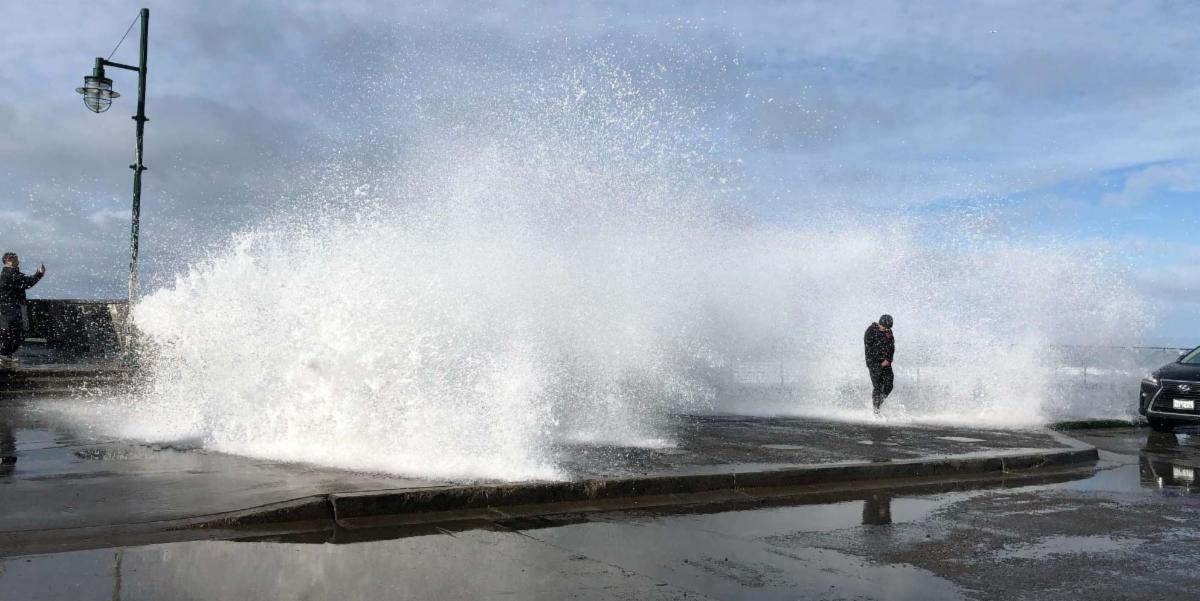
Not much dry beach during the 11-16-20 king tide. (Larry Loeher)

This Malibu Colony house looks like it’s falling into the sea during king tide, but I think the camera was a little tilted. It’s not that bad off. Normally the bottoms of the leftmost support pilings are not submerged. (Grace Murayama 11-16-20)
| The highest high tides of the year are on their way |
 Look out for King Tides! Look out for King Tides! Dec. 13-15, 2020 Plus, for locations North of Vandenberg/Point Conception, Jan. 11-12, 2021 The California King Tides Project is calling on you to photograph our highest high tides of the year. Documenting these tides helps us preview the impacts of sea level rise and understand how our shoreline is affected by high water today. If you’re able to safely take photos at the coast or Delta during King Tides you will be contributing to an important community science effort. Find your local King Tide times and learn how to upload your photos on our website or with a free app. You can check out a selection of photos from each coastal county and access a map of all the King Tides photos from the last few years. Educators and parents can find ways to incorporate King Tides into student learning, including with an elementary-level science journal downloadable in English or Spanish. Middle and high school students may want to use King Tides images and concepts as they enter the Climate Video Challenge. We can’t wait to see your photos! In the meantime, please join us on social media for #KingTides: What causes sea level rise, and what do King Tides have to do with it? The sea level rise we’re experiencing now and will experience in the future is caused by burning fossil fuels like coal, oil, and natural gas. Carbon dioxide in our atmosphere acts like a blanket, trapping in heat that would otherwise escape. When we burn fossil fuels, we’re adding more carbon dioxide, “thickening the blanket” and warming the planet and ocean. Sea level is rising because land-based glaciers and ice sheets are melting into the ocean and also because water expands in volume when it warms. The amount of sea level rise we will ultimately experience will depend on how quickly we stop burning fossil fuels. King Tides themselves are not caused by sea level rise, but allow us to experience what higher sea level will be like. King Tides are the highest high tides of the year, about a foot or two higher than average tides, which corresponds to the one to two foot rise in sea level expected during the next few decades. When you observe the King Tides, imagine seeing these tides (and the flooded streets, beaches, and wetlands) every day. Understanding what a King Tide looks like today will help us plan for sea level rise in the future. Sharing your photos and talking about what you’ve noticed helps others understand that they’re part of a community that cares about climate change. Why are there different dates for northern and southern California? Southern California will experience King Tides in November and December. There is an additional January King Tide in northern California, north of Point Conception/Vandenberg AFB, due to a combination of astronomical influences such as the relative tilt of the Earth’s rotation with respect to the Sun and seasonal influences on water level such as temperature and wind that differ in southern California as compared to northern California over the course of the year. Thank you for your help! We look forward to seeing your photos! california.kingtides.net |
| California Coastal Commission 455 Market Street, Suite 228, San Francisco, CA 94105 |
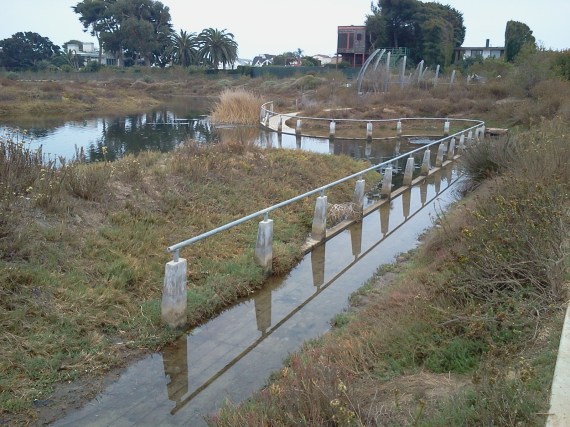
An inundated tidal clock sidewalk measured 6′ 9.6″ lagoon water
level a week after the king tide. (L. Johnson 11-23-20)
Books for budding scientists | Natural History Magazine
[Posted by Chuck Almdale]
Every year at Christmastime Natural History, the magazine of the American Museum of Natural History in New York City, lists books for ‘budding scientists.’ Here’s a few from their Dec ‘20 – Jan ’21 issue. It’s not too late to order one and pick it up at your local bookstore and support our local businesses. Descriptions below are from Natural History, written by Dolly Setton.
For Young Readers
The Boy Who Dreamed of Infinity: A Tale of the Genius Ramanujan
by Amy Alznauer, Illustrated by Daniel Miyares: Candlewick Press, 2020; 48 pages, $17.99
When Srinivas Ramanujan (1887-1920) was a young boy in a small town in India, he chopped a mango in half, and in half again. He imagined that if he continued cutting, the number of bits would approach infinity; yet, if he put the pieces back together, there would be one mango. “Will and endless list of tiny numbers add up to one or to infinity?” he wondered. “What is big?” and “What is small?” His questions multiplied as he got older. He experimented and explored on his own. Without knowing their names, he filled notebooks with his discoveries about primes, partitions, and infinite sums. He solved problems that, unbeknownst to him, were considered unsolvable. After reading a pamphlet on infinity by Cambridge University mathematician G.H. Hardy (1877-1947), Ramanujan humbly introduced himself in a letter. Weeks later, Hardy responded – “magnificent, outlandish ideas” – and invited Ramanujan to visit him in England. Illustrated with warm watercolor paintings, this book stands out for its endearing biographical tale, its flavor of the beauty and mystery of math, and its sense of intellectual freedom and creativity to which children can relate.
Also recommended
The Big Book of Blooms
by Yuval Zommer; Thames & Hudson, 2020; 64 pages, $19.95
Packs: Strength in Numbers
by Hannah Salver; HMH Books for Young Readers, 2020; 48 pages, $17.99
Sharuko: El Archeologo Peruano Julio C. Tello / Peruvian Archeaologist Julio C. Tello
by Monica Brown, Illustrated by Elisa Chavarri, Translated by Adriana Dominguez;
Children’s Book Press, 2020; 40 pages $19.95
A Way with Wild Things
by Larissa Theule, Illustrated by Sara Palacios; Bloomsbury Children’s Books, 2020; 32 pages, $17.99
For Intermediate Readers
Unseen Worlds: Real-Life Microscopic Creatures Hiding All Around Us
by Hélène Rajcak, Illustrated by Damien Laverdunt; What On Earth Books, 2019; 36 pages, $21.99
Peruse the table of contents, and anticipation of strange new visions of familiar vistas will grow: “The Miniature Jungle of Your Bed,” “The Secret Life of the Beach,” “A Parade of Ocean Floor Monsters.” Magnificent illustrations put microscopic beings, such as “lonely mud dragon,” at the center of a seemingly alien world that is really our own. On the ocean floor, “a snow of bacteria and plankton falls all around. Spiny silhouettes of loriciferans haunt the shadowy waters. Meanwhile, at the beach, “creatures slink around in the spaces between the grains of sand…the dark, damp mazes…are both an ideal hideaway and a well-stocked pantry.” Richly detailed illustrations and eloquent descriptions invite continued examination and wonder. A final spread describes the portal to these invisible worlds, the microscope.
Also recommended
The Ocean: Exploring Our Blue Planet
by Miranda Krestovnikoff, Illustrated by Jill Calder; Bloomsbury Children’s Books, 2020; 64 pages, $23.99
Stay Curious! A Brief History of Stephen Hawking
by Kathy Krull & Paul Brewer, Illustrated by Boris Kulikov; Crown Books for Young Readers, 2020; 40 pages, $23.99
Tiger, Tiger, Burning Bright! An Animal Poem for Every Day of the Year
Selected by Fiona Waters, Illustrated by Britta Teckentrup; Nosy Crow, 2020, 328 pages, $34.42
For Advanced Readers
The Natural History Puzzle Book
Dr. Gareth Moore; Carlton Books, 2019; 224 pages, $29.99
Why is space silent? What do dolphin clicks mean? What makes cypress trees fire resistant? Over 100 puzzles – inspired by London’s Natural History Museum – explore a variety of scientific questions, clearly sorted into three levels of difficulty. Easy puzzles, such as mazes and spot-the-differences, can be done by any age, while the more challenging ones, such as nonograms and bridge puzzles, might require an adult’s help. There are also quizzes and brainteasers, including questions like: “What is the longest bone in the human body?” and “How many genes does a banana have?” Readers get to keep territorial primates away from each other, trace the wiggle dance movements of bees and learn about the tectonic movement of plates. The puzzles are divided into six categories: animals, oceans, space, dinosaurs, human evolution, the natural world. Fun facts and scientific background are scattered throughout this beautifully designed book.
Also recommended
Music for Tigers
by Michelle Kardarusman; Pajama Press, 2020; 224 pages, $17.95
The Radium Girls: The Scary but True Story of the Poison that Made People Glow in the Dark
(Young Readers’ Edition) by Kate Moore; Sourcebooks Explore, 2020; 432 pages, $17.99
Rocket Science: A Beginner’s Guide to the Fundamentals of Spaceflight
by Andrew Rader, Illustrated by Galen Frazer; Candlewick Press, 2020; 64 pages, $16.99



 SANTA MONICA BAY AUDUBON SOCIETY BLOG