Free email delivery
Please sign up for email delivery in the subscription area to the right.
No salesman will call, at least not from us. Maybe from someone else.
Every fall, male tarantulas leave home for good with one thing on their minds: sex. But before these spiders can make the ultimate connection, they have to survive the perils of the open road…which include their potential mates.
Every September, a generation of newly mature male tarantulas leave their underground homes to wander the landscape south of La Junta, Colorado, to look for mates. The lucky males will find females, who remain near their dens the whole lives, and possibly mate. But this so-called “migration” is a one‐way trip.
Among the many risks for these itinerant tarantulas, besides running out of time and becoming roadkill, are the local tarantula hawks. The two‐inch long, blue‐and‐gold wasps pounce on the unsuspecting arachnid travelers, hit them with a paralyzing sting, then drag them off to their lairs. Once there, the female wasp lays an egg on the spider that eventually hatches into a larva. The larva burrows inside him to feast and grow before emerging from his body, Alien‐like, as an adult.
If a male does survive long enough to find a den, he courts the female by first “knocking” at the entrance by tapping the ground with his front mouth parts, called pedipalps. He must rely on vibration to communicate his intentions, since tarantulas are mostly blind. If the larger and more dangerous female comes out to investigate, they face off at the den entrance. She may reply with drumming of her own to indicate that she’s receptive ‐‐ or she might try to eat him.
But he’s come prepared. When male tarantulas reach maturity, right before they set out on their quest, they develop a special set of clasps on their front legs called “tibial hooks.” Tibial hooks serve a single purpose: to fasten underneath the female’s fangs during courtship, allowing him to keep danger at arm’s length, so to speak.
This is another installment of the PBS Deep Look series. If no film or link appears in this email, go to the blog to view it by clicking on the blog title above. If the film stops & starts in an annoying manner, press pause (lower left double bars ||) to let it buffer and get ahead of you. [Chuck Almdale]
Diorama Challenge
Another Fun Night at the Museum!

No vegetables were harmed in the construction of these dioramas.
The celebrated diorama halls of the Natural History Museum of the County of Los Angeles’s capture nature in painstaking detail. They each portray breathtakingly realistic scenes of wildlife in their natural habitats, whether it’s a herd of moose in Alaska, a polar bear family in the frozen Arctic, a herd of elephants in Africa, or hippos snoozing by a pond.
Not only are these dioramas iconic for their captivating presence at the Museum, but also for their contributions to pop culture—from Sheryl Crow’s “If It Makes You Happy” music video, to Honda’s “Matthew Broderick’s Day Off” commercial.
Now, we challenge you to recreate the magic at home.
The concept is simple: we are challenging our participants to recreate our classic diorama scenes with items found at home. To participate, all you have to do is:
- See the website for images of our dioramas
- Create your own diorama photo using items found in your home….get creative!
- Include an image of it side-by-side with the original NHM Diorama image
- In your post include tag @NHMLA and #DioramaChallenge
Are you ready to take on the #DioramaChallenge?
Then go to the NHMCLA website where you will find additional creative examples.

Enlist members of your family. Or any loose food.
How to Do a Bird Sit
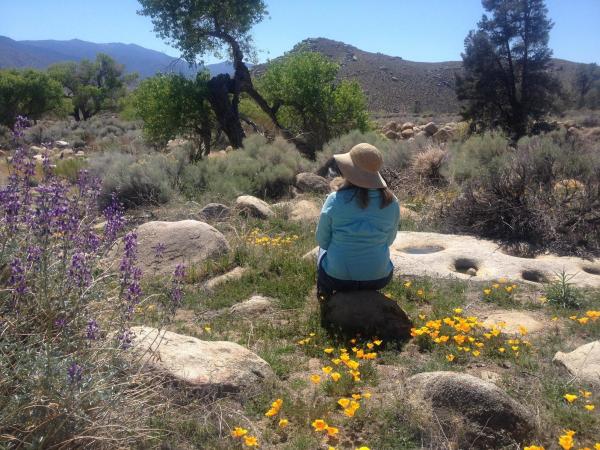
Kern Wildlife (AC website)
A bird sit routine can be an anchor in your life, especially during turbulent times. The practice is like an outdoor meditation, with a focus on birds.
Audubon California website. By Molly Tsongas, April 09, 2020
Enjoy watching birds from home? Did you know that birdwatching is a gateway to a powerful mindfulness practice? It’s called a “bird sit.”
A bird sit is like an outdoor meditation with a focus on birds.
Bird sits provide similar benefits to mindfulness practices, including relaxation and quiet mind. They also cultivate a deeper bond with the birds around us and reveal the birds’ secret languages.
Follow these 5 simple steps:
1) Find a Spot: Choose a spot where you can sit quietly and observe birds for 10-20 minutes. This can be your window, doorstep, backyard, or local park. Convenience is key.
2) Have a Seat: Find a comfortable sitting position. Feel free to bring along whatever you need to be comfortable such as a chair, cushion, blanket, snack, or hot drink. When we sit down, the birds to come closer to us than they would if we were walking.
3) Wake Up Your Senses: Take 5 deep breaths to settle your nervous system. Then, take a moment to activate your senses, focusing on what you are feeling, seeing, hearing, touching, tasting, and smelling. Take a moment to listen for the quietest sound in all directions. Imagine expanding your senses from your body outward, to explore the world around you.
4) Tune in to the Birds: Now, tune into any birds you might hear or see. Don’t worry about identifying them. Instead, lead with curiosity and ask questions like: “What are the birds doing right now? Do they have a nest nearby? What have they eaten today?” Watch their behavior and listen for their vocalizations. Try to notice when the birds seem relaxed, alarmed, aggressive, or joyful. Gently check in with the feelings that arise in your own body while you are sitting.
5) Repeat: The best benefits come from repetition. Each day, look for the same birds you may have seen the day before. Getting to know a few feathered neighbors well is much more important than listing all the birds you’re seeing or hearing. You may begin to discover which birds sing first at sunrise, which birds are mated pairs, where the nearest nest is located, and when the hawks are hunting.
Over time, you’ll discover what the birds are saying to each other and how their behaviors are driven by predation, feeding, mating, and nesting in the landscape. You’ll begin to understand how your behaviors affects nearby birds as well.
What secrets will the birds reveal to you the longer you practice?
Thanks to Susan Penn at Redwood Region Audubon Society for posting this on their website and for providing the link to the original Audubon California post.
[Chuck Almdale]
Black-Cockatoos, et. al. | GrrlScientist
Here’s another from GrrlScientist.
She wrote “Not everyone experiences the joys of birding like me – a white woman,” which is included in our posting of May 30, 2020, “Birding while black in NYC Central Park.” She is a prolific writer. If you’ve birded in Australia and admired their many parrots, rosellas, lorikeets, cockatiels, cockatoos, black-cockatoos and budgerigars, totaling to an ever-shifting number of species somewhere over fifty, you’ll be interested in the following report, published 5-31-20 in Forbes. Maybe you’ll pick up an “armchair lifer.”
Hidden In Plain Sight: New Cockatoo Subspecies Identified In Australia
Forbes, May 31, 2020. GrrlScientist: Senior Contributor in Science. Evolutionary & behavioural ecologist, ornithologist & science writer.
Advances in DNA technologies have uncovered a new subspecies of red-tailed black-cockatoo in Western Australia. A large genetic study has uncovered a new subspecies of one of Australia’s most iconic birds, the red-tailed black cockatoo, Calyptorhynchus banksii. The newly identified subspecies is unique to inland Western Australia and lives in regions spanning the Wheatbelt, east of Perth, to the Pilbara in the state’s north-west.

Fig. 1 The distribution of Calyptorhynchus banksii subspecies in Australia and localities of the individuals genotyped in this study. Circles represent tissue samples (n = 113) and stars represent toe pad samples (n = 29). The inset photo of Calyptorhynchus banksii banksii demonstrates the morphological differences between male (right) and female (left) birds. Photo: Patrick Tomkins. (doi:10.1038/s41437-020-0315-y)
GrrlScientist has written a lot of articles. Because she alerts fellow American birders to them through her BirdChat messages, I have read many of them over the years. However I was not aware of her website which I found through a link in the Forbes article above. There I found over one hundred articles on various subjects. Here are a few: bumblebees, birds, narwhals, tigers, coronavirus, Cherokee seeds, algae, engangered plants, climate change, fireworks, salamanders, electric eels. And on and on. Birds are her favorite subject and parrots are obviously her favorite birds. Like Black-Cockatoos (a member of Psittaciformes order, but technically not a parrot).
Read the article above and check out her website. I highly recommend it.
[Chuck Almdale]
Birds at my window | RM Videos
First we see the Eurasian Eagle-Owl (Bubo bubo) and her – ahem – rather large chicks. From the Netherlands, I think. 5-18-20. 3:16.
And now a Common (Eurasian) Kestrel and her five brown eggs. 6-6-19. 2:17
RM Videos has quite a collection of short films, including many about birds and another many about that perennial favorite, people doing stupid things. If no film or link appears in this email, go to the blog to view it by clicking on the blog title above. If the film stops & starts in an annoying manner, press pause (lower left double bars ||) to let it buffer and get ahead of you. [Chuck Almdale]



 SANTA MONICA BAY AUDUBON SOCIETY BLOG