Free email delivery
Please sign up for email delivery in the subscription area to the right.
No salesman will call, at least not from us. Maybe from someone else.
Reprise 14: Bird Song Opera | YouTube Video
Editor’s Note: Entry number fourteen in our tenth anniversary honor roll was originally posted 6-5-18 and is eighteenth in overall popularity. It’s popularity on our blog has increased greatly in recent months, and it has appeared many other places on the web. [Chuck Almdale]
***********************************************************
This must be seen and heard to be believed.
Watch it at least twice. It gets better. 3 ½ minutes.
Based on music by Wolfgang Amadeus Mozart, arranged and edited by Volker Pannes, www.shakeup.de. ShakeUp Music recomposed the Magic Flute “Papageno/Papagena” Duet into a colorful Mozart bird aria. Listen to an audiovisual Twitterstorm performed by our feathered fellows.
Many thanks to “Hollywood” Dave Surtees, aficionado of strange humor, for sending this in. [Chuck Almdale]
Your Neighborhood Birds – A Free Handout
Editor’s Note: I apologize if the email version of this posting was unreadable, unintelligible or bizarrely formatted. It looked fine in the preview on the web before I posted it, but it’s appearance in the email I received was just awful. It’s really hard sometimes to get these things to look right in the emails. The material below should display properly. If you download any of the attachments, they should look fine, although in the WORD versions, you may have to play with the margins. I tend to use narrow margins in order to cram more information onto a page. – Chuck Almdale
Back in 2013 I was asked by a local elementary school to give a presentation about their neighborhood birds. I put together a twenty-minute slide show, added a couple of nests, some feathers and bones and off I went. I also took a one-page two-sided handout printed on heavy plasticized 8.5×11″ paper which could be used as a relatively sturdy field guide for absolute beginners. I think the handout was pretty good, so I’m posting it here.
You can print it, download and save it, or simply admire it’s fabulous beauty and wealth of information. If you like the appearance, idea or format, feel free to download and use it. Add or delete birds and information to suit your desires. Make it become your neighborhood birds. Make thousands of versions and millions of copies. Give one to everyone on the planet. Whatever. This bird is now free.
There are three versions attached to this post.*
- Adobe PDF File: Los Angeles Neighborhood Birds – The Ten Most Common. Two pages, designed to be printed one page/two sides. If you have access to a program that can edit PDF files (I don’t) you can use this and adapt it to your desires. Otherwise, it can’t be altered.
- MS Word File – Los Angeles Neighborhood Birds – The Ten Most Common. Same text and photos as above, but anyone with MS Word on their computer can download and edit it as they see fit.
- MS Word File – Los Angeles Neighborhood Birds – The Most Common. Twelve pages. Same as #2 with eleven additional birds, two birds per page, longer text descriptions, two local birdwalks for children and some weblinks.
* Note: There are really eleven birds in the list of ten, but hummingbirds are very small and easily-confused, so the two most-common species are counted as one.
[Chuck Almdale]
Los Angeles Neighborhood Birds – The Ten Most Common
All Photos: Jim Kenney
Text: Ballona Wetlands Land Trust & Chuck Almdale
AMERICAN CROW – Corvus brachyrhynchos
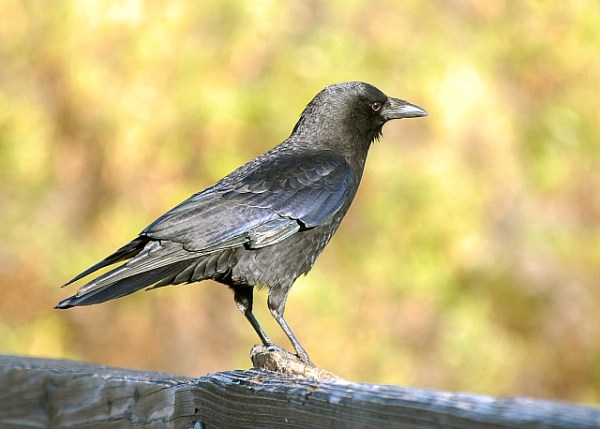 Length: 17.5”. Presence: All year.
A large, all black bird with a thick black bill, black eyes and black legs. Its loud “caw” call is often heard before the bird is seen. Common in parks, mall parking lots and neighborhoods, especially at dawn and dusk. Usually in families of 3-10 birds, sometimes in large flocks. Can be seen in trees, on the ground or in flight. Our largest common neighborhood bird. Large nest is usually high in a tree. Male and female look alike.
NORTHERN MOCKINGBIRD – Mimus polyglottos
Length: 10”. Presence: All year.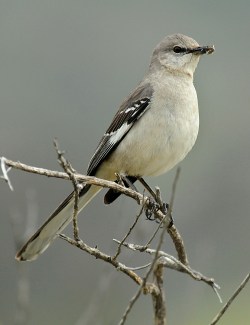
Medium-sized bird with gray back and light underside. Black wings have white wing patches that can be seen in flight. Tail has white edges. Usually very vocal and often heard before seen, imitating songs of other birds, machinery and electronics, sometimes late at night. Often leaping and fluttering wings while singing, it may attack nearly any other animal. Nests in dense bushes and trees. Male and female look alike.
MOURNING DOVE – Zenaida macroura
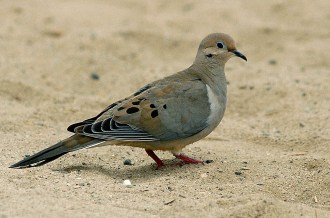 Length: 12”. Presence: All year.
Medium-sized bird with a grayish back and lighter underside and dark spots on the wings. The long pointed tail with white edges is best seen in flight. It has a distinctively slow, mournful call. Its wings also make a whistling sound when it starts to fly. Common on phone wires or on ground looking for seeds or insects. Male and female look alike.
HOUSE FINCH male – Haemorhous mexicanus
Length: 6”. Presence: All year.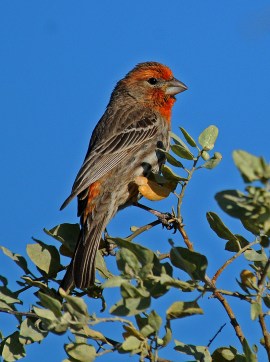
Small seed-eating bird with a cone-shaped bill. Males have red on the face, breast and rump. Both males and females have streaking on their breasts. Common in neighborhoods and parks and most often seen in flocks. Very common at seed feeders with House Sparrows and Mourning Doves. Their small cup-shaped nest may be in a bush, tree or building cranny. Their musical up-and-down song is heard all year; song often ends with an up-slurred “zreeeep.”
ANNA’S HUMMINGBIRD male – Calypte anna
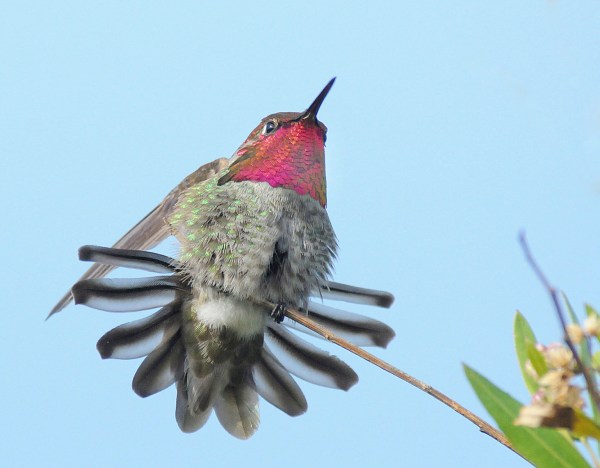 Length: 4”. Presence: All year.
Very small bird able to hover, fly backwards or upside down. Male is green overall with rosy-red forehead and throat. Female has only a few colorful flecks on the throat. Most often seen at hummingbird feeders or at flowers, sipping nectar. Male displays to female by rising to great height, plummeting to below female, making an explosive “chirp”, then rising to above her, hovering, and singing a squeaky song. Female watches all this from her perch on a twig.
ALLEN’S HUMMINGBIRD male – Selasphorus sasin
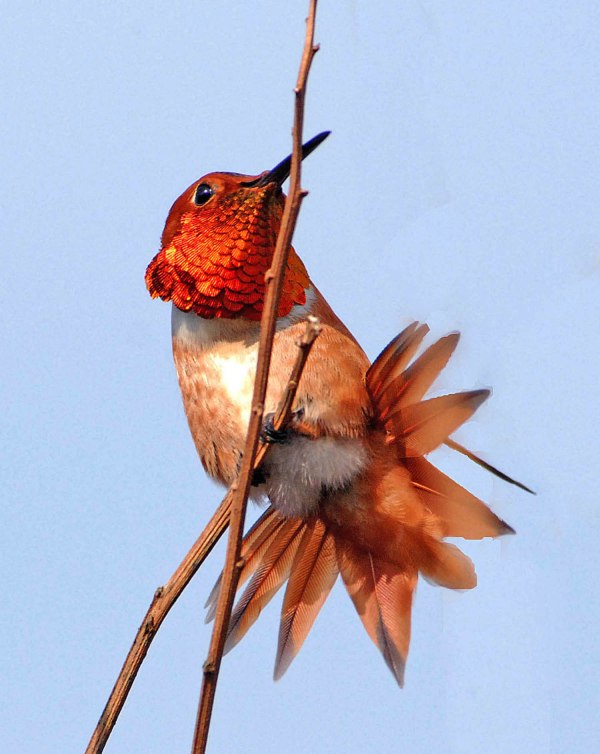 Length: 3.25”. Presence: All year.
Our smallest neighborhood bird. Like all hummingbirds it is able to hover, fly backwards or upside down. Male has a green back with rusty-orange face, belly, rump and tail. Female is rusty-orange on sides and in tail with a few colorful flecks on her throat. Hummingbirds’ wings hum in flight, some species louder than others. Male’s display flight is a tall ‘J’-pattern, plummeting from a great height, making a metallic buzz at the bottom, and curving up to hover in front of the female. All hummingbird females build their nest, incubate eggs, feed and care for the young without help from the males.
ROCK PIGEON – Columba livia
 Length: 12.5”. Presence: All year.
Chunky medium-sized bird very common around parks, parking lots, malls and developed areas. Nearly always in flocks. Also known as ‘park pigeon’ or ‘carrier pigeon’, it comes in many colors from pure white to dark gray. Natural color is gray-blue, two dark wing-bars, white rump and shiny neck and breast. Song is a repeated “coo coo” often made when resting. Eats nearly anything from ground.
HOUSE SPARROW male – Passer domesticus
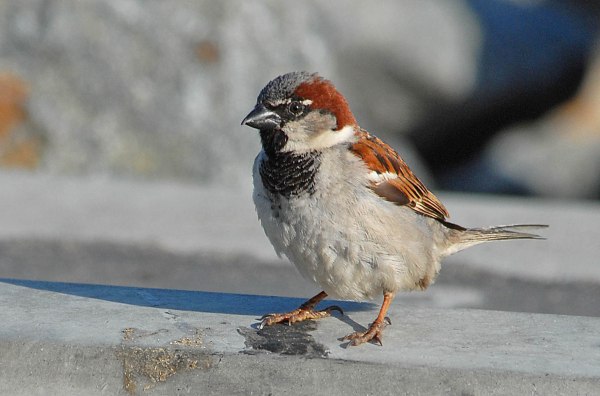 Length: 6.25”. Presence: All year.
Small bird, very common around buildings, parks, parking lots and fast food restaurants. Male has a gray stripe on the crown of its head, brown eyebrows and wings, a black bib and bill and white cheeks. The female is a much duller bird with a pale tan eyebrow. The simple song is a frequently sung “cheep.”
BLACK PHOEBE – Sayornis nigricans
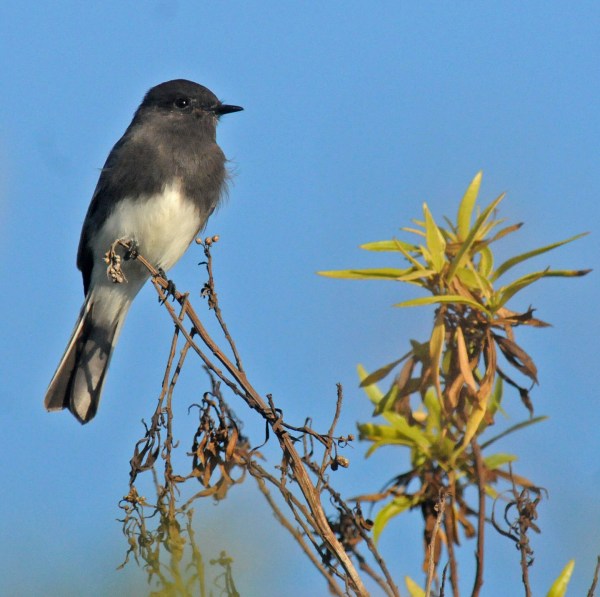 Length: 6.75”. Presence: All year.
Small flycatcher with black head, chest, back, tail and wings. The white belly comes up to a point on the breast. Often seen in residential yards and local parks, flying back and forth from a perch as it hunts flies and other insects. It often pumps its tail up and down when perched. Often nests on houses in the eaves, gutter supports, or lights. Frequently heard song is a soft whistled descending ‘seeeep.” May be near its mate or young, but never in flocks. Sexes look alike.
CALIFORNIA SCRUB-JAY – Aphelocoma californica
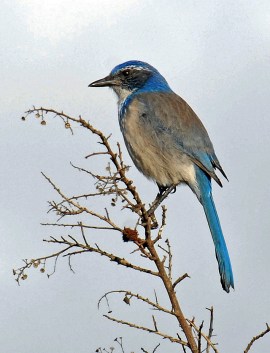 Length: 11”. Presence: All year.
Medium-sized bird with blue and gray back and light gray belly. Dark cheeks and bill and white eyebrow. White throat is bordered by blue breast band. Seen in parks or neighborhoods around thick, brushy areas and oak trees. Often heard before seen. Aggressive at feeders and will eat nearly anything. Often in loose pairs or small family flocks, but also forages alone. Male and female look alike.
CALIFORNIA TOWHEE – Melozone crissalis
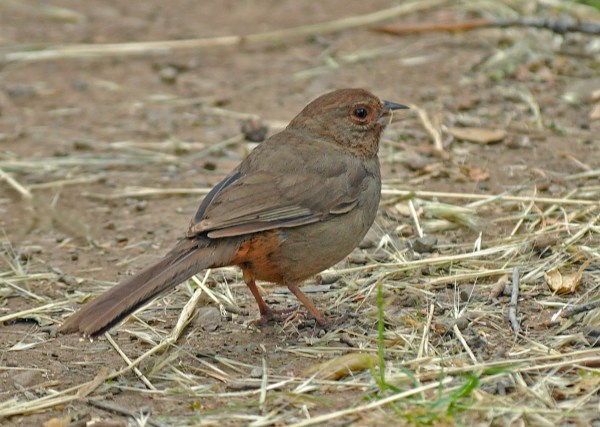 Length: 9”. Presence: All year.
Medium-small brown bird with dark eyes, cone-shaped bill and a long tail with reddish undertail coloring. It feeds quietly on the ground and moves mouse-like through bushes and brush. Its metallic “chink” call note is often heard before the bird is seen. Eats seeds, fruit and insects. Male and female look alike.
Facebook Photo Album of Songbirds – 67 photos
https://www.facebook.com/media/set/?set=a.215104801919570.46394.108132545950130&type=3
Facebook Photo Album of Other Birds – 170 photos
https://www.facebook.com/media/set/?set=a.128635707233147.25144.108132545950130&type=3
Birds make some of the weirdest sounds in the natural world – here’s just a handful of some of the most outrageous!
0:07 Grey Go-away-bird 0:40 Capuchinbird 1:08 American Bittern 1:29 Brown Sicklebill 1:40 Laughing Kookaburra 2:05 Great Potoo 2:35 Willow Grouse 3:13 Jack Snipe 3:44 Channel-billed Cuckoo 4:26 Black-footed Albatross 5:17 Western Capercaillie 6:10 Black-throated Loon 6:43 Northern Lapwing 7:11 Southern Cassowary 7:28 Tui 8:27 Montezuma Oropendola
This is an installment of the Bird Kind series. If no film or link appears in this email, go to the blog to view it by clicking on the blog title above. If the film stops & starts in an annoying manner, press pause (lower left double bars ||) to let it buffer and get ahead of you. [Chuck Almdale]
Field Trips of Yore: Black Rock Campground & Morongo Valley Preserve Trip Report: 2-3 May, 2015
Editor’s Note: We’ve cancelled the May 9-10 field trip to Black Rock and Morongo Valley due to novel coronavirus sequestering. This trip report is a reminder of what we’re missing. Lots of photos in the slideshow on the blog!
**************************************************
We weren’t even out of our campervan before California Thrashers, Gambel’s Quail and Western Scrub-Jays came by to (maybe) check us out. Colorful lizards sunned themselves in the cactus garden. Unlike the movie, it would be a good day at Black Rock.
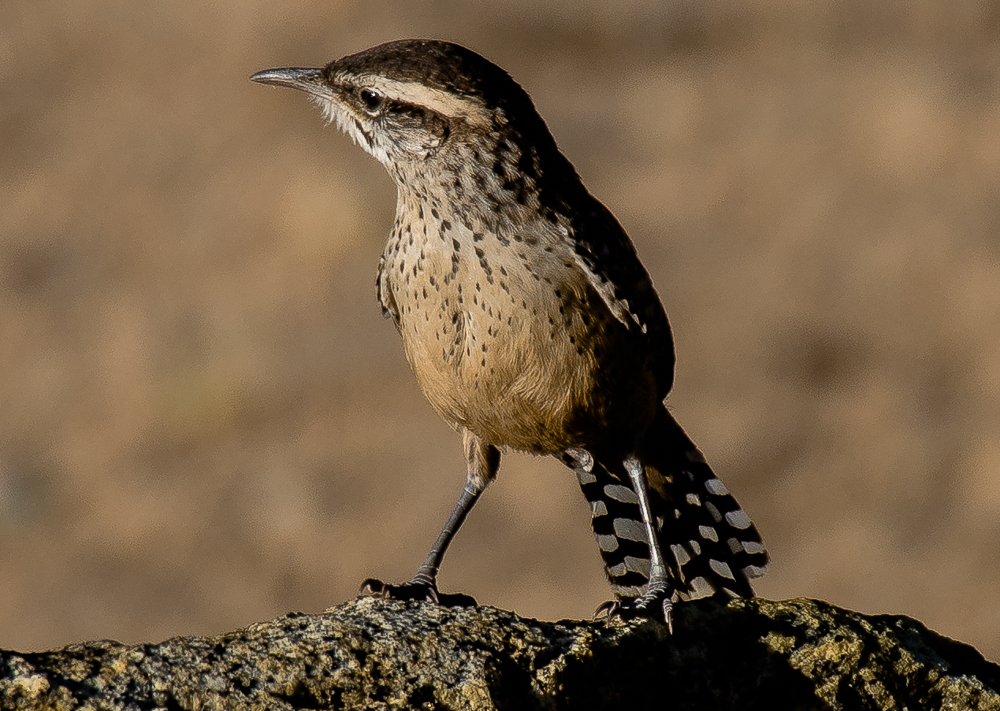
Cactus Wrens sound like a birthday party toy (D. Erwin 5/3/15 Black Rock)
A few years ago we broke this trip into two parts: Saturday afternoon at Black Rock Campground; Sunday morning at Morongo Valley Preserve & adjacent Covington Park.
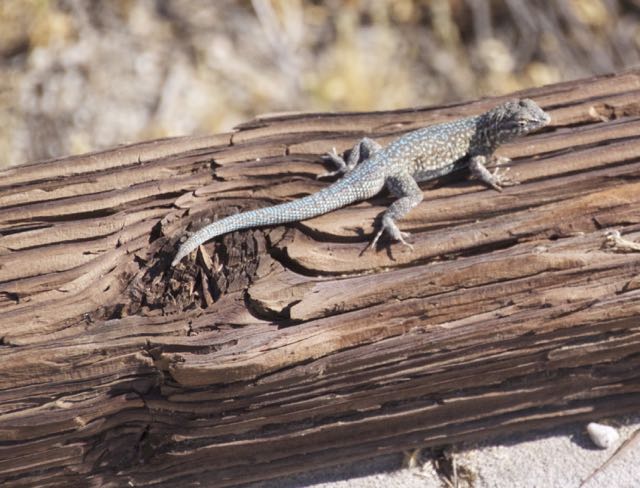
Speckled Lizard – Black Rock
(R. Seidner 5/2/15)
Late afternoon, after the heat of the day, when birds begin rousing themselves for a final burst of feeding, is a good time for Black Rock. Many birders had already taken to moteling Saturday night in Yucca Valley, close to the campground five miles south into northwestern Joshua Tree Nat. Park. The best time to see Piñon Jays is shortly before sunset, when they fly up and downslope above the campground. Other birds are always around the campground, but – as do most birds everywhere – they make themselves scarce mid-day.

Males Gambel’s Quail, a desert bird, watches for his mate (D. Erwin 5/3/15 Black Rock)
We found most of the Black Rock specialties: Gambel’s Quail came to water drips and called from the Joshua Treetops, the increasingly more common White-winged Dove, several hummingbirds worked the bushes and ephemeral flowers, Ladderbacked Woodpeckers drilled the Joshuas, the aforementioned Piñon Jay, Verdin with faces the color of yellow mesquite flowers, the squat-jumping Rock Wren and the cranky Cactus Wren, desert early-nesting Phainopeplas, the Black-throated Sparrow who never drinks water, and the lovely-to-see-and-hear Scott’s Oriole. Perhaps the most uncommon sightings were several Chuckwalla lizards warming on rock tops, and a large

Rattlesnake, either Western or Red – Black Rock (R. Seidner 5/2/15)
Diamondback Rattlesnake (either Western or Red) near the front door of the ranger station. His rattles had broken off. Mary, temporarily alone, saw a Roadrunner the rest of
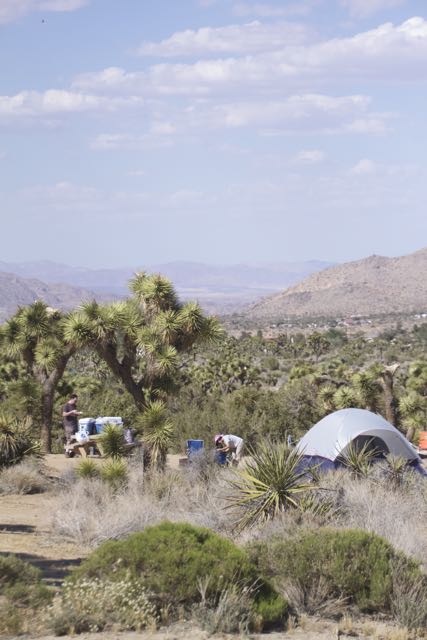
Black Rock campground – no wind, tents still in place
(R. Seidner 5/2/15)
us missed. We then went off to dinner at La Casita in Yucca Valley, a good Mexican restaurant. Those of us camping returned, stuffed to the gills, to Black Rock and waited for the wind to rise. Infamous for its winds – we call it Windy Ridge – people have seen their unpegged tents sail away into yucca-strewn gullies, or been rocked to sleep – or into terror – by a wind-wobbled campervan.
Next morning, on the way from our Black Rock campsite to Morongo Valley, we spotted two Roadrunners, one road-crossing as we coasted down the long road back to the highway, and one crossing the highway itself, right in the middle of town. I almost forgot: Lillian and I witnessed a 6:05am flyover of 60-100 Piñon Jays, heading down-canyon directly above our campsite, each one calling in their peculiar quail-like purr.
Morongo Valley Preserve was moderately birdy and – for a change – neither windy nor unbearably hot. Warblers were few: we did see six of the eleven western warbler species, but 95% of them were Wilson’s Warblers.
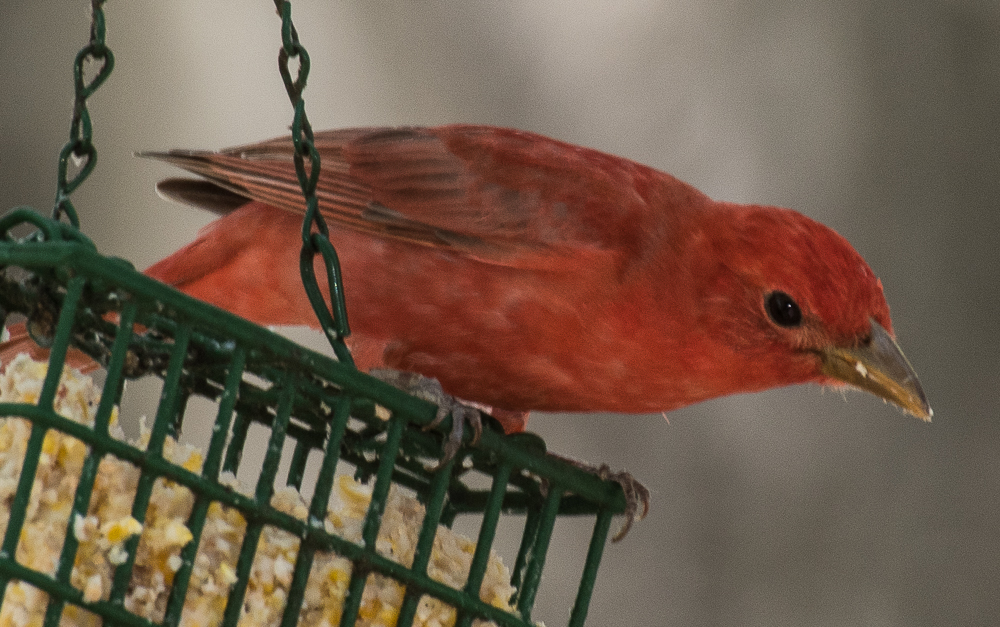
Male Summer Tanager at the seed feeder
(D. Erwin 5/3/15 Morongo Valley)
Summer Tanagers have apparently already paired up; we first spotted them whizzing back and forth, and later at the seed feeder by the warden’s house. Brown-crested Flycatchers were very vocal, as were Yellow-breasted Chats, and we heard them singing and calling over and over before we finally spotted either species. At least one pair of Vermillion Flycatcher were in Covington Park, and we saw a female sitting on her nest near the tennis court, her mate busily bringing her flies.

Male woodpecker, probably a Nuttall’s – Ladderbacked hybrid – misshapen black on shoulder (D. Erwin 5/3/15 Morongo Valley)
Nearby, birds, including Lawrence’s Goldfinches, were coming to the small water drip someone had set up. White-winged Doves were frequently seen; a few years back we had to diligently search for this species, often missing it, but now they seem widespread. At the seed feeders we could admire their blue orbital ring.
Morongo Valley is one of the few areas where the ranges of the Nuttall’s and Ladderbacked Woodpeckers overlap, and they do interbreed. Of the photos taken, none are clearly one or the other species. Check the three photos for some of the annoying details.

This female woodpecker might actually be a hybrid – buffy lores with otherwise Nuttall’s appearance (D. Erwin 5/3/15 Morongo Valley)

Female woodpecker belly seems too white to be pure Ladderbacked
(D. Erwin 5/3/15 Morongo Valley)
All told, we had 66 species in two days, down from 2013’s 76 species (see list below). A lot depends on which winds the birds encounter as they move north from the brushy shore of the Salton Sea. A good tail wind and they sail right on by, high over the hills. A stiff head wind like the screamers that frequently come through San Gorgonio Pass, and they are forced to stay low and slow, moving up through Big Morongo Canyon to rest and refuel at the Preserve.

Brown-crested Flycatcher (D. Erwin 5/3/15 Morongo)
Ash-throated and Brown-crested Flycatchers both nest at the preserve. Very similar in appearance, even the thinner bill of the Ash-throated can be mistaken by some (moi!) for the chunkier bill of the Brown-crested. Fortunately, the latter bird has a much more liquid Whit! call and rolly song than the former. If you’re lucky, you’ll see one sing. [Added Note: The fact that this photo was captioned “Ash-throated Flycatcher” in the original email demonstrates how easily they’re confused.] [Chuck Almdale]
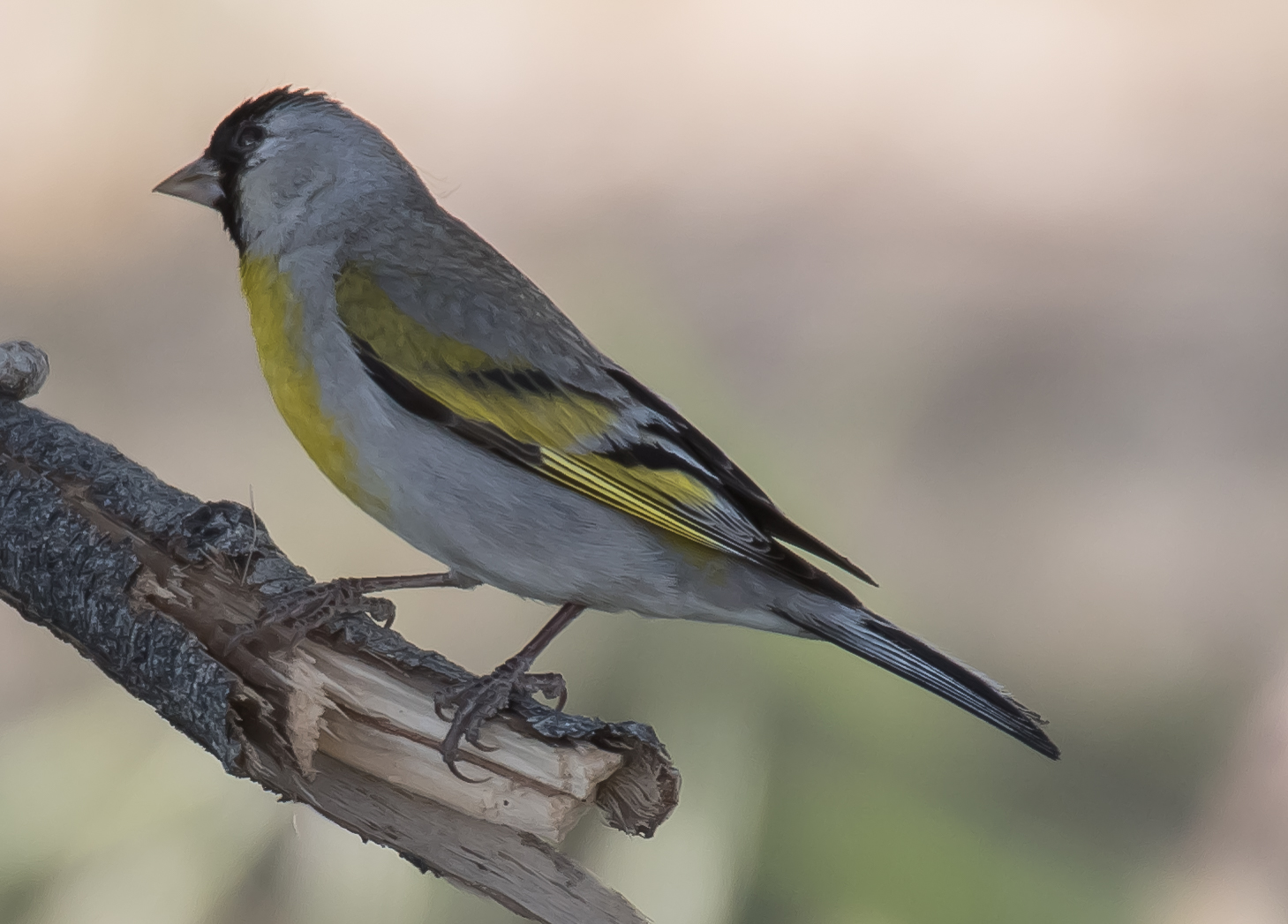
The uncommon male Lawrence’s Goldfinch
(Dennis Erwin 5/3/15 Morongo Valley)
Many thanks to Dennis Erwin and Roxie Seidner for all the great photographs!
| Black Rock & Morongo Valley | ||
| Codes: B – Black Rock Campground | ||
| M – Morongo Valley Preserve & Covington Park | ||
| H – Heard Only | ||
| Species List | 5/2-3/15 | 5/4-5/13 |
| Gambel’s Quail | MB | MB |
| Green Heron | M | |
| Turkey Vulture | MB | M |
| Cooper’s Hawk | M | M |
| Red-tailed Hawk | M | |
| Virginia Rail | M-H | M-H |
| Rock Pigeon | MB | MB |
| Eurasian Collared-Dove | MB | M |
| White-winged Dove | MB | MB |
| Mourning Dove | MB | MB |
| Greater Roadrunner | B | |
| White-throated Swift | M | |
| Black-chinned Hummingbird | MB | MB |
| Anna’s Hummingbird | MB | MB |
| Costa’s Hummingbird | MB | MB |
| Allen’s Hummingbird | M | |
| Calliope Hummingbird | M | |
| Ladder-backed Woodpecker | MB | MB |
| Nuttall’s Woodpecker | M | M |
| American Kestrel | M | B |
| Olive-sided Flycatcher | M | |
| Western Wood-Pewee | MB | MB |
| Willow Flycatcher | M | |
| Pacific-slope Flycatcher | M | M |
| Black Phoebe | MB | MB |
| Say’s Phoebe | B | |
| Vermilion Flycatcher | M | M |
| Ash-throated Flycatcher | MB | B |
| Brown-crested Flycatcher | M | M |
| Cassin’s Kingbird | M | MB |
| Western Kingbird | M | MB |
| Loggerhead Shrike | M | |
| Bell’s Vireo | M | M |
| Cassin’s Vireo | M | M |
| Warbling Vireo | M | M |
| Pinyon Jay | B | B |
| Western Scrub-Jay | MB | MB |
| Common Raven | MB | MB |
| Mountain Chickadee | M | |
| Oak Titmouse | MB | M |
| Verdin | MB | |
| Bushtit | M | M |
| Rock Wren | B | |
| House Wren | M | M |
| Bewick’s Wren | MB | MB |
| Cactus Wren | B | B |
| Blue-gray Gnatcatcher | M | |
| Western Bluebird | MB | MB |
| Townsend’s Solitaire | M | |
| Swainson’s Thrush | M | |
| Hermit Thrush | M | |
| California Thrasher | MB | MB |
| Northern Mockingbird | B | B |
| European Starling | MB | MB |
| Phainopepla | MB | MB |
| Orange-crowned Warbler | M | M |
| Nashville Warbler | M | |
| Common Yellowthroat | M | M |
| Yellow Warbler | MB | M |
| Yellow-rumped Warbler | MB | M |
| Black-throated Gray Warbler | M | |
| Townsend’s Warbler | M | |
| Hermit Warbler | M | |
| Wilson’s Warbler | MB | MB |
| Yellow-breasted Chat | M | M |
| Spotted Towhee | MB | |
| California Towhee | MB | MB |
| Brewer’s Sparrow | B | |
| Black-throated Sparrow | B | |
| Song Sparrow | M | M |
| Summer Tanager | M | M |
| Western Tanager | M | M |
| Black-headed Grosbeak | M | M |
| Blue Grosbeak | M | |
| Lazuli Bunting | M | |
| Great-tailed Grackle | M | |
| Brown-headed Cowbird | M | M |
| Hooded Oriole | M | M |
| Bullock’s Oriole | M | M |
| Scott’s Oriole | B | B |
| House Finch | MB | MB |
| Pine Siskin | M | |
| Lesser Goldfinch | M | MB |
| Lawrence’s Goldfinch | M | M |
| House Sparrow | MB | MB |
| Total Species – 85 |
66 | 76 |

Just before the horribly disfiguring accident, Chuck checks a Cactus Wren nest in a cholla to see if anyone is home (R. Seidner 5/2/15 Black Rock)
Editor’s Note: Entry number thirteen in our tenth anniversary honor roll was originally posted 4-1-13 and is thirteenth in overall popularity. It was the fourth installment in our SMBAS Monograph Series – Spring Quarter, and brought unwelcome news to the tickers and twitchers of the world. [Chuck Almdale]
***********************************************************
In the past 30 years, about 1300 new avian species have been added to the world’s birdlist. Some were entirely new to science. Collectors in the Amazon basin continually turn up new antbirds, tapaculos and tyrant flycatchers, for example, but new species keep trickling in from all the world’s under-explored areas. However, the majority of new bird species are the result of “splitting” – raising already known and described subspecies up to full species status. This comes about from additional research: sometimes field studies, sometimes DNA analysis, sometimes both.

Feathered dinosaur, also known as Secretary-bird
“Lumping” occurs when new research shows -or appears to show – that one or more birds with full species status are more properly considered as subspecies of a variable species. Several decades ago the Red-shafted, Yellow-shafted and Gilded Flickers of North America were “lumped” into the single Northern Flicker (Colaptes auratus) when found freely interbreeding in areas where their ranges overlapped. A few years later, the Gilded Flicker (Colaptes chrysoides) was “re-split” from the Northern Flicker, based on even newer research. Decades earlier, the Spotted and Eastern Towhees had each been “good” species; again, research found them interbreeding and they were lumped into the Rufous-sided Towhee (Pipilo erythrophthalmus), only to be re-split in 1995 back into Spotted (Pipilo maculatus) and Eastern Towhees (P. erythrophthalmus).
And so the pendulum swings: splitting to lumping to splitting, with a preponderance of the latter over the past half-century. But it now swings back to lumping, and with a vengeance utterly unexpected.
Recently, researchers in molecular genetics at the Carl von Linné Conservatory of Biological Systematics at Uppsala University in Sweden have admitted to an enormous, decades-long error. “We found a glitch in analysis program we used many decades,” says conservatory head Dr. Thorbald Thorbaldson. “Simple, but bringing a catastrophe. Several people resigned. One man became reindeer herder with the Lapps. Not seen since.”

Artist’s rendition of the typical bird
Simply put, a decimal place was off by three orders of magnitude. DNA samples with a reported variance of – say – 2.7%, were actually only 0.0027% at variance. Dr. Thorbaldson: “Samples we thought quite different, indicating great evolutionary separation, are – well – not so different after all! Mildly speaking. With birds, it turns out there are far fewer “good species” and far more subspecies than we thought.”
How few? Sit down and hold your breath. Keep holding. Now read on.
“Careful reanalysis, ” reports Dr. Thorbaldson, “indicates there are probably 10 species of birds, with approximately 24,000 subspecies. Give or take a few, of course.”
Ten species? TEN? It makes you want to hang up your binoculars, take off your Tilley and anorak, crawl back into bed and pull the blanket up over your head for a long, long while. Maybe forever.
The name of the ten species needed simplification, resulting in a certain uniformity. They are, alphabetically, with English translations of the scientific name in parentheses:
Hoopoe – Upupa omnimodia (universal hoopoe)
Sapayoa – Sapayoa incertaesedis (uncertain origin sapayoa)
Secretary-bird – Venator terrafirma (solid-ground hunter)
The Budgie – Primosittacus familiaris (social first-parrot)
The Chicken – Gallus assus (roasted chicken)
The Cuckoo – Cuculus horacustodis (time-keeper cuckoo)
The Duck – Anas mundus (world duck)
The Peep – Charadrius tibicinus (piper waterbird)
The Railbird – Erepus palus (marsh creeper)
The Songbird – Passerina cantata (sparrow-like singer)
Many of the water birds – penguins, cormorants, tubenoses, and auks for example – were discovered to not be birds at all, but long-scaled fish. Similarly, swifts and hummingbirds are actually insects, most closely related to damselflies. The Secretary-bird (pictured above), which as anyone can see looks like a feathered dinosaur, turned out to be ancestral to all the hawks, falcons, owls, nightjars and such. The Hoopoe holds a similar position for many egret and stork-like birds. Finally, that long-term ornithological bugaboo, the Sapayoa (a small manakin-like bird ranging from southern Panama to northwestern Ecuador) is still of indecipherable lineage. “We’re pretty sure it is a bird…at least some of us are,” explains Dr. Thorbaldson, “but, as always, it seems completely unrelated to anything else. We don’t know what it is, and frankly we’re (expletive deleted) tired of looking at it.”
For a quick look at how the birds used to be organized, take a look at this chart, courtesy of the University of Sheffield. [If you find Crows, Jays or Ravens on the chart, please let me know, because I couldn’t.]
Those who found this article plausible, should also read:
2012: Canyonland Roadrunner Captured on Film
2011: New Hummingbird Species Discovered in Los Angeles County!
2010: The Western Roof-Owl: Bird of Mystery
[Chuck Almdale, on behalf of Club 401]



 SANTA MONICA BAY AUDUBON SOCIETY BLOG