Free email delivery
Please sign up for email delivery in the subscription area to the right.
No salesman will call, at least not from us. Maybe from someone else.
This inspiring footage of birds and wildlife celebrates the Cornell Lab of Ornithology’s long-standing tradition of documenting and sharing information about the natural world. Thanks to you, that tradition continues. We hope you’ll keep watching, listening, and exploring with us to improve the understanding and protection of birds and biodiversity.
A film from the Cornell Lab of Ornithology. If no film or link appears in this email, go to the blog to view it by clicking on the blog title above. If the film stops & starts in an annoying manner, press pause (lower left double bars ||) to let it buffer and get ahead of you. The Lab is a member-supported organization; they welcome your membership and support. [Chuck Almdale]
Reprise 10: Canyonland Roadrunner Captured on Film
Editor’s Note: Entry number ten in our tenth anniversary march of time was originally posted 4-1-12 and is fourteenth in overall popularity. It was the eagerly-awaited third installment in our SMBAS Monograph Series – Spring Quarter.
***********************************************************
While the official consensus of the western American ornithological community is that there is only one form of Geococcyx californianus, the Greater Roadrunner, there have long been whispers in back corridors of biological institutions scattered across the western states that the systematics of this species are more complex than officially recognized, even – it was hinted – that evidence of this complexity had been suppressed by mysterious persons with sinister motives. This suspicion was strengthened recently when the unique and until-now elusive central New Mexican form was captured on newly-developed high-speed film equipment. Close examination of this footage by specialists in Geococcyx revealed a bird quite unlike the form familiar to Americans from California to Oklahoma. Leading roadrunner specialist, Dr. Thaddeus “kook” Kookaburra, BS, MS., PhD, LSMFT, avers it is a new species altogether. “Well,” said Dr. Kookaburra, located in his laboratory at Central Texas University – Midland: “We will of course make our final determination after a full DNA analysis has been completed, but just look at it, for cryin’ out loud! It’s completely different! Any idiot can see that!” he said, laughing loudly. Calming down, he added, “In my humble scientific opinion of course. We’re calling it the ‘Canyonland Roadrunner’.”

Widespread nominate form of Greater Roadrunner – Geococcyx californianus. (G.Commeau photo)
Numerous Morphological Differences
One frame of the film sequence is reproduced below. A cursory comparison of the two forms reveals certain morphological differences. In the new bird (G. c. sp. nov.) overall plumage is a plain, unstreaked gray to blue-gray. Crown feathers extend into a dark, long and flowing crest. Eyes are located at the front of the head, rather than the side, presumably producing improved frontal binocular vision while impairing peripheral vision. The bill is thick and upcurved, giving the bird a permanent amused expression. The neck is extremely elongated and slender, resembling that of an egret more than the nominate G.californianus. Wings are stunted, extending only slightly past the base of the tail; primaries are so weak and abbreviated that the bird must be flightless, and indeed, has never been seen to leave the ground, except when suddenly accelerating or making a U-turn. The tail is long and flowing, unlike the stiffened retrices of the nominate form. The body is extremely small. The legs are very long, especially the tarsometatarsi; again, they resemble those of an egret rather than the typical roadrunner. The feet are disproportionately large and thick.
Taxonomic Problems, Classification Uncertain
According to Dr. Kookaburra, this bird presents several taxonomic problems, causing it’s classification to remain far from certain.
Plumage – Nominate form is dark brown above with whitish edging on the back feathers, lighter brown below, cryptic plumage in its brushy, rocky habitat. The Canyonland form is gray with gray-blue wings and crest. In brush it would be easily seen by predators; on highways it blends in well with the gray pavement. Dust clouds kicked up by its large feet are often the only indication of its presence.
Long Crest feathers – Do they serve a function other than sexual attraction for a prospective mate?
Cervical Vertebrae – How many are there? Until an actual specimen is obtained – a difficult endeavor – this cannot be determined.
Digestive System – The torso is so small, one wonders how it can contain a system capable of digesting anything, yet it must contain systems for respiration, circulation and reproduction as well.
Feet – Bioengineers quickly see the problem of having large, fleshy, weighty feet on the ends of long, thin legs; every step tends to throw the creature off balance. It’s incredible speed demonstrates that somehow evolution overcame this problem. The feet may be quite light, like foam rubber, and serve as insulation from the hot, stony surfaces prevalent in its habitat. If so, this is a unique adaptation.
Voice: The nominate roadrunner call is a series of 5-10 soft “coos”, much like that of many other members of Cuculiformes, as well as many Columbiformes species. The call of G. c. sp. nov. (G.accelleratii-incredulus if full species status is accepted) is radically different: a two-note call, described variably as “meep meep,” “beep beep” or “bweep bweep;” the tone resembles that of the horn of a very small car.
The problem of the cervical vertebrae and several other important morphological and behavioral differences has led some ornithologists, particularly Dr. Kookaburra, to maintain this to be not just a new species, not just a new avian Family, but a unique and monotypic Order, tentatively called “Rapidiaviiformes,” or “fast-bird-form.”

Rare photo of “Canyonland” Roadrunner in motion. (tentatively G.c.accelleratii-incredulus)
Not Significantly Different, says Expert
Leading spokesman for the the opposing viewpoint is Dr. William C. Oyote, Vice President in charge of Pursuit Vehicle Research at Acme Industries, and world-renowned expert on G.californianus. We met at his research facility at Acme Industries Plaza, located on the outskirts of Albuquerque, NM. Dr. Oyote, who prefers the sobriquet “Dr. Willie” [pronounced ‘Wiley’ locally], was elegantly dressed in a long fur jacket and pants, despite the 110° temperature outside. I asked about the origin of his odd name. “First American,” he replied. “My people go back a long, long way in these parts. We honor all those who call it home, including roadrunners. Especially roadrunners,” he added, with a wide, toothy grin.
“I have studied this high-speed footage in detail,” he mused, ” and frankly, I don’t see anything warranting species status. Those who speak of elevation to new family or even order status are – in a word – cuckoo. I grew up in this region of New Mexico, as I said, and in my younger years became well acquainted with this species in general and this local morph in particular. And that’s all it is: a regional color morph with a few insignificant phenotypical variations, well within the general range of variation for this species. They’re fast and they look slightly odd, but that’s all. Their apparent preference for highways is an illusion: people often see them there because that’s where people usually are. I call that “the streetlight effect.” Like most cuckoos, these birds are not very bright, and they elude easy capture only because of their speed. Their flavor is rather delicate: a delightful blend of Western Fence Lizard, sage and southern-slope cactus fruit. This bird needs no special protection; they take care of themselves quite well, and there’s plenty of them out there, if you know where to look.”
The complete film – first ever for this interesting bird – was removed from YouTube by evildoers (They who shall not be named), but alternate footage of a later sighting can be found here: http://www.youtube.com/watch?v=KJJW7EF5aVk
Warning: This film contains scenes some viewers may find disturbing. Natural selection in action is often not pretty to see.
Those who found this article plausible, should also read:
2011: New Hummingbird Species Discovered in Los Angeles County!
2010: The Western Roof-Owl: Bird of Mystery
[Chuck Almdale]
[Editor’s Note: We’ve cancelled the April 26th field trip to Malibu Lagoon due to Coronavirus sequestering. This trip report, originally posted April 24, 2016, is a reminder of what we’re missing.]
**************************************************
The creaking calls of the large flock of Elegant Terns nearly drowned out the sounds of traffic from Pacific Coast Highway, and a few of the thirty birders present wondered if such numbers were unusual. Well, yes – and no. Forty years ago they were uncommon north of San Diego and, once or twice a year, you might see a few birds at the lagoon.

Elegant Terns in flight, Pepperdine University in distance (R. Ehler 4/24/16)
On 10-21-79, I found three Elegants on my very first Malibu Lagoon census. Twenty-two years later, on 3-25-01, they finally hit double digits with 10 whole birds. Only two years later, on 4-27-03, they hit triple digits at 250 birds. Then 700 birds on 4-26-09, and a whopping 3,100 birds on 4-26-15. To date, we’ve seen 12,423 terns of all species at the lagoon, of which 79% (9,795) have been Elegant. And 67% (6,585) of those were in April. Today’s count of 1,800 Elegant Terns is unusual, but considering the progression over time, not unexpected.

One of three islands covered with Elegant Terns – a thirteen photo panorama
(C. Bragg 4/24/16)
Elegant Terns have long nested primarily on Isla Rasa in Mexico’s Sea of Cortez, but in May 1959, 31 pairs were found nesting in the salt works area of southern San Diego Bay. They began nesting at Bolsa Chica in Orange County in 1987, and in Los Angeles Harbor in 1988. Post-breeding, in late summer and fall, they migrate up the coast as far as northern California, with irregular appearances as far north as southwest Washington. All these migrants spend the winter in Mexico, but, as made apparent by their appearances at the lagoon, they do a lot of springtime moving around before settling down to breed. Since 1979, our lagoon records show the following winter totals: Nov. 16 birds, Dec. 0, Jan. 1, Feb. 1, Mar. 391. The single bird(s) recorded Jan & Feb 2010 could have been a misidentified Royal Tern, a wintering species which was present on both dates.
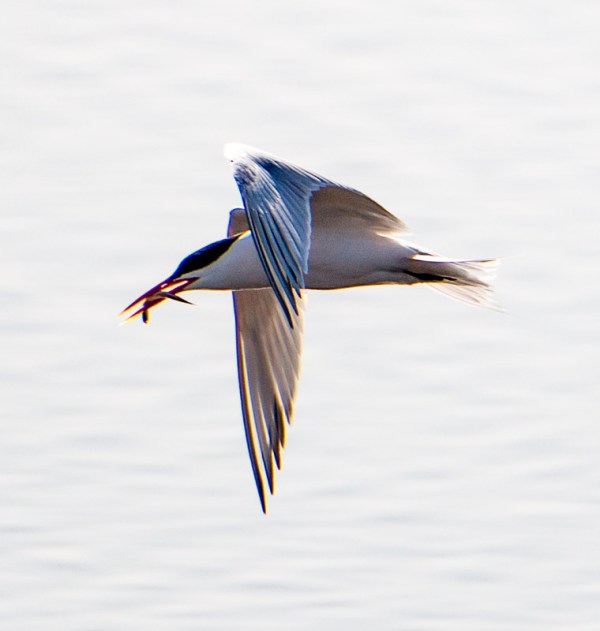
Lucky tern, unlucky fish (R. Juncosa 4/24/16)
We don’t get a lot of Black-necked Stilts at the lagoon: 29 total birds in 7 sightings, including today’s 19 birds. Ray Juncosa captured them with some very interesting effects of lighting. Stilts, along with Avocets, are in their own family, Recurvirostridae (Latin – bent backwards bill). Our stilt ranges from the U.S. to the West Indies, Peru & Brazil, plus Hawaii, where it used to be considered a separate species, the Hawaiian Stilt. The five other Stilt species and ranges are: Black-winged – Eurasia & Africa; Pied – Indonesia to New Zealand; the critically endangered Black – South Island of New Zealand; White-backed – so. South America; Banded – Australia.

Black-necked Stilts, a study (R. Juncosa 4/24/16)
The “semipalmated” foot is partially webbed between the toes. The Semipalmated Plover is a regular Spring & Fall migrant visitor at the lagoon, but no one ever actually sees the webbing. Of the “stints” or “peeps” in the Calidris genus, two are also semipalmated – the Western (Calidris mauri) (Greek – “a gray speckled sandpiper” + mauri [Ernesto Mauri, Italian naturalist]) and the aptly named Semipalmated Sandpiper (C. pusilla) ( Latin – very small).
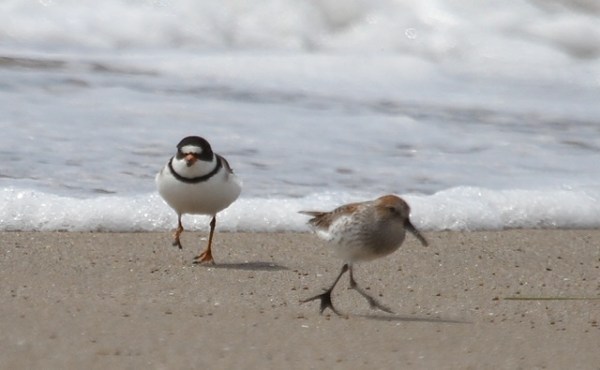
Somehow the semipalmated foot moved from the Semipalmated Plover (left) to the Western Sandpiper (J. Waterman 4/24/16)
I could find nothing in book or on web about differences in webbing between the Western and Semipalmated Sandpipers (SeSa), so I checked with Kimball Garrett of the L.A. Co. Museum of Natural History. He replied, in short, “No difference.” “Then why,” you (dear reader) may inquire, “is one called semipalmated and the other isn’t?” The answer, I believe, is (as with “unusual” Elegant Tern presence) time-dependent. The SeSa was first described in 1766 by Linnaeus himself, based on a specimen from Santo Domingo, which he named Tringa (changed much later to Calidris) pusilla. The Western was described a century later in 1857, from a specimen from South Carolina. [Many Westerns winter on the SE U.S. coast.] The name Semipalmated was already taken, so Western it became.
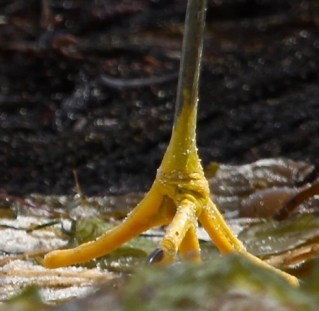
If you don’t know what this is, come birding with us. No, it’s not a plover or sandpiper foot.
(J. Waterman 4/24/16)
So what about the rarely seen webbed feet of the Semipalmated Plover (Charadrius semipalmatus)? I’ll spare you the gruesome details and say simply that it has visible – but short – webbing between all three toes. The very similar Ringed Plover (C. hiaticula) of Eurasia & Africa has visible webbing between middle and outer toe, and nearly invisible webbing between middle and inner toe. 10,000 Birds gives a great description, but the pictures of feet aren’t so hot. [Beware (!!) of Google Images – I’ve seen many misidentifications there.]
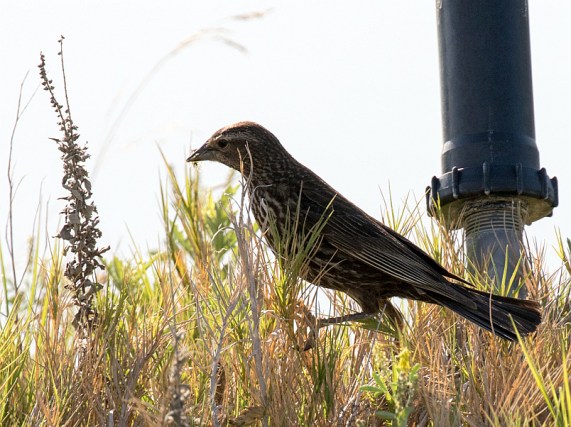
Many people mistake the female Red-winged Blackbird for a sparrow
(R. Ehler 4/24/16)
We didn’t have any Snowy Plovers; probably all have left for their various breeding grounds farther north. Grace Murayama snapped this nice photo of an adult Snowy on 4/13.

The last Snowy Plover of Springtime (G. Murayama 4/13/16)
Bonaparte’s Gull is another species whose lagoon presence has changed significantly over the years. We used to get them in large numbers: 3-15-80 1,600 birds, 11-29-80 530, 12-12-82 1,095. Our last triple-digit count was 632 birds on 1-8-83, shortly after the first lagoon reconfiguration in late 1982. Since then, out of 180 census days, their numbers have reached double-digits only 6 times out of 62 sightings. I don’t know if their overall population has plummeted, or they just didn’t like the new (in 1983) lagoon and stopped coming.
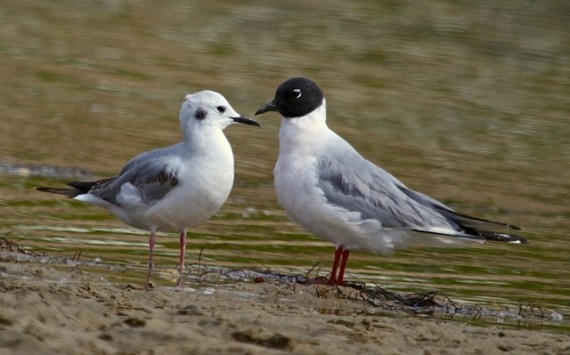
Bonaparte’s Gull – basic & alternate plumages (J. Waterman 4/24/16)
Birds new for the season were: Black-necked Stilt, Semipalmated Plover, Common Murre (by Malibu Pier), Belted Kingfisher, Violet-green Swallow, Black-headed Grosbeak, Red-winged Blackbird, Western Meadowlark, Brewer’s Blackbird, and Brown-headed Cowbird.
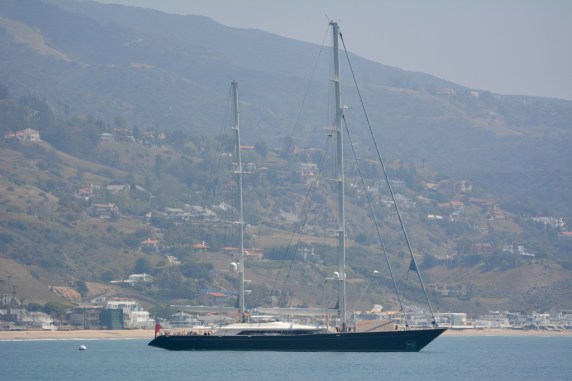
The foremast is about 170 ft high on this giganto-yacht moored off Malibu Pier
(G. Murayama 4/13/16)
As always, many thanks to our photographers: Chuck Bragg, Randy Ehler, Ray Juncosa, Grace Murayama and Joyce Waterman.
*Cotillion of Elegant Terns is the official collective noun for this species.
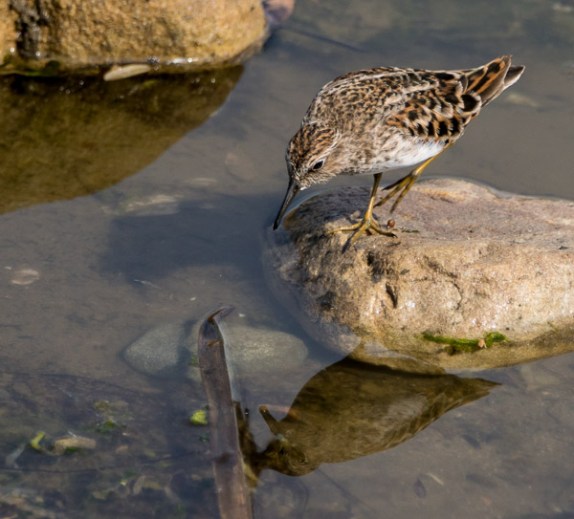
Least Sandpiper, like Narcissus, admires his own reflection (C. Bragg 4/24/16)
Our next four scheduled field trips: To be announced, 14 May; Malibu Lagoon 8:30 & 10am, 22 May; Mt. Piños, 11-12 June 8am; Malibu Lagoon 8:30 & 10am, 26 Jun.

American Robins infrequent the lagoon
(R. Ehler 4/24/16)
Our next program: Grunion, Tuesday, 3 May, 7:30 pm, at [note location change] Chris Reed Park, 1133 7th St., NE corner of 7th and Wilshire Blvd. in Santa Monica.
NOTE: Our 10 a.m. Parent’s & Kids Birdwalk meets at the shaded viewing area. Watch for Willie the Weasel. He’ll be watching for you and your big floppy feet.
Links: Unusual birds at Malibu Lagoon
9/23/02 Aerial photo of Malibu Lagoon
Prior checklists:
2015: Jan-May, July-Dec 2014: Jan-July, July-Dec
2013: Jan-June, July-Dec 2012: Jan-June, July-Dec
2011: Jan-June, July-Dec 2010: Jan-June, July-Dec
2009: Jan-June, July-Dec
The 10-year comparison summaries created during the project period, despite numerous complaints, remain available on our Lagoon Project Bird Census Page. Very briefly summarized, the results unexpectedly indicate that avian species diversification and numbers improved slightly during the period Jun’12-June’14. [Chuck Almdale]
| Malibu Census 2016 | 11/22 | 12/27 | 1/24 | 2/28 | 3/27 | 4/24 |
| Temperature | 64-80 | 48-61 | 48-64 | 57-70 | 55-65 | 60-67 |
| Tide Lo/Hi Height | L+0.24 | H+6.07 | H+5.90 | L+1.38 | H+3.43 | H+3.63 |
| Tide Time | 1241 | 0945 | 0855 | 0654 | 1228 | 1143 |
| Brant | 3 | 2 | ||||
| Canada Goose | 11 | 7 | ||||
| Gadwall | 4 | 13 | 3 | 20 | 14 | 4 |
| American Wigeon | 2 | 10 | 16 | 10 | ||
| Mallard | 25 | 2 | 15 | 22 | 16 | 18 |
| Northern Shoveler | 8 | 2 | 16 | 12 | 14 | |
| Northern Pintail | 2 | 4 | ||||
| Green-winged Teal | 11 | 8 | 8 | |||
| Lesser Scaup | 5 | |||||
| Surf Scoter | 1 | 2 | 17 | 16 | ||
| Bufflehead | 4 | 1 | 2 | 2 | ||
| Hooded Merganser | 2 | |||||
| Red-brstd Merganser | 2 | 17 | 3 | 3 | 2 | |
| Ruddy Duck | 110 | 1 | 10 | |||
| Red-throated Loon | 1 | 2 | ||||
| Pacific Loon | 2 | 1 | 2 | |||
| Common Loon | 2 | 1 | 1 | |||
| Pied-billed Grebe | 3 | 2 | 3 | 8 | 3 | |
| Horned Grebe | 1 | 1 | ||||
| Eared Grebe | 10 | 2 | 2 | 5 | 2 | |
| Western Grebe | 15 | 4 | 1 | 1 | ||
| Blk-vented Shearwater | 1 | |||||
| Brandt’s Cormorant | 2 | 1 | 4 | 2 | ||
| Dble-crstd Cormorant | 45 | 15 | 24 | 19 | 6 | 23 |
| Pelagic Cormorant | 2 | 1 | 2 | |||
| Brown Pelican | 11 | 10 | 30 | 43 | 28 | 77 |
| Great Blue Heron | 3 | 2 | 3 | 4 | 3 | |
| Great Egret | 1 | 2 | 2 | 1 | 5 | 2 |
| Snowy Egret | 8 | 30 | 21 | 7 | 7 | 4 |
| Blk-crwnd N-Heron | 1 | |||||
| Osprey | 1 | 1 | 1 | 3 | 1 | |
| Cooper’s Hawk | 1 | 1 | ||||
| Red-shouldered Hawk | 1 | |||||
| Red-tailed Hawk | 1 | |||||
| Sora | 1 | 2 | ||||
| American Coot | 60 | 10 | 40 | 65 | 53 | 4 |
| Black-necked Stilt | 19 | |||||
| Blk-bellied Plover | 33 | 30 | 12 | 32 | 8 | 20 |
| Snowy Plover | 28 | 12 | 4 | 3 | ||
| Semipalmated Plover | 8 | |||||
| Killdeer | 4 | 14 | 2 | 4 | 3 | 2 |
| Spotted Sandpiper | 2 | 5 | 1 | 1 | 1 | |
| Greater Yellowlegs | 1 | |||||
| Willet | 18 | 13 | 8 | 8 | 12 | 10 |
| Whimbrel | 5 | 1 | 3 | 4 | 21 | 2 |
| Marbled Godwit | 8 | 11 | 13 | 22 | 15 | 6 |
| Ruddy Turnstone | 9 | 2 | 5 | 1 | ||
| Surfbird | 1 | |||||
| Sanderling | 6 | |||||
| Least Sandpiper | 4 | 13 | 7 | |||
| Western Sandpiper | 4 | 35 | 1 | |||
| Long-billed Dowitcher | 2 | 2 | ||||
| Common Murre | 1 | 3 | ||||
| Bonaparte’s Gull | 2 | 1 | 3 | |||
| Heermann’s Gull | 11 | 4 | 1 | 2 | ||
| Mew Gull | 1 | |||||
| Ring-billed Gull | 95 | 60 | 30 | 90 | 15 | 1 |
| Western Gull | 140 | 80 | 13 | 160 | 45 | 60 |
| California Gull | 1430 | 620 | 400 | 650 | 130 | 15 |
| Thayer’s Gull | 1 | |||||
| Glaucous-wingd Gull | 1 | 1 | 4 | 1 | ||
| Caspian Tern | 3 | 19 | ||||
| Forster’s Tern | 3 | |||||
| Royal Tern | 23 | 11 | 25 | 31 | 18 | 2 |
| Elegant Tern | 5 | 1800 | ||||
| Rock Pigeon | 20 | 2 | 2 | 6 | 6 | 6 |
| Mourning Dove | 1 | 2 | 2 | 2 | 1 | |
| Anna’s Hummingbird | 2 | 3 | 1 | 2 | 1 | |
| Allen’s Hummingbird | 5 | 2 | 3 | 3 | 4 | 4 |
| Belted Kingfisher | 1 | 1 | ||||
| American Kestrel | 1 | 1 | ||||
| Merlin | 1 | |||||
| Peregrine Falcon | 1 | |||||
| Nanday Parakeet | 8 | 2 | ||||
| Black Phoebe | 10 | 12 | 3 | 8 | 6 | 4 |
| Say’s Phoebe | 1 | 2 | 1 | 1 | ||
| Cassin’s Kingbird | 1 | |||||
| Western Scrub-Jay | 1 | |||||
| American Crow | 3 | 1 | 6 | 23 | 6 | 4 |
| Common Raven | 1 | 1 | ||||
| Violet-green Swallow | 1 | |||||
| Rough-wingd Swallow | 10 | 10 | ||||
| Cliff Swallow | 1 | 6 | ||||
| Barn Swallow | 6 | 4 | ||||
| Oak Titmouse | 1 | 1 | ||||
| Bushtit | 28 | 40 | 4 | 5 | 4 | |
| House Wren | 2 | 1 | 1 | |||
| Marsh Wren | 1 | |||||
| Bewick’s Wren | 1 | 1 | ||||
| Blue-gray Gnatcatcher | 9 | 3 | ||||
| Ruby-crowned Kinglet | 10 | 6 | 1 | |||
| Western Bluebird | 1 | |||||
| Hermit Thrush | 1 | 3 | 1 | |||
| American Robin | 2 | 1 | ||||
| Northern Mockingbird | 6 | 2 | 1 | 3 | 4 | 6 |
| European Starling | 21 | 10 | 110 | 90 | 1 | 2 |
| Ornge-crwnd Warbler | 5 | |||||
| Common Yellowthroat | 7 | 1 | 1 | 5 | 5 | |
| Yellow-rumpd Warbler | 40 | 40 | 9 | |||
| Townsend’s Warbler | 1 | |||||
| Spotted Towhee | 2 | 1 | ||||
| California Towhee | 1 | 1 | 2 | 5 | 3 | |
| Savannah Sparrow | 1 | |||||
| Song Sparrow | 3 | 6 | 3 | 3 | 12 | 14 |
| Lincoln’s Sparrow | 1 | |||||
| White-crwnd Sparrow | 4 | 15 | 20 | 5 | 5 | |
| Black-headed Grosbeak | 1 | |||||
| Red-winged Blackbird | 5 | |||||
| Western Meadowlark | 5 | 4 | 2 | |||
| Brewer’s Blackbird | 6 | |||||
| Great-tailed Grackle | 4 | 3 | 2 | 1 | 9 | 3 |
| Brwn-headed Cowbird | 2 | |||||
| Hooded Oriole | 1 | |||||
| House Finch | 4 | 3 | 1 | 6 | 21 | 16 |
| Lesser Goldfinch | 1 | |||||
| Totals by Type | Nov | Dec | Jan | Feb | Mar | Apr |
| Waterfowl | 169 | 58 | 61 | 118 | 74 | 22 |
| Water Birds – Other | 152 | 48 | 104 | 146 | 100 | 106 |
| Herons, Egrets & Ibis | 13 | 34 | 26 | 12 | 15 | 6 |
| Quail & Raptors | 2 | 4 | 2 | 4 | 2 | 1 |
| Shorebirds | 113 | 83 | 50 | 86 | 113 | 76 |
| Gulls & Terns | 1703 | 775 | 472 | 939 | 219 | 1903 |
| Doves | 21 | 2 | 4 | 8 | 8 | 7 |
| Other Non-Passerines | 7 | 6 | 4 | 13 | 7 | 5 |
| Passerines | 164 | 156 | 150 | 168 | 105 | 95 |
| Totals Birds | 2344 | 1166 | 873 | 1494 | 643 | 2221 |
| Total Species | Nov | Dec | Jan | Feb | Mar | Apr |
| Waterfowl | 10 | 10 | 8 | 11 | 7 | 2 |
| Water Birds – Other | 11 | 9 | 9 | 10 | 9 | 4 |
| Herons, Egrets & Ibis | 4 | 3 | 3 | 3 | 3 | 2 |
| Quail & Raptors | 2 | 4 | 2 | 2 | 2 | 1 |
| Shorebirds | 9 | 10 | 6 | 10 | 11 | 10 |
| Gulls & Terns | 7 | 7 | 5 | 9 | 8 | 8 |
| Doves | 2 | 1 | 2 | 2 | 2 | 2 |
| Other Non-Passerines | 2 | 3 | 2 | 3 | 3 | 2 |
| Passerines | 20 | 21 | 12 | 19 | 22 | 20 |
| Totals Species | 67 | 68 | 49 | 69 | 67 | 51 |
Climate change is THE existential question that humanity is facing. But are we too late? Has climate change reached the point of no return? Are we doomed?
**What’s the state of climate change right now?**
Since around 1880, the average global temperature of the earth has increased by 1 degree Celsius, or 1.8 degrees Fahrenheit. That increase is due almost entirely to humans burning fossil fuels, mostly from 1950 on. That might not sound like a big increase, but it is. It means sea level rise, shrinking polar ice caps, and increased extreme weather events like heat waves and monsoons.
That’s why a hundred and ninety-plus countries signed onto the Paris Climate Agreement. The goal is to limit the temperature increase to 1.5 degrees Celsius — or 2.7 degrees Fahrenheit — by the end of this century. Many scientists say that staying under 1.5 puts us near the upper limit of what’s tolerable. We’ll have droughts, sea level rise, and extreme weather, but chances are we can manage it.
**What does climate change look like in the future?**
That’s why we have the IPCC. The IPCC is part of the United Nations, and it stands for the Intergovernmental Panel on Climate Change. It’s been the world’s top authority on climate science for the last 30 years. Thousands of climate scientists from around the world volunteer their time to analyze and summarize the latest and best climate science. According to these experts, if we keep burning fossil fuels like we are today, then we’re blowing past 1.5 degrees of warming by 2100. We’ll almost definitely hit 2 degrees, and might even reach 3 or even 4 degrees. That means longer and more intense heat waves. And stronger hurricanes and dangerous flooding.
**How do we get climate change under control?**
Let’s start with transportation. 95% of the vehicles on the planet burn fossil fuels. They’re responsible for almost ⅓ of all greenhouse gas emissions worldwide! It might sound like a pipe-dream to replace those gas-guzzlers with electric vehicles, but it might not be. In the last decade and a half electric vehicles that don’t have any pollution out of the tailpipe went from a dream to commonplace in places like California, China, Norway.
ABOVE THE NOISE is a show that cuts through the hype and takes a deeper look at the science behind controversial and trending topics in the news. Hosted by Myles Bess and Shirin Ghaffary.
This series is aimed at teens, but after viewing a few episodes, I’m sure that most adults will benefit from it as well. Let us know what you think.
This is another installment of KQED’s Above the Noise series. If no film or link appears in this email, go to the blog to view it by clicking on the blog title above. If the film stops & starts in an annoying manner, press pause (lower left double bars ||) to let it buffer and get ahead of you. [Chuck Almdale]
Editor’s Note: Entry number nine in our tenth anniversary exercise in total recall was originally posted May 2, 2010, is nineteenth in overall popularity but first in field trip report popularity. We still try to run camping trips to Butterbredt twice a year – Springtime and Halloween – but don’t always succeed. I posted it, but Mary wrote it.
***********************************************************

Indian Paintbrush (G.Bando 5/10)
Great weather was the rule, although powerful, gusty winds on Highway 14 challenged control of my Dolphin RV on Friday evening. Three of us were en route to Sageland, in preparation for our Saturday morning meeting with the rest of our group at Butterbredt Spring.
Next morning, warmly dressed, we drove up and down through a frosty Butterbredt Canyon in Roxie’s 4WD hybrid Ford. We chose that route partly to test the road – which is often messed up by motorcycles and tricky to drive –but also to catch migrants. It was a hasty journey, but we heard unmistakable songs of Western Meadowlarks, briefly glimpsed a Mountain Quail scurrying up the hill, had a great look at a male Scott’s Oriole on a Joshua Tree, a Western Kingbird and a briefly perched Cooper’s Hawk. Approaching the spring, we saw large groups of migrants passing westward along the canyon’s sides and ridge, too quickly to count or even guess their names.

Western Kingbird (G.Bando 5/10)
We three – my daughter Roxane, my neighbor Linda Cady (retired Jr. High science teacher who loved camping with her students, is a nature enthusiast and new to birding) and I – met the rest of our group waiting at the Spring: Jean Garrett, Gloria Bando and Chris Lord. We later joined Keith Axelson at his Sageland Ranch where we camped and had dinner, including a cake to celebrate his 85th birthday on this trip, which he inaugurated many years ago. Many birders honor Keith as primarily responsible for establishing Butterbredt Spring as a premier birding destination and Sanctuary, supported by Santa Monica Bay Audubon.
8:15 a.m. is a little late to catch all the migrants, but we immediately found many species of birds. A beautiful male and female Black-throated Grey Warbler, Lesser Goldfinches, Chipping Sparrows, Dark-eyed Juncos, Wilson’s Warblers dripping off willow branches, male and female Black-headed Grosbeaks, Yellow-rumped Warblers in eye-popping breeding plumage and White-crowned Sparrows to list a few. Mourning Doves and House Finches were numerous. California Towhees, Bewick’s Wrens, House Wrens and Rock Wrens were all singing. Long-eared Owls and Roadrunners were absent, but maybe next year! Floral bonuses included: deep pink Beavertail Cactus on the slopes, many yellows, especially brilliant Biglow’s Coreopsis, Golden Bush, and other yellow composites. Purple Chia was also common, and deep blue, fragrant Bush Lupine warranted numerous pictures.
An interesting variety of difficult-to-identify lizards were a frequent distraction: we think they included a yellowish Southern Alligator Lizard, a Common Leopard Lizard, a Western Skink, a Whiptail and numerous Fence Lizards. I hesitate to speculate on butterflies, but American Ladies and small Blues were common.

Common Leopard Lizard. Cryptic, isn’t it? (G.Bando 5/10)
While walking back up-canyon, Jean spotted a House Finch, seeming secure in its nest built in a very prickly cholla cactus. An Ash-throated Flycatcher perched and called. Hammond’s Flycatcher’s were in the Spring’s cottonwoods and along the trail. A couple of Loggerhead Shrikes sat on trailside Joshua trees. California and Mt. Quail and Chukar lurked and chattered in the shrubbery. The call of a male Mt. Quail tantalizingly, and invisibly, echoed down the canyon.
To our surprise we found both an out-of-place Acorn Woodpecker on a cottonwood tree in the desert canyon, and an excellent look at Green-tailed Towhee. Even more surprising was a Yellow-breasted Chat foraging low in trailside bushes and the base of willows beyond the large cottonwood. It was uncharacteristically silent, but willing to be seen!
Exploring independently around the spring, Chris found a MacGillivray’s Warbler, both Cassin’s and Warbling Vireos, and a Costa’s Hummingbird. We joined him and saw Hermit Thrushes working the ground and three Great Horned Owls in the trees. A Black-throated Sparrow was viewed singing.
Chris needed to leave early, so after lunch he took Jawbone Road to Sageland Ranch to say hi to Keith. Our two remaining vehicles tackled the sandy track back up Butterbredt Canon in hopes of eagles and other rarities. Jean, expertly driving her non-4WD car, managed the challenge. We saw Common Ravens and Red-tailed Hawks, but no Pinyon Jays or Golden Eagles by the time we exited onto Kelso Valley Rd. The pond and creek at Tunnel Well, which occasionally harbors Wilson’s Snipes, didn’t, but we added more Ruby-crowned Kinglets, Red-winged Blackbirds, a Killdeer and Spotted Towhee.
Welcomed at Sageland, we set up camp, explored the local canyon, relaxed and enjoyed observing the numerous nesting bird families as we added to our sightings. Of the dozens of wintering Pine Siskins, seven remained to swarm Keith’s finch feeders. Three nest boxes held active Western Bluebird families. One of the male bluebirds pounded a window periodically, as it had been doing for some weeks. A pair of Say’s Phoebes tended their nest under an eve. A pair of Phainopeplas displayed in the tree tops and an American Kestrel pair, nesting in the large box on the water tank, entertained us, with the male bringing lizards to feed his mate and spell her on egg duty. They eat a lot of lizards! At sundown, Kingbirds twittered as they settled to sleep in the trees, and groups of quail fluttered and chattered as they found their night’s roosts.
The Western Scrub-Jays patronized other feeders while small flocks of California Quails cleaned up below; the chipmunks vacuumed their share despite Keith’s black kitty watching for a chance to grab one.
The admirable Saki has learned never to make a move on a bird! He is probably one of the world’s few well-trained cats. Occasionally, a handsome little male Costa’s hummer with brilliant magenta georgette came to sip at the nectar feeder but, unfortunately, male or female Scott’s Orioles chose not to appear. A male Bullock’s Oriole did visit in the trees. Nuttall’s Woodpeckers, male and female, drummed to mark territory and find insects. More unique were the pair of Hairy Woodpeckers seen foraging in the grounds. I must mention the California Thrasher pouring out song up on the hillside, along with Bewick’s Wrens, and an Oak Titmouse sounding off. Morning calls included the unmistakable coo of a Eurasian Collared Dove, which has found its way to Keith’s land, and, of course, European Starlings.

Baby Blue Eyes on sandy soil (G.Bando 5/10)
Keith had prepared, mowed clear paths, cut away overgrown branches, improved the trail in his canyon for our safety and convenience. The stream flows continuously. It is an idyllic place. We were able to add Song Sparrow, Western Wood Pewee, Orange-crowned Warbler, Brewer’s Sparrow to our lists, if they had not been seen before, along with a debated empidonax flycatcher.
Townsend’s Warblers and a Plumbeous Vireo were seen later. At night, Western Screech-Owls gave their little warbling contact calls to prove their presence in a hollow cottonwood limb, where we hope they are raising a family. Also distant Great Horned Owls hooted under the ever brilliant desert starry sky.
On Sunday morning a pair of Ash-throated Flycatchers entertained us by continually examining the empty, for rent, nest boxes, bringing material with obvious thoughts of setting up housekeeping.
We we then hiked through fences and brush to Dove Spring Rd., admiring the flowers and checking Joshua Tree nest holes.

House Finch nest in Cholla cactus – Watch that first step when leaving! (G.Bando 5/10)
We found a pair of Cactus Wrens with a nest in progress in their favorite nesting location, a cholla cactus. We saw Western Kingbirds with similar intentions. Occasionally we needed to dodge roaring motorcycles (the only sour note in Paradise). Sadly, their idea of “fun” doesn’t merely miss the wonder of their surroundings but often defies all laws protecting that environment. Fortunately, the Friends of Jawbone Canyon, the BLM, and the SCA organization of young volunteers (which SMBAS supports financially), have made huge improvements in blocking and obliterating their illegal trails.
We also found a House Finch nest in a cholla. Theirs is an open-bowl nest unlike the Cactus Wren’s nest which is a roughly globe-shaped nest with a side entrance, always well-buried among the extremely thorny cholla branches. Incidentally, a cholla location did not save a wren nest last season when a bear came along, tore the nest and birds out of the cholla and devoured them!
As we hiked we could hear the melodic songs of distant Scott’s Orioles and the ever elusive Mt. Quail calling. We can be glad those are so cautious. Hunting season will test their survival strategies.
Most of our participants needed to head back to Los Angeles in the afternoon, but took with them, I believe, memories of a beautiful experience. I thank them, as does Keith, for joining us and making the outing a success.
I often think how very fortunate we are to have this tradition and connection to the real, wild world, where there is escape from the insanity, the violence, the unending consumerism, commercialism, and banal entertainments which currently dominate human society and destroy Nature. There, in the desert wilderness, one can escape to a haven of sanity, quiet, where all living things – animal, plant, and even the earth itself – are allowed to exist in peace, work out destiny, and, you can hear the birds sing!
All this peace may be gone at some point, of course, under the groaning rumble of wind turbines on the ridges (ask someone who lives near one; they are not as ecologically benign as touted.) Or when development creeps south along the valley road. But for now, we are greatly privileged. I am sorry some, who wanted to come, could not make it after all this year. Perhaps they and others will join us on another occasion. My species count may not be altogether complete. But it I will add it to almost 30 years of memorable Butterbredt Spring spring trips! Thanks, Keith, for having made them possible. [Mary Prismon]
| Butterbredt Trip List | May 1-2, 2010 |
| Chukar | Western Bluebird |
| Mountain Quail | Hermit Thrush |
| California Quail | Northern Mockingbird |
| Cooper’s Hawk | California Thrasher |
| Red-tailed Hawk | European Starling |
| American Kestrel | Phainopepla |
| Killdeer | Orange-crowned Warbler |
| Eurasian Collared Dove | Yellow-rumped Warbler |
| Mourning Dove | Black-throated Grey Warbler |
| Western Screech-Owl | Townsend’s Warbler |
| Great Horned Owl | MacGillivray’s Warbler |
| Costa’s Hummingbird | Wilson’s Warbler |
| Acorn Woodpecker | Yellow-breasted Chat |
| Nuttall’s Woodpecker | Green-tailed Towhee |
| Hairy Woodpecker | Spotted Towhee. |
| Western Wood Pewee | California Towhee |
| Hammond’s Flycatcher | Chipping Sparrow |
| Say’s Phoebe | Brewer’s Sparrow |
| Ash-throated Flycatcher | Black-throated Sparrow |
| Western Kingbird | Song Sparrow |
| Loggerhead Shrike | White-crowned Sparrow |
| Plumbeous Vireo | Dark-eyed Junco |
| Cassin’s Vireo | Black-headed Grosbeak |
| Warbling Vireo | Red-winged Blackbird |
| Western Scrub Jay | Western Meadowlark |
| Common Raven | Brewers Blackbird |
| Oak Titmouse | Bullock’s Oriole |
| Cactus Wren | Scott’s Oriole |
| Rock Wren | House Finch |
| Bewick’s Wren | Pine Siskin |
| House Wren | Lesser Goldfinch |
| Ruby-crowned Kinglet | 63 Species |



 SANTA MONICA BAY AUDUBON SOCIETY BLOG