Free email delivery
Please sign up for email delivery in the subscription area to the right.
No salesman will call, at least not from us. Maybe from someone else.
An up-close look at the territorial displays and breeding behavior of the Red-winged Blackbird.
Learn more about Red-winged Blackbirds on All About Birds: https://www.allaboutbirds.org/guide/Red-winged_Blackbird/id
A film from the Cornell Lab of Ornithology. If no film or link appears in this email, go to the blog to view it by clicking on the blog title above. If the film stops & starts in an annoying manner, press pause (lower left double bars ||) to let it buffer and get ahead of you. The Lab is a member-supported organization; they welcome your membership and support. [Chuck Almdale]
Reprise 4: Kestrel Photoshow
Editor’s Note: Entry number four in our tenth anniversary trip down memory lane was originally posted July 7, 2013, and is fifteenth in popularity. Our readership then was about 1/8th, or maybe 1/16th what it is now, and – for us – went viral with over 1100 hits. [Please stop laughing.] This Kestrel nest box project is still in operation with the participation of (mostly) the same people.
Go to the blog to see all 21 pictures in the slideshow. For the most part the photos are self-explanatory.
With two exceptions, the photos were taken on June 17, 2013. Two nests were involved, with significant age differences between the two groups of nestlings.
Kestrel Team Leader, Don McCartney, provided the following comment on Kestrel chick meals, which sheds light on some of the pictures.
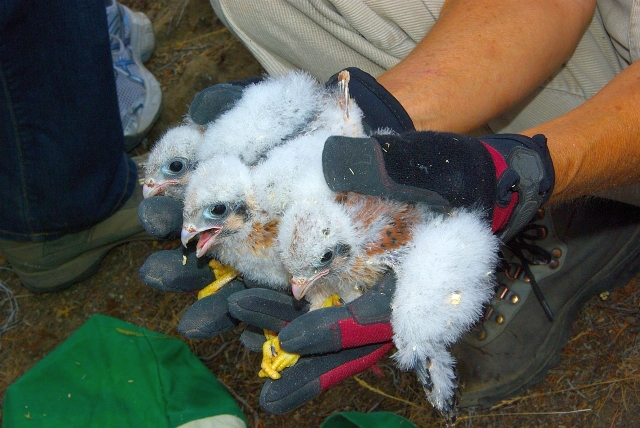
Quite a handful – now I know why the parents build nests
(Don & Diana Roberts 6/17/13)
We have documented some of the rather amazing eating habits of nestling Kestrels. One photo, taken in Wisconsin in 2005, shows an approximately 18-day old female slooowly devouring a snake. Another photo shows a little glutton on the Crooked River Ranch, who was being retrieved for banding from its nestbox by volunteer Marilynne Keyser. Several photos show close-ups of the bird as it devours a western fence lizard. It’s too bad that we didn’t have the time to check on the progress of the nestling/lizard situation a day or two later.
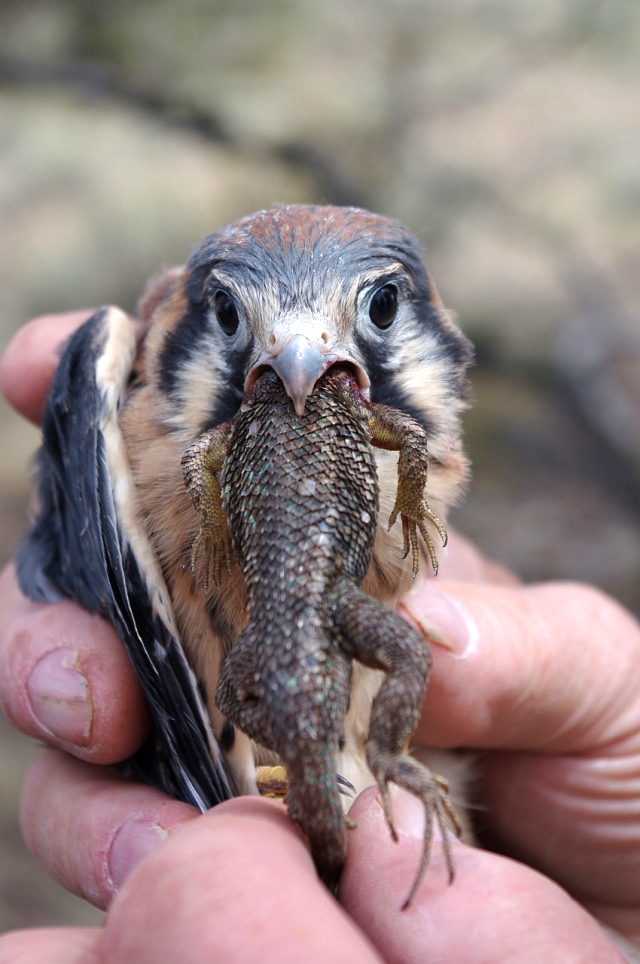
It’s a western fence lizard
(Don & Diana Roberts 6/17/13)
How do they do this? Once the chicks reach a certain size, the adults drop the intact reptile in the box rather than tearing them to pieces. Specialized mouth parts, including the median ridge, keep the prey progressing inward while allowing the nestling to breathe. It is very often interesting to check the remains of prey in the boxes to discover the animals on which the Kestrels have been dining.
*****************
Photographers Don & Diana Roberts live in the small town of Prineville, northeast of Bend, Oregon, just east of the central Cascade Mountains. Don is a professional fly fisherman, photographer and writer; Diana is an avid birder and photographer, as is Marilynne Keyser, the intrepid bird-handler in many of the photos. The fellow in the straw hat and holding the ID booklet is Don McCartney; when Jim Anderson isn’t checking wings and ringing the legs of birds, he’s resting in his portable lawn chair. [Chuck Almdale]
Reprise 3: Malibu Lagoon Fish Life
Editor’s Note: Entry number three in our tenth-year “blasts from the past” celebration, originally posted July 6, 2014, and number twenty on our popularity list. The mullets continued to “go forth and multiply” in the lagoon. Then August, 2018 arrived (read about it). Extreme temperatures continued for weeks, the shallow lagoon became overheated. Even the ocean was exceptionally warm and an oceanic “blob” of hot water extended northward from Baja California to Santa Barbara. Lagoon waters rose to 84°F., ten degrees above the survival point of the mullet. Warm waters lose dissolved oxygen. Fish rose to the surface, gulping air. Within a week, they died en masse. Over four thousand mullet dead were collected and counted by emergency workers. The dead dismayed beach-goers; most of us were stunned to discover that the lagoon held so many fish. The mullet are recovering, jumping again in fewer numbers, but our delight is tempered by the knowledge of what may happen again. [Chuck Almdale]
************************************************************

Striped Mullet (Wikipedia)
According to Wikipedia, Striped Mullet goes by many names, including: Black mullet (Cuba, US), Bully mullet (Australia, Vietnam), Callifaver mullet (Cuba, Netherlands Antilles, US), Common grey mullet (UK), Common mullet (Cuba, Netherlands Antilles, US), Flathead grey mullet (India, Philippines, UK), Flathead mullet (Europe, FAO, UN), Grey mullet (Thailand, Turkey, Australia, Taiwan, Cuba, Fiji, Hong Kong, Mauritius, Netherlands Antilles, New Zealand, Spain, Tonga, UK, US, Mediterranean, Egypt), Hardgut mullet (Australia), Mangrove mullet (Australia), and Sea mullet (Australia, Fiji, Papua New Guinea, UK).
Decades ago, British and American bird mavens decided to agree on English names for all the world’s birds. They’ve made much progress, with some exceptions such as when the bird Americans knew as Common Gallinule was renamed Common Moorhen to satisfy British intransigence (recently rectified), whereupon some American birders pointed out that we don’t have moors, they’re not all hens, and they’re not all that common. LAAS’s Western Tanager newsletter, highlighting this problem of multiple nomenclature once ran an article, by Kimball Garrett & Jon Dunn, detailing how to differentiate between three then-widespread egrets: Common, Great and American. [It was an April first issue in I forget which year.]
Fish lovers have made no such progress, as any piscivore should know. Surely you are aware that Chilean sea bass was previously known as Patagonian toothfish; the name change was a marketing decision – sea bass sounded far more scrumptious than toothfish, and anyway, no real red-blooded American knows where Patagonia is. [The friendly sales people at REI will gladly direct you towards their clothing racks.]
Which brings us around to the mullet many have seen leaping friskily from Malibu Lagoon in recent months. The New England Aquarium says they are also called jumping mullet or jumping jack (take that, Wikipedia!) because of this behavior. I couldn’t find out if this is a courting display, a feeding behavior, an attempt to shake off parasites or a recreational activity. [Anyone out there know?]
If you haven’t personally witnessed this phenomenon, check out the Dance of the Striped Mullet slideshow on Bob Purvey’s EcoMalibu website.
EcoMalibu also has a video page of forty different films pertaining to Malibu Lagoon and the reconfiguration project. The following is a list of short underwater films taken near the water monitoring stations (those posts with vertical depth gauges) ; you’ll be surprised at how much life is swimming around down there. This list, along with many other delights, is on our permanent Malibu Lagoon Project page. [Chuck Almdale]
1. Aug. 7, 2013 Length 1:48 minutes “Life Below the Surface”
2. Aug. 12, 2013 Length 9:20 minutes “Malibu Lagoon Aquarium”
3. Sep. 9, 2013 Length 4:55 minutes “Malibu Lagoon Aquarium III”
4. Sep. 30, 2013 Length 1:47 minutes “Shrimpfest”
5. Oct. 2, 2013 Length 2:42 minutes “Malibu Lagoon Aquarium IV”
6. Oct. 22, 2013 Length 8:31 minutes “Fish, Fish, Fish”
7. Nov. 4, 2013 Length 0:57 minutes “The Big Fish”
8. Apr. 30, 2014 Length 3:36 minutes “Lagoon Crustaceans”
9. Jun. 18, 2014 Length 3:49 minutes “Aquarium & Aviary”
10. Jun. 25, 2014 Length 2:21 minutes “Got Fish? Malibu Lagoon Does”
11. Jun. 25, 2014 Length 2:08 minutes “Shrimpfest II”
12. Jul. 7, 2014 Length 1:56 minutes “Mullet Adult School”
COVID-19: The Tomas Pueyo Blog Series

0.3 Microns. So small you can’t see it.
These blogs have been viewed by over 60 million people and translated into over 40 languages.
Information-rich, not dumbed down. You will know what “The Hammer” and “The Dance” are, why we are currently exiting The Hammer stage and entering The Dance, what it it takes to get to the dance and – eventually – through it, and why we shouldn’t rush it. Very highly recommended, and thanks to Ray Juncosa for sending it to me. [Chuck Almdale]
Important Coronavirus Articles by Tomas Pueyo, with more coming. (Buzzfeed article on Pueyo)
How Bad is the Coronavirus? March 1, 2020. 14 minute read
And what you can do to curb its spread.
https://medium.com/@tomaspueyo/what-you-can-do-to-curb-the-coronavirus-9f878d5982f2
Summary of the article: The world is slowly realizing the true dimension of the coronavirus, but it’s reacting slowly. Here’s a summary (as of March 1, 2020) of everything we know that’s relevant and what we can do to protect ourselves and our communities.
***************************************************************
***************************************************************
Coronavirus: Why You Must Act Now. March 10, 2020. 27 minute read.
Part one of three.
https://medium.com/@tomaspueyo/coronavirus-act-today-or-people-will-die-f4d3d9cd99ca
Summary of the article: Politicians, Community Leaders and Business Leaders: What Should You Do and When?
We all should have read this two months ago. Cases and deaths have risen since then, but the charts and analysis are still valid. Not dumbed-down.
***************************************************************
Coronavirus: The Hammer and the Dance. March 19, 2020. 29 minute read.
Part two of three.
https://medium.com/@tomaspueyo/coronavirus-the-hammer-and-the-dance-be9337092b56
Summary of the article: Strong coronavirus measures today should only last a few weeks, there shouldn’t be a big peak of infections afterwards, and it can all be done for a reasonable cost to society, saving millions of lives along the way. If we don’t take these measures, tens of millions will be infected, many will die, along with anybody else that requires intensive care, because the healthcare system will have collapsed.
Some charts from this article are at the bottom of this page.
***************************************************************
Coronavirus: Out of Many, One. April 1, 2020. 29 minute read.
Part three of three.
https://medium.com/@tomaspueyo/coronavirus-out-of-many-one-36b886af37e9
Summary: It makes political and economic sense for the US to suppress the coronavirus. For that, states and the federal government each have their own roles that they need to adjust.
***************************************************************
***************************************************************
Coronavirus: Learning How to Dance. April 20, 2020. 19 minute read.
Part 1: A Dancing Masterclass, or What We Can Learn from Countries Around the World
https://medium.com/@tomaspueyo/coronavirus-out-of-many-one-36b886af37e9
Summary: The first three articles have been viewed by over 60 million people and translated into over 40 languages. Since then, the number of confirmed coronavirus cases has grown twentyfold, from 125,000 to over 2.5 million. Billions of people around the world are under the Hammer: Their governments have implemented heavy social distancing measures to quench the spread of the virus. Most did the right thing: The Hammer was the right decision. It bought us time to reduce the epidemic and to figure out what to do during the next phase, the Dance, in which we relax the harsh social distancing measures in a careful way to avoid a second outbreak. But the Hammer is hard. Millions have lost their jobs, their income, their savings, their businesses, their freedom. The world needs answers: When is this over? When do we relax these measures and go back to the new normal? What will it take? What will life be like?
***************************************************************
Coronavirus: The Basic Dance Steps Everybody Can Follow. April 23, 2020. 18 minute read.
Part 2 of Coronavirus: Learning How to Dance
https://medium.com/@tomaspueyo/coronavirus-the-basic-dance-steps-everybody-can-follow-b3d216daa343
Summary: Any country can follow a series of measures that are very cheap and can dramatically reduce the epidemic: mandate wearing home-made masks, apply physical distancing and hygiene everywhere, and educate the public.
***************************************************************
Coronavirus: How to Do Testing and Contact Tracing. April 28, 2020. 39 minute read.
Part 3 of Coronavirus: Learning How to Dance
https://medium.com/@tomaspueyo/coronavirus-how-to-do-testing-and-contact-tracing-bde85b64072e
Summary: We can reopen the economy again if we do a few things right, including testing and contact tracing. We need to test all people with symptoms and their contacts, which means at most 3% of our tests should turn out positive. We need to identify as many infected as possible, and 70% to 90% of their contacts, to isolate or quarantine them. If we do all of that really fast (within a day or so), it might be enough to control the epidemic. We should hire lots of people to do that, and also use technology. The technology has some privacy tradeoffs, but they are really reasonable. Most of the bluetooth contact tracing apps built today are amazing pieces of technology that will be useless unless they get some fundamental changes.
***************************************************************
Coronavirus: Isolations and Quarantines – Not yet published as of May 14, 2020
Part 4 of Coronavirus: Learning How to Dance
***************************************************************
Coronavirus: Prevent Seeding and Spreading. May 12, 2020. 31 minute read.
Part 5 of Coronavirus: Learning How to Dance
https://medium.com/@tomaspueyo/coronavirus-prevent-seeding-and-spreading-e84ed405e37d
Summary: In this section of the article we cover the importance of continuing to limit travel and social gatherings. We touch on the idea of opening travel in less infected areas while isolating areas of higher risk. This section also reviews the impact large social gatherings can have and the importance of preventing the spread at home.
***************************************************************
Coronavirus: Putting it All Together – Not yet published as of May 14, 2020
Part 6 of Coronavirus: Learning How to Dance
Summary: We will give specific recommendations on each, including a warning: Most countries are not approaching the Dance well. If they continue their current path, they will end up like Singapore.
***************************************************************
***************************************************************
Should We Reopen Churches? May 12, 2020. 31 minute read.
https://medium.com/@tomaspueyo/should-we-reopen-churches-38428619a174
Summary: The Coronavirus loves churches. They are its perfect breeding ground: confined environments where lots of people gather for a long time to talk, sing, and touch each other. That’s why temples across the world have closed and masses are conducted online. Yet in the United States, there’s been a debate. Some states have closed churches, while the President asked them to reopen them. The debate is necessary. Churches are important for the spiritual and social lives of many people. It’s essential to try opening them back up as soon as possible.
***************************************************************
Coronavirus: Should We Aim for Herd Immunity Like Sweden. June 9, 2020. 32 minute read.
And what can countries like the U.S. or Netherlands learn from it?
https://medium.com/@tomaspueyo/coronavirus-prevent-seeding-and-spreading-e84ed405e37d
Summary: Sweden has famously followed a different coronavirus strategy than most of the rest of the Developed world: Let the virus run loose, curb it enough to make sure it doesn’t overwhelm the healthcare system like in Hubei, Italy or Spain, but don’t try to eliminate it. They think stopping it completely is impossible. The natural consequence is that most citizens get infected, and that eventually slows down the epidemic. That’s why, in short, people call that strategy “Herd Immunity”. The other strategy is the Hammer and the Dance: Aggressively attack the coronavirus by locking down the economy. Once curbed, jump into the Dance by replacing the aggressive lockdown with cheap and intelligent measures to control the virus. Some countries and states, such as the Netherlands and the UK, or US states like Texas and Georgia, have implemented measures in between the two strategies. So which strategy is best?
***************************************************************
Coronavirus: How to Reopen Travel Safely. June 25, 2020. 11 minute read.
Which citizens should countries allow in? Under what conditions?
https://medium.com/@tomaspueyo/coronavirus-how-to-reopen-travel-safely-f5951dfe06f0
Summary: The current plans to reopen EU countries are too blunt. Citizens from different countries are either blocked or fully allowed to travel. This will result in new outbreaks. Instead, there should be tiers of countries based on best guesses on prevalence and value per visitor. Within that, higher value visitors such as those owning a home should be treated differently. There is no excuse for lack of PCR tests. European countries with special situations, such as Sweden, Portugal or the UK should be treated separately.
Some chart snip excerpts from article two, Coronavirus: The Hammer and the Dance.
All charts are sharper on the original blog.
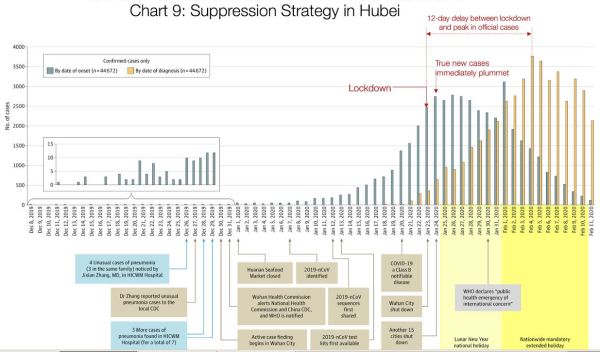
Above chart 9: Chinese authorities were able to determine, through after-the-fact interviews, just when actual cases (blue-gray bars) began, as opposed to known cases (orange bars). Actual cases began to drop within two days after lockdown, but known cases continued to rise.

Above chart 3: The cost of doing nothing is catastrophic.
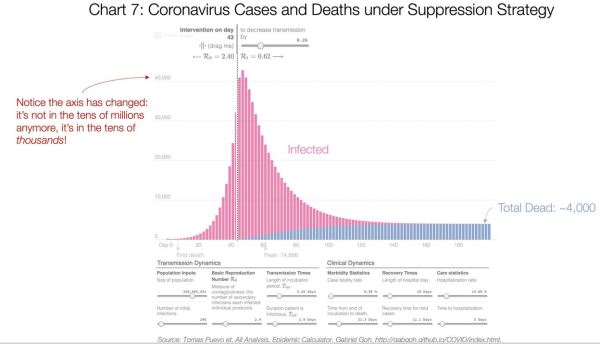
Above chart 7: Under suppression (not just mitigation) death rates plummet.

Above chart 13: “Hammering” the virus through suppression for 3-7 weeks, should be followed by “The Dance,” keeping the transmission rate at one transmission per infected person rather than the 2.4 and higher we previously saw.
Once the Hammer is in place and the outbreak is controlled, the Dance phase begins.

Above chart 14: About 50% (or perhaps 45%) of transmissions occur before the infected person has any symptoms.

Above chart 15: What our authorities need to know and need to do to get the contagion rate below one rate per infected person.
The Superb Lyrebird – Song Breakdown | Bird Kind Video
The Superb Lyrebird (Menura novaehollandiae) is the arguably the finest songster in the world. Famed for its ability to imitate almost any sound it hears, the Lyrebird has been incorporating the calls of other birds long before adding chainsaws and cameras to its repertoire. In this 7 minute clip taken in Dhurug National Park NSW (Australia), we break down the amazing variety of bird calls a single lyrebird can replicate in its song.
List of species imitated in this recording: Grey Butcherbird Laughing Kookaburra Yellow-faced Honeyeater Australian King Parrot Pied Currawong Little Wattlebird Satin Bowerbird Eastern Whipbird Lewin’s Honeyeater Noisy Friarbird Crimson Rosella Grey Shrikethrush Noisy Miner White-eared Honeyeater Yellow-tailed Black Cockatoo.
This is an installment of the Bird Kind series. If no film or link appears in this email, go to the blog to view it by clicking on the blog title above. If the film stops & starts in an annoying manner, press pause (lower left double bars ||) to let it buffer and get ahead of you. [Chuck Almdale]



 SANTA MONICA BAY AUDUBON SOCIETY BLOG