Free email delivery
Please sign up for email delivery in the subscription area to the right.
No salesman will call, at least not from us. Maybe from someone else.
Reprise 2: Snowy Plover likely to be Split from Kentish Plover ( & other hot news flashes) – Revisited
Editor’s Note: Entry number two in our trip down memory lane was originally posted 12-4-10, and is number ten on our all-time popularity list. The prediction that the AOU would split this species came true in 2011. People still read this posting, most recently in January, 2020.
The International Ornithological Congress has recognized the split between our New World Snowy Plover (Charadrius nivosus) and the Old World Kentish Plover (Charadrius alexandrinus), and it seems likely that the American Ornithological Union (AOU) will do the same. If they do, the US Fish and Wildlife Service will most likely also recognize this split. Here’s the write-up submitted to the AOU.
****************************************************************

Long term lagoon resident, Snowy Plover NO:WW (C.Almdale)
2010-A-1 N&MA Classification Committee p. 145-146
Separate Snowy Plover Charadrius nivosus from Kentish Plover C. alexandrinus
Description of the problem:
Despite their distinct geographic distributions, Palaearctic and Nearctic populations of Snowy Plover Charadius alexandrinus are currently considered to be a single species. Snowy Plovers in America were first described as Aegialitis nivosa by Cassin in 1858 (cited by Oberholser 1922), but the differences in adult plumage to Eastern Snowy Plovers were not deemed to be consistent enough to warrant full species status (Oberholser 1922).
New information:
Genetic differences between Eurasian and American populations of Snowy Plovers are substantial (Küpper et al. 2009). Mitochondrial DNA sequences of ND3 and ATPase differ by more than 6% between American and Eurasian populations. Φst values for North American and Eurasian populations are large (all population comparisons ≥ 0.95). Autosomal and sex chromosomal markers show distinct alleles for Eurasian and American Snowy Plovers. Fst values based on microsatellite analyses are above 0.25 for all population comparisons between Eurasian and North American Snowy Plovers. The American and Eurasian Snowy Plovers are more genetically differentiated than the Eurasian Snowy Plovers and African White-fronted Plovers C. marginatus (described by Vieillot 1818).
Genetic differences are also reflected in morphological and behavioural differences. Eurasian Snowy Plovers are larger than American Snowy Plovers. There are also differences in chick plumage and male advertisement calls (Küpper et al. 2009).
The North American subspecies nivosus, tenuirostris and occidentalis show genetic structuring, but mitochondrial sequence differences between subspecies are comparatively low (< 1%, Funk et al. 2007).
Recommendations:
1. Split Kentish Plover from Snowy Plover and adopt ‘Kentish Plover’ for Palaearctic populations
2. Change scientific name of Snowy Plover to Charadrius nivosus (Cassin 1858) with three subspecies: C. nivosus nivosus (currently C. alexandrinus nivosus), C. nivosus tenuirostris (currently C. alexandrinus nivosus) and C. nivosus occidentalis (currently C. alexandrinus occidentalis)
3. Keep scientific name Charadrius alexandrinus (Linneaus 1758) for Kentish Plover
Literature cited:
Funk, W. C., T. D. Mullins, and S. M. Haig. 2007. Conservation genetics of snowy plovers (Charadrius alexandrinus) in the Western Hemisphere: population genetic structure and delineation of subspecies. Conservation Genetics 8:1287-1309.
Küpper, C., J. Augustin, A. Kosztolányi, J. Figuerola, T. Burke, and T. Székely. 2009. Kentish versus Snowy Plover: Phenotypic and genetic analyses of Charadrius alexandrinus reveal divergence of Eurasian and American subspecies. Auk 126:839−852.
Linnaeus, C. 1758. Systema naturae per regna tria naturae :secundum classes, ordines, genera, species, cum characteribus, differentiis, synonymis, locis. 10th edition
Oberholser, H. C. 1922. Notes on North American birds. XI. Auk 39:72-78.
Vielliot, J. 1818. Ornithologie.
Submitted by:
Clemens Küpper, Department of Biology and Biochemistry, University of Bath, Bath, BA2 7AY, UK
Tamás Székely, Department of Biology and Biochemistry, University of Bath, Bath, BA2 7AY, UK
Terry Burke, Department of Animal and Plant Sciences, University of Sheffield, S10 2TN
Date of proposal: 23 Dec 2009
*********************************************
This link takes you to PDF file “Proposal 2010-A“, you can read the AOU document from which the above was extracted. Some of the other items of interest under consideration by the AOU and discussed in this document are:
1). Split Mountain Chickadee Poecile gambeli into two species:
A). Gambel’s Chickadee P. gambeli including subspecies P.g. gambeli, P.g. grinelli, P.g. inyoensis, P.g. wasatchensis.
B). Bailey’s Chickadee Poecile baileyae – the coastal California, Sierra Nevada, and Cascade populations, including subspecies: P.b. baileyae, P.b. abbreviatus, P.b. atratus.
2). Split the Common Moorhen (or Gallinule) Gallinula chloropus into:
A). Old World species Common Moorhen Gallinula chloropus
B). New World species Common Gallinule Gallinula galeata. An alternative English name suggested is Laughing Gallinule due to its distinctive call.
3). Split Yellow-rumped Warbler Dendroica coronata into two, three, or four species. You read that right! This one is really up in the air. If any of the proposed splits are accepted, our local subspecies D.c. auduboni will again be classified a full species, D.auduboni, probably again known as Audubon’s Warbler (the name which some of us have never stopped using).
4). Farther afield, yet fascinating to bird-geeks like me, the Sapayoa Sapayoa aenigma may get its own monotypic family, Sapayoidae. The species name aenigma (enigma) is extremely apt, as this little bird of Central Panama to extreme NW Ecuador continues to bamboozle ornithologists. Depending on which organization or ornithologist is talking, it’s a Mannakin, or a Tyrant Flycatcher, or in it’s own family, or a Broadbill, or even an Asity (a small family of 4 species endemic to Madagascar). Twenty years ago, Sibley & Monroe classified it incertae sedis (“uncertain position” or “We don’t know what the heck it is!”), and many Central/South American field guides still classify it as such. The Broadbill classification seems very odd to me, as the 15 recognized species of Broadbills are all Old World species, found in various tropical localities from Sierra Leone in west Africa to the central Philippine Islands. To be some sort of Broadbill would mean that the Sapayoa has somehow maintained it’s existence and integrity as a species for at least 52 million years, which seems extraordinary. I suspect that the dust will not soon settle on where the Sapayoa belongs on the evolutionary tree of birds. Don Roberson of Monterey, Ca., has a nice picture and write-up of this bird’s story on his website Birds Families of the World. [Chuck Almdale]
Reprise 1: The Western Roof-Owl: Bird of Mystery
Editor’s Note: SMBAS has published over one thousand postings and twenty-two pages in slightly over ten years. In recognition of that fact and as sort of a birthday celebration, we’ve decided to revisit a small number of our reader’s favorite blog postings and pages. Readers who have joined us recently will find many of these new to them, and our long-term readers can revisit old favorites. Plus you get to see some permanent pages which you probably didn’t know we had.
The following selection, number seventeen on our all-time popularity chart, was originally published 4-1-10, and was the initial installment in our SMBAS Springtime Monograph Series, now five articles long.
SMBAS Monograph Series Paper #1: The Western Roof-Owl

Western Roof Owl in typical roosting posture (A.Non 2/10)
The Western Roof-Owl, Bubo pneumatikus (WRO), is in many regards unique among the owls of the world. Most owls are nocturnal predators which roost during the day in hard-to-see locations, deep in foliage, high in trees or cliff holes or on rafters in dark barns, in order to avoid detection by their justifiably annoyed prey. At night such owls are often heard calling and occasionally seen pursuing their prey: small mammals, especially rodents, and small songbirds.
In contradistinction, the WRO eschews dark and hidden perches and does its daytime roosting right out in the open, usually on peaks or edges of roofs, its preferred perch, occasionally also on large antennas and fence posts. This atypical behavior causes it to be perhaps the most commonly seen owl in Western North America, although it is not the most abundant.
This peculiar roosting behavior permits the easy observation of its most recognizable and remarkable behavioral characteristic – complete immobility. Once it has chosen its diurnal roosting spot, it never moves: neither broiling desert summer sun nor freezing winter mountain storm can cause this bird to do so much as blink an eye. Many species of small birds – potential nocturnal prey for the WFO, one presumes – notice this lack of movement and actually seek out its company. European Starlings and Rock Pigeons are often observed to perch right on the WRO’s head, sometimes for hours. It is conjectured that such birds are attempting to demonstrate friendship with this large predator, perhaps in order to impress their friends or frighten away potential rivals, but no one knows for sure. [This possibility provides an intriguing subject for a Ph.D. thesis in Avian Ethology.]
The Western Roof Owl – or at least the most intensively studied local subspecies B.p.immobilus – is about the size, shape and coloration of its more infrequently seen congener, the Great Horned Owl Bubo virginianus. In fact, the best way to separate these two species is by roosting location and behavior. If you see it roosting immobile on a roof, it is most likely the WRO. If you can’t see it, it’s the Great Horned Owl.
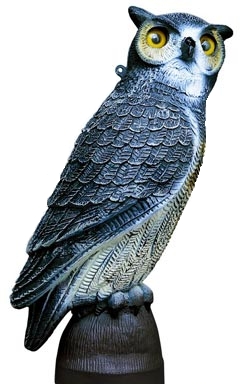
Right-looking behavioral morph (function of the tiny feather-curl at nape of neck is unknown)
So secretive and little-known is the nesting and feeding behavior of the WRO that there is not a single recorded observation of the bird leaving or arriving at its roosting site. One millisecond they are not there, the next millisecond they are, never to move until they again vanish, unseen.
Researchers conjecture that they hunt only on moonless cloud-covered nights. In utter pitch-black skies, no living creature ever sees them in flight, and their prey die never knowing what hit them. If true, this would go far to explain the lack of fear they elicit from potential prey species at their roosting sites.
If these conjectures are correct, such behavior necessitates certain physiological characteristics. They must have exceptional hearing as does the Barn Owl which can locate a vole rustling in the grass at 100 meters in complete darkness. [Bizarrely, no researcher has ever been able to detect any external auditory canal on the WRO. However, unless the owl can detect body heat in the infra-red, they must have excellent hearing. This is another excellent subject for an enterprising Ph.D. candidate.] They must be able to catch great numbers of prey during their infrequent hunting expeditions, as it may be a long wait until the next suitably pitch-black night occurs. This explains why they are not found north of the Arctic Circle where the sun may not set for months. Their digestive systems must be extremely efficient in order to extract every calorie of energy from each morsel of whatever it is that they eat. This would explain the complete lack of regurgitated pellets around their roost sites: there are no pellets as they digest everything – fur, feather, bone, gristle, shell, skin. It would also explain why they never move: they are conserving energy in order to insure survival through what may be a very long fast. It should be noted that their apparent sleep must actually an exceptionally deep form of torpor, a form of near-suspended animation also used by hummingbirds at night and by the Common Poorwill during the winter. The WRO’s torpor is so deep that no medical equipment can detect any heartbeat, breathing or thermoregulatory activity.
Needless to say, nothing is known of their breeding biology. No nest has ever been found, no downy or juvenile bird has ever been seen. They simply appear, full size and in adult plumage. Neither has any sign of molting ever been detected.
The Western Roof Owl has yet one more unique feature: it is the only avian species known to have behavioral morphs. Many species have color morphs: dark-phase and light-phase Red-tailed Hawks for instance. Such color morphs do not indicate subspecies status, they are simply a coloration variation that the individual possesses throughout its life. As far as researchers can tell, the straight-ahead and the right-looking forms are lifelong and invariant behavioral morphs.
All-in-all, the Western Roof Owl is one of our most interesting local species. Its easy visibility when roosting recommends it to any diligent observer of birds. The difficulties one encounters in actually witnessing it doing anything only make the eventual documentation of its mysterious behavior that much more rewarding a pursuit.
[Charles V. Almdale]
If you found this article plausible, you may be interested in the other monographs in our springtime series:
2011: New Hummingbird Species Discovered in Los Angeles County
2012: Canyonlands Roadrunner Captured on Film
2013: Birders Take Their Lumps with their Splits
Up Your Game and Be a Better Birder
“I will see you, and I’ll seize you, and I’ll squeeze you til you squirt.”
“What’s that,” you say? That’s a Warbling Vireo talking to the insects it’s about to eat for breakfast. Learn this mnemonic and a host of other skills in The Cornell Lab of Ornithology’s online Bird Academy series of courses. Now is a perfect time to jumpstart your birding skills. Then, just walk out your door, look, listen, and be present in nature to boost your immune system and elevate your mood.

Warbling Vireo (Western) by V.J. Anderson – Own work
Did you Know: Shakespeare wrote King Lear while quarantined from the plague.
With these courses, you can start at your level, go at your own pace, and access them whenever you want. In addition to courses for a fee, they offer free videos, learning games, and open lectures. The courses include videos of behavior, photos, easy-to-remember tips, bird song recordings, and much more. If you are an educator or professional and need to earn Continuing Education Units, you can purchase a CEU Add-on for each qualifying course.Need more convincing? Watch this video from the intro to “How to Identify Birdsongs.”
It’s easy to scan through a course overview before signing up to make sure it is right for you. For example, the “How to Identify Bird Songs” course uses a unique approach to teach you how to listen to bird songs in their natural soundscapes. You can even try a free sample lesson before enrolling. Once you learn the fundamentals, you can supplement what you’ve learned by using Cornell’s free Merlin app on your smart phone when you are in the field. You step through Merlin’s filters to narrow down the possible birds by date, location, size, color, and behavior to get a short list of the most likely candidates. Pick a bird, and then click on the “Sounds” icon to hear a selection of songs and calls.

The “Warbler Identification” course includes 12 lessons that cover all 51 warblers across the U.S. and Canada. They can be tricky to identify because they flit by in a flash of color, but you’ll find the help you’ve been looking for in this class. In addition to a step-by-step process for identification, the photos and audio recordings are a great help. Many of the pictures were taken from angles that are the way you actually spot the birds in the field, but are seldom seen in the field guides. There are pictures of their vents and bottoms of tails taken from directly below. Warblers have adorable little bums.
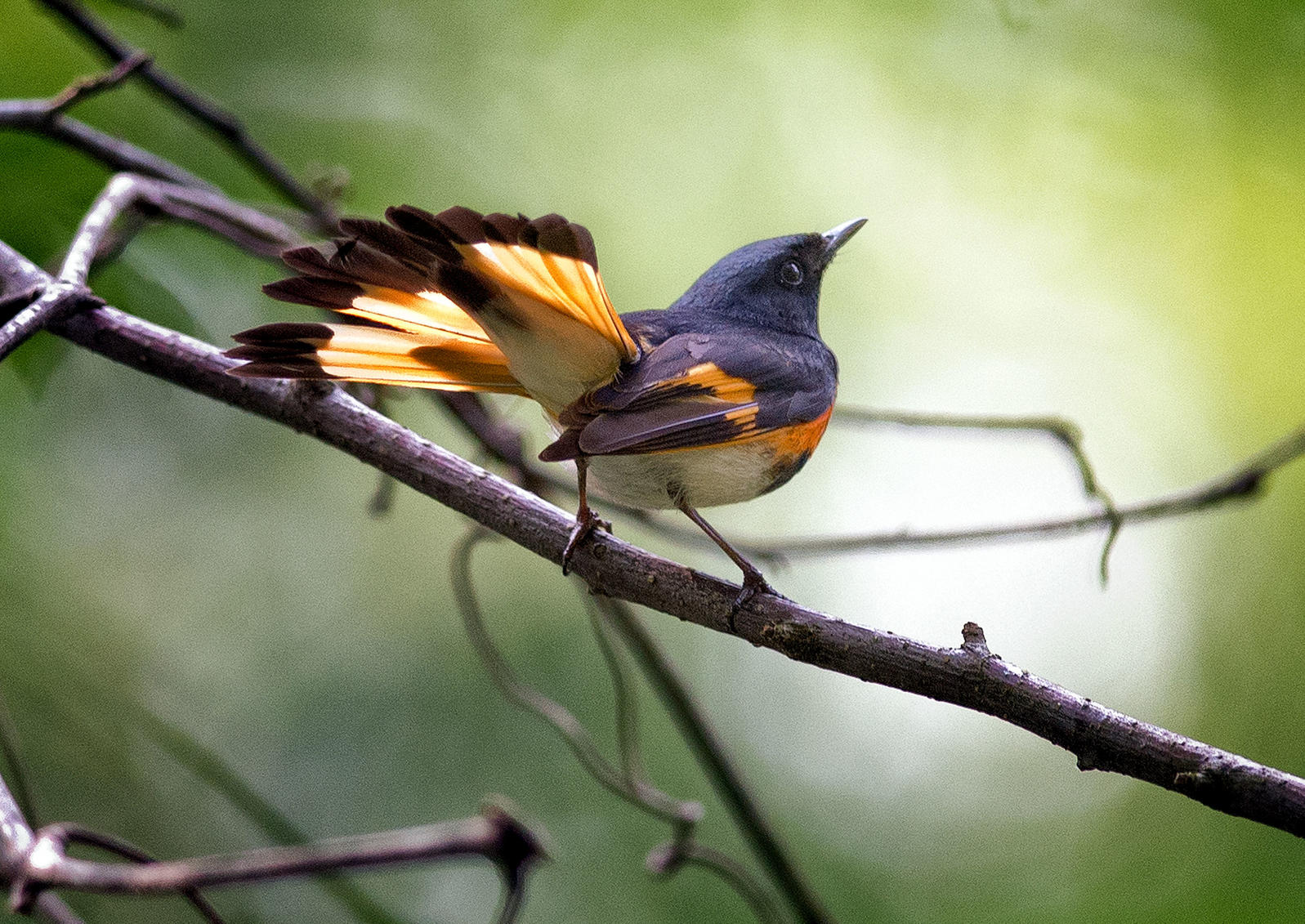
American Redstart. Photo Tom Warren/Audubon Photography Awards
To get a speed-learning preview of this bottom-up trick for ID’ing warblers, check out Nicholas Lund’s Audubon article “Birdist Rule #59: Learn to Identify Warblers From Below.”

The “eBird Essentials” course is free. Now, that’s a bargain. The eBird app, which is also free, will help you discover tools to find birds wherever you go, and gain confidence in submitting your sightings. You’ll get expert tips for using eBird and joining the global community of birders.
There is even a course on “Nature Journaling and Field Sketching.” The enticing course description says, “Whether you’re looking for a creative spark for your artistic expression, a way to develop your observational skills, or an immersive and mindful journey through nature, this course will guide you with friendly art instruction and engaging practice sessions that will help you make the most out of your journaling.”
Bird identification is a challenge, which makes it a great hobby for a lifetime. There is always something new to learn. But there are tips and tricks that will make it easier. As Cornell’s Kevin McGowan says, “All male dabbling ducks can be distinguished by the arrangement of their white patches alone.” Did you know that?

Bufflehead by Liron Gertsman | Macaulay Library

Common Goldeneye by Greg Schneider
To put this info on waterfowl right at your fingertips, the Lab of Ornithology has teamed up with Waterford Press to publish “Where’s the White?” This series of three laminated foldout pocket guides focuses on picking out patterns of white and dark. You can order here for $7.95 each.

Cornell Waterfowl “The Basics” foldout
Now, you’re sold on taking a course, right? Then jump right in! Be sure to get out in the field right away and start using what you learned to keep it from slipping away. Even with parks and beaches closed temporarily, look for new discoveries right in you own neighborhood patch.
[Jane Beseda]
How to deal with uncertainty a little bit better. Vanessa explores a more personal style of storytelling. There are definitely fewer facts in here, but she hopes the conversational approach to talking about studies is more entertaining and memorable for you. What is life if not a big experiment?
This is an installment of the PBS – BrainCraft series created by Vanessa Hill. If no film or link appears in this email, go to the blog to view it by clicking on the blog title above. If the film stops & starts in an annoying manner, press pause (lower left double bars ||) to let it buffer and get ahead of you. [Chuck Almdale]
A Message from the Audubon Rockies Regional Office
Our Federal Administration in Washington, DC continues its
relentless attacks on all things environmental. [Chuck Almdale – Ed.]
Hello California Chapter leaders and members,
My name is Daly Edmunds and I’m the Policy and Outreach Director for Audubon Rockies, a regional office of National Audubon Society (WY, CO, UT). I’ve reached out to your chapter in previous years, in efforts to organize chapters around issues to protect Greater Sage-grouse. While many parts of our country are shutting down in response to COVID-19, the Department of Interior is continuing its efforts to weaken important protections for Greater Sage-grouse. While we’ve shifted our personal and work lives around at Audubon, we’re still fighting hard for birds and could use your help!
Yesterday, we circulated an action alert to all National Audubon Society members across the country. I’m hoping that your chapter will help Greater Sage-grouse (as their populations continue to decline across the range, including in California) and the sagebrush ecosystem … hence my email to you. I’ve also included some educational resources at the bottom of this email, which I hope you’ll find useful.
I’m reaching out to you because the Department of Interior/Bureau of Land Management is planning to make decisions that impact sage-grouse in California – notably in northeastern CA, where there are sage-grouse populations that are considered part of the western population (along with sage-grouse in nearby NV). This is separate from the Bi-State population.
REQUEST:
- Due to a court-order, BLM has re-opened up its public comment opportunity around their federal resource management plans for sage-grouse … deadline is April 6. Please consider share this link to Audubon Grouse Action Alert with your members – via email and/or social media channels, encouraging them to speak-up for sage-grouse protections and balanced management of our public lands.
Background: What Happened
In 2015, after years of work by a wide range of stakeholders in your state —states, ranchers, conservationists, industry, scientists, and federal agencies— sound conservation plans were adopted by the BLM. The 2015 plans included strong science-based protections for the bird’s most important habitat and assurances that there would be limits to the amount of habitat damaged, which were the foundation for the U.S. Fish and Wildlife Service’s finding that the species did not warrant federal protection under the Endangered Species Act. These plans also ensure sustainable economic growth for communities across the West.
Between 2017 and 2019, the Department of the Interior systematically attacked these popular bi-partisan plans. In March 2019, the 2015 plans were formally amended, resulting in weakened protections in important sage-grouse habitats in the BLM plans. In October 2019, a U.S. District Court judge in Boise granted a preliminary injunction blocking the implementation of BLM’s changes to the 2015 sage-grouse conservation plans. The federal court found that the federal administration failed to consider how sage-grouse would be impacted by the BLM’s changes to the 2015 conservation plans. The BLM’s 2019 changes permitted expanded drilling, mining, grazing and other activities on sensitive sage-grouse habitat in ID, WY, UT, CO, NV, CA and OR. In the court’s words, the impact of the changes to the 2015 plans “was to substantially reduce protections for sage grouse without any explanation that the reductions were justified by, say, changes in habitat, improvement in population numbers, or revisions to the best science.” Additionally, the court ruled “the record shows that the 2019 Plan Amendments were designed to open up more land to oil, gas, and mineral extraction as soon as possible.”
Now What…
In late February 2020, the BLM – under guise of responding to the federal court’s concerns – has opened up another public comment period. But in fact, BLM is proposing more of the same. BLM continues to disregard science and undermine needed protections for important sage-grouse habitat. We need strong conservation actions – those that were agreed to in 2015, which respects the years of work that went into developing the plans … not only in California, but elsewhere too.
You can help by weighing in with the BLM, as they are asking for public comments. Tell BLM to maintain Greater Sage-Grouse protections. The deadline to comment is Friday, April 6. We are joining our conservation partners – who have fought together for years for balanced management of our public lands – to make sure the BLM hears loud and clear from the public that they should honor their 2015 commitment to protect important sage-grouse habitat.
EDUCATIONAL RESOURCES RE: SAGEBRUSH ECOSYSTEM: Either you’re homebound with kids yourselves (and are struggling!) or know of others who are (and are struggling!!). This is an opportunity for the Audubon network to help our neighbors, while building a connection/appreciation for the natural world. Here are some resources that you are welcome to share on your chapter’s social media sites, webpages, and newsletters. And if you have resources to share with us, please do so!!
- Sagebrush steppe habitat flashcards (click here to download): You’ll find plants, the animals that eat the plants, the animals that eat those animals, and then the clean-up crews that recycle the living matter to make it available to start the cycle again.
- Rockie’s Sagebrush Adventures! This online illustrated book follows a Burrowing Owl and her friends as they discover what life in the sagebrush is all about.
- Sagebrush Ecosystem Poster and Lesson Plan (click here to download):Through this free lesson plan and poster, students will discover the plants and animals of the sagebrush ecosystem. Students can take it further by researching a habitat and creating a poster depicting the plants and animals that live there. Students will then draw parallels between the habitats, what animals need to survive, and their place the food web.
Thank you for all you each do for birds, our natural world, and for our communities.
I sincerely hope you’re doing well during these uncertain times, and while you’re trying to stay sane at home, perhaps finding joy in some unexpected places! Please know that this email comes to you with encouraging thoughts and hope for improved conditions for everyone.
Warmest regards from Colorado,
Daly
——
Daly Edmunds
Policy and Outreach Director
c: 307.760.7342
Audubon Rockies (WY, CO, UT)
215 West Oak Street, Suite 2C
Fort Collins, CO 80521
https://rockies.audubon.org/



 SANTA MONICA BAY AUDUBON SOCIETY BLOG