Free email delivery
Please sign up for email delivery in the subscription area to the right.
No salesman will call, at least not from us. Maybe from someone else.
Los Angeles Audubon’s College Interns at Kenneth Hahn Park
Cindy Hardin sent us a report about her other educational activity,
this one involving many college student as docents.
Although LAAS’s Environmental Education Program at Kenneth Hahn State Recreation Area (KHSRA) is similar in format to that of Ballona, our staffing system is quite different. At KHSRA we host field trips for elementary and middle school students as well, but our docent roster is just about evenly split between older adults and college interns. The internship is designed to provide real world experience for participating college students, and to provide education about the environment for them, which they in turn pass on to our younger visitors. This year we received a significant grant from the California State Parks Foundation that was used to pay intern stipends and fund our bus scholarship program for the visiting schools. We are extremely grateful to the Foundation for recognizing and supporting our work at Kenneth Hahn.

We have been extremely fortunate in the past few years to have some outstanding young people become involved with the program. Depending on their availability and future education plans, most choose to extend their time with us to a second year. Oscar Rodriguez is one of those individuals. Oscar found time to act as a docent at the park in addition to his studies at Santa Monica College and other commitments, and volunteered at almost every tour for two school years. KHSRA sits atop the Newport Inglewood earthquake fault, and is a 400 acre island of open space, with intact sections of Coastal Sage Scrub habitat. Oscar’s interest in geology and geography made him a natural for the program. The young students gravitated to him, and his skills in communicating concepts to them and bringing out their interest in the natural world improved every time he was present for a program. This is what Oscar had to say about his experience with Los Angeles Audubon:
“Being a volunteer at the [Los Angeles] Audubon Society has given me the opportunity to learn, grow and be a part of a contribution to greater society. Here I was able to solidify my dream of me being and outdoor educator. This program is a rich environment to learn from; bringing my own college education and my passion for nature turned out to bring a positive change to children and myself. Being a child raised in the most unsuitable places I appreciated those who were able to bring a new life in my life; by opening my eyes to the greater world. By educating these children I am able to repay those who have taught me and in turn I hope to open the children’s hearts to new possibilities. Here I grew stronger as a student, leader and overall human being. For this, Audubon Society has my thanks. I am truly grateful for allowing me to be part of this program”.
Oscar has been awarded a scholarship which will enable him to continue his education this fall at Chico State. Although he will be missed, he has promised to make a “guest appearance” or two at Kenneth Hahn if some our school tours coincide with his winter or spring break. We are all very excited for him and his opportunity to work towards his goal of becoming a professor while attending a California State University.
Other interns made huge contributions to the program during the 2014-2015 school year, and we hope they will be available our next round during the 2015-2016 school year. Katrina Liu got some hands-on practice with students as she pursues a teaching career at LMU. Carolyn Canterbury came to the rescue of our sadly neglected Facebook page, and used her talents beautifully to spread the word about our program through social media. You can check out her work on Facebook by typing in Los Angeles Audubon Native Plant and Wildlife Garden Education Program. Okoy Dillon brought humor and style to the organization; his overheard greeting to the visiting students who were the victims of a late bus was priceless: “Okay, gentle people-let’s boogie!”. Joanna Ruacho continues to win the award for most consistent and reliable intern-she can always be counted upon to be present, with virtually one hundred percent attendance. Maura Estrada was only able to participate for the first half of the year due to scheduling conflicts with her studies, but her calm, patient and pleasant demeanor lingered and helped to set the tone for the remainder of the year.
As our Education Division of LAAS has discovered during its work with students from Dorsey High and Leo Politi Elementary, the youngest students love to listen to the “big kids”, and are able to relate to them in a way that is different from their interaction with older adults. At Kenneth Hahn we are fortunate to have a range of ages amongst our volunteers, which has helped to create a rich and unique program. Participation of local schools continues to grow, and over a thousand students took part in our program this year. Some of the schools were new to our field trips, and many were repeat visitors. In fact, we have already received requests from teachers and principals to reserve spots for the next school year! Our stellar volunteers and interns make it all happen, and as Program Director I would like to say I am profoundly proud and grateful to all that have helped our program at Kenneth Hahn evolve into a high quality educational offering that has positive effect on the many that it involves.
Cindy Hardin
Director of Outdoor Education for Los Angeles Audubon Society
Annual Report from Ballona Education Program for 2018-2019

The main wetland channel looking south towards Culver Blvd. (Leslie Davidson ’08)
We have had another busy and successful year with Los Angeles Audubon’s education program at the Ballona Wetlands. Between the teachers’ strike in January and an extremely rainy winter, there was much re-scheduling going on throughout tour season. In spite of that, we managed to do 43 separate tours, and were visited by 21 different schools. We worked with four different school districts, although the majority of students that participated were part of LAUSD.
Every teacher that visits is asked to fill out an evaluation form regarding their experience. These are valuable tools, as their input is considered seriously, and used to fine tune what is really a great program. What follows is a compilation of their comments. Numbers in parentheses next to some of the comments reflect multiple remarks of the same nature.
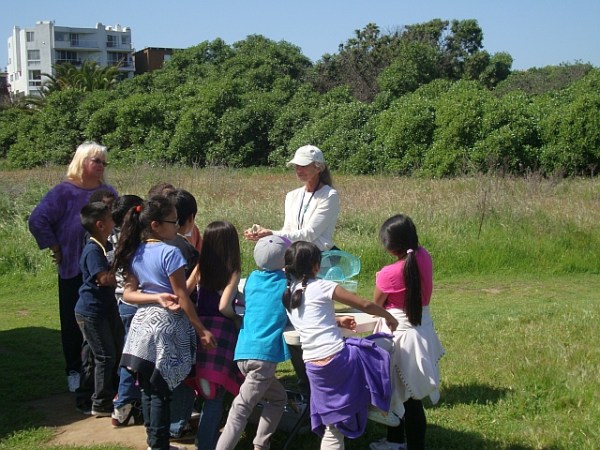
Students and Docents (Leslie Davidson 2011)
What would you tell another teacher about your trip?
- It was amazing
- Different stations set up in kid-friendly and engaging way that instructs students on a wetlands ecosystem
- Students learned about local natural history and Tongva people-hands-on experience
- Observe the environment, conservation and the need to protect
- A chance to see birds up close, learn about migration and what LA looked like long ago
- Excellent way to experience Common Core Standards
- Importance of wetlands to the planet-beautiful hike
- Science exploration using microscopes, nature walk
- Great-precious experience for kids to have direct contact with nature
- Explains to children the importance of being respectful and not kill the mosquitoes!
- Explored amazing habitats for migrating and resident birds, detailed exploration/investigation of microorganisms, etc.
- We got to experience the wetlands and live with the life there. An appreciation for what used to be, and what is
- We explore flora and fauna of the Ballona Wetlands and the importance of wetlands
- A hands-on, interactive, standards based awesome trip
- A bit like hiking with history and science built in
- Fantastic tie-in to our life science unit-an outdoor classroom for the day
- Many amazing conversations and discoveries
- Opportunity to observe nature and animals
- Explore the wetlands and observe species relying on habitat for survival
- Allows the students to explore habitat of certain birds

Here’s lookin’ at you, kids. (Leslie Davidson 2010)
What interested your students the most about the trip?
- Binoculars (10)
- Microscopes (10)
- All of it! (4)
- Birds from the Bird Books (6) Every student that attends receives the book Birds of Ballona prior to their trip. Lots of the teachers use these as prep tools, and the attendees are delighted to see the birds that they learned about in their own personal reference book!
- Tongva session (3) The Tongva Station was a new addition this year, thanks to the innovative, hard work of docent Jamie Lowry. Feedback has been over the top positive-thanks, Jamie!
- Seeing the crabs create “crab homes”
- And quotes from the students: “All the pretty birds I saw”, “The birds that blended into the rocks”, “The nature and the wildlife”, “Watching all the animals”, “Great Blue Heron on top of the roof”
- Being Outdoors

Marbled Godwits and Willets get some shut-eye (Nancy Conner 11-19-16)
Was your tour guide helpful, knowledgeable and informative?
- Guides were excellent
- Full of information and very patient (3)
- So helpful and knowledgeable (7)
- Yes!-well trained to ask questions and lead discussion
- Very thorough yet easy to understand-answered every little question
- She even tallied up the birds we saw at the end
- Able to identify species living in the wetlands
- Spoke at a grade level that was appropriate
- Super!
- Patient too!
- Fantastic
- Lots of enthusiasm
- Great about pointing out things the students might have missed
- Wonderful
- Aware of all the native plants
- Fully aware and prepared to answer all of my students’ questions

Bufflehead male (Joyce Waterman 12-9-17)
What could be done to improve the field trip program?
- An art station where they can draw, paint and color
- The interactive stations were so amazing-we would love more, although the trip would have to be extended
- Closer, more convenient place to eat
- Nothing! (19)
- Nothing-it rocks!
- Start at 9:30
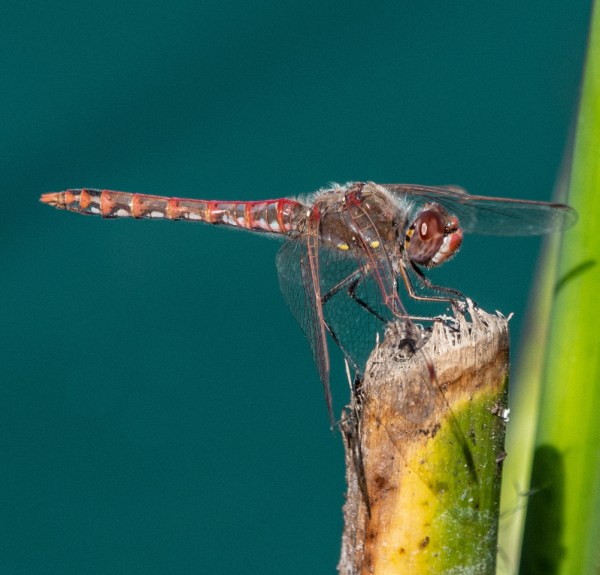
A tiny dragon momentarily perches (Ray Juncosa 11-3-18)
Additional Comments:
- We appreciate your support and outreach to our inner city schools who may not always be aware of and visit the wetlands/marina area
- Thank you, thank you (2)
- Great trip
- We loved it, the parents loved it, and many had no idea this wetland existed
Well, we all know that this is a wonderful program, and the teacher’s comments back that up. You will notice that I highlighted words like “experience”, “explore” and “interactive”. The term “experiential learning” is being tossed around quite a bit lately; the Los Angeles Audubon Ballona Education Program has been using this approach for decades! A huge thanks to all of you for your fantastic work and being ahead of the curve. I am already looking forward to a fabulous 2019-2020 school year at Ballona!
Cindy Hardin
Director of Outdoor Education for Los Angeles Audubon Society
Ballona Fresh Water Marsh Reminder: 9 November, 2019, 8 AM

Great Blue Heron (R.Ehler 2/22/15)
Although it’s now been over 15 years since the Ballona Fresh Water Marsh was created, it’s still one of the newest and birdiest spots around. Last year’s trip found 48 species. We’ll look for whatever is around, of course, but we have good chances for wintering birds like Hermit Thrush, Blue-gray Gnatcatcher, Say’s Phoebe, Orange-crowned Warbler, and Fox, Lincoln’s and Savannah Sparrows. Least Bittern is less likely but possible; they are far more often heard than seen, so if you can, familiarize yourself with their calls before the walk. Wintering ducks, including Green- winged and Cinnamon Teals, should be back in their basic (winter) plumage. Year-around residents include our area’s five most common herons and egrets. Yellow-crowned Herons, both adult and immature, seem to be expanding their range from Baja into Alta California (that’s us) and show up irregularly at this marsh, Raptors are likely but unpredictable there.
Distance: It is about a 1.75 to 2-mile walk on mostly flat ground with a sometimes uneven dirt path.

Bufflehead male (Joyce Waterman 12-9-17)
Leader: Ellen Vahan (310-476-3359) ertvahan [AT] aol [DOT] com
Field Trip Chair: Jean Garrett 310-472-7209
Link to Google Map
You’re heading for the inland red dot for the freshwater marsh, NOT the westernmost dots near the beach.
Via Freeway: SAN DIEGO FWY (I-405) south to MARINA FWY (CA-90) west to CULVER BLVD. off-ramp and turn left under freeway and west towards Playa del Rey. Cross the Lincoln Blvd. overpass, then turn left at the first traffic light onto W. JEFFERSON BLVD. Park on the right at the Wetlands entrance, the last few hundred yards before you get back to Lincoln Blvd. Free street parking only.
Via Lincoln Blvd: Lincoln Blvd. south through Marina del Rey to West Jefferson Blvd. Right on Jefferson. Parking is on the south side of Jefferson only, so you’ll have to figure out where to turn around to get back close to Lincoln Blvd. [Chuck Almdale]

Green Heron. Ballona Wetlands 2016 Randy Ehler
How Computers Work: Cybersecurity & Crime | Video
Google Security Princess Parisa Tabriz and Jenny Martin from Symantec introduce the most common types of cybercrime including viruses, malware, DDOS attacks and phishing scams. Watch at 4:40 to see the top four tips to avoid getting hacked,
Part IX (5 minutes) of the series produced by Code.com explaining computers in terms most of us can understand. We’re getting past the ins & outs of downloads and uploads and into the guts. We’ll post a new installment approximately every ten days until we run out.
If you like this series and want to go through it at your own rate, the 17 videos listed HERE include the 12 which I have scheduled so far. Having some familiarity with the topics, I watched the first 12 in about an hour. It’s time well spent.
[Chuck Almdale]
https://youtu.be/AuYNXgO_f3Y
Have native plants in your yard? Sign up for this study.
If you have native California plants in your yard, these study people want to hear from you. No fee, no home invasions, no lengthy quizzes and probably front yard only. But contact them. Eric Wood, the study supervisor, told me the study idea was sparked last spring when people saw the Painted Lady butterflies flocking to yards with native plants while avoiding the yards without native plants. We’ve already signed up for the study!
You can check out Dr. Wood’s interesting website. However, I couldn’t find any references on it to this particular study, probably because the idea is brand new and the study has not started.
If you’re interested, just send an email to the contact in the blurb, Noriko Smallwood, who is the person actually doing the study. [Chuck Almdale]




 SANTA MONICA BAY AUDUBON SOCIETY BLOG