Free email delivery
Please sign up for email delivery in the subscription area to the right.
No salesman will call, at least not from us. Maybe from someone else.

Hermit Thrust (R. Juncosa)
Several people had signed up for this trip, but only one of those showed up; others were reportedly put off by the lack of parking spaces. In spite of our efforts to avoid it, we managed once again to hit the exact same day of the Boy Scout Jamboree, hence no parking spaces. Fortunately, others did show up, and we had a nice little group of eager birders.
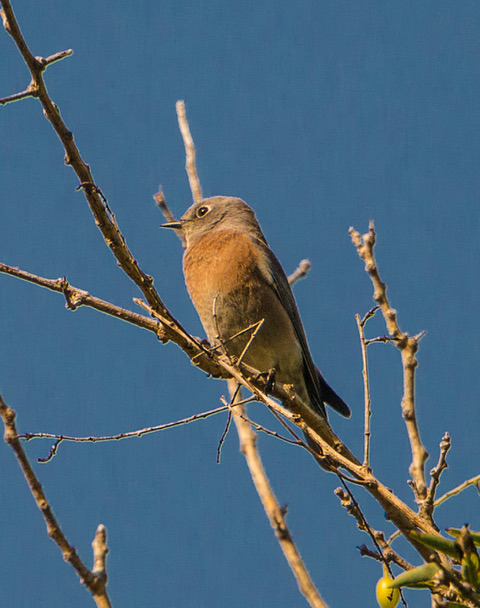
Western Bluebird (R. Juncosa)
The day was lovely, not too hot, and for us from west LA, a welcome lack of smoke. The birds managed to avoid the Boy Scouts, and our list will show a fair number. It includes the usual suspect foreign invaders (not their fault!): Scaly-breasted Munia, in bands of 20 or so, sticking close together cheek by jowl, Bronze Mannikin, a spectacular Pin-tailed Whydah, and several Japanese White-Eyes. The pond was entirely covered by green algae and looked like a lawn, which American Coots, Mallards and American Wigeons were swimming through.

White-faced Ibis (R. Juncosa)
As we spent some time counting Warblers: Yellow, Wilson’s, Orange-crowned, several beautiful Townsend’s and Nashville — a goodly haul — a White-faced Ibis flew by, and then a Red-shouldered Hawk came along with a fresh mouse that he proceeded to have for breakfast.

Red-shouldered Hawk, sans mouse (R. Juncosa)
Several Woodpeckers, mostly Nuttall’s and a few Flickers, knocked on the trees. Tree squirrels importuned us for whatever we might have in our pockets.
At the garden area, we were scolded by a few House Wrens, also California Towhees showed up. We noted sadly that many of the trees we were used to seeing had been taken down: a visiting Audubon Board Member from Orange County told us they were victims of the shot hole borer. We did note also that not only were there Boy Scouts, but many people were in the Park that day, of all ages, particularly young people (complete with cell phones). It was a good place to be that day. [Liz Galton]
| Huntington Beach Central Park | Bird List Oct. 12, 2019 |
| Egyptian Goose | House Wren |
| Mallard | Blue-Gray Gnatcatcher |
| Great Egret | Hermit Thrush – 2 |
| Snowy Egret | Orange-crowned Warbler |
| American Wigeon | Nashville Warbler |
| Mourning Dove | Townsend’s Warbler |
| Black-crowned Night-Heron | Wilson’s Warbler |
| White-faced Ibis | Yellow Warbler |
| Red-shouldered Hawk, with mouse | Yellow-rumped Warbler |
| American Kestrel | Common Yellowthroat |
| American Coot | California Towhee |
| Various small sandpipers too far to ID | Song Sparrow |
| Anna’s Hummingbird | White-crowned Sparrow |
| Allen’s Hummingbird | Hooded Oriole |
| Nuttall’s Woodpecker | House Finch |
| Downy Woodpecker | American Goldfinch |
| Northern Flicker | Lesser Goldfinch |
| Western Wood-Pewee | Scaly-breasted Munia |
| Black Phoebe | Japanese White-Eye |
| Western Bluebird – 25 | Bronze Mannikin |
| American Crow | Pin-tailed Whydah |
| Bushtit | Total Species 43 |
The past as a window into the future
This is from Science News magazine, 9/28/19.
Caves offer glimpse of sea level rise
By Lucas Laursen
Link to longer article in University of Southern Florida newsroom
Even longer article with charts, text excerpts, etc.
The future of sea level rise may be written into the walls of coastal Spanish caves.
Mineral “bathtub rings” deposited inside the limestone Artà Caves on the island of Mallorca show how high seas rose during the Pliocene Epoch – when Earth was about as warm as it’s expected to bet by 2100. Those deposits suggest that seas were around 16 meters (52.5 ft.) higher on average than they are today, researchers report August 30 in Nature.
That measurement provides the most precise peek yet into what may be in store as climate change causes ice sheets to melt and oceans to rise over hundreds to thousands of years. Previous estimates of sea levels during the Pliocene, 5.3 million to 2.6 million years ago, gave similar results. But those relied on more indirect dating methods or failed to incorporate information about the subsequent rise and fall of Earth’s crust.
For the new research, Oana-Alexandra Dumitru, a geochemist at the University of South Florida in Tampa, and colleagues turned to aragonite and calcite deposits on stalactites and stalagmites in the Artà Caves – “a very protected environment,” Dumitru says. Called phreatic overgrowths, the deposits accumulate as brackish seawater laps against rock. Similar features have been found on the island of Sardinia and in Mexico and Japan.
Seawater washing into the caves left behind mineral deposits at heights from 14.7 to 23.5 meters (48.2 to 77.1 feet) above today’s sea level, Dumitru’s team found. One deposit corresponds with a warm period that lasted from about 3.3 million to 3 million years ago. Global temperatures during that time were 2 to 3 degrees Celsius warmer than in modern, preindustrial times – and resemble forecasts for the year 2100. Global mean sea levels then were 16.2 meters (53.1 feet) higher than today, Dumitru’s team calculates.
“We still may not know exactly how much sea level rose,” says Alan Haywood, a paleoclimatologist at Leeds University in England. But with results like these, “we’re getting more confidence that we’re in the right ballpark.”
[Chuck Almdale]
How Computers Work: HTTP & HTML | Video
Tumblr founder David Karp and Xbox program manager Jasmine Lawrence give a detailed description of how the Internet works using HTTP and HTML.
Part VII (7 minutes) of the series produced by Code.com explaining computers in terms most of us can understand. We’re getting past the ins & outs of downloads and uploads and into the guts. We’ll post a new installment approximately every ten days until we run out.
If you like this series and want to go through it at your own rate, the 17 videos listed HERE include the 12 which I have scheduled so far. Having some familiarity with the topics, I watched the first 12 in about an hour. It’s time well spent.
[Chuck Almdale]
Porcupines Give You 30,000 Reasons to Back Off | Deep Look Video
Porcupines may be adorable, but their quills are razor-sharp, designed to impale and next to impossible to remove. But it’s not all bad news. Researchers are designing new surgical staples that mimic the quill’s shape to better close wounds and promote healing.
This is another installment of the PBS Deep Look series; this installment is adapted from the “It’s OK to be Smart” series. If no film or link appears in this email, go to the blog to view it by clicking on the blog title above. If the film stops & starts in an annoying manner, press pause (lower left double bars ||) to let it buffer and get ahead of you. [Chuck Almdale]
Native Plant Sale Reminder: 10am – 3pm, October 12-13, 2019
Here’s a message from the local chapter of the California Native Plant Society
Native plants feed native insects which feed native birds.
No food, no insects, no birds.
A native oak can feed 500 native insect species where an African or
Australian tree will support only three species.
Native Plant Celebration & Symposium, Wildflower Show & Plant Sale
Saturday-Sunday, October 12-13, 2019 – 10 am – 3 pm
Sepulveda Garden Center
16633 Magnolia Blvd., Encino, CA 91436
Member Pre-Sale at 9:30 am -10 am Saturday only
All CNPS members get 10% off plants & books*
*CNPS members must show CNPS ID card or a
recent Toyon with their address label to receive discounts
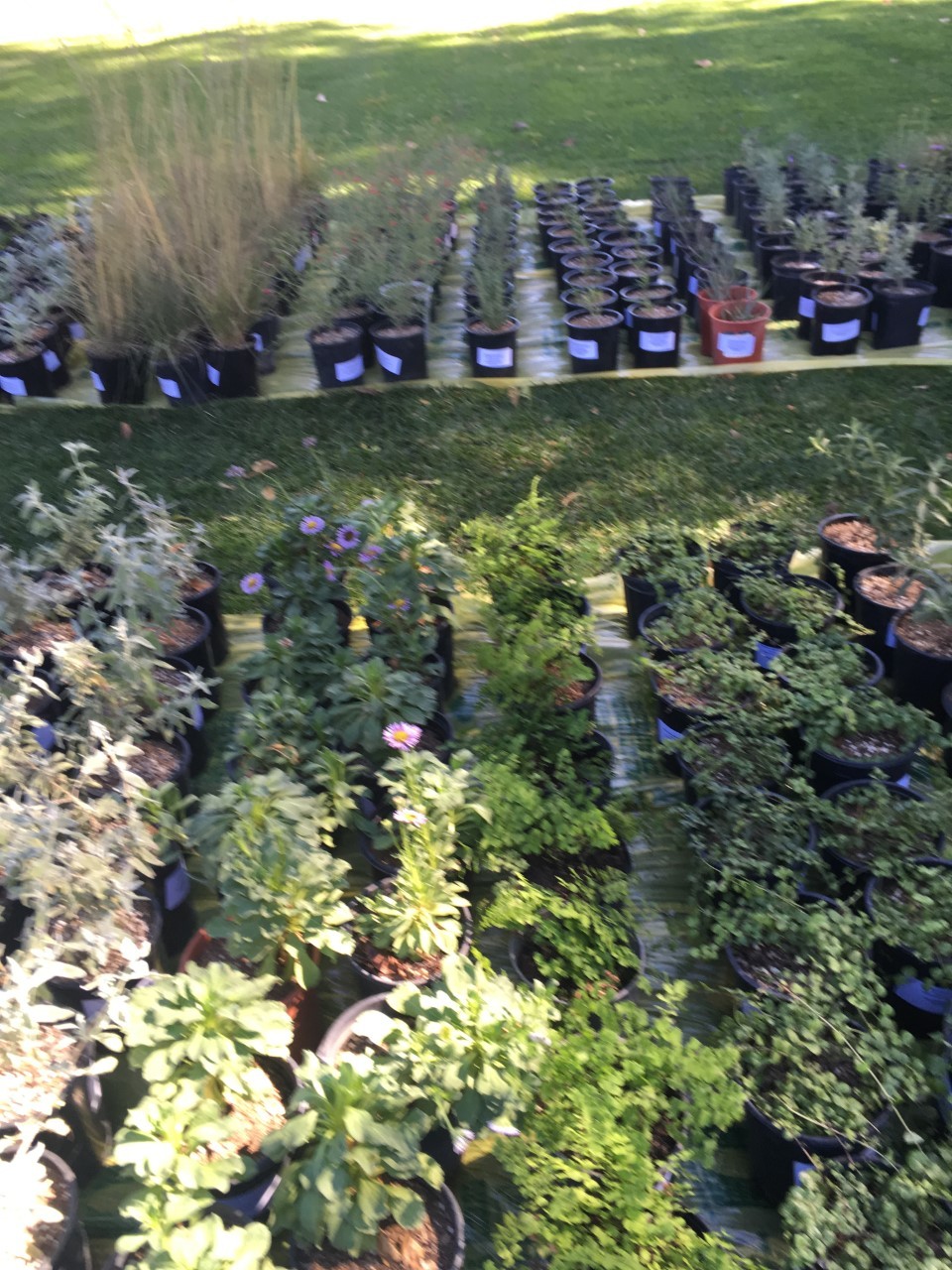
Website: Los Angeles/Santa Monica Mtns. Chapter of California Native Plant Society
We will continue with our expanded selection this year – with a focus on species that can survive in our hot and dry climate – there is a plant that can fill your garden’s needs. Many native plants can survive quite well with natural rainfall once they get established. ltems for sale include perennial wild flowers, irises, mints, sages, berries, hummingbird and butterfly plants, shrubs, perennials, and trees. A diverse selection of wildflower seeds will be available for purchase. Also for sale are new and used natural history and native gardening books, activity books for children, field guides, and posters. Refreshment s and lunch will be available for purchase.
During the sale, experienced CNPSers can assist you in selecting plants that are suitable for your garden! Proceeds from the plant sale help support the activities of the Los Angeles / Santa Monica Mountains chapter of CNPS.
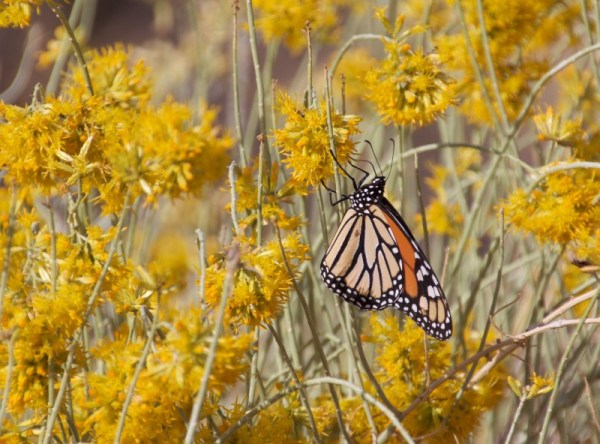
Native insects and birds love native plants (Roxie Seider 10-29-16)
[Chuck Almdale]



 SANTA MONICA BAY AUDUBON SOCIETY BLOG