Free email delivery
Please sign up for email delivery in the subscription area to the right.
No salesman will call, at least not from us. Maybe from someone else.
Birds of the World Taxonomy Seminar now on line
[Posted by Chuck Almdale]
As many birders know, the checklists of the world’s birds are merging and the overall master list (One List To Rule Them All!) is called Avilist. This officially happened this month, November 2025, ta da! Birds of the World (BOW) had a 90-minute seminar about it on 13 November, 2025, and it’s now on line. You might as well grab a beer (herbal tea) and bowl of popcorn (infused kale & sprouts sandwich) and watch it. Otherwise you won’t know what happened to your checklist on eBird or anywhere else.
According to the BOW announcement page:
Description: Every year, the world’s taxonomic authorities propose a newly restructured avian taxonomy. Soon after the taxonomic changes are settled, our taxonomy team and editors get busy revising accounts so that the Birds of the World website reflects the new taxonomy. Concepts are intermediate to advanced. The 2025 taxonomy updates were available in Birds of the World, eBird, Merlin, and Macaulay Library in November, 2025.
Concepts are intermediate to advanced.
1. Intro: AviList vs. Clements–Marshall Iliff
2. Summary of 2025 updates–Pam Rasmussen
3. Higher order taxonomic changes–Shawn Billerman
4. Other names, other taxa, and hybrids–Marshall Iliff
5. eBird, taxonomy, and you!–Marshall Iliff
6. Audience Q&A
Featuring:
Dr. Shawn Billerman, Science editor, Birds of the World
Dr. Pamela Rasmussen, Senior research associate – avian systematist, Birds of the World
Marshall Iliff, eBird project leader, taxonomy specialist, common names database manager
Host: Laura Kammermeier
Fun time for all!
Identification of Eastern & Western Warbling Vireos | David Sibley
[Posted by Chuck Almdale]
David Sibley has written a long, detailed article about distinguishing this recently split species pair in the field. Read the article, complete with illustrations, sonograms and range maps, to find out all about it.
His lead paragraph:
The Warbling Vireos were considered a single continent-wide species until 2025, when two species – Eastern [Vireo gilvus] and Western [Vireo swainsoni] – were officially recognized by AOS and eBird (Cicero 2025). The differences between these populations have been the subject of intensive research for decades, mainly in Alberta where they meet. I have spent a lot of time studying their identification over many years, with new focus in the months after the split.
His Quick Summary:
In practice virtually all will be identified presumptively by range. Positive identification depends on careful analysis of details of song (but questions remain about variation in song). Positive identification of silent birds is not possible on current knowledge.
According to the article’s range maps, their breeding ranges overlaps in Alberta. South of there they are divided by the crest of the Rocky Mountains. According to Sibley’s list of vagrants, the “only fully convincing record of an Eastern Warbling Vireo west of the Rocky Mountains (the only one supported by recordings of song)” was in Pima County, AZ on 30 June 2014. And…after listening to the sonograms, my decrepit ears hear the eastern song as having clearer, more musical and less buzzy tones than the western song. Songs can be the same 3 1/2-second length.

From the Article
So…no more reporting of ‘Warbling Vireo sp.’ as these two are so easily differentiated, as anyone can see from the above illustration. Right, birders? Right. And stay out of Alberta during breeding season lest you be driven mad.
Malibu Lagoon bird walks: 8:30 & 10am Sunday, 23 November, 2025
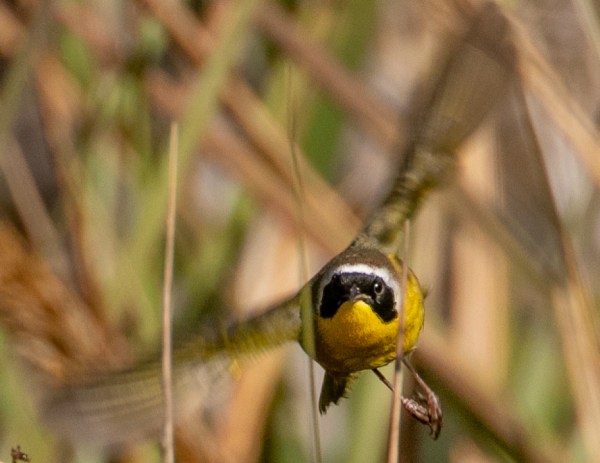
and the photographer barely escapes with his nose intact
(Chris Tosdevin 11/25/24)
[Chuck Almdale]
Pacific Coast Highway: It’s much harder to confirm a road is open than closed. As far as I can tell, all lanes on all routes into Malibu are open, but speed limits between Santa Monica and Malibu are 25 MPH in certain places and the police ARE issuing speeding tickets in an attention-getting manner.
If you learn differently about closures, let me know.
So… SMBAS lagoon trips (8:30am general and 10am parents & kids) are happening.
Lots of migrants and wintering birds and dwindling crowds of humans make it a great day for the lagoon. Usually sunny, sometimes cool, with dolphins dancing upon the waves. Forget those Thanksgiving table birds: see your birds here with us. A possible Vega Gull and a large flock of White Pelicans have recently been seen.

Some of the great birds we’ve had in November are:
Green-winged Teal, Lesser Scaup, Surf Scoter, Bufflehead, Red-breasted Merganser, Pacific & Common Loons, Horned & Western Grebes, Osprey, American Kestrel, Merlin, Snowy Plover, American Avocet, Spotted Sandpiper, Marbled Godwit, Boneparte’s & Glaucous-winged Gulls, Belted Kingfisher, Common Raven, Bushtit, Bewick’s, House & Marsh Wrens, California Towhee, Great-tailed Grackle, Lesser Goldfinch.
Weather prediction as of 19 November:
Sunny, cool. Temp: 55-65°, Wind: NE 6 mph, Clouds: 25%>15%, rain: 0%
Tide: near-high, then falling: Low: 2.79 ft. @ 3:13am; Low: +5.46 ft. @ 9:39am.
Oct 26 trip report link
Adult Walk 8:30 a.m., 4th Sunday of every month. Adults, teens and children you deem mature enough to be with adults. Beginners and experienced, 2-3 hours, meeting at the metal-shaded viewing area between parking lot and channel. Species range from 35 in June to 60-75 during migrations and winter. We move slowly and check everything as we move along. When lagoon outlet is closed we may continue east around the lagoon to Adamson House. We put out special effort to make our monthly Malibu Lagoon walks attractive to first-time and beginning birdwatchers. So please, if you are at all worried about coming on a trip and embarrassing yourself because of all the experts, we remember our first trips too. Someone showed us the birds; now it’s our turn. Bring your birding questions.
Children and Parents Walk, 10:00 a.m., 4th Sunday of every month: One hour session, meeting at the metal-shaded viewing area between parking lot and channel. We start at 10:00 for a shorter walk and to allow time for families to get it together on a sleepy Sunday morning. Our leaders are experienced with kids so please bring them to the beach! We have an ample supply of binoculars that children can use without striking terror into their parents. We want to see families enjoying nature. (If you have a Scout Troop or other group of more than seven people, you must call Jean (213-522-0062) to make sure we have enough binoculars, docents and sand.)
Directions: Malibu Lagoon is at the intersection of Pacific Coast Highway (PCH) and Cross Creek Road, west of Malibu Pier and the bridge, 15 miles west of Santa Monica via PCH. We gather in the metal-shaded area near the parking lot. Look around for people wearing binoculars. Neither Google Maps nor the State Park website supply a street address for the parking lot. The address they DO supply is for Adamson House which is just east of the Malibu Creek bridge.
Parking: Parking machine recently installed in the lagoon lot: 1 hr $3; 2 hrs $6; 3 hrs $9, all day $12 ($11 seniors); credit cards accepted. Annual passes accepted. You may also park (read the signs carefully) either along PCH west of Cross Creek Road, on Cross Creek Road, or on Civic Center Way north (inland) of the shopping center. Lagoon parking in shopping center lots is not permitted.
[Written & posted by Chuck Almdale]
Birds & Butterflies: Malibu Creek State Park, 8 Nov 2025
[Written by Jean Garrett; Photos by Marie Barnidge-McIntyre, Ray Juncosa & Chris Tosdevin, edited by Chuck Almdale]

(Chris Tosdevin 11-8-25)
The American Snout Butterfly is far less common in the west than in the east (see below). Butterflies and Moths has a nice write-up this medium-small butterfly (1 3/8 – 2″) wingspan, with much the same information on Wikipedia. Most of us have never seen this butterfly before.
(link to interactive map at ButterfliesandMoths.org)
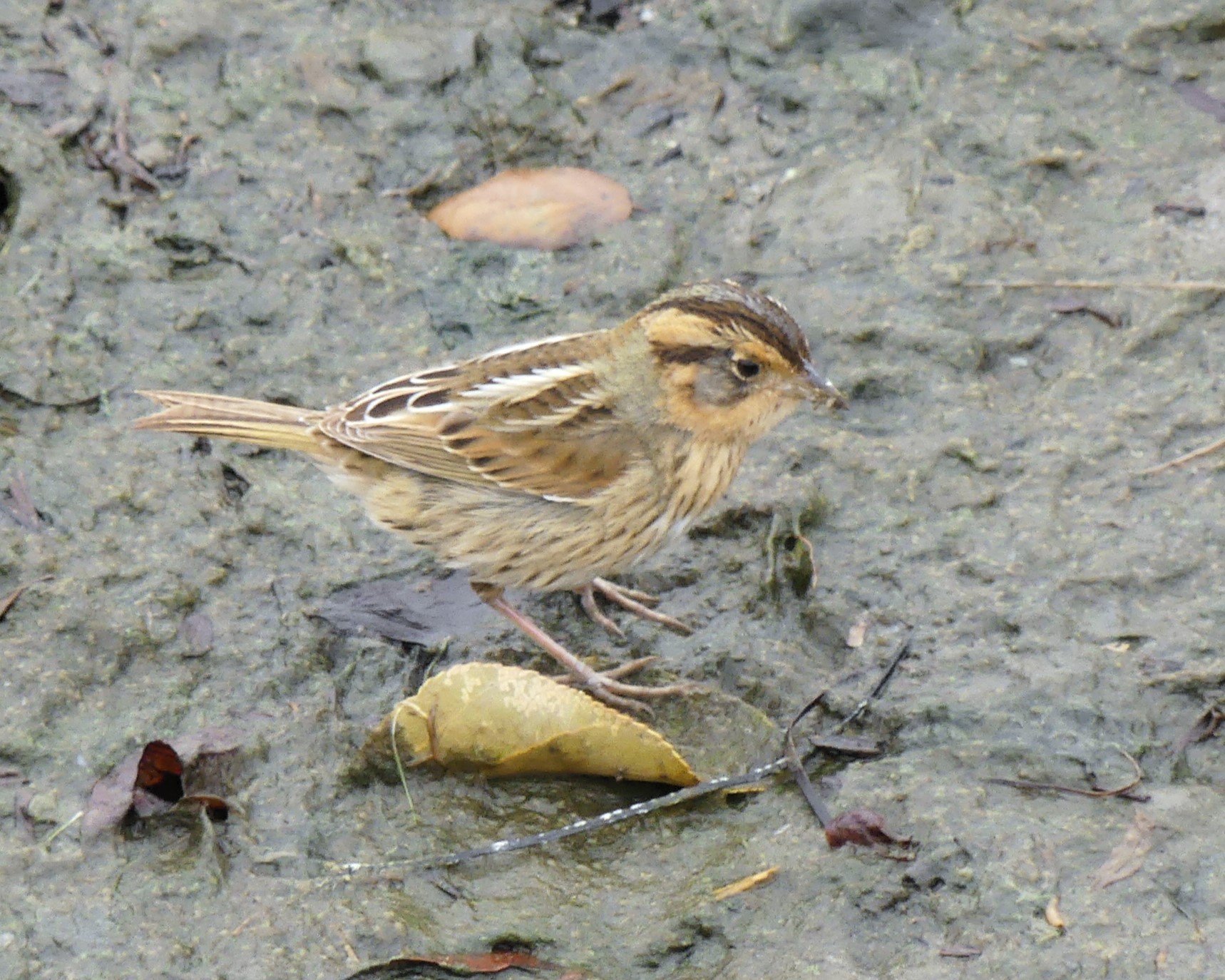
It was a cool day that eventually warmed up for our group of nine people. We were first greeted by several Juncos with one having pink flanks but there were no blackish lores so all hope of a “Pink-sided” Junco was dashed. The sounds of Acorn Woodpeckers serenaded us throughout the day as they always do at Malibu Creek.


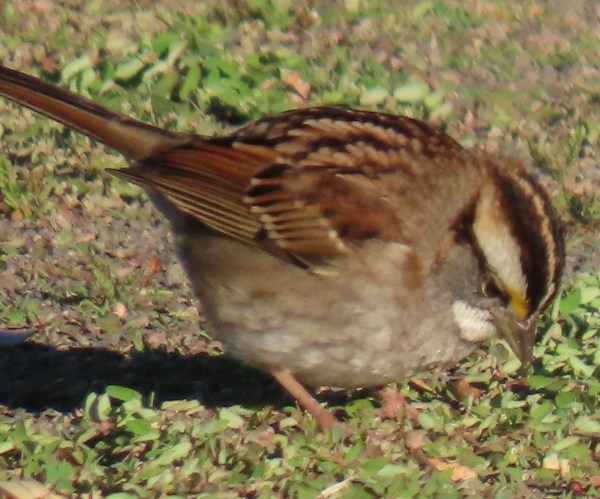
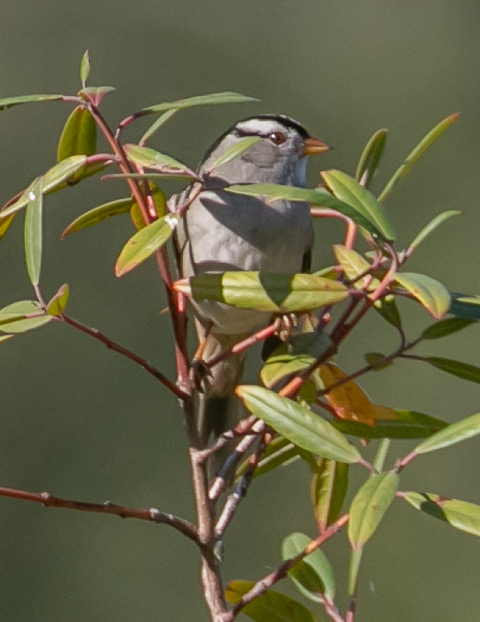
Looking over to the west of the meadow gave us 3 Western Bluebirds. Then looking back to the Juncos we saw that some House Finches and one Purple Finch had joined them along with a White-throated Sparrow with a strongly outlined throat (it has been seen previously this fall at Malibu Creek).
(Marie Barnidge-McIntyre 11-8-25)
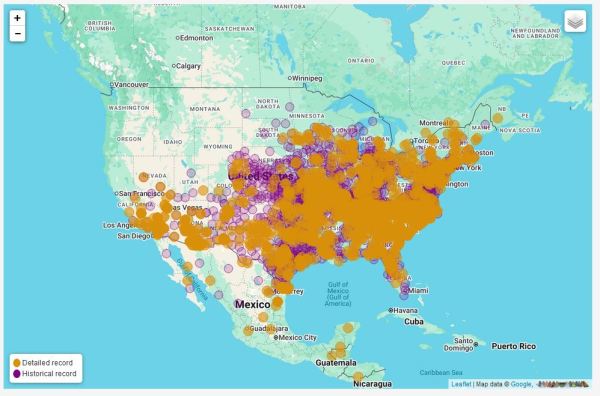
As you can see from the map below, White-throated Sparrows have a wide breeding range across Canada and New England. As with many other North American passerines, their southward migration is typically east of the Rocky Mountains. Occasionally, especially in southwestern Canada, they fly over the ridges to the west side of the mountains and wind up spending the winter along the American west coast from southern Washington to the Mexican boarder.

For some reason, they seem reluctant to spend the winter south of the border and west of Big Bend, Texas, which may be an artifact of the lack of people noticing their presence; they are easily confused with the far more common White-crowned Sparrows.

(Ray Juncosa 11-8-25)
Walking along the meadow into the forest gave us a leucistic Red-tail Hawk that was somewhat expected since it has been seen previously on several occasions by some in our group. The White-crowned Sparrows with their distinctive mournful song accompanied us as we saw a Great Blue Heron busy hunting near the river.
An opening in the forest gave us some Lesser Goldfinches, Mourning Dove, and Ruby-crowned Kinglets. The Hermit Thrush was on the floor of the forest and 2 American Kestrels were overhead in the trees.

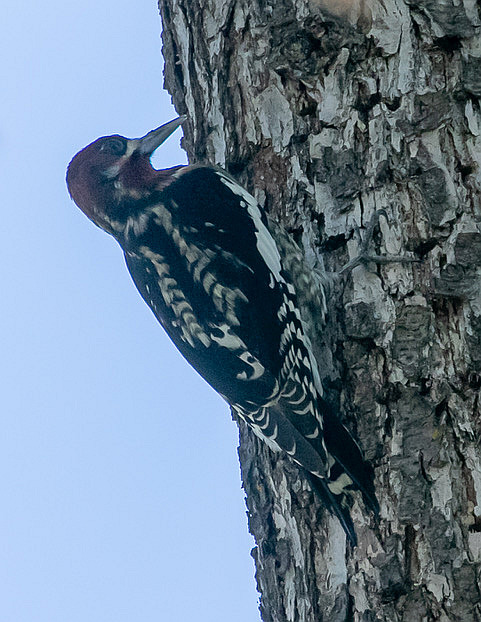
Walking back towards the meadow, the Downy Woodpecker was seen crawling up trunk of a tree and then 6 Nanday Parakeets flew overhead. Heading into the forest north of the meadow, the Wrentit trilled while we carefully looked at some Kingbirds and determined they were Cassin’s. As we looked behind us, there was the lovely site of a flock of about 60 Rock Pigeons. Spotted Towhees were in the bushes with a White-breasted Nuthatch working a tree and at last a Red-breasted Sapsucker was found.
In the grass we found a Golden-crowned Sparrow, which we see far less often than the abundant White-crowned Sparrows. This made it a three-Zonotrichia day, an uncommon event.

(Chris Tosdevin 11-8-25)
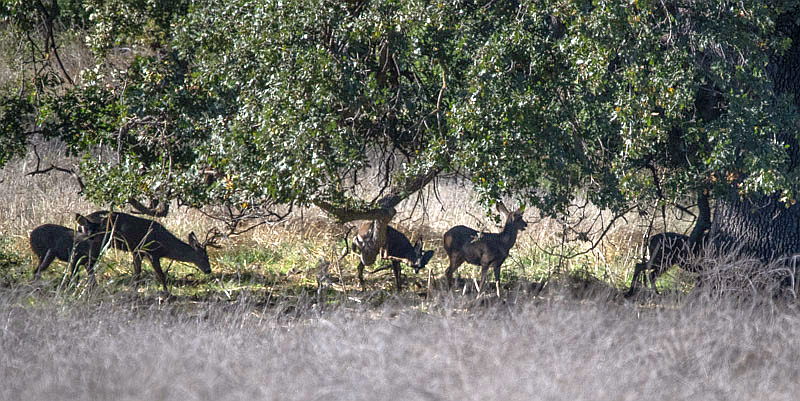
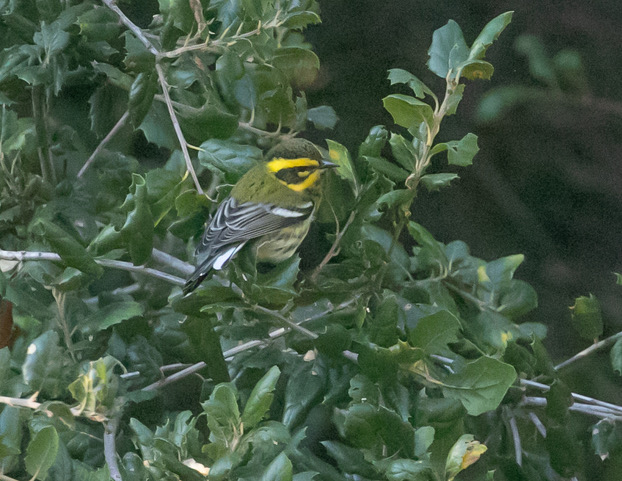


All in all we did not do badly for a quiet day. We got 50 species and it was a pleasant sunny day in the fall.
| Malibu Creek State Park | |||||
| Field Trips | 11/8/25 | 6/14/25 | 5/11/24 | 11/12/11 | 11/13/10 |
| American Wigeon | 2 | ||||
| Mallard | 14 | 10 | 5 | 20 | 15 |
| Ring-necked Duck | 1 | ||||
| Bufflehead | 2 | ||||
| California Quail | 20 | ||||
| Pied-billed Grebe | 1 | ||||
| Band-tailed Pigeon | 6 | 4 | 6 | 80 | 12 |
| Mourning Dove | 10 | 19 | 5 | 2 | 2 |
| Feral Pigeon | 60 | ||||
| White-throated Swift | 5 | 20 | |||
| Black-chinned Hummer | 2 | ||||
| Anna’s Hummingbird | 1 | 5 | 3 | 1 | 2 |
| Allen’s Hummingbird | 1 | 2 | 1 | ||
| Hummingbird sp. | 1 | ||||
| American Coot | 1 | 20 | 15 | ||
| Killdeer | 1 | ||||
| Double-crested Cormorant | 1 | 1 | |||
| Snowy Egret | 6 | ||||
| Green Heron | 2 | ||||
| Great Egret | 1 | ||||
| Great Blue Heron | 1 | 2 | 2 | 1 | 1 |
| Turkey Vulture | 3 | 10 | 10 | ||
| White-tailed Kite | 2 | 2 | |||
| Cooper’s Hawk | 2 | 2 | 1 | ||
| Northern Harrier | 1 | ||||
| Red-shouldered Hawk | 2 | 4 | 2 | 3 | 1 |
| Red-tailed Hawk | 4 | 4 | 6 | 4 | 3 |
| Belted Kingfisher | 1 | 1 | |||
| Red-naped Sapsucker | 1 | ||||
| Red-breasted Sapsucker | 1 | 2 | 1 | ||
| Acorn Woodpecker | 16 | 20 | 15 | 8 | 15 |
| Downy Woodpecker | 1 | 1 | 2 | ||
| Nuttall’s Woodpecker | 5 | 10 | 4 | 4 | 1 |
| Northern Flicker | 3 | 1 | 5 | 2 | |
| American Kestrel | 2 | 1 | 2 | 4 | 1 |
| Nanday Parakeet | 4 | 11 | 8 | H | |
| Cassin’s Kingbird | 5 | 2 | |||
| Western Wood-Pewee | X | ||||
| Western Flycatcher | 3 | 4 | |||
| Black Phoebe | 2 | 4 | 2 | 6 | 6 |
| Say’s Phoebe | 1 | 3 | 2 | ||
| Ash-throated Flycatcher | 9 | 5 | |||
| Cassin’s Kingbird | 4 | 2 | |||
| Hutton’s Vireo | 2 | 1 | |||
| Loggerhead Shrike | 2 | 1 | |||
| California Scrub-Jay | 10 | 12 | 6 | 2 | 6 |
| American Crow | 30 | 6 | 10 | 30 | 30 |
| Common Raven | 6 | 6 | 4 | 8 | 10 |
| Oak Titmouse | 10 | 22 | 10 | 20 | 12 |
| Tree Swallow | X | ||||
| Violet-green Swallow | 6 | 1 | |||
| Northern Rough-winged Swallow | 20 | 5 | |||
| Barn Swallow | 3 | ||||
| Cliff Swallow | 10 | 20 | |||
| Bushtit | 8 | 50 | 10 | 15 | 15 |
| Wrentit | 4 | 8 | 2 | 3 | 1 |
| Ruby-crowned Kinglet | 8 | 4 | 3 | ||
| White-breasted Nuthatch | 1 | 9 | 3 | 6 | 6 |
| Blue-gray Gnatcatcher | 7 | 3 | |||
| Canyon Wren | 3 | 1 | |||
| No. House Wren | 3 | 11 | 12 | 1 | 3 |
| Bewick’s Wren | 1 | 2 | 2 | ||
| California Thrasher | 2 | ||||
| Western Bluebird | 5 | 8 | 2 | 20 | 1 |
| Hermit Thrush | 4 | ||||
| American Robin | 1 | ||||
| Phainopepla | 4 | 1 | 2 | ||
| House Finch | 8 | 10 | 10 | 30 | 4 |
| Purple Finch | 2 | 6 | 2 | ||
| Pine Siskin | 5 | ||||
| Lesser Goldfinch | 6 | 10 | 10 | 1 | |
| Lark Sparrow | 20 | ||||
| Dark-eyed Junco | 8 | 4 | 8 | 30 | 12 |
| White-crowned Sparrow | 24 | 40 | 20 | ||
| Golden-crowned Sparrow | 2 | ||||
| White-throated Sparrow | 1 | ||||
| Song Sparrow | 1 | 5 | 6 | 4 | 1 |
| California Towhee | 8 | 8 | 9 | 12 | 4 |
| Spotted Towhee | 2 | 6 | 8 | 8 | 4 |
| Yellow-breasted Chat | 2 | 1 | |||
| Hooded Oriole | 2 | ||||
| Bullock’s Oriole | 4 | ||||
| Red-winged Blackbird | 10 | 1 | |||
| Brown-headed Cowbird | 4 | 3 | |||
| Orange-crowned Warbler | 1 | 8 | 5 | ||
| Common Yellowthroat | 2 | 10 | 6 | 2 | 1 |
| Yellow Warbler | 8 | 12 | |||
| Yellow-rumped Warbler | 8 | X | 40 | 40 | |
| Townsend’s Warbler | 1 | X | |||
| Wilson’s Warbler | X | ||||
| Western Tanager | 2 | ||||
| Black-headed Grosbeak | 2 | ||||
| Blue Grosbeak | 2 | ||||
| Lazuli Bunting | 6 | 1 | |||
| Total Species: 94 | 50 | 65 | 47 | 47 | 48 |
Sierra Club’s Current Problems
[Posted by Chuck Almdale]
On November 7, 2025 the New York Times published an article entitled The Sierra Club Embraced Social Justice. Then It Tore Itself Apart, written by David Fahrenthold and Claire Brown. The club, more than a century old and beloved by millions, always a defender and promoter of the outdoors, doesn’t come off too well, to put it lightly.
I’m not going to write much about this situation here for reasons I won’t go into. Instead I’ll give you some links to articles written by others. Hopefully they’ll stay open for you to read. I don’t have a subscription to NYT and google couldn’t provide me with a free link to the article, but I came across a link in another article that may continue to work. Those with a NYT subscription can undoubtedly find it.
https://www.nytimes.com/2025/11/07/us/politics/sierra-club-social-justice.html?unlocked_article_code=1.zk8.s4Tz.sWdkCspnaIh8&smid=url-share
Lead paragraphs:
The Sierra Club calls itself the “largest and most influential grass roots environmental organization in the country.” But it is in the middle of an implosion — left weakened, distracted and divided just as environmental protections are under assault by the Trump administration.
The group has lost 60 percent of the four million members and supporters it counted in 2019. It has held three rounds of employee layoffs since 2022, trying to climb out of a $40 million projected budget deficit.
Its political giving has also dropped. Federal campaign-finance records show $3.6 million in donations from the Sierra Club during the push to defeat Donald J. Trump in 2020, but none as Mr. Trump stormed back to the presidency in 2024.
And this year, as the Trump administration returned better organized and better prepared than in its first term, the Sierra Club was the opposite. While Mr. Trump boosted coal power, canceled wind farms and rolled back pollution limits, the club was consumed by internal chaos, culminating when the board fired its executive director, Ben Jealous, a former president of the N.A.A.C.P.
Among the numerous commentaries on the situation and the NYT article is one by Jerry Coyne, professor emeritus of evolutionary biology at the University of Chicago and author of several bestsellers including Why Evolution is True (2009), a book I highly recommend. On his blog of the same name is his article Social Justice Wrecks the Sierra Club (11-14-25)
https://whyevolutionistrue.com/2025/11/14/social-justice-wrecks-the-sierra-club/
Lead paragraph:
This happens over and over again. It happened with the Southern Poverty Law Center. It happened with the ACLU. It happened with the Audubon Society [emphasis added]. And now it’s happening with the Sierra Club. What is happening? An organization with a narrowly defined but admirable mission cannot resist the ideological Zeitgeist, and embraces social justice precepts that are not universally accepted. The organization becomes riven with controversy, and it erodes, becoming damaged. (This also happened with Scientific American, remember?)
What the Hell Happened to the Sierra Club? appeared on the Legal Planet website on Nov 14. The writer, Jonathan Zasloff, provides an interesting perspective as a leftist who has worked in leftist organizations.
https://legal-planet.org/2025/11/14/what-the-hell-happened-to-the-sierra-club/
From the article:
I encountered this when I was a “Global Justice Fellow” at the American Jewish World Service ten years ago. Although the organization purported to foster broad principles of democracy and liberalism, staff was much further to the Left. We were advocating for changes in USAID (z”l) policies concerning the empowerment of women, and I suggested to our consultant that one way to reach Republican support was to pitch it as a way to fight sex trafficking. He was enthusiastic. But absolutely not, according to staff. Why? Because fighting “sex trafficking” meant that we would somehow not be respectful of sex workers. (We saw this in the NYT piece when the Sierra Club stopped using the phrase “lame duck” because it was disrespectful to the disabled).
From Reason (Free minds and free markets: Mostly law professors | Sometimes contrarian | Often libertarian | Always independent) comes The Sierra Club Went Woke and Now Is Going Broke (Nov 8), written by Jonathan H. Adler, whose name rings a vague bell.
https://reason.com/volokh/2025/11/08/the-sierra-club-went-woke-and-now-is-going-broke/
From the article:
While the Sierra Club’s leadership disputes the Times‘ analysis, the story makes a compelling case that as the Club’s attempted to become more “woke”–to integrate broader concerns about racial justice, gender equity, and so on–it lost focus and support, drove away longtime supporters and volunteers. But according to the Club’s leadership, the real problem is that those concerned about the environment became complacent after Joe Biden was elected, and the ability of supporters to give to the organization was hampered by broader economic conditions.
As the Times recounts, after Trump’s first election, the Club sought to broaden its base by appealing to a wider range of progressive policy concerns, as well as to make its own operations more equitable. Among other things, it supported and buttressed the employee union, which increased the organization’s labor costs substantially. But that was not all.
1. It issued an “equity language guide,” which warned employees to be cautious about using the words “vibrant” and “hardworking,” because they reinforced racist tropes. “Lame duck session” was out, because “lame” was offensive. Even “Americans” should be avoided, the guide said, because it excluded non-U. S. citizens.
2. After the murder of George Floyd in 2020, the group called for defunding the police and providing reparations for slavery.
3. The club even turned on its own founder, John Muir, with Mr. Brune saying the environmental icon had used “deeply harmful racist stereotypes” in his writings about Native Americans and Black people in the 1860s.
Mr. Mair, who had been the group’s first Black board president, wrote a rebuttal defending the founder. The Sierra Club refused to publish it, and censured him when he published it elsewhere. “Do we want to still be the Sierra Club anymore?” Mr. Mair said he thought at the time.
This was apparently a reasonable question, as the organization, for a time, seemed more focused on investing in priorities other than environmental protection.
This is a good spot to insert a link to the Sierra Club’s Equity Language Guide.
I find reading things like this to be a mixture of enlightening, discouraging, frightening and humorous.
https://smbasblog.com/wp-content/uploads/2025/11/32cff-sierraclubequitylanguageguide2018.pdf
From the Guide:
Use the term “cisgender” (rather than “non-trans” or “non-transgender”) to refer to a person who is not transgender, if there is a need to refer to their gender. Cisgender means you identify with the gender you were assigned at birth.
Messaging around sexual and reproductive rights is a particularly sensitive issue because environmental groups, including many members and leaders of the Sierra Club, have used concern about “overpopulation” as a pseudo-scientific justification for racist and xenophobic policies to limit both immigration and reproductive freedom. The Sierra Club has made an intentional shift away from this
legacy with our current focus on gender and rights.
My last suggestion is to simply read some of the comments on Reddit, a site which combines intelligence, information, wisdom, humor, nonsense and idiocy in unequal proportions. I found this:
https://www.reddit.com/r/ezraklein/comments/1or1dbg/the_sierra_club_embraced_social_justice_then_it/
A few comments:
“…but looking back I see a lot more examples like the Sierra Club: orgs that sort of lost the plot because they were trying to either appease their young staff members or be part of the racial justice zeitgeist. My favorite anecdote was talking to someone who was part of an international animal welfare organization who was requiring their foreign subsidiaries to explain how they were addressing anti-black racism….and “we don’t have many black people in lithuania” was not an acceptable answer.”
–Reddit–
Ms. Malone thought that someone else in the chapter had filed a complaint. She recalled an incident when a club staff member had scolded her for saying that the club should lobby Colorado’s legislature for more protections for wolves.
“One of the staff said, ‘That’s fine, Delia. But what do wolves have to do with equity, justice and inclusion?’” Ms. Malone said.
–Reddit–
“The entire discourse around environmentalism is so toxic and poisoned anymore, it’s just pointless to even discuss it.
It doesn’t matter the person, the organization, or the issue – it will be criticized and torn down. So and so was racist, so and so is an old white guy, that group are just NIMBY Boomers, that group hates nuclear, those people are all gatekeepers and colonist, etc.
My favorite are those who deconstruct “leave no trace” as a privileged white gatekeeping activity intended to discriminate against native people and POC.”
–Reddit–
At the height of the 2020 hysteria there were people who considered it racist to think blasting music on trails was inappropriate.
It is kind of crazy to think what a fever dream that was and then how people don’t understand how we had this huge backlash to all of it.
There’s a lot more where that came from. Just Google “Sierra Club + DEI problems”
The “huge backlash” referred to above affected not just the Sierra Club but is widely acknowledged to have been a significant factor in the outcome of the 2024 presidential election.
I recently read that social systems often fail not because of a shortage of intelligence or idealism, but from an abundance of less-than-ideal adherents promoting them. When the blind lead the blind, both fall into a ditch. As someone, somewhere, once said.



 SANTA MONICA BAY AUDUBON SOCIETY BLOG