Free email delivery
Please sign up for email delivery in the subscription area to the right.
No salesman will call, at least not from us. Maybe from someone else.
Biologist Karl Berg asks the question, “How do parrots learn their names?” Are they genetically encoded or are the learned from their parents? In this video, Producer Marc Dantzker delves into Karl’s work and explains how this simple question is shedding light on one of nature’s most complex communication systems.
A film from the Cornell Lab of Ornithology. If no film or link appears in this email, go to the blog to view it by clicking on the blog title above. If the film stops & starts in an annoying manner, press pause (lower left double bars ||) to let it buffer and get ahead of you. The Lab is a member-supported organization; they welcome your membership and support. [Chuck Almdale]
Citizen Science? – Check out Zooniverse.org
Zooniverse.
Think of it as crowdsourcing or “wisdom of the crowd”
applied to modern science.

Computers can calculate enormously faster than we humans can, but we are still far better at some things. Pattern recognition is one of those things. There are a lot of projects where you can make a real contribution by using your ability to recognize patterns that supercomputers could examine for days and get nowhere.
Zooniverse is a one-stop site for these projects looking for human helpers. As it says on their site:
The Zooniverse Works
418,806,839
Classifications so far by 1,757,426 registered volunteers
A vibrant community.
Zooniverse gives people of all ages and backgrounds the chance to participate in real research
with over 50 active online citizen science projects. Work with 1.6 million registered users
around the world to contribute to research projects led by hundreds of researchers.
Their sites shows that there are currently 91 projects running in the following eleven general divisions: Arts, Biology, Climate, History, Language, Literature, Medicine, Nature, Physics, Social Science, and Space.
In the Biology division the have the following projects involving birds: The Cornell Lab – Hawk Talk, The Cornell Lab – Battling Birds, London Bird Records, Interior Least Tern and Piping Plover Predators, Penguin Watch, Project Plumage, and Seabird Watch.
Here’s a few of their other projects:
GALAXY ZOO -To understand how galaxies formed we need your help to classify them according to their shapes. If you’re quick, you may even be the first person to see the galaxies you’re asked to classify.Look at telescope images of distant galaxies.Explore the sky. What will you find? “In the decade the project has been running, Galaxy Zoo volunteers have helped understand the Universe and made spectacular discoveries. We hope you’ll join us for the next stage of the adventure. ”
WEATHER RESCUE – We’re asking for your help to unearth some of the long-forgotten secrets about the UK’s weather. By helping us to digitize these records, we can unlock answers to questions about our weather and changing climate, as well as contribute to new discoveries. “The fastest way to collect new weather observations is by looking back in time!”
SHAKESPEARE’S WORLD – Transcribe handwritten documents by Shakespeare’s contemporaries and help us understand his life and times. Along the way you’ll find words that have yet to be recorded in the authoritative Oxford English Dictionary, and which will eventually be added to this important resource.
CHIMP & SEE – Welcome to Africa—home of the chimpanzee. Our cameras have taken thousands of videos of these and other animals. Now we need your help to study, explore, and learn from them.
Link to Zooniverse.
[Chuck Almdale]
A Sand Dollar’s Breakfast is Totally Metal | Deep Look Video
Their skeletons are prized by beachcombers, but sand dollars look way different in their lives beneath the waves. Covered in thousands of purple spines, they have a bizarre diet that helps them exploit the turbulent waters of the sandy sea floor.
This is another installment of the PBS Deep Look series; this installment is adapted from the “It’s OK to be Smart” series. If no film or link appears in this email, go to the blog to view it by clicking on the blog title above. If the film stops & starts in an annoying manner, press pause (lower left double bars ||) to let it buffer and get ahead of you. [Chuck Almdale]
Black Hole Photo Released
Not a fuzzy hot doughnut, but a glowing accretion disc around a black hole.
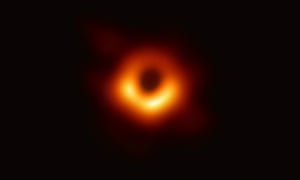
The photo released today was of the enormous black hole at the center of galaxy Messier 87, 55 million light years from earth and 7 billion times more massive than our sun, which we mentioned in our blog yesterday.
The Guardian has a nice write-up on the black hole, photo and release of the photo here. It contains some worthwhile explanatory graphics (although the YouTube film we mentioned yesterday is more detailed and complete). It also mentions the young woman who made this possible – Computing and Mathematical Scientist Dr. Katie Bouman, now at CalTech, but still a Masters Degree student at MIT when she came up with the key algorithm that could crunch all the data from all the radio telescopes involved in order to produce this single picture.
And it was a lot of data. So much data that the half-ton of hard drives needed to hold it had to be physically shipped to MIT. An extra six months had to pass for the data from the south pole to arrive, as there are no flights in or out during the Antarctic winter.
This CNN.com article has more on Bouman, hero of science, and this phys.org article has more on her algorithm. [Chuck Almdale]

Katie Bouman
Black Hole Photo Tomorrow 10 April, 2019
At 6 AM Pacific time, astronomers operating the Event Horizon Telescope network of radio telescopes plan to release their photos of two black holes. One hole sits at the center of our galaxy with a mass 4.1 million times that of our sun. The other is at the center of galaxy Messier 87 in the Virgo constellation Virgo, and is 7 billion times more massive than our sun and spews jets of particles.
I know you’re all awaiting this photographic event with baited breath, and just in case you’re not completely up-to-date on the peculiarities of black holes and photographing them, here’s a great explanation by astrophysicist Derek Mueller. [Chuck Almdale]



 SANTA MONICA BAY AUDUBON SOCIETY BLOG