Free email delivery
Please sign up for email delivery in the subscription area to the right.
No salesman will call, at least not from us. Maybe from someone else.
Voracious, venomous and hella leggy, house centipedes are masterful predators with a knack for fancy footwork. But not all their legs are made for walking, they put some to work in other surprising ways.
CORRECTION, 9/26/2018: This episode of Deep Look contains an error in the scientific name of the house centipede. It is Scutigera coleoptrata, not coleoptera. We regret the error. The viewers who caught the mistake will receive a free Deep Look T-shirt, and our gratitude. Thanks for keeping tabs on us!
This is another installment of the PBS Deep Look series; this installment is adapted from the “It’s OK to be Smart” series. If no film or link appears in this email, go to the blog to view it by clicking on the blog title above. If the film stops & starts in an annoying manner, press pause (lower left double bars ||) to let it buffer and get ahead of you. [Chuck Almdale]
Macaulay Library Curator, Greg Budney, talks about the brilliant song of the Northern Cardinal. Learn more about the Northern Cardinal on All About Birds: http://www.allaboutbirds.org/guide/no…
A film from the Cornell Lab of Ornithology. If no film or link appears in this email, go to the blog to view it by clicking on the blog title above. If the film stops & starts in an annoying manner, press pause (lower left double bars ||) to let it buffer and get ahead of you. The Lab is a member-supported organization; they welcome your membership and support. [Chuck Almdale]
Malibu Creek flood of 1995
OK, a little historical perspective is needed. We’ve had some decent rain this 2018-19 season (unless your house washed away! – then it’s indecent) but it’s been larger in the past.
Here’s a link to two short films of Malibu Creek. According to Bob Purvey of EcoMalibu (where the films are posted) they were shot by Greg Hutto in 1995, month uncertain. Most likely, according to this report, it was the result of early morning rain on January 4 or the rains of January 9-10. [Note: EcoMalibu is permanently listed in our Links-Malibu Lagoon section in the right-hand column.]
Film 1 starts with a Red-breasted Merganser, cuts to the Pacific Coast Highway bridge and Malibu Creek, then cuts to the beach: https://www.facebook.com/EcoMalibu/videos/429339087839128/
Film 2 includes scenes from film 1, but also includes aerial maps for perspective:
https://www.facebook.com/watch/?v=1757252684296331
I ran across this document which reports on the 46 1000-year storms in California for 1862-1995 (that’s a bit more common than I expected, but the explanation is immediately forthcoming).
A 1000 year rainfall is one that occurs on the average once in a thousand years at a given site. This is an event in which the maximum storm rainfall is approximately five standard deviation above the average annual maximum event. With a 1000 rain gages we should expect an average of one 1000 year rainfall each year; if rainfalls were independent events- which they are not. A single storm can effect many rain gages therefore the measurements are not independent.
I have found only 46 storms which could be classified as 1000-year events in just over 147 years, based mainly on the daily rainfall readings. If hourly records were considered there would be many as the short duration extremes seem to be much more variable than the once a day rainfalls. The 1000 year one day rainfall expressed as a percent of the mean annual precipitation varies from 15 percent in the north west corner of the State to 165 percent in the south east corner.
On the storms of January, 1995, it relates:
Storm of January 4, 1995
Large rainfalls occurred in San Luis Obispo and Santa Barbara Counties during January. A new high rainfall was reported for Santa Barbara of 8.00 inches on January 4,1995 was reported in Climatological Data. This would have been the largest one day rain in their 125 year record; but it turned out to be a key entry error. The actual record for January 3, 1995 was only 2 inches. The highest ever daily rainfall for Santa Barbara was 6.95 inches on January 25, 1914. The notable rainfall for Santa Barbara this month was the 6.10 inches on the January 10, 1995.Storm of January 7 to 13, 1995
Record breaking rainfalls occurred during the six days from January 7 to 12, 1995 on the west side of the Sacramento Valley. Fifty stations reported the greatest ever six day total rainfall. Cobb in the Clear Lake Basin received 35.18 inches in six days. The largest return period, from the records collected, was for Greenville in the Feather River Basin where 30.50 inches in six days had a return period of 2400 years. The main precipitation for this storm series was located in a band extending from Clearlake northeast to the Lake Almanor Region. Another band of high rainfalls extended from Whiskeytown north to the Mc Cloud region in the Upper Sacramento River Basin.Storm of January 10, 1995
Embedded in the January 7 to 12 storm was the January 10,1995 event northeast of Sacramento. The peak 24 hour rainfall was 7.57 inches at the Granite Bay Country Club rain gage. This peak 24 hour storm consisted of 3 separate rainfall sequences; the first from about 7 to 11 PM on the ninth, the second and heaviest from 4 to 8 AM on the tenth and another burst of rain from about 1 to 5 PM.Return periods represent the average time in years between storms of a given magnitude. They are calculated for stations with well organized and readily available rain records; hence they are not available for all records. The largest return period from the January 10 storm was 4000 years from 5.63 inches of rainfall at Rancho Cordova. This was from the rain gage of Joe Fierria, who kept a rain record there for 28 years. Thirty eight stations reported the greatest ever one day rainfall. Twelve Sacramento area stations reported over five inches of rain in one day.
The January 10,1995 storm in the Sacramento area was a low elevation event some what similar to the Columbus Day storm of 1962, when 5.5 1 inches fell on October 13,1962 at Citrus Heights. Unlike the 1962 Columbus Day storm however, the January 10, 1995 rain storm fell on saturated ground. It was preceded by eight days of rain. High antecedent rains preceding record rainfalls resulting in devastating flooding in the Sacramento area centered on Linda Creek which flows through Roseville and Rio Linda.
The storms of January 1995 extended from Humboldt County in the north to Riverside County in the south They caused a total of 740 million dollars in damage along with 17 deaths. Extensive debris flows occurred on Santa Barbara County.
The oldest storm event reported in California:
Storm of December 23 to January 21, 1862
The flood of 1862 we know to have been real, even with inadequate coverage of rain records, because [of] the size of the temporary lake that formed in the Central Valley .The Central Valley reportedly swelled up to a size rivaling that of Lake Superior before draining off into San Francisco Bay. William H. Brewer (1930) of the Whitney California Geological Survey wrote from San Francisco on Sunday, January 19, 1862, “The amount of rain that has fallen is unprecedented in the history of the state.—-The great central valley of the state is under water – the Sacramento and San Joaquin valleys – a region of 250 to 300 miles long and an average of twenty miles wide, a district of five thousand or six thousand square miles, or probable an area of three to three and a half millions of acres!”Brewer writes of the Central Valley on February 9,1862, ” Nearly every house and farm in this immense region is gone. There was such a body of water-250 to 300 miles long and 20 to 60 miles wide, the water ice cold and muddy-that the winds make high waves which beat the farm homes in pieces”.
On October 4,1861 the Red Bluff Independent reported: “Six months have elapsed since rain has fallen at Red Bluff. This has been the hottest, driest season since California became a State. On Sunday something happened in Red Bluff which nobody has expected or wanted. Dust blew in every crack. It came in showers, people breathed gallons of dust and grit every time they opened their mouths.” On November 7,1861 the Independent wrote ” The mortality of cattle was high, they were starving.”
The Red Bluff Independent states that on December 10,1861 the drought was over and flood damage was extensive. The Red Bluff Beacon reported; “Even though California received tremendous damage, Oregon suffered more, The Williamette Valley completely overflowed and a town was swept away. Crescent City California was nearly swept away.”
A Belgian miner Jean -Nicolaus Perot (1985) left the gold fields to settle at Portland Oregon in time to witness the flood there. He writes, ‘The peaceful Wllamette became, by the fifth of December, an impetuous torrent; leaving its bed, it upset and carried away the establishments which bordered its bank. It was, for two days, a curious and heart-rending spectacle: the river was covered with strays of all kinds, trees, animals, fences, provisions, houses, sawmills, flour mills all that was floating pell-mell, and passed before Portland with a speed of three leagues an hour.”
Rainfall was recorded at only a few stations in the lower elevations in 1862. The heaviest rains were recorded at San Francisco where 28.25 inches occurred in 30 days. This was 6.48 standard deviations above the mean rainfall for 30 consecutive days with a return period of 37,000 years. Sacramento had 19.33 inches in 30 days with a return period of 2,200 years.
McGashen and Briggs (1939) indicate that the river stage on the American River at Folsom was 8 feet higher than in 1852, this was higher than any other known stage. A notable feature of the flood was the prolonged period of flooding in the lower Sacramento Valley from December 13, 1861 to about February 1,1862.
A report from the Stockton Independent Record quotes a Dr. Snell of Sonora who reported 30 inches of rain at Sonora, in 10 days. This would be 7.84 standard deviations above the mean and a very rare event.
Brewer reported that, “At Los Angeles it rained incessantly for twenty-eight days– immense damage was done–one whole village was destroyed. It is supposed that over one-fourth of all taxable property of the state has been destroyed.” —Brewer kept in touch with the State Treasurer and news of the dwindling state government income because he was having long delays in being paid for his work.
There you go – Lake Superior in the Central Valley.
[Chuck Almdale]
Trolls are all over the internet, just annoying people to no end. So we were wondering, what makes someone an internet troll? Are some people just destined to be a troll, or do they develop this ability? The science may surprise you.
ABOVE THE NOISE is a show that cuts through the hype and takes a deeper look at the science behind controversial and trending topics in the news. Hosted by Myles Bess and Shirin Ghaffary.
This new (to us) series is aimed at teens, but after viewing a few episodes, I’m sure that most adults will benefit from it as well. Let us know what you think.
This is another installment of KQED’s Above the Noise series. If no film or link appears in this email, go to the blog to view it by clicking on the blog title above. If the film stops & starts in an annoying manner, press pause (lower left double bars ||) to let it buffer and get ahead of you. [Chuck Almdale]
The Feather Thief by Kirk Wallace Johnson: Book Review
The Feather Thief: Beauty, Obsession, and the Natural History Heist of the Century
Kirk Wallace Johnson
Viking (Penguin Random House) 2018.
254 pages plus 35 pages of notes and 16 pages of photographs.
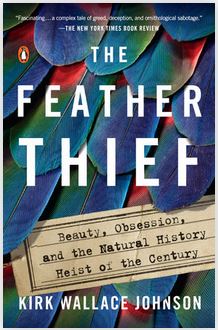
In June, 2009, American music student Edwin Rist broke into the ornithological collection of the British Museum of Natural History and stole hundreds of bird skins worth over one-half-million dollars. This collection was located in Tring, a suburb of London, and had begun with 280,000 skins sold to the museum by the Rothschild family in 1931. Walter Rothschild had spent a fortune amassing the largest private collections of bird skins and other natural history specimens the world has ever seen. A great many of the skins, including Birds-of-Paradise, had been collected by Alfred Russel Wallace during his explorations through what was then called the Malay Archipelago. It was here, laid low by one of many attacks of malaria, that Wallace dreamed up the theory of evolution by means of natural selection, and – when sufficiently able – wrote it up in a letter and sent it off to Charles Darwin, whom Wallace greatly admired. Darwin, upon receiving it, panicked, and moved quickly to get his own writings in order, in order to simultaneously present his work and Wallace’s letter to the Royal Society. The rest is history.
Is this convoluted enough for you yet?
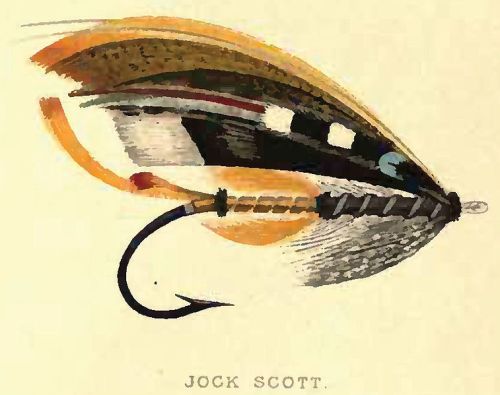
Painting of salmon fly ‘Jock Scott’ from The Salmon Fly by George Mortimer Kelson (Wikipedia)
This crime story is laid out like an historical novel, and tension mounts as you read.
Along the way you will learn about:
- Bird skin collectors and collections
- Walter’s Rothschild and the world’s largest collection of bird skins
- Alfred Russel Wallace – collector extrordinaire with the worst luck in the world, co-discoverer of evolution
- The Tring ornithological collection
- Victorian fly-tiers and the development of a Very Odd Obsession
- What is the ‘Indian Crow’
- Dead birds and feathers on women’s hats, and the Origin of the Royal Society for the Protection of Birds and the Audubon Society
- Modern day fly-tiers, and why their creations never hit water
- Asperger’s Disorder and the rule of law
- How were the skins sold, who sold them, who bought them
- And much, much more
You will find this book both entertaining and informative. Highly recommended!
[Chuck Almdale]

Diagram of salmon fly ‘Jock Scott’ from The Salmon Fly by George Mortimer Kelson (Wikipedia)



 SANTA MONICA BAY AUDUBON SOCIETY BLOG