Free email delivery
Please sign up for email delivery in the subscription area to the right.
No salesman will call, at least not from us. Maybe from someone else.
Wiki Science Photo Competition 2025 | Wikimedia Commons
[Posted by Chuck Almdale]
Wikimedia Commons is a vast storehouse of photos and other images which anyone can use with the stipulation that you’re supposed to credit the source, just as with any of the stuff people steal all day long from the web and never credit anyone. So if you’re one of the 99.998% of photographers whose photos will never be sold to anyone, but who think they’re good and want to share them with a larger audience than their maiden aunt and her cat, in this case the entire world, this is a great place to send them. I have no idea how many thousands of photos I’ve uploaded from Wikipedia and Wikimedia over the past 15 years to use in the various things I write and post, but it was probably 500 or so just for my 138-installment-series on the early Mongol Empire, the Kyivan Rus,’ and why the Mongols didn’t conquer all of Europe. [Yes, that was a plug.]
And…I just found out they have contests. A different topic every single month. This has been going on since 2013. They also have longer contests. For example there is a year-long, biannual, science competition going on right now, and it has a U.S.-only section.

All you need to know about the Wiki Science Competition in the United States is at the link below. From the snippet above you can see there’s a wide variety of acceptable “science” photos. I particularly like the shot of the tree canopy, appropriately titled “Crown Shyness” by Mirai Kambayashi. There are several categories: People in science, Microscopy, Astronomy, Non-photographic media, Image sets, Wildlife and nature, & General. The contest runs Nov. 1 – Dec. 15, 2025.
https://en.wikipedia.org/wiki/Wikipedia:Wiki_Science_Competition_2025_in_the_United_States
But that current contest barely scratches the surface. Linked below is a page that explains everything, and has a ton of example photos people have sent in. The winners are decided by those who send in photos: you can’t vote for yourself, photos must be new to the commons, you can submit as many as you want, and a few other caveats.
https://commons.wikimedia.org/wiki/Commons:Photo_challenge
The November 2025 contest is on glaciers. Here’s a screensnip of a few photos:

Categories can seem screwy, but no screwier than the endless shots of people about to eat a burrito or other presumed edible with which people entertain each other these days. For example the October 2025 contest is (as it’s still open) on…Freight Cars! Here’s an example:

The September 2025 contest was on…yes, you guessed it…bricks!

This just keeps going. As said above, these contests started in 2013. It’s all on this page, and you can branch out from there. Check it out. Maybe they’ll soon be doing a contest on…eating desserts!
https://commons.wikimedia.org/wiki/Commons:Photo_challenge#
There’s a table of contents on the left side of the page that can get you to any of the above photo sets, plus plenty more.
President’s Annual Appeal for 2025
We are asking you to consider giving us your support this year. Remember, this is our only fund raising effort. We don’t pester you weekly, monthly, or throughout the year. Your help allows our all-volunteer group to accomplish our mission “to be a center for wildlife education, habitat protection, and conservation issues that involve birds.”
These efforts are of increasing importance in view of the past decreasing support for environmental issues coming from the Federal Administration.
You can DONATE four different ways:
- With the self-addressed envelope enclosed with the annual appeal letter (sent to those already on our membership rolls)
- Send a check to our mailing address: SMBAS, PO Box 35, Pacific Palisades, CA 90272
- With PayPal using the PayPal Widget located on the right side bar of the blog
- With a Credit Card using the same PayPal Widget located on the right side bar of the blog. You do not have to join PayPal to donate, just have your credit card “standing by.”
Please take a moment and make a donation today.
We continue our strong backing of all things birds, habitat, native plants, the environment and conservation through education, field trips, bird monitoring, speakers and grants to students and conservation groups.
Please take a minute to read the annual appeal letter below and see what we have been doing this year.
Thank you,
Jean Garrett
President
Link to our online 2025-26 Calendar of Field Trips and Programs
Dear Friend of SMBAS, November 6, 2025
As we write this letter, we are acutely aware of the consequences of the Palisades Fire for many of our members, neighbors, and friends. We hope for their recovery and continuing interest in nature in general and especially in birds. Most of you know, this is our only financial appeal of the year. As an all-volunteer chapter our expenses are low, but our activities are frequent and with great local impact. Our members have supported us over the decades and we hope you will help us continue in our mission.
This year we are welcoming several new members – five and counting – to the Board of SMBAS. As time progresses, you’ll probably see a gradual change in our activities and outreach that corresponds to a younger population on the board. We’re also looking forward to next year as Santa Monica Bay Audubon Society celebrates its 50th Anniversary.
We are approaching the end of the year along with the holiday season and hope it gives you the opportunity to celebrate. Please remember that local birding is at its best for the next six months, so we hope to see you on a field trip in the near future.
Please join us and encourage your friends to do so. Our activities are all free and most have no attendance limit. If you’re experienced or want to start joining our leadership, we welcome co-leaders. Just get in touch with the leader listed on the blog announcement.
Jean Garrett, President SMBAS
Your support helps these activities and services to continue:
- The Blog: In addition to advance announcements and follow-up reports of all our activities, our blog has frequent interesting articles on birds, nature and science in general. There are occasional longer series on subjects like avian taxonomy and polyandry. The blog also has permanent pages on special topics: Animal rescue information, Western Snowy Plovers, 80 L.A. Co. Birding Areas, Malibu Lagoon, Calendar, Grant Applications, The Tongva, Birds in the Bible, Locating Birds for Others, Zoom Recordings. When you give that www.smbas.org address to your friends and acquaintances, make sure you encourage them to explore the multiple links on our site. It’s a treasury of history, local knowledge and bird lore!
- Malibu Lagoon monthly bird walks: (4th Sunday–not the last), we welcome new and experienced birders at 8:30 and ‘Kids and Parents’ at 10 am.
- Field Trips: Held October—June to nearby destinations, usually on the 2nd Saturday of the month. Currently scheduled: 13 Dec: Back Bay Newport; 14 Feb: Madrona Marsh; 14 Mar: Sepulveda Basin. Remember to check smbas.org for updates and adjustments!
- Evening Programs: October through December and February through May, an online program on scientific, travel, or conservation topics. Please check smbas.org for our next program. Sign up on the blog to receive all announcements in your inbox.
- Your funding helps support:
- Endowments with Santa Monica College Foundation and Loyola Marymount University supply scholarship aid to biology or ecology students.
- Grants up to $600 to students at local colleges and universities for research on local species and environments. We would love to expand the number of awards as the costs for students keeps ballooning.
- Funding for bus transportation for inner city children to visit and explore Ballona Saltwater Lagoon. The number of buses we pay for depends on our annual fundraising.
- Sponsorship of student summer internship with Student Conservation Association.
- Staffing the Annual Coastal Cleanup station at Malibu Lagoon State Beach for Heal the Bay, [held on the 3rd Saturday of September.]
- Our conservation activities include: Regular monitoring of our beloved Western Snowy Plovers, monitoring and encouraging the Bay Foundation’s Dune Restoration program on local beaches, special letter-writing and appearances before local and national organizations to develop influence. We alert our readers to letter-writing campaigns in conjunction with other organizations to oppose or support legislation.
Please check the blog www.smbasblog.com for changes and updates.
[posted by Chuck Almdale]
Zoom Recording: Bats! Genomics, gene-flow, connectivity and the Yuma Myotis, with Joseph Curti, PhD.
The recording of this program from 4 November 2025
is now available online.

Bats! Genomics, gene-flow, connectivity and the Yuma Myotis, with Joseph Curti, PhD.
It may take 30 seconds to boot up. If you want to turn the closed captioning off, click the ‘CC’ button at lower right.
Many people associate the month before and after Halloween with spooky symbols like witches, ghouls, and of course BATS! But how much do you really know about these furry winged creatures? Join UCLA Postdoctoral Researcher and bat scientist Joseph Curti for an hour-long lecture on the remarkable and misunderstood group of mammals known as bats. In this talk, Joseph will discuss bat diversity in Southern California as well as basic features of bat ecology and natural history. He will also share some of the findings from his research on bat genomics aimed at applying whole genome sequencing to understand genomic health and inbreeding in Yuma Myotis bats (Myotis yumanensis), how connected the Yuma Myotis populations are across their range, and barriers to the movement across California.
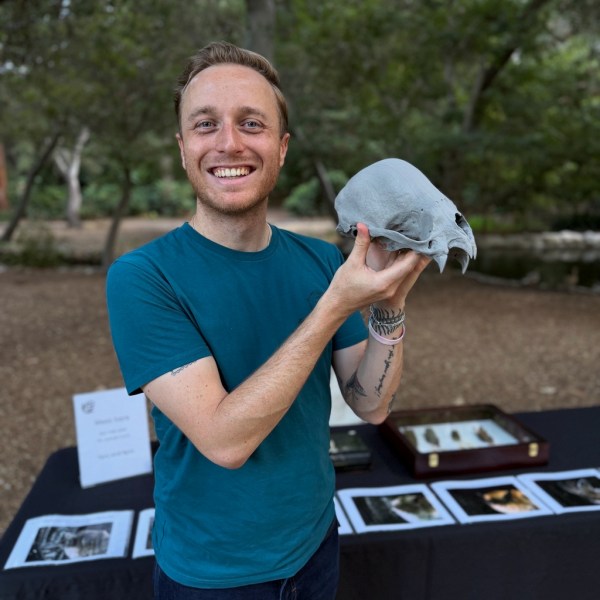
Joseph Curti, Ph.D. is a postdoctoral research fellow at the UCLA La Kretz Center for California Conservation Science. Joey’s current research focuses on the impacts of anthropogenic stressors on bat community composition in urban areas across California. Joey received his Ph.D. in 2024 from the UCLA Ecology and Evolutionary Biology department, where he worked with statewide resource managers on a variety of conservation genomics projects. These included a project aimed at evaluating the impact of roadways in Los Angeles to California quail (Callipepla californica) gene flow and rangewide landscape genomics of the Yuma Myotis bat (Myotis yumanensis). Joey has been working with bats since 2015 and has worked on a variety of projects including radio tracking Big Brown Bats (Eptesicus fuscus) in the California Central Valley, mist netting and acoustic surveys of bats on the California Channel Islands, and acoustic surveys of bats for the Santa Monica Mountains National Recreation Area. Outside of his academic research, Joey regularly leads acoustic bat walks and classes on bat ecology and natural history for groups across Los Angeles, including Theodore Payne Foundation, the LA Natural History Museum, the Ojai Valley Land Conservancy, the Resource Conservation District of the Santa Monica Mountains, and the San Fernando Valley Audubon Society. For more information and to stay up-to-date on his most recent publications and research, please visit his website at www.josephcurti.com.
Link to all SMBAS Zoom Recordings

when ‘seen’ through the ears of a bat?
2025 Top 100 Audubon Photos | Trish Oster’s Hungry Young Grebe
[Posted by Chuck Almdale]
Link to 2025 National Audubon Society winners.
The best 100 of somewhere in the high thousands of entries.
Hallmarks: Clear, sharp, well-framed, interesting, unusual views, unusual behaviors, unusual angles.

Pied-billed Grebe toying with a crayfish. No. 93 in the 2025 NAS photo contest.
(Trish Oster, Legacy Park, Malibu 14 Apr 2024). Birds always swallow fish
head first, but when the beast come front-loaded with weaponry,
that might not be the best tactic.
Among the 100 top photos in the NAS contest, for at least the third year in a row, is #93 by Trish Oster, local birder & bird photographer who occasionally joins us on our Malibu Lagoon bird walks. Trish sent me a copy of the photo. I’ve birded with Trish and I’ve never seen her without her camera, even when eating lunch, and I suspect she had the camera permanently grafted onto her arm, or perhaps it was only the quick-release attachment, which is one reason why she gets so many great photos.
The NAS website has the following photo information:
Contest: United States and Canada
Image Location: Legacy Park, Malibu, California, United States
Camera: Canon EOS R6 with a Canon RF 100-500mm f/4.5-7.1 L IS USM lens; 1/3200 second at f/7.1; ISO 8000
Behind the Shot: A juvenile grebe was foraging in our little local pond. As I was observing the bird, it dove down and came up with a very large non-native red swamp crayfish. At first, I thought it had bitten off more than it could chew. Since I hand-hold my camera, I set a higher shutter speed of 1/3200 sec to compensate for the movement and lowered my exposure to -0.3 EV to make the grebe and the crayfish stand out. After much effort, the grebe miraculously swallowed the crayfish whole. It not only got a well-deserved meal—it was also cleaning our waterways, one invasive crustacean at a time.
Some additional NAS photography links:
2025 Contest Winners: Top 15 Photos & 2 Videos
2025 Contest Honorable Mentions: The next 15
How to become a better bird photographers: Advice from the winners
Malibu Creek State Park
1925 Las Virgenes Rd, Calabasas
Saturday, 8 November 2025 at 8am
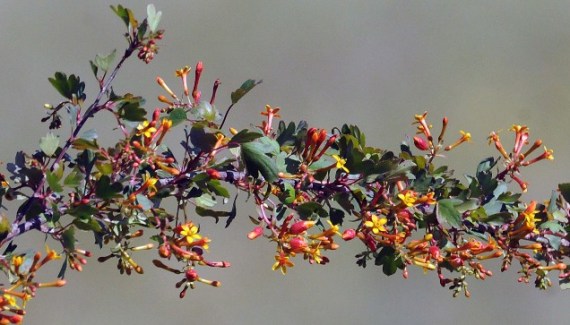
This is always a lovely walk past grassy fields and groves of Live Oak. We should see resident species such as Red-tailed and Red-shouldered Hawk, Band-tailed Pigeon, Acorn Woodpecker, Oak Titmouse and Western Bluebird.

We’ll look for raptors, hummers and swifts, flycatchers, swallows, wrens, warblers, finches, sparrows and late migrants. (Did I omit anything?) Phainopepla and Merlin are possible. Red-tailed Hawks, Red-shouldered Hawks and American Kestrel all nest here and generally stay all year. Nanday Parakeets as well. Swifts may still be overhead. Wrens, Thrashers, Vireos. Are the White-tailed Kites there again? The sapsuckers? Have the Lewis’ Woodpeckers returned? Come and find out. Deer, Coyote and Bobcat are resident though seeing a Bobcat is a rare treat.
Links to prior trips: Jun 2025, May 2024, Nov 2012, Nov 2011, Nov. 2010
Family guide: 1-3 miles walking on pavement and dirt trails. Morning temperatures start cool.
[Directions] From the Ventura Fwy (101): exit at Las Virgenes Rd. Go south on Las Virgenes Rd. for about 3 miles. Continue past the traffic light at the intersection with Mulholland Hwy. The Park entrance is on the right just south of the traffic light.
Coast Route: From PCH, take Malibu Canyon Road inland. The main entrance of the park is on the left about 1.5 miles past the traffic light at Piuma Rd. (Don’t turn at the entrance to Tapia Park which is just after Piuma Rd.)
If you don’t have a CA State Park pass, the day-use fee is $12 per vehicle, $11 for seniors, or $3/hour. Go straight after you pass the kiosk. We’ll meet in the second (lower) parking lot near the bathroom block. Look for the sign that says “Main Trailhead Parking”. Either way, allow 45 minutes travel time from Santa Monica.

Meet at 8:00 a.m. in the Main Trailhead parking lot. Watch for roadside birds on your way into the park.
For additional information, call Jean; reservations not needed: 213-522-0062




 SANTA MONICA BAY AUDUBON SOCIETY BLOG