Free email delivery
Please sign up for email delivery in the subscription area to the right.
No salesman will call, at least not from us. Maybe from someone else.
The 39 species of birds-of-paradise look very different from each other, and they also also sound very different from each other. But researchers are only beginning to investigate their calls in detail. The sounds they make run the gamut from basic squawks, to seemingly mechanical noises, to melodious whistles, to sounds that don’t involve their voices at all. The Cornell Lab’s Ed Scholes explains.
There are currently seventy-two short films in the entire Birds-of-Paradise Project playlist, ranging from 26 seconds to 8:29. In the upcoming weeks, we will present some of our favorites.
A film from the Cornell Lab of Ornithology. If no film or link appears in this email, go to the blog to view it by clicking on the blog title above. If the film stops & starts in an annoying manner, press pause (lower left double bars ||) to let it buffer and get ahead of you. [Chuck Almdale]
We continue the PBS explanation of evolution in twelve short episodes, suitable for all.
This is an installment of the PBS – It’s OK to be Smart series. If no film or link appears in this email, go to the blog to view it by clicking on the blog title above. If the film stops & starts in an annoying manner, press pause (lower left double bars ||) to let it buffer and get ahead of you. [Chuck Almdale]
A beautiful day at the Lagoon as spring migration tails off. Maybe it’s a little earlier than usual this year. We had few ducks and shorebirds, but just enough for the edification of the ten or so new faces we welcomed to “our” lagoon. Some signs of renewal in the fifth year since the reconfiguration of the area: Black-crowned Night-herons exploring the trees around the lagoon, and a Red-winged Blackbird checking out the reeds, …for nesting? The best drama award went to the mom Snowy Plover sitting on her nest who bolted out of the protective wire exclosure when a pushy Killdeer approached. She put on an extensive broken-wing, distressed diversion and eventually led the Killdeer a good hundred feet from the nest.
Total 38 species. Not very rich for spring–more like a summer doldrums count. Maybe we’ll be surprised in May.
Gadwall (Mareca strepera) 5
Mallard (Anas platyrhynchos) 4
Double-crested Cormorant (Phalacrocorax auritus) 18
Brown Pelican (Pelecanus occidentalis) 32
Great Blue Heron (Ardea herodias) 1
Snowy Egret (Egretta thula) 1
Black-crowned Night-Heron (Nycticorax nycticorax) 2
American Coot (Fulica americana) 2
Snowy Plover (Charadrius nivosus) 9
Semipalmated Plover (Charadrius semipalmatus) 4
Killdeer (Charadrius vociferus) 7
Whimbrel (Numenius phaeopus) 3
Sanderling (Calidris alba) 45
Least Sandpiper (Calidris minutilla) 12
Western Sandpiper (Calidris mauri) 4
Willet (Tringa semipalmata) 6
Ring-billed Gull (Larus delawarensis) 1
Western Gull (Larus occidentalis) 18
Caspian Tern (Hydroprogne caspia) 8
Elegant Tern (Thalasseus elegans) 30
Rock Pigeon (Feral Pigeon) (Columba livia (Feral Pigeon)) 1
Eurasian Collared-Dove (Streptopelia decaocto) 2
Allen’s Hummingbird (Selasphorus sasin) 3
Black Phoebe (Sayornis nigricans) 1
American Crow (Corvus brachyrhynchos) 2
Barn Swallow (Hirundo rustica) 4
Bushtit (Psaltriparus minimus) 1
Northern Mockingbird (Mimus polyglottos) 2
Orange-crowned Warbler (Oreothlypis celata) 1
Common Yellowthroat (Geothlypis trichas) 1
Savannah Sparrow (Passerculus sandwichensis) 1
Song Sparrow (Melospiza melodia) 10
California Towhee (Melozone crissalis) 1
Spotted Towhee (Pipilo maculatus) 2
Red-winged Blackbird (Agelaius phoeniceus) 1
Brown-headed Cowbird (Molothrus ater) 2
Great-tailed Grackle (Quiscalus mexicanus) 4
House Finch (Haemorhous mexicanus) 4
Why can’t you just flick a tick? Because it attaches to you with a mouth covered in hooks, while it fattens up on your blood. For days. But don’t worry – there *is* a way to pull it out.
This is another installment of the PBS Deep Look series; this installment is adapted from the “It’s OK to be Smart” series. If no film or link appears in this email, go to the blog to view it by clicking on the blog title above. If the film stops & starts in an annoying manner, press pause (lower left double bars ||) to let it buffer and get ahead of you. [Chuck Almdale]
Malibu State Park Trip Report, Saturday, 14 April 2018
Malibu Creek State Park
Saturday, 14 April 2018
It was sunny but a rather chilly 39° when we gathered in the Trailhead (formerly “lower”) parking lot but we could hear many birds singing. As we start across the parking lot in the direction of the path to the Amphitheatre we saw several American Crows investigating the trash dumpsters at the edge of the parking lot. Suddenly an immature Cooper’s Hawk flew past us, over the dumpsters and landed in a small tree a short distance away. It remained on its perch long enough for us to get good scope views.
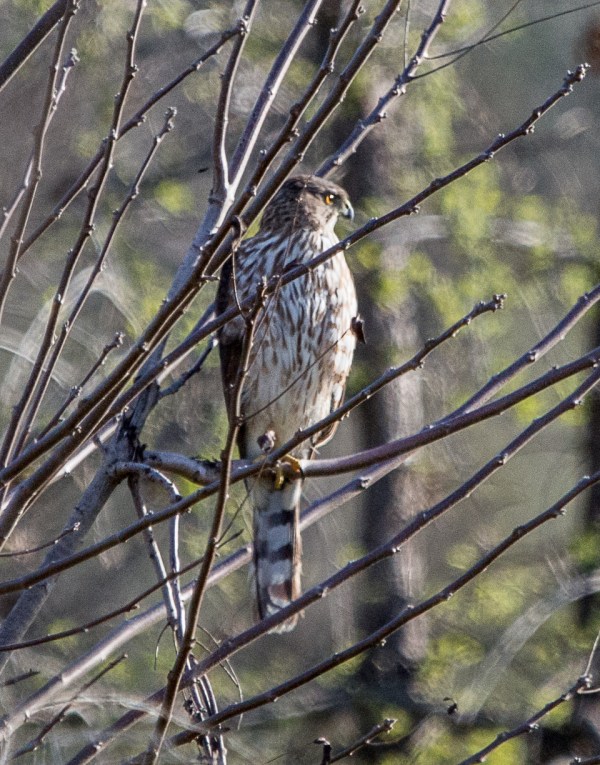
Cooper’s Hawk, Ray Juncosa, 04/14/18
Two Band-tailed Pigeons circled overhead with their wings and tails spread in what appeared to be a form of display. Raucous screeching alerted us to the approach of 2 Nanday Parakeets and a single Canada Goose flew over.
We left the parking lot and started along the path that runs alongside the dry ravine. An uncooperative House Wren was singing loudly from a large shrub on our left. It was the first of many House Wrens we heard during the walk. We heard the songs of Pacific-slope Flycatcher, Orange-crowned Warbler, Yellow Warbler, Spotted and California Towhee from the trees beside the path. Since the deciduous trees were already leafing out and the warblers were flitting about in the vegetation it wasn’t easy to get good looks at some of those birds but a Yellow-rumped Warbler in breeding plumage was very cooperative.
When we stepped out from under the oaks we stopped just across from the Amphitheater. From there we could see several Acorn Woodpeckers flying back and forth in the upper reaches of one of one of the oaks. A California Towhee perched in a shrub in front of us, an Allen’s Hummingbird made a brief appearance and we saw a White-breasted Nuthatch carrying nesting material in its bill. Some Lesser Goldfinch perched in the trees and a Dark-eyed Junco was foraging on the ground.
From there, we turned and walked along the path that runs along the opposite side of the ravine. We heard another House Wren singing from the knoll behind the Amphitheater and a lonse Bushtit disappeared into a dense shrub next to the path. A few moments later, we noticed a pair of Western Bluebirds perched on a sign at the side of the trail. They appeared to be fly-catching as they repeatedly flew from and back to their perch. The light was behind us so their colors were brilliantly illuminated. Since they kept returning to the same perch we had ample opportunities for scope views.
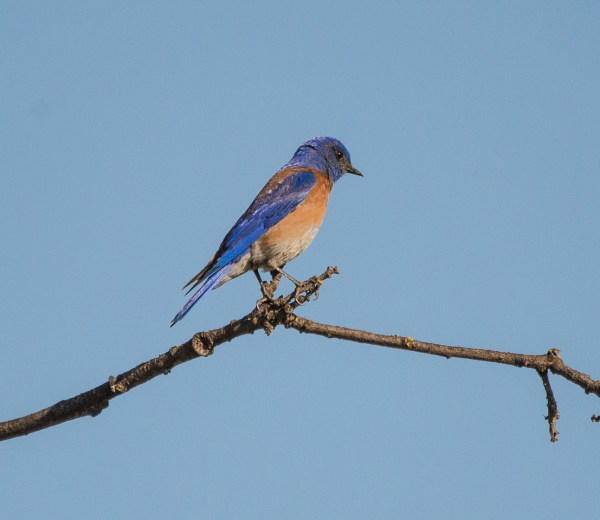
Western Bluebird, Ray Juncosa, 04/14/18
As we continued along the path, we could see some Mule Deer in the distance and some soaring Turkey Vultures. We stopped to watch some Acorn Woodpeckers that were flying to and from a large oak in the distance.

Turkey Vulture, Ray Juncosa, 04/14/18
When we reached the paved road that provides vehicle access to the campground, we crossed it and stopped at the picnic table under the oak at the head of the Nature Trail (called the “Visually Impaired Trail” on the current park map). A Red-tailed Hawk that was carrying prey in its talons flew over the field and into the trees and a California Quail called once. Two Oak Titmice were moving through the oak beside the picnic table, a Spotted Towhee was on the ground beneath the tree and, to our surprise, a gopher briefly poked its head out of the ground at the edge of the path.
We left the picnic table and started along the Nature Trail. The back section of the trail is a loop which we walked in a clockwise direction. There were warblers singing from the canopies of the trees and we heard a Nuttall’s Woodpecker, Pacific-slope Flycatcher and another House Wren. We saw a male Anna’s Hummingbird, some Acorn Woodpeckers, California Scrub-Jays, Spotted and California Towhees.

California Towhee, Ray Juncosa, 04/14/18
As we rounded the loop in the trail, we heard the song of yet another House Wren. Fortunately, the vegetation in that area consists of scattered trees and shrubs with patches of vines and some fallen logs. The more open habitat and the configuration of the trail meant that everyone was able to see the area. Their small size and cryptic coloration often make seeing House Wrens difficult but this bird kept moving from perch to perch while singing seemingly without pause and everyone was able to see it well.
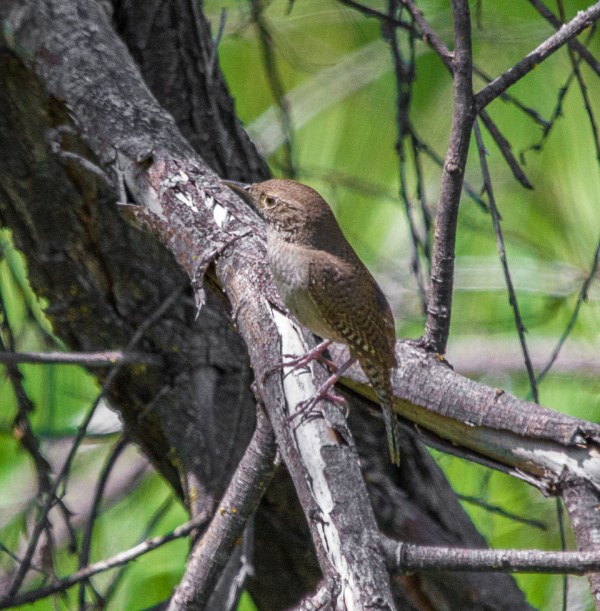
House Wren, Ray Juncosa, 04/14/18
It was almost noon when we left the Nature Trail and walked toward the parking lot. Since the area where the park is located is well-known for extremes of heat and cold, mid-day is not prime birding time in warm weather so we often plan to end our field trips by lunch time. However, a thin cloud layer was moderating the effects of the sun so some of us decided to continue birding, this time from the Crags Road Trail.
As soon as we crossed the road from the parking lot we heard at least 2 Yellow Warblers singing from the trees or shrubs near the cement “bridge” over Las Virgenes Creek. We backtracked a bit to listen and watch for movement in the shrubbery. Despite our efforts, we got little more than quick glimpses of a small yellow-colored bird flitting from one spot to another, each time disappearing in the foliage. Disappointed, we finally gave up and resumed walking up the trail.
As we crossed the creek we scanned the trees along the water in the hope of seeing a woodpecker but saw none. Since the road was built on land that is higher than the creek bed, much of the canopy on the south side of the road is either at or only slightly above eye level. However, even with that in our favor, it was not easy to see birds we could hear. However, we did get quick looks at a Nuttall’s Woodpecker, Orange-crowned and Yellow Warblers and a male Wilson’s Warbler flitted past us.
We spotted a Bewick’s Wren on the trunk of a dead tree below us. It flew off, replaced by first one and then a second House Wren. We quickly realized that they were going in and out of a hole on the side of the trunk. We watched them for a time, savoring the clear views of a species we had worked so hard to see that same morning.
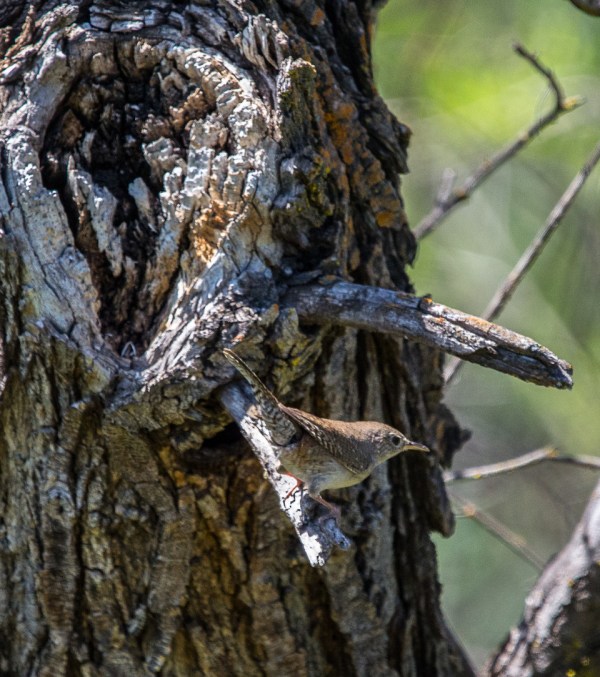
House Wren by nesting cavity, Ray Juncosa, 04/14/18
After a time, we left the wrens, walked a bit farther and stopped to scan the trees. A Nanday Parakeet was perched on the trunk of a tree.
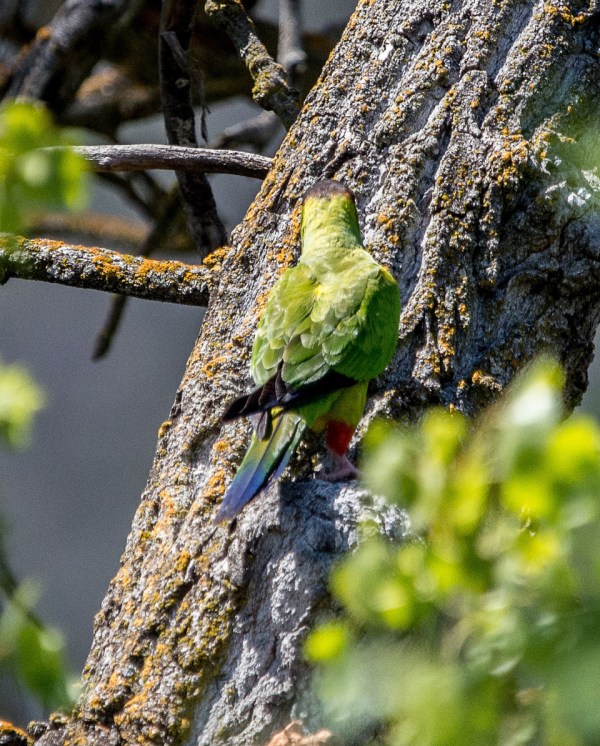
Nanday Parakeet, Ray Juncosa, 04/14/18
A male Blue Grosbeak was actively foraging in a willow close to the road. Getting scope views wasn’t easy because it was so active but it was certain worth the effort.
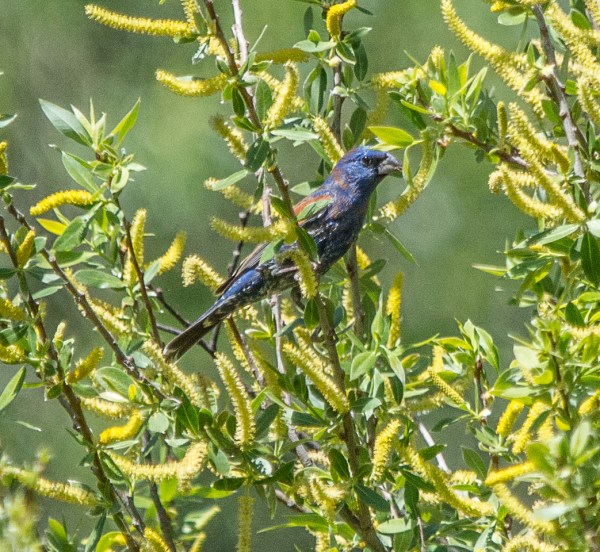

Blue Grosbeak, Ray Juncosa, 04/14/18
Suddenly a large adult Cooper’s Hawk flew from behind us and landed in a tree that was just beginning to leaf out. It did not stay long and when it flew, it headed downstream. Almost immediately, a second, smaller Cooper’s Hawk flew from behind us and perched somewhat deeper in the trees. After a few moments, it flew off, heading the same direction as the first bird.
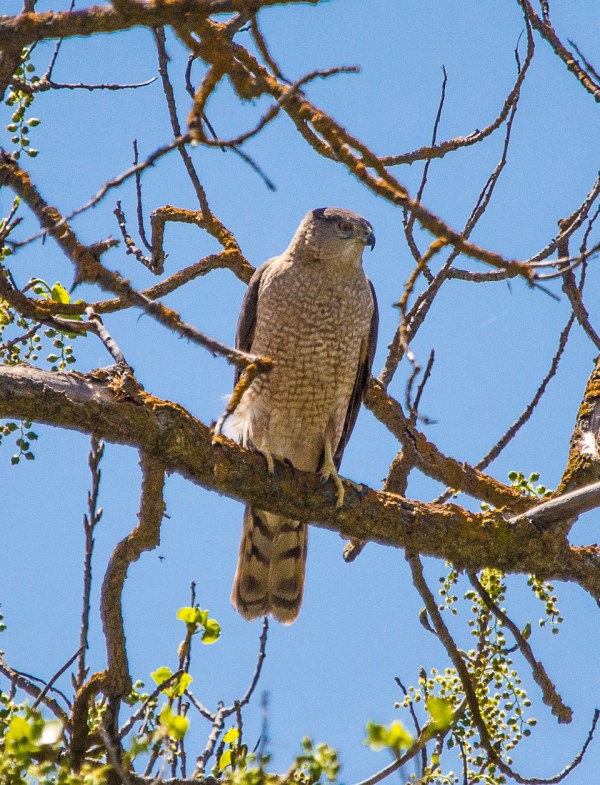
Cooper’s Hawk, Ray Juncosa, 04/14/18
Since it was getting hot, we decided to call it a day. While we were on our way back to the parking lot, we stopped in the shade where we could look down into the creek. A female Mallard and six young were working their way downstream and 2 Song Sparrows were foraging on the ground and in the low vegetation on the opposite bank.
The last bird of the day was a Great Blue Heron which we saw in flight from the parking lot as we returned to our cars after an excellent morning in the park.
Special thanks to Ray Juncosa for sharing his photos.
| MCSP, 14 April 2018 | ||
| Canada Goose | Branta canadensis | 1 |
| Mallard | Anas platyrhynchos | 1F, 6 imm |
| California Quail | Callipepla californica | heard |
| Band-tailed Pigeon | Patagioenas fasciata | 2 |
| Anna’s Hummingbird | Calypte anna | M |
| Allen’s Hummingbird | Selasphorus sasin | M |
| Hummingbird sp. | 1 | |
| Great Blue Heron | Ardea herodias | 1 |
| Turkey Vulture | Cathartes aura | 4 |
| Cooper’s Hawk | Accipiter cooperii | 3 (M,F,imm) |
| Red-tailed Hawk | Buteo jamaicensis | 1 carryng prey |
| Acorn Woodpecker | Melanerpes formicivorus | >30 |
| Nuttall’s Woodpecker | Picoides nuttallii | 1, 1 heard |
| Black-hooded Parakeet [I] | Nandayus nenday | 3 |
| Pacific-slope Flycatcher | Empidonax difficilis | several heard |
| Black Phoebe | Sayornis nigricans | 6 |
| California Scrub-Jay | Aphelocoma californica | 12 |
| American Crow | Corvus brachyrhynchos | >10 |
| Common Raven | Corvus corax | 4 |
| Oak Titmouse | Baeolophus inornatus | >10 (mostly heard) |
| Bushtit | Psaltriparus minimus | 2 |
| White-breasted Nuthatch | Sitta carolinensis | 1 w/ nesting material |
| House Wren | Troglodytes aedon | 3 seen, many heard |
| Bewick’s Wren | Thryomanes bewickii | 1 |
| Wrentit | Chamaea fasciata | heard |
| Western Bluebird | Sialia mexicana | 10 |
| Lesser Goldfinch | Spinus psaltria | 10 |
| Spotted Towhee | Pipilo maculatus | 12 |
| California Towhee | Melozone crissalis | 15 |
| Song Sparrow | Melospiza melodia | 2 |
| Dark-eyed Junco | Junco hyemalis | 4 |
| Orange-crowned Warbler | Oreothlypis celata | 4 seen, many heard |
| Yellow Warbler | Setophaga petechia | 4 seen, many heard |
| Yellow-rumped Warbler | Dendroica coronata | 1 |
| Wilson’s Warbler | Cardellina pusilla | M |
| Blue Grosbeak | Passerina caerulea | 1 |
| total = 35 species |



 SANTA MONICA BAY AUDUBON SOCIETY BLOG