Free email delivery
Please sign up for email delivery in the subscription area to the right.
No salesman will call, at least not from us. Maybe from someone else.
Natural Selection & Sexual Selection: An Illustrated Introduction | Cornell / National Geographic
How does evolution happen? Through a gradual process called selection. Individuals that are better equipped to survive and reproduce pass those traits to their offspring. These “selected” changes accumulate over thousands of years. We tend to think of natural selection—”survival of the fittest”—but sexual selection works the same way and can be just as strong in shaping how species look and act. Filmed and photographed by Tim Laman and Ed Scholes.
There are currently seventy-two short films in the entire Birds-of-Paradise Project playlist, ranging from 26 seconds to 8:29. In the upcoming weeks, we will present some of our favorites.
A film from the Cornell Lab of Ornithology. If no film or link appears in this email, go to the blog to view it by clicking on the blog title above. If the film stops & starts in an annoying manner, press pause (lower left double bars ||) to let it buffer and get ahead of you. [Chuck Almdale]
The title describes it. We begin at the beginning, where all beginnings should begin.
The start of the PBS explanation of evolution in twelve short episodes, suitable for all.
This is an installment of the PBS – It’s OK to be Smart series. If no film or link appears in this email, go to the blog to view it by clicking on the blog title above. If the film stops & starts in an annoying manner, press pause (lower left double bars ||) to let it buffer and get ahead of you. [Chuck Almdale]
Second sighting of Ehler’s Sandhopper-Warbler
LATE-BREAKING ALERT !
Several days after our original publication on 1 April, 2018, we received notification of another sighting of Ehler’s Sandhopper-Warbler. This sighting was on 1 April, 2018, but several hundred miles farther north and quite likely was a different bird. Well-known international birder, Don Roberson, was out doing some morning birding at a local patch, – the Iris Canyon vicinity of the Monterey MPC campus in Monterey, CA, to be exact – when he spotted and photographed what he naturally assumed at the time to be a typical Yellow-rumped Warbler, well on its way into alternate (breeding) plumage. Alerted by our announcement of the presence of the Ehler’s Sandhopper-Warbler in Southern California, he reexamined his photograph, and discovered it to be the Ehler’s. This second sighting supports Dr. Ehler’s conjecture (see bottom of the original article) that the birds may have been wintering in North America for a very long time, their presence unsuspected until now, due to their exceptionally close resemblance to the unrelated and very common Yellow-rumped Warblers.
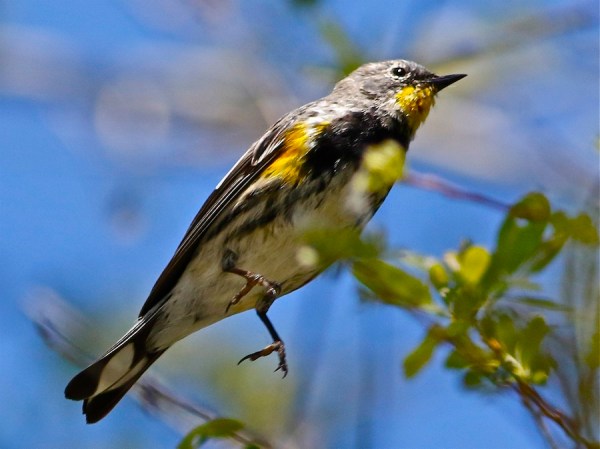
Another sighting of Ehler’s Sandhopper-Warbler in Monterey, CA, this time hopping over both a large bush and the photographer. (Don Roberson 4-1-18)
The photo is included in Roberson’s eBird checklist for that day (not yet corrected to include Ehler’s Sandhopper-Warbler). In his communication with us, Roberson commented:
I read your article with interest. Just yesterday I photographed what I thought was a Yellow-rumped Warbler but I wonder if I misidentified the Ehler’s Sandhopper-Warbler? Please note that subject in question is clearly hopping — without spreading its wings — except this hop was much higher — well over my head — and might suggest a means to hopping from canopy to canopy across North America. Just a hypothesis, of course, as you guys are on the cutting edge of science here.
Roberson has long been fascinated by the entire spectrum of the families of birds of the world, and has assembled his photographs and discussions into an extremely attractive and informative website*, Creagrus @ Monterey Bay, deserving of the attention of any birder similarly inclined. I didn’t see Sandhopper-Warblers among the avian families listed, so this sighting will give him something to catch up on. Many thanks to Don Roberson for his alert attention to detail!
[Chuck Almdale — 6 April, 2018]
*The lovely Swallow-tailed Gull Creagrus furcatus is endemic to the Galapagos Islands and is the sole species in its genus.
Those who found this article plausible, should also read:
2013: Birders Take Their Lumps With Their Splits
2012: Canyonland Roadrunner Captured on Film
2011: New Hummingbird Species Discovered in Los Angeles County!
2010: The Western Roof-Owl: Bird of Mystery
Most firefly flashes are pure romance, a sexy form of skywriting. But one variety copies the mating signals of others to lure them to their demise.
This is another installment of the PBS Deep Look series; this installment is adapted from the “It’s OK to be Smart” series. If no film or link appears in this email, go to the blog to view it by clicking on the blog title above. If the film stops & starts in an annoying manner, press pause (lower left double bars ||) to let it buffer and get ahead of you. [Chuck Almdale]
A Salp Washed Up…

Salp – front end with “horns” at right (Lu Plauzoles Malibu Surfrider Beach 3-25-18)
This now defunct object found on the beach at Malibu Lagoon (aka Surfrider beach) is not a jellyfish. It is not a sea hare either. We consulted Tara Crow, former Programs Manager at Heal the Bay’s Santa Monica Pier Aquarium and she revealed the identity of our rather rare participant in the SM Bay Audubon monthly walk on March 25th. It is a …salp.
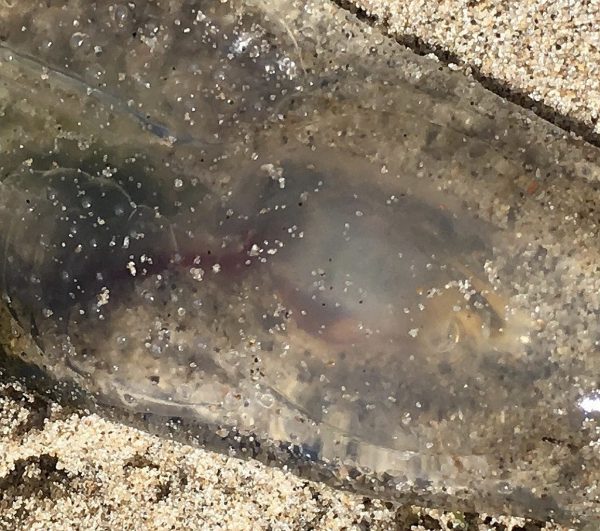
Salp closeup – organs visible through translucent body
(Lu Plauzoles Malibu Surfrider Beach 3-25-18)
There is a prize for the birder who can prove they previously knew the existence of that word, and that creature! According to Ms. Crow, they are not as common as jellyfish, sea hare, or the (in)famous Gumboot chiton; all of which tend to wash up on the shore more often than our critter. The salp’s proper name is the rather scandalous (most unfortunate) Thetys vagina. But the salp used that name before human anatomists.

Salp chain (Frierson, Oregon Dept. of Fish & Wildlife 11-15-12 8253212250)
Tara continues:
“They are crazy cool organisms on so many levels. One of the most amazing things is they have the first evidence of a notochord during development. The notochord is what turns into the spinal column on vertebrates. Of course, those guys instead went a totally different direction and turned into giant floating colonial blobs. Giant is relative, of course. We estimated this was 25-30 centimeters, or between 10 and 12 inches long and approximately four inches across. Many of the salps are apparently smaller, but often congregate in the thousands.”

Gumboot chiton Cryptochiton stelleri topside
(Jerry Kirkhart 12-12-08 wikicommons)
What makes this discussion doubly interesting for us birders, however, is the lateral mention of the Gumboot chiton, which is a rock scouring creature that some have described as a sea-meatloaf. Its proper name is Cryptochiton stelleri.

Gumboot chiton Cryptochiton stelleri underside
Note three-handed gumboot holder
(Professor Douglas Eernisse 2-27-06 wikicommons)
It turns out the Gumboot chiton is another of the species discovered and named by Steller who spent a short time on the Alaskan Coast while on Bering’s expedition. We California birders often see the bright blue Steller’s Jay at elevation and in a few spots northward along the coast. (I don’t recall seeing the chiton.)

Steller’s Jay, San Gabriel Mtns. (C. Almdale 6-7-10)

Georg Wilhelm Steller himself
(Courtesy University of Tyumen, The Center of Russian-German Cooperation of Georg Wilhelm Steller)
From Wikipedia: The Latin name Cryptochiton stelleri means Steller’s hidden chiton. “Steller” is in honor of the 18th-century German zoologist Georg Wilhelm Steller, who first described many species of the northern Pacific seashore.
So…as it turns out, again. It’s all about the birds!
[Lucian Plauzoles, arranged by C. Almdale]



 SANTA MONICA BAY AUDUBON SOCIETY BLOG