Free email delivery
Please sign up for email delivery in the subscription area to the right.
No salesman will call, at least not from us. Maybe from someone else.
DNA Doesn’t Look Like What You Think! | PBS Science Video
They used #badDNA once in this video. Can you find it?
Biology textbooks are full of drawings of DNA, but none of those show what DNA actually looks like. Sure, they’re good models for understanding how DNA works, but inside of real cells, it’s a whole lot more interesting. Learn why we can’t look directly at DNA, and find out how DNA is actually packed inside cells.
This is an installment of the PBS – It’s OK to be Smart series. If no film or link appears in this email, go to the blog to view it by clicking on the blog title above. If the film stops & starts in an annoying manner, press pause (lower left double bars ||) to let it buffer and get ahead of you. [Chuck Almdale]
A Major Policy Action Against Birds
In a Christmas gift to industry and business, Daniel Jorjani, counsel to the Department of Interior, has issued a legal opinion that guts the Migratory Bird Treaty Act, (MBTA), which is a law about to celebrate 100 years of bird protection.
The MBTA is a very broad law, sparingly enforced by the US Fish and Wildlife Service, part of the Department of Interior. Those of us who are involved in trying to protect birds from the multiple threats of human land use and industry, know the law is very rarely applied and prosecutorial discretion is a major brake on its potential bite. I have spoken to former employees of the USFWS who left the agency because of its prosecutorial timidity. The fact is the MBTA is very rarely invoked in prosecution.
However, in his long, eminent lifelong legal career*, Mr. Jorjani has become the brave defender of every cat owner and auto driver in the United States. By arguing that the MBTA makes every pet owner and driver a potential criminal, subject to the whims of prosecutors and officials, he has decided to strictly limit the implementation of the law to only “direct and affirmative purposeful actions that reduce migratory birds, their eggs, or their nests, by killing or capturing, to human control.”
This means he has effectively gutted the MBTA. We know how difficult it is to prove intent, i.e. “affirmative, purposeful action.” Every builder, developer, bulldozer operator and drone-flyer must be cheering today. In order to avoid any penalty for killing birds, mowing their grassland nests, or otherwise harming or harrassing them, all the people have to do is say “I didn’t mean to. I was doing something else.” In a strange twist, the dog owner whose pet starts chasing an endangered or threatened species might also use the same excuse. I fear for our Snowy Plovers. The concept of “incidental take” has been taken off the books by administrative action. The current administration has shown its disregard for wildlife.
*You may be interested in Mr. Jorjani’s background and career. Go to https://departmentofinfluence.org/person/daniel-jorjani/
Butterbredt Christmas Count–a Big Surprise
Our count was scheduled for Saturday, December 16th, but Mary Prismon and her daughter Carole went up on Friday, and what did they find? Fire trucks at Butterbredt Spring!
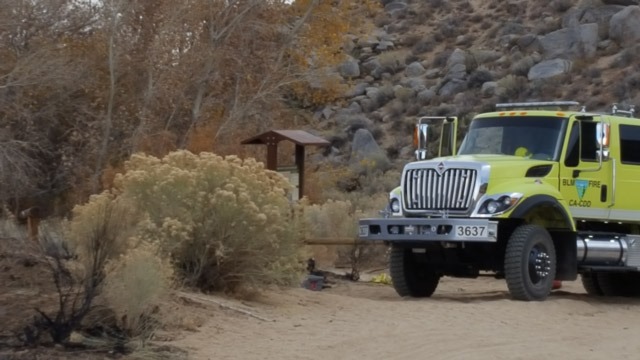
Photo: Carol Reed 12-16-17
Doesn’t look so bad, right? That’s the most favorable angle. On Saturday afternoon my car went by and Chris Lord took a few snaps.

Photo: Chris Lord 12-16-17
This is where the fire started, according to the Park Rangers we spoke with. It could have been a car parked in the brush with a hot exhaust pipe – we don’t know.
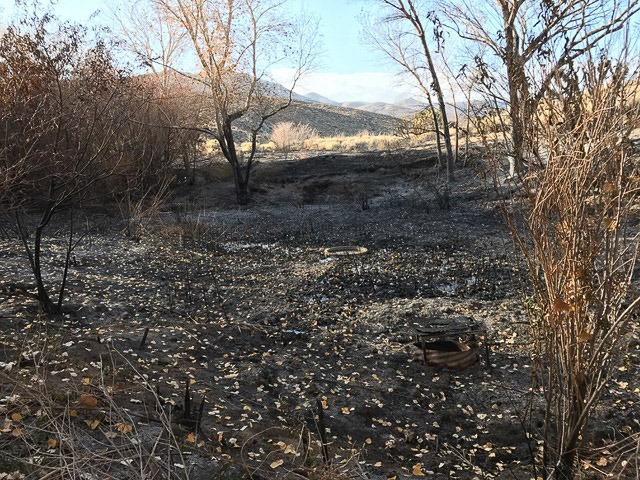
Photo: Chris Lord 12-16-17
We’ve been mulling over just how we might get rid of the bulrushes that soak up all the spring water, but a fire was not one of our options. This view would have been 100% bulrushes before the fire. Temporarily, they are gone, but the roots remain and they will probably come back very soon. The area covered by the fire extended over a much larger area than you see here.

Photo: Chris Lord 12-16-17
The Important Bird Area sign built by Keith Axelson was destroyed. The Park Service sign survived.
We’ll bring news of the plans the Park Service may have when we hear them. Until then, most of the trees down the canyon from the spring survived and we don’t anticipate the burned areas will affect birds coming through, although it may encourage some Indigo Buntings to hang around. One never knows.
So, on to the count itself. The weather was quite cool, but winds were light and the sun came out so it was a good day to bird. After spending the morning from 8:30 a.m. chasing birds we ended up at Sageland Ranch and for the first time all the counters were gathered together. Our thanks to Reed Tollefson, Jake Abel, Steve Hylton, Mary Prismon, Carol Reed, Chris Lord, Jean Garrett, Alice Bragg, and a special thanks to Lys and Kit Axelson who opened Sageland Ranch for us.
Here’s the list. We saw an above average number of birds and species – perhaps the rain last year has encouraged more nesting. Nothing truly unusual showed up although we were very happy to see a Golden Eagle; they have not been around for a while. Once again I got skunked on Pinyon Jays, even when seen by my own group!
| California Quail | 68 |
| Golden Eagle | 2 |
| Sharp-shinned Hawk | 1 |
| Red-tailed Hawk | 7 |
| Raptor sp. | 1 |
| Great Horned Owl | 1 |
| Swift sp. | 1 |
| Anna’s Hummingbird | 2 |
| Acorn Woodpecker | 1 |
| Williamson’s Sapsucker | 1 |
| Sapsucker sp. | 1 |
| Ladder-backed Woodpecker | 3 |
| Nuttall’s Woodpecker | 4 |
| Downy Woodpecker | 1 |
| Hairy Woodpecker | 1 |
| Northern (Red-shafted) Flicker | 3 |
| American Kestrel | 2 |
| Merlin | 2 |
| Prairie Falcon | 1 |
| Black Phoebe | 1 |
| Say’s Phoebe | 3 |
| Loggerhead Shrike | 6 |
| Pinyon Jay | 12 |
| California Scrub Jay | 24 |
| Common Raven | 223 |
| Oak Titmouse | 4 |
| Bushtit | 12 |
| Rock Wren | 3 |
| Bewick’s Wren | 6 |
| Blue-gray Gnatcatcher | 2 |
| Ruby-crowned Kinglet | 16 |
| Western Bluebird | 73 |
| Mountain Bluebird | 2 |
| California Thrasher | 7 |
| Thrasher sp. | 1 |
| Phainopepla | 3 |
| Yellow-rumped (Audubon’s) Warbler | 3 |
| Fox Sparrow | 2 |
| Dark-eyed (Oregon) Junco | 142 |
| White-crowned Sparrow | 526 |
| Golden-crowned Sparrow | 15 |
| Bell’s Sparrow (belli) | 53 |
| Savannah Sparrow | 2 |
| California Towhee | 9 |
| Spotted Towhee | 12 |
| sparrow sp. | 16 |
| Western Meadowlark | 1 |
| Brewer’s Blackbird | 150 |
| House Finch | 8 |
| Cassin’s Finch | 6 |
| Total Seen: | 1446 |
| Total Species (net) | 46 |
Parotia: Ballerina Dance | Cornell / National Geographic
At first, the parotias seem to do a different kind of shape shifting from other birds-of-paradise. They fan their feathers into a kind of skirt and then stutter-step around their court in a display called a “ballerina dance.” But a new camera angle reveals that the display looks entirely different to the females who are judging from above.
There are currently seventy-two short films in the entire Birds-of-Paradise Project playlist, ranging from 26 seconds to 8:29. In the upcoming weeks, we will present some of our favorites.
A film from the Cornell Lab of Ornithology. If no film or link appears in this email, go to the blog to view it by clicking on the blog title above. If the film stops & starts in an annoying manner, press pause (lower left double bars ||) to let it buffer and get ahead of you. [Chuck Almdale]
The Burgess Shale

Herpetogaster collinsi – A creeping organism with tentacles and a long stalk
511 million years ago – give or take a few million years – during the Middle Cambrian era, the earth was populated by some very strange creatures. Most of them were soft-bodied creatures like jellies, sponges, worms and other invertebrates. Such animals without hard parts rarely fossilize, and the Burgess Shale, a site high on a mountain ridge in Yoho National Park in British Columbia, Canada, is the only place in the world where their fossils are found.

Hallucigenia sparsa – A prickly worm that turns out to have “legs”
Discovered in 1909 by paleontologist Charles Walcott, they were initially, and erroneously, categorized into known taxonomic groups. Fifty years later, paleontologist Simon Conway Morris revisited the area and determined that many were weird, improbable, different. The Royal Ontario Museum currently has a collection of 150,000 specimens from the Burgess Shale, and you can tour a selection of the collection on-line, viewing photographs of the fossils and short animated films of what scientists imagine their behavior may have been like.

Opabinia regalis – A primitive arthropod with five eyes and a long “nozzle” with claws
The three pictures included here are ‘screen shots’ from animated videos. The website has over 120 sample fossils. I didn’t look at all of them, but most of the ones I viewed had video animations of the animals in action. You’ll probably have to load Adobe Flash Player (a perfectly safe one-click action, supplied by the site) to run the videos. [Chuck Almdale]



 SANTA MONICA BAY AUDUBON SOCIETY BLOG