Free email delivery
Please sign up for email delivery in the subscription area to the right.
No salesman will call, at least not from us. Maybe from someone else.
Dinosaur feathers and flight, with Luis Chiappe | Natural History Museum’s Curiosity Show
Birds are living dinosaurs, but there was a long evolutionary path from small dinosaurs into today’s birds. Dinosaur Institute Director Dr. Luis Chiappe tells us about how and when feathers and flight evolved, and even how we can tell from fossils the types of flight used by early birds.
This comes from the Natural History Museum of Los Angeles County. If no film or link appears in this email, go to the blog to view it by clicking on the blog title above. If the film stops & starts in an annoying manner, press pause (lower left double bars ||) to let it buffer and get ahead of you. [Chuck Almdale]
Out on the Ballona Jetties: 9 December, 2017

Bufflehead male has a glossy green-blue-purple head in good light
(Joyce Waterman 12-9-17)
A good day to go look at birds – a break from all the wildfire smoke and ash and what better place than the beach.

Ring-billed Gulls move in (Ray Juncosa 12-9-17)
We had coordinated the walk with the tide tables – low tide is best as birds like to poke around the uncovered rocks and find tasty bits. What we had not planned on was the Sheriff’s Department closure of the North jetty so they could install fireworks for that night’s boat parade.

Horned Grebe – with it’s clean white breast, neck and throat appearing like a miniature Western Grebe – can often be difficult to find (Joyce Waterman 12-9-17)
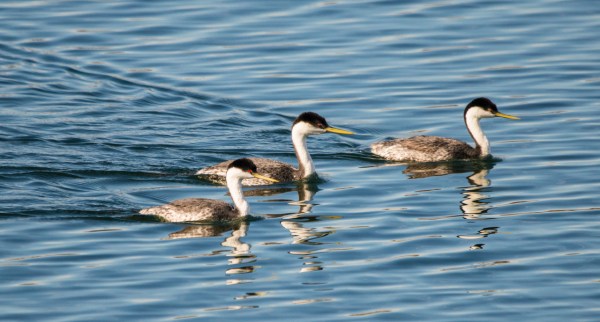
A trifecta of wintering Western Grebes (Ray Juncosa 12-9-17)
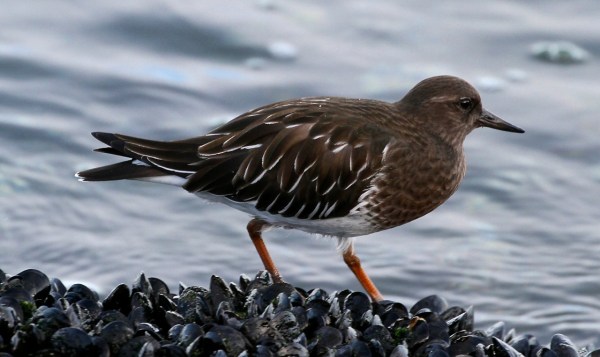
Black Turnstone in winter plumage (Joyce Waterman 12-9-17)
Male Surf Scoters in the water showed bright red/orange feet when they flew. Red-breasted Mergansers had bright orange bills. For sea birds, orange may be the fifth most popular color after black, white, gray and dull and boring but cryptic gray-brown.
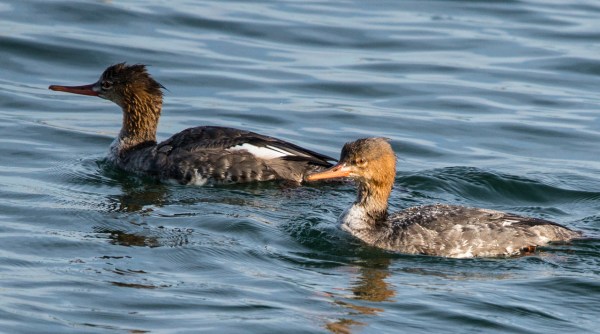
Red-breasted Mergansers (Ray Juncosa 12-9-17)
We saw handsome Buffleheads in the lagoon which showed some color other than black and white in the strong light.We had three different grebes.

Black-bellied Plover (Joyce Waterman 12-9-17)
We also saw the largest concentration of birds up the creek with Black-bellied Plovers, Marble Godwits and Willets abounding.
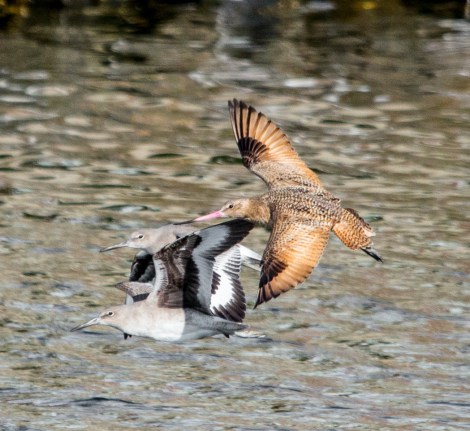
Willets & Marble Godwit in close formation (Ray Juncosa 12-9-17)
[Ellen Vahan]

Mixed flocks – this one of Willets, Marbled Godwits & Black-bellied Plovers – congregate inland along the rip-rap edges of Ballona Creek (Joyce Waterman 12-9-17)
Malibu Lagoon Loses Water
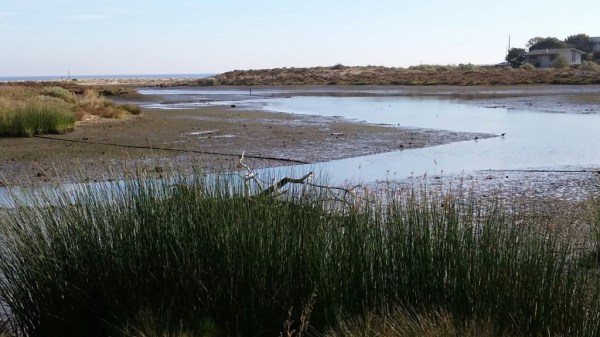
Malibu Lagoon drained, view from north (G Murayama 12-02-17)
Water runs downhill. No news there. Water comes down Malibu Creek and gathers in the lagoon. When the water gets high enough, it breaks through the beach. The water was very high on our last field trip (11/26/17), and we expected to see it break through the beach soon.
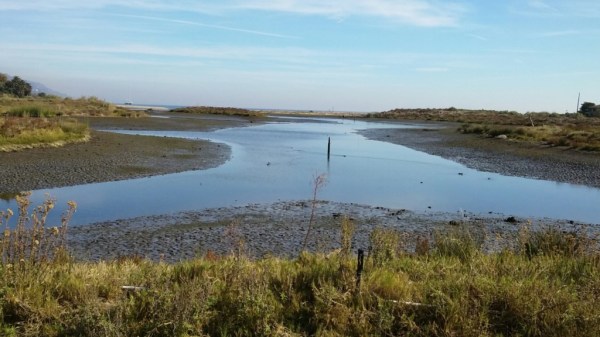
Most of the channel water drained away (G Murayama 12-02-17)
Still it’s surprising to see it happen so quickly. Once it started, it kept going.

Channel near the “Bird Hide” is drained (G Murayama 12-02-17)
Grace Murayama and Larry Loeher, on one of their frequent jaunts to census Snowy Plovers at Malibu Lagoon and Zuma Beach, took these photos a few days ago (12/2/17). Apparently, a high tide washed over the beach, raising the lagoon level. Water began flowing back into the ocean, and as the tide dropped, velocity of the outflow increased, carving a deep trench through the beach.
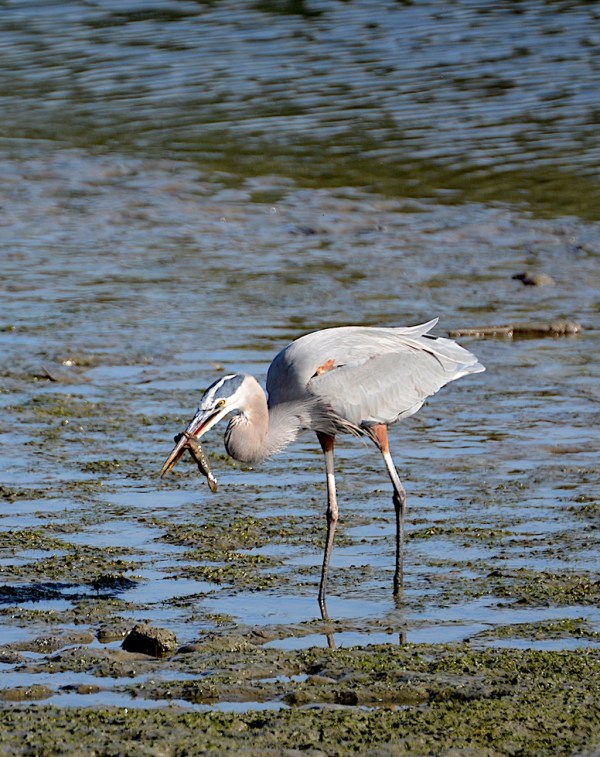
Great Blue Heron finds a hapless fish (G Murayama 12-02-17)
This was a boon to the fish eaters, like the Great Blue Heron above. The lagoon is full of “Jumping” Mullet, but this fish looks more like a Sculpin. Grace reported that fish were churning in the outflow.
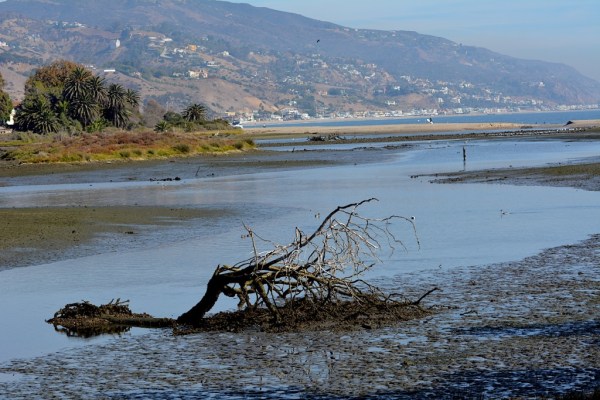
Beach breach in the distance (G Murayama 12-02-17)
The islands got much larger and the previously buried snag was now almost high and dry.

Most of the beach is wet. Gulls like the mud. (L. Loeher 12-02-17)
The beach got a lot wider and the gulls had a lot more mud to stand on. While the mud is wet, predators like Coyotes may be reluctant to walk on it.

Looking towards the northwest; Pepperdine University on the Hill
(G Murayama 12-02-17)
Most of the brush edging the lagoon and growing on the sand was unchanged. When the ground is relatively open and flat, Western Meadowlarks can find something to interest them. Even dried pieces of kelp wrack.
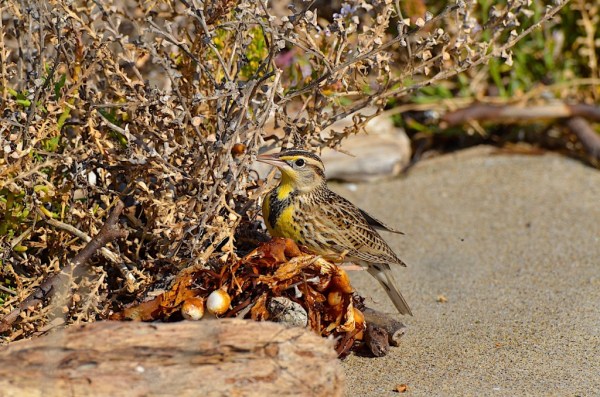
A Western Meadowlark explores the brushy beach (L. Loeher 12-02-17)
The water is faster and deeper than it looks, and the banks are higher and less solid than one might wish. This fellow almost fell in.
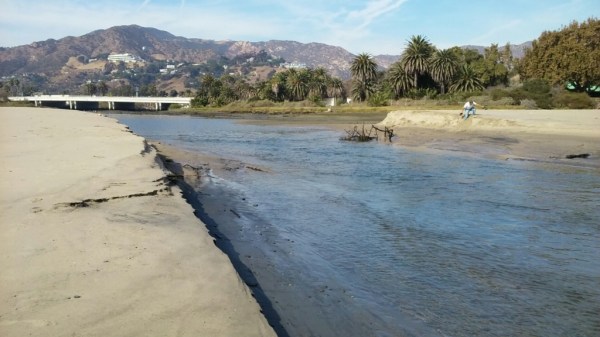
Looking north the breach banks are steeper and higher than they seem.
(G Murayama 12-02-17)
Looking south towards the ocean, you can see the breach emptying onto the rocks exposed at low tide.

Surfrider beach breaches near Adamson House (L. Loeher 12-02-17)
Everyone like seaweed wrack. Snowy Plovers, Western Meadowlarks, Marbled Godwits. If you can’t find food in it, you can just lie down on it.
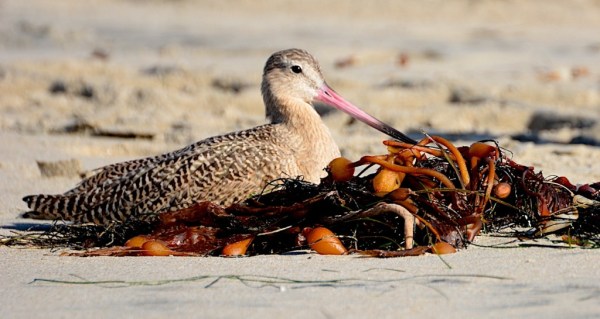
Marbled Godwit is wracked out (G Murayama 12-02-17)
It doesn’t look like the lifeguards will be able to drive past the breach for some time.

Lagoon flowing through the beach breach (L. Loeher 12-02-17)
The Heermann’s Gulls seemed quite happy to rest on the exposed rocks.
Many thanks to Larry Loeher and Grace Murayama for their photos. [Chuck Almdale]
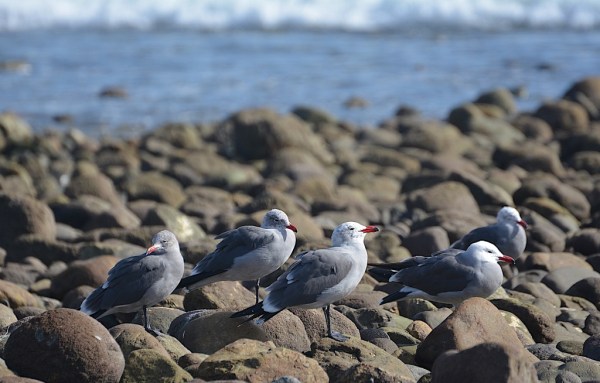
Heermann’s Gull group. Not all gulls are white. (G Murayama 12-02-17)
Correction to last night’s talk, RE: Snowy Plovers
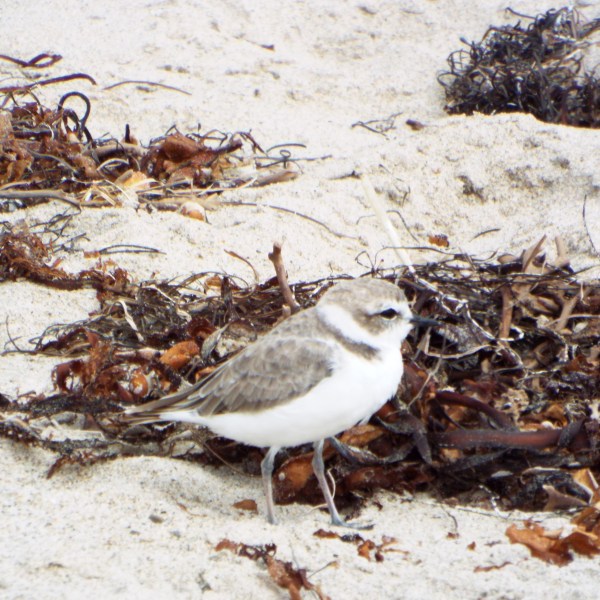 Apologies to the audience. I mis-spoke in saying Snowy Plover chicks were “altricial”. In fact, they are “precocial” in the terminology of most biologists. For details, see https://web.stanford.edu/group/stanfordbirds/text/essays/Precocial_and_Altricial.html
This is to say that Snowy Plover chicks are born required to, and able, to find food on their own, and not dependent on feeding by their parent.
Even though I said chicks were required to find their own food, I quoted the opposite term. I apologize for the confusion.
LucienP



 SANTA MONICA BAY AUDUBON SOCIETY BLOG