Free email delivery
Please sign up for email delivery in the subscription area to the right.
No salesman will call, at least not from us. Maybe from someone else.
Malibu Lagoon Loses Water
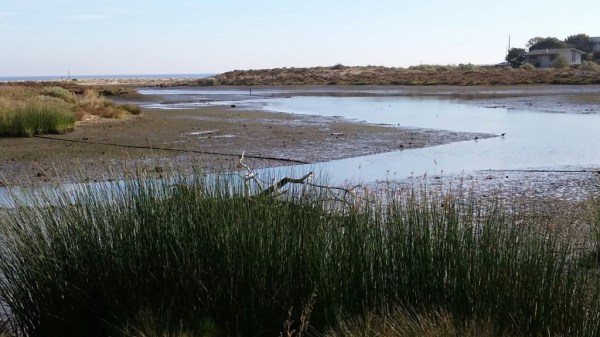
Malibu Lagoon drained, view from north (G Murayama 12-02-17)
Water runs downhill. No news there. Water comes down Malibu Creek and gathers in the lagoon. When the water gets high enough, it breaks through the beach. The water was very high on our last field trip (11/26/17), and we expected to see it break through the beach soon.
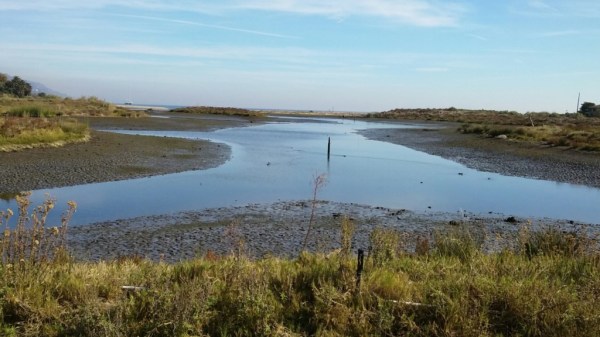
Most of the channel water drained away (G Murayama 12-02-17)
Still it’s surprising to see it happen so quickly. Once it started, it kept going.

Channel near the “Bird Hide” is drained (G Murayama 12-02-17)
Grace Murayama and Larry Loeher, on one of their frequent jaunts to census Snowy Plovers at Malibu Lagoon and Zuma Beach, took these photos a few days ago (12/2/17). Apparently, a high tide washed over the beach, raising the lagoon level. Water began flowing back into the ocean, and as the tide dropped, velocity of the outflow increased, carving a deep trench through the beach.
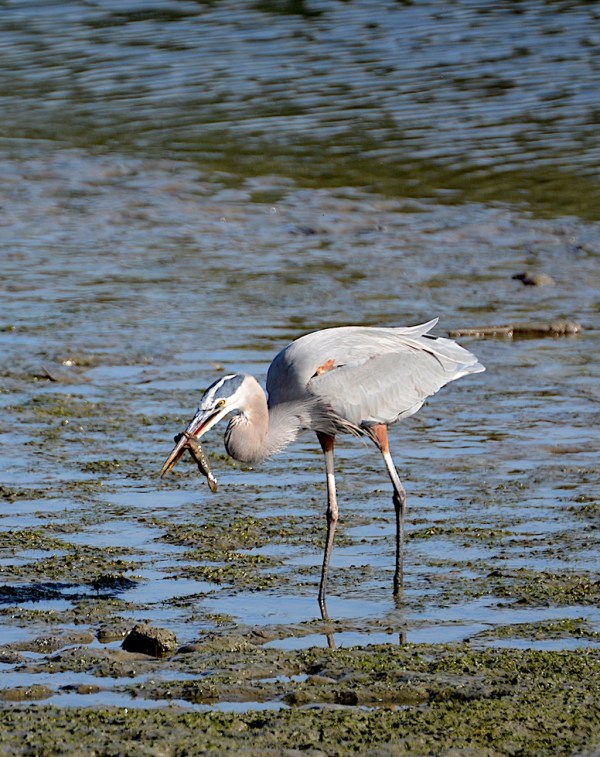
Great Blue Heron finds a hapless fish (G Murayama 12-02-17)
This was a boon to the fish eaters, like the Great Blue Heron above. The lagoon is full of “Jumping” Mullet, but this fish looks more like a Sculpin. Grace reported that fish were churning in the outflow.
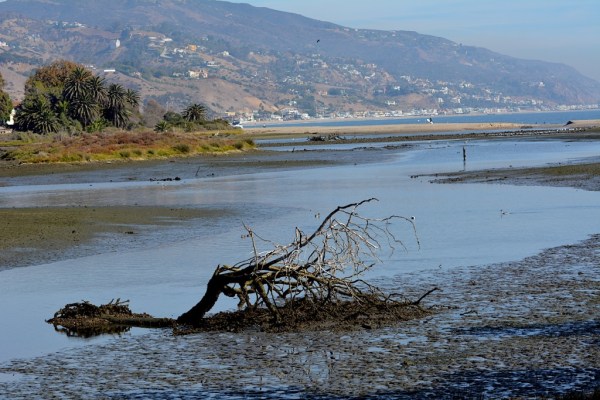
Beach breach in the distance (G Murayama 12-02-17)
The islands got much larger and the previously buried snag was now almost high and dry.

Most of the beach is wet. Gulls like the mud. (L. Loeher 12-02-17)
The beach got a lot wider and the gulls had a lot more mud to stand on. While the mud is wet, predators like Coyotes may be reluctant to walk on it.

Looking towards the northwest; Pepperdine University on the Hill
(G Murayama 12-02-17)
Most of the brush edging the lagoon and growing on the sand was unchanged. When the ground is relatively open and flat, Western Meadowlarks can find something to interest them. Even dried pieces of kelp wrack.
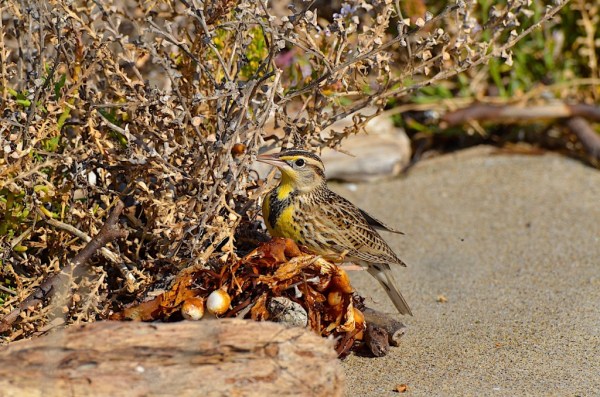
A Western Meadowlark explores the brushy beach (L. Loeher 12-02-17)
The water is faster and deeper than it looks, and the banks are higher and less solid than one might wish. This fellow almost fell in.
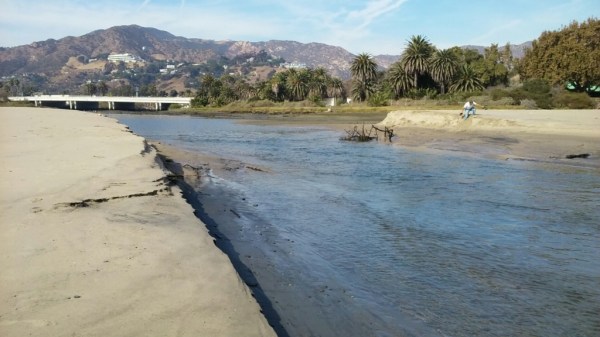
Looking north the breach banks are steeper and higher than they seem.
(G Murayama 12-02-17)
Looking south towards the ocean, you can see the breach emptying onto the rocks exposed at low tide.

Surfrider beach breaches near Adamson House (L. Loeher 12-02-17)
Everyone like seaweed wrack. Snowy Plovers, Western Meadowlarks, Marbled Godwits. If you can’t find food in it, you can just lie down on it.
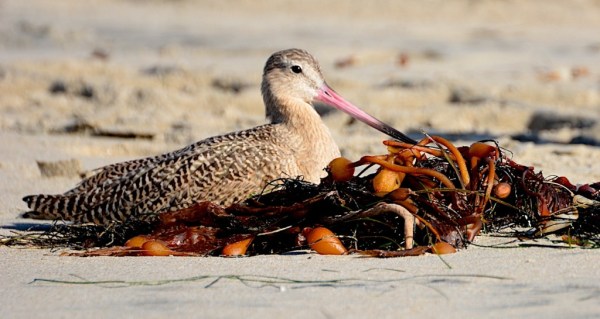
Marbled Godwit is wracked out (G Murayama 12-02-17)
It doesn’t look like the lifeguards will be able to drive past the breach for some time.

Lagoon flowing through the beach breach (L. Loeher 12-02-17)
The Heermann’s Gulls seemed quite happy to rest on the exposed rocks.
Many thanks to Larry Loeher and Grace Murayama for their photos. [Chuck Almdale]
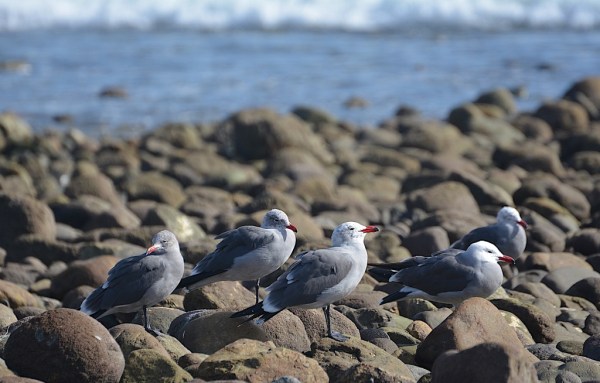
Heermann’s Gull group. Not all gulls are white. (G Murayama 12-02-17)
Correction to last night’s talk, RE: Snowy Plovers
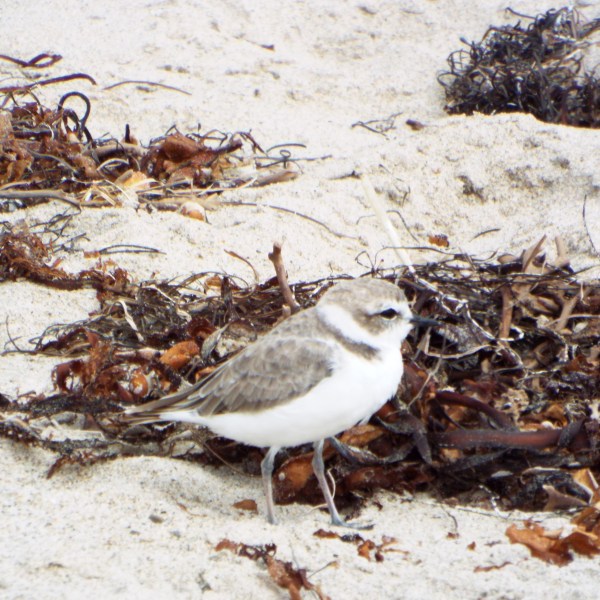 Apologies to the audience. I mis-spoke in saying Snowy Plover chicks were “altricial”. In fact, they are “precocial” in the terminology of most biologists. For details, see https://web.stanford.edu/group/stanfordbirds/text/essays/Precocial_and_Altricial.html
This is to say that Snowy Plover chicks are born required to, and able, to find food on their own, and not dependent on feeding by their parent.
Even though I said chicks were required to find their own food, I quoted the opposite term. I apologize for the confusion.
LucienP
The Birds-of-Paradise Project | Cornell / National Geographic
An overview of the Birds-of-Paradise Project, gratis of the Cornell Lab of Ornithology and National Geographic. Witness diverse strategies of evolution at work and experience one of nature’s extraordinary wonders – up close.
There are currently seventy-two short films in the entire Birds-of-Paradise Project playlist, ranging from 26 seconds to 8:29. In the upcoming weeks, we will present some of our favorites.
A film from the Cornell Lab of Ornithology. If no film or link appears in this email, go to the blog to view it by clicking on the blog title above. If the film stops & starts in an annoying manner, press pause (lower left double bars ||) to let it buffer and get ahead of you. [Chuck Almdale]
When predators attack, daddy longlegs deliberately release their limbs to escape. They can drop up to three and still get by just fine.
This is another installment of the PBS Deep Look series. If no film or link appears in this email, go to the blog to view it by clicking on the blog title above. If the film stops & starts in an annoying manner, press pause (lower left double bars ||) to let it buffer and get ahead of you. [Chuck Almdale]



 SANTA MONICA BAY AUDUBON SOCIETY BLOG