Free email delivery
Please sign up for email delivery in the subscription area to the right.
No salesman will call, at least not from us. Maybe from someone else.
Huntington Central Park: Exotics Rule! – Oct. 14, 2017 Field Trip
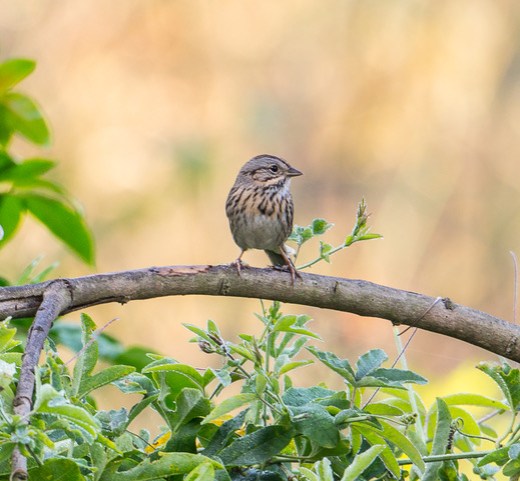
Lincoln’s Sparrow (Ray Juncosa 10-14-17)
Huntington Central Park turned out to be a wonderful place for birding this year. Within a few minutes we saw a Lincoln’s Sparrow perched on a limb and posed nicely for the cameras. It was the best view some people have ever had of that bird.

Hermit Thrust (R. Juncosa 10-14-17)
As we were admiring it, a Hermit Thrush walked by, giving us a great beginning for the trip. We were fortunate the birds in this park are used to people. To our surprise, there was a huge boy-scout campout that day and their shouting and singing created a wave of noise.
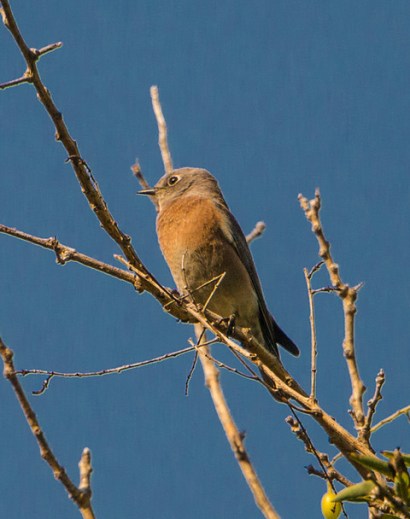
Western Bluebird (R. Juncosa 10-14-17)
The only flighty birds were the flocks of Nutmeg Mannikins (aka Scaly-breasted Munia), Japanese White Eyes, Orange-cheeked Waxbills, and Bronze Mannikins. Although Huntington Central Park has had these flocks of exotics for many years, they seem to be flourishing in spite of all the people.
The Nutmeg Mannikins are so well established here that they have been added to the California bird records list, although the name was (yet again!) changed to Scaly-breasted Munia. First recorded in Florida in 1964, all U.S. wild-living Nutmeg Mannikins are descendants of escaped cage birds. They are a very popular pet species, and the descendants of escapees can be found nearly worldwide, living in fields and parks and busily gobbling up seeds, especially grass seeds.
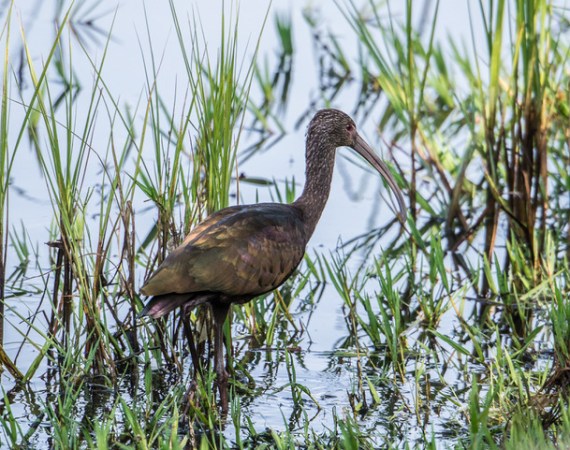
White-faced Ibis in the pond (R. Juncosa 10-14-17)
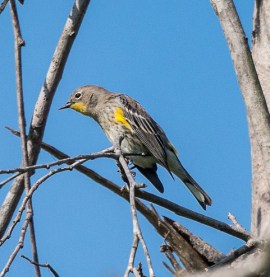
Yellow-rumped Warbler (R. Juncosa 10-14-17)
As we wandered through the park, we found the following warblers: Wilson’s, Townsend’s, Orange-crowned, Common Yellowthroat, Audubon’s, and Black-throated Grey. The trees in the park gave us lots of shade so we had a nice leisurely walk and found a Hutton’s Vireo and several Ruby-crowned Kinglets.
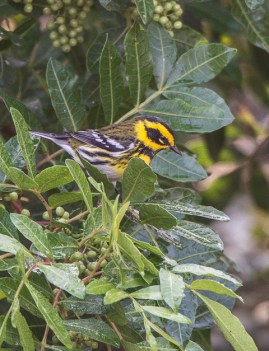
Townsend’s Warbler (R. Juncosa 10-14-17)
The parks perennial Red-shouldered Hawk called frequently, but only once did he alight on a branch close to the trail, giving Ray a great chance to photograph him.

Red-shouldered Hawk (R. Juncosa 10-14-17)
Then we started looking for the Cooper’s Hawk and of course we heard him for quite awhile before he made an appearance. What we didn’t see was a Red-tailed Hawk or any House Finches, but we did find an American Kestrel. It was a little early in the season for ducks but we did see American Wigeons and Mallards. It seems that you can’t leave that park without seeing the Downy Woodpecker but we found the bird only at the end of the walk. One of our newcomers found the Great Horned Owl. [Jean Garrett]
| Huntington Central Park | Bird List – Oct. 14, 2017 |
| American Wigeon | Bushtit |
| Mallard | House Wren |
| Pied-billed Grebe | Blue-gray Gnatcatcher |
| Great Egret | Ruby-crowned Kinglet |
| Snowy Egret | Western Bluebird |
| Black-crowned Night-Heron | Hermit Thrush |
| White-faced Ibis | Orange-crowned Warbler |
| Cooper’s Hawk | Common Yellowthroat |
| Red-shouldered Hawk | Yellow-rumped Warbler |
| American Coot | Black-throated Gray Warbler |
| Great Horned Owl | Townsend’s Warbler |
| Anna’s Hummingbird | California Towhee |
| Allen’s Hummingbird | Chipping Sparrow |
| Belted Kingfisher | Song Sparrow |
| Nuttall’s Woodpecker | Lincoln’s Sparrow |
| Downy Woodpecker | Red-winged Blackbird |
| American Kestrel | Lesser Goldfinch |
| Western Wood-Pewee | Scaly-breasted Munia |
| Black Phoebe | Orange-cheeked Waxbill |
| Say’s Phoebe | Bronze Mannikin |
| Hutton’s Vireo | Japanese White-eye |
| American Crow | Total Species – 43 |
They may look serene as they glide across the surface of a stream, but don’t be fooled by water striders. They’re actually searching for prey for whom a babbling brook quickly becomes an inescapable death trap.
This is another installment of the PBS Deep Look series. If no film or link appears in this email, go to the blog to view it by clicking on the blog title above. If the film stops & starts in an annoying manner, press pause (lower left double bars ||) to let it buffer and get ahead of you. [Chuck Almdale]
You Are Mainly Microbe… Meet Your Microbiome! | PBS Science Video
Ever not felt completely like yourself? There’s a good reason for that. Because a large part of you . . . isn’t you. Our bodies are home to ten times as many microbes as human cells. We are walking ecosystems, each of us home to thousands of different species on and inside of us. Meet your microbiome!
Sure, some bacteria are dangerous, but without our tiny friends we wouldn’t be here (literally). Enjoy this introduction to your microbiome, and let me know in the comments if you’d like to know more about any part of your personal ecosystem!
This is an installment of the PBS – It’s OK to be Smart series. If no film or link appears in this email, go to the blog to view it by clicking on the blog title above. If the film stops & starts in an annoying manner, press pause (lower left double bars ||) to let it buffer and get ahead of you. [Chuck Almdale]
Why Is The Very Hungry Caterpillar So Dang Hungry? | Deep Look Video
Because it’s hoarding protein. Not just for itself, but for the butterfly it will become and every egg that butterfly will lay. And it’s about to lose its mouth… as it wriggles out of its skin during metamorphosis.
This is another installment of the PBS Deep Look series. If no film or link appears in this email, go to the blog to view it by clicking on the blog title above. If the film stops & starts in an annoying manner, press pause (lower left double bars ||) to let it buffer and get ahead of you. [Chuck Almdale]
Dinosaurs of Los Angeles | Natural History Museum’s Curiosity Show
Dinosaurs in Los Angeles?? Millions of years ago, Los Angeles was underwater, so we didn’t see too many dinosaurs. Further inland, Southern California did have dinosaurs, and sometimes we find fossils that were washed out to sea. But our ocean did contain some fierce marine reptiles! Chris joins Dinosaur Institute curator Dr. Nate Smith to learn about these monsters of the Mesozoic.
This comes from the Natural History Museum of Los Angeles County. If no film or link appears in this email, go to the blog to view it by clicking on the blog title above. If the film stops & starts in an annoying manner, press pause (lower left double bars ||) to let it buffer and get ahead of you. [Chuck Almdale]



 SANTA MONICA BAY AUDUBON SOCIETY BLOG