Free email delivery
Please sign up for email delivery in the subscription area to the right.
No salesman will call, at least not from us. Maybe from someone else.
Coastal Cleanup Day at Malibu Lagoon Reminder: Sat. Sept. 20 – 9am to noon
[Posted by Chuck Almdale]
Annual International Coastal Cleanup Day, from 9:00 A.M. to Noon at the Malibu Lagoon. Help us clear the trash around the lagoon! Last year, more than 6,900 volunteers in the Los Angeles area removed over 18,200 lbs. of trash and 900 lbs. at 62 cleanup sites: beaches, rivers, underwater, and along trails. Ninety percent of all floating marine debris is plastic.
As we know, bright colored plastics or small micro-plastics can be confused for food. A 2012 study by the Convention on Biological Diversity found that 663 marine species have been impacted by plastic litter through ingestion or entanglement. It is important that we clean the lagoon area before the first rains come and carry everything out to the ocean.

Registration begins at 8:30 a.m. We encourage you to get waivers and registration forms on-line at https://healthebay.org/coastalcleanupday/. Just follow the on-screen instructions.
Our chapter concentrates its efforts at Malibu Lagoon, but you can call 1-800-HEALBAY for information and other places to volunteer. Parking passes will available at the lagoon on this day. If possible, bring your own gloves, bucket for trash, and sunscreen. Don’t worry if you forget such stuff because from 9:00 a.m. until noon, volunteers will be given supplies and instructions on how to carry out a beach cleanup.
Family Guide: Suitable for everyone but toddlers. Small children, already built conveniently close to the ground, are great at picking up those tiny pieces of plastic.
Information Contact: Jean Garrett (213-522-0062)
[Directions] Malibu Lagoon is at the intersection of Pacific Coast Highway and Cross Creek Road in Malibu. Parking in the official lagoon lot is normally $3/hour (should be free today) or by annual pass. You may also park either along PCH north of Cross Creek Road or on Cross Creek Road itself but be careful – some parts of PCH are off-limits (read the signs carefully.) Lagoon parking in the shopping center lot is not permitted.
NGS Bird field guide followup
[By Chuck Almdale]
We received our copies of the National Geographic Field Guide to the Birds of the United States and Canada, both books autographed by the author on adhesive paper, one by “Ted Floyd” and the other apparently by “Ted Flogel”, so we know they weren’t printed signatures cranked out by the millions. I like it. It’s very well put together, I’m happy I bought it, and I think it will survive the unwarranted beating I give my hapless field guides. This is a very brief & incomplete comment/description.
Link to prior posting.
Uh…you may have heard rumors that this will be the last printed NGS bird field guide ever. I checked out some online comments to that effect and they were talking about the 7th. ed. being the last by Dunn and Alderfer. That’s true; this one is by Ted Floyd (or Flogel). However, I’d estimate that “most” (an exacting statistical term) of the material and artwork is unchanged.
My only warning. This is a larger book. If your current NGS fits very snugly into whatever you carry it in, you may be SOOL (look it up). This one is 6″ x 9″ x 1″ thick; my NGS 6th ed. is 5 3/8″ x 7 15/16″ x 1 3/8″ thick. Edition #8 is 26.6% larger. I gulped when I saw it, as I really like my book bag and wasn’t at all certain it would fit and then what would I do! [Cue copious tears.] But it fits, so no problemo.
Likes: This is in comparison to my 6th edition. Some of this is due to the larger size allowing for more info. per page.
- Most of it looks the same
- Front-flap quick-find index: 30% more alphabetized names, separated by lines
- Tough plasticized cover
- Colors and details seem slightly brighter and finer; perhaps due to wear on my 6th ed.
- Follows1 the new phylogenetic order
- Each family and genus gets an introduction3; in sparrows and warblers which have many genera with few species, a few genera are grouped
- Allen’s and Rufous Hummingbirds more extensively covered
- Glossary: About 120 terms, including rectrices & remiges
Meh…not-so-much:
- The pages seem slightly more flimsy, perhaps less plasticizer or waterproofing?
- Subspecies range maps at the back disappeared, just gone. Now that hurts.
- Range maps slightly smaller
- Some rarer birds (e.g. Baikal Teal, Key West Quail-Dove) were banished to the rearward 27-page “Rare Bird” collection
- Many small notes2 next to illustrations disappeared, another needless pain
Notes.
1. I didn’t come even close to checking all possible changes, but parrots and falcons are in the right place (between woodpeckers and flycatchers); and these thirteen are now next to each other in sequence as they should be: ducks, chickens, flamingos, grebes, doves, cuckoos, nightjars, swifts, hummers, rails, limpkin, cranes, stilts (yes, you read that right). I did a complete and up-to-that-date phylogenetic checklist last year of all 41 orders and 251 families (link) which you can check. If you didn’t read that posting, you will find surprises.
2. As the pages are larger, it’s not that there wasn’t room for these little comment/notes, and in many (perhaps most) cases they were not replaced by anything, just blank paper. Unless these comments were wrong, they should have remained, fer cryin’ out loud!
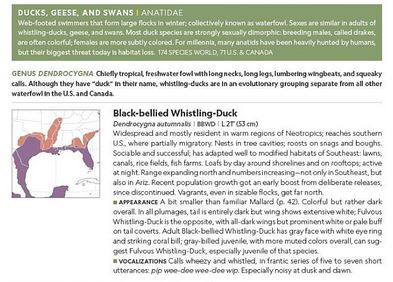
3. The page copied (very poorly) below is far clearer in the book, have no fear. Every family and nearly every genus gets a short description, which helps build bridges between the book layout and the recent changes in phylogenetic order. The more birders know about the latter, the better will be their understanding of the evolution of birds and their relationships, which is both fascinating and useful.
NGS 8th Edition North American Bird Field Guide
[Posted by Chuck Almdale]
Finally! Gasp! Now all of you birders who have been toiling under the burden of being forced to suffer with that annoying electronic field guide — yeah, the one with the tiny photos, indecipherable text, poorly-lit screens in broad daylight, and near-total-inability to easily scan through 81 sandpipers, 66 waterfowl, 65 warblers, 46 sparrows, or 42 flycatchers, not to mention 2 to 6 illustrations per species — yeah, that one — can breathe a sign of relief. Help is on its way.

The immensely valuable National Geographic Field Guide to the Birds of North America is now out in its 8th edition. You can put it in your pocket or pouch, next to that 64-oz. bottle of water and the granola bar the size and chewability of a cinder block. You can write in it, use it as a lap-table, compare birds on the same page!, pass it to someone else and the pages won’t inexplicably disappear or even get stuck upside down, and everyone can see the colors and read the words and study the maps without shading it with an umbrella, instead of simply pretending to be able to see it as they do now so you won’t feel bad. It won’t even die on you out in the field, miles or days from the nearest electric socket. It’s your true friend in need, quietly waiting until you take it in hand. And it won’t beep, squawk or ring at you or try to sell you something.
Sounds perfect, doesn’t it?
This appeared in my desktop inbox, from Scott Weidensaul, author of Living on the Wind, via those friendly folks at Buteo Books:
In its eighth edition, this venerable guide is a reborn marvel — new range maps, changes to avian taxonomy, the addition of Hawaii’s incredible birdlife, and perhaps best of all, all-new and deeply instructive text by Ted Floyd, one of the giants of the field. I’m not sure how this book could be any better.
Buteo Books [Link] added:
| Combining exciting new features with tried-and-true traditions, this beloved field guide will satisfy birders young and old, experienced life-listers and backyard birdwatchers alike. This new edition of the trusted National Geographic field guide combines fresh new text, updated taxonomy, expanded art including 240 new illustrations, and authoritative, data-derived maps, organized in the user-friendly format for which their field guides are known. |
| We have a limited number of copies signed by author Ted Floyd! Place your order today to ensure you snag a signed copy. |
Ted’s been around for about a million years, looking at birds and writing about birds. I’ve never [knowingly] met him but I’m quite sure he isn’t some sort of AI program which we all [should] know by now are loaded with errors and nonsense and highly reluctant to retract them when caught.
Anyways…the book is out, check your local bookseller if one still exists in your area, or order it from Buteo Books (guess what they specialize in) — 33 bucks & shipping — and maybe you can get one signed. My autographed (by all the authors!) and heavily annotated by me 2nd-edition decided one day to stay on the roadside wall at Parker Dam on the Colorado River, so now I make do with a 6th-edition, now 14 years old. Maybe it’s time to get a new one.
No, we don’t get any freebies for mentioning Buteo. I’ve bought books from them in the past, they’re OK and they haven’t cheated me.
Volunteers needed at Audubon Ballona Wetlands Education Program
[Posted by Chuck Almdale, submitted by Cindy Hardin]
Nature Nexus Institute has taken over the operation of Los Angeles Audubon’s school outreach program of school field trips to the Ballona Wetlands. Santa Monica Bay Audubon Society has helped support this organization for several decades.
Nature Nexus Institute is all about sharing and teaching local school children about the special habitats found right here in Los Angeles. They will be starting their six-week Fall Training on 16 September to get ready for school field trips to the Ballona Wetlands. Their tours take place on Tuesdays and Thursdays. All you need to be a volunteer is a love of the outdoors and the enthusiasm to work with school age aspiring nature lovers. Please contact Cindy Hardin at chardin@naturenexusinstitute.org or give her a call at 310-745-2118 if you are interested.
The following announcement is from them.

We are looking for Volunteers!
The sun is shining, August is starting to feel like a real August (not Fogust!) and the calls are starting to come in from teachers requesting field trip dates. We are rolling!! In order to prepare, our Fall Training will commence on Tuesday, September 16th. We have also had a change in our speaker schedule. The fabulous Tracy Drake, formerly of the Madrona Marsh and the City of Torrance, will be available to speak to our group. Tracy is one of the best interpreters of Nature that I have ever known, and as she is now in retirement, she has the time to come down and inspire the team. The new schedule is as follows:
Time: 9 am to noon, unless otherwise noted (see below)
Contact: Cindy Hardin, Ph/Text 310-745-2118, <chardin@naturenexusinstitute.org>
September 16th –Introductions and Wetland Ecology with Dr. John Dorsey
September 23rd – Birds and Birding with Ace Birder Walter Lamb
September 30th – Inspiring joy and Interpretation of Nature with Tracy Drake.
October 7th – Indigenous Knowledge and Practices with Matt Teutimez of the Kizh Gabrielino Nation
October 14th – Ecological Restoration and a Hopeful Future with Dr. Margot Griswold
October 21st – Bringing it all Together and Practical Considerations when Conducting School Field Trips
In addition, on our last day of Training, October 21st, we will have the folks from LiveScan on site at Ballona. A recently passed California Assembly Bill now requires that all personnel that work with children go through a process known as LiveScan. This is a background check, and if you have already gone through the process there is no need to do it again. However, if you have not (as some of you did come in mid-year and missed the first round) you will be able to do this on the 21st. The service is provided at no cost to you, and is a relatively quick procedure that will be done at the end of training on that day.
There is also an online training about being a Mandated Reporter, which is also required. NNI Staff Member Emily Cobar will be on site on 21st to assist in implementing LiveScan, and to help set you up for the Mandated Reporter training.
All sessions will go from 9 am to Noon, and take place at the Ballona Wetlands Ecological Reserve. The Reserve has no actual address. We use 303 Culver Blvd., Playa del Rey, 90293. This is a Local Market and Deli (it’s actual name!) that is currently being renovated. There is a driveway immediately after the building that opens up into a large parking lot. The gate to the Reserve is located in the northeast corner of the lot. Please feel free to call me at 310-745-2118 if you have any suggestions, ideas, questions, or schools you might have in mind that could participate in one of our fabulous field trips.
Looking forward to working with all of you and the school children of Los Angeles — who are in dire need of some time in Nature!
Thanks,
Cindy



 SANTA MONICA BAY AUDUBON SOCIETY BLOG