Free email delivery
Please sign up for email delivery in the subscription area to the right.
No salesman will call, at least not from us. Maybe from someone else.
A deadly fungus is attacking frogs’ skin and wiping out hundreds of species worldwide. Can anyone help California’s remaining mountain yellow-legged frogs? In a last-ditch effort, scientists are trying something new: build defenses against the fungus through a kind of frog “vaccine.”
This is another installment of the PBS Deep Look series. If no film or link appears in this email, go to the blog to view it by clicking on the blog title above. If the film stops & starts in an annoying manner, press pause (lower left double bars ||) to let it buffer and get ahead of you. [Chuck Almdale]
Mysterious Land Snails of Los Angeles with Dr. Jann Vendetti | Natural History Museum’s Curiosity Show
Everything you ever wanted to know – and some of what you didn’t – about the land snails of Los Angeles and their slime (which tastes just like chicken, they say).
This comes from the Natural History Museum of Los Angeles County. If no film or link appears in this email, go to the blog to view it by clicking on the blog title above. If the film stops & starts in an annoying manner, press pause (lower left double bars ||) to let it buffer and get ahead of you. [Chuck Almdale]
Plovers Struggling
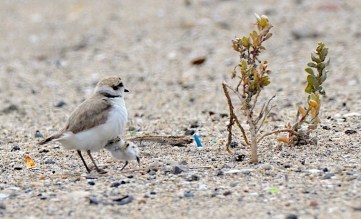
Dad & 1 of 3 chicks on Dockweiler Beach
(Grace Murayama 5-14-17)
I’ll be short and not-so-sweet. We witnessed the first nesting of Western Snowy Plovers on Los Angeles County Beaches since 1948 in the past three weeks. The first nest was overcome by sand in a vicious three-day windstorm in late April. The eggs of another disappeared at Malibu Lagoon, even though a mini-exclosure had been placed around them. The first nest at Dockweiler State Beach resulted in three chicks–but they were eaten by a Ring-billed Gull when not quite four days old.
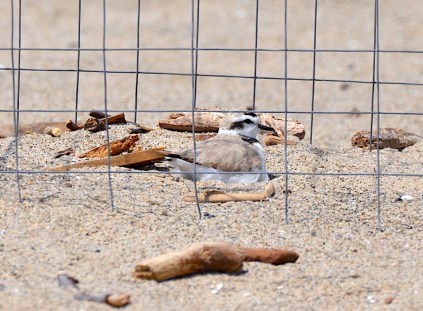
Male settling on nest, Malibu (Larry Loeher 5-12-17)
We may be able to affect this trend for the remaining nests and better prepare for next year’s possible nesting in L.A. County if we can contract for more qualified biologist time and availability. There are time and legal constraints as to what we volunteers can and are authorized to do. No guarantees, folks, but I feel we need to try. That means, we need you to use the little PayPal button on the right of this screen; please follow the instructions and include the phrase “Snowy Plovers” in the “+Add special instructions to the seller” area. Or you can send us a check the Santa Monica Bay Audubon (P.O. Box 35 PAC PAL 90272) to help the cause. 100% of your donations will go to the L.A. County Snowy Plover Conservation Project. From all of us who have been volunteering for this threatened species for 5, 10 …even 50…years. Thank you!
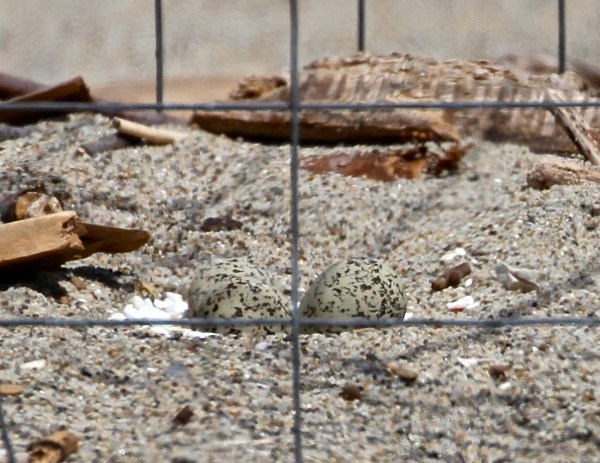
Three Snowy Plover eggs at Malibu (Joyce Waterman 5-28-17)
Nesting Snowy Plovers of Los Angeles
Click HERE for a slideshow of banded Snowy Plovers, then scroll down
to the slideshow located below the photo of the banded chick.
It may take some time to load.
Use the arrows to advance and reverse.
Update as of May 20, 2017
For the first time since 1949, when they last nested in Manhattan Beach, Western Snowy Plovers have nested on Los Angeles beaches. Not just one nest or even one location, but several nests at three different locations! Needless to say, this caused great surprise, excitement, and some consternation among the volunteers and professionals who have worked with these birds for so long.
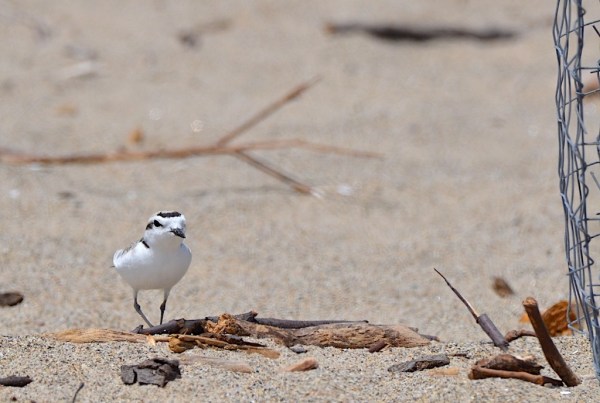
Male arriving at nest, Malibu (Larry Loeher 5-12-17)
Surprise, because it had been so long since they last nested here, there had been virtually no nesting attempts in earlier years, and no one thought there was a chance it would happen.
Excitement, because it signaled that we humans had actually changed our behavior sufficiently to permit these birds to make these nesting attempts.
Consternation, because we were not prepared for it. We have no paid biologists for the summer season when Snowy Plovers are – until now – absent, and no money in the pipeline from any of the various governmental agencies involved. We had no protocols (plans, methods, etc.) in place for assisting the birds or for at least doing a better job of keeping people out of the birds’ way. We need to educate people and encourage them to: 1) back off from the birds, including not observing them too closely; 2) keep their boisterous pets and children away from the birds; 3) reduce potentially litter on the beaches. With the local governmental authorities we need to: 1) make sure they know where the winter roosting and summer nesting areas are located, especially because these areas are so small (about 0.6%) in comparison to the entire county coastline; 2) get them to reduce or eliminate beach grooming and wrack removal in these nesting and roosting areas; 3) set aside areas near winter roosting locations where native beach plants can re-establish themselves (they do it naturally); 4) stop issuing permits for dog parks, volleyball courts and beach parties in the nesting and roosting areas.
Nearly all changes suggested above merely ask that humans cease from doing harm, rather than doing something costly and proactive.
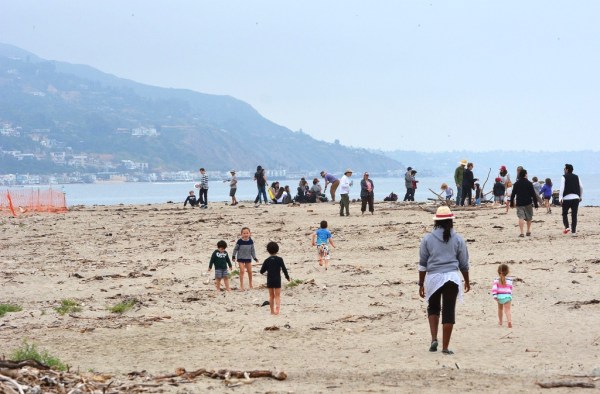
Beach crowd near orange fence surrounding nest, Malibu
(Grace Murayama 5-12-17)
Snowy Plovers incubate their eggs for 27-28 days (rarely as short as 25 days or as long as 32 days). The young are born precocial and quickly begin following the parent(s) for protection and to find the sources for their own food. With Western Snowy Plovers, the female generally abandons the young within 6 days and flies elsewhere to nest with another male, while the male stays with the young for an additional 23-41 days.
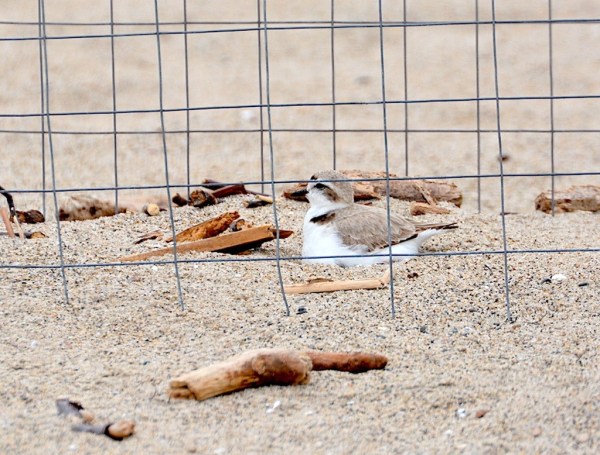
RR:BB waits on nest for male to take over incubation, Malibu
(Grace Murayama 5-12-17)
Snowy Plovers incubate their eggs for 27-28 days (occasionally 25-32 days). The young are born precocial and quickly begin following the parent(s) for protection and to find their own food. With Western Snowy Plovers, the female generally abandons the young within 6 days and flies elsewhere to nest with another male, while the male stays with the young for an additional 23-41 days.
Link to U.S. Fish & Wildlife Service 5/8/17 news release on Snowy Plovers nesting in Los Angeles County.
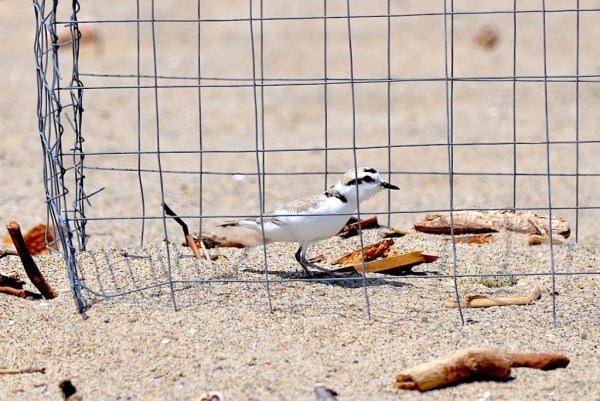
Male approaching nest, Malibu (Larry Loeher 5-12-17)
Northern Santa Monica Beach
(L.A. Nest #1) On April 18, 2017, a nest with three eggs was found within the Bay Foundation’s beach restoration area. On 4/24/17 Tom Ryan and Chris Dellith from U.S. Fish & Wildlife Service placed a protective metal cage-like enclosure around the nest in order to fend off predators, dogs and people. An unusually strong wind came up on 4/27 and continued for four days. The birds stopped incubating by 4/28 and by 4/30 the nest was covered by sand and abandoned.
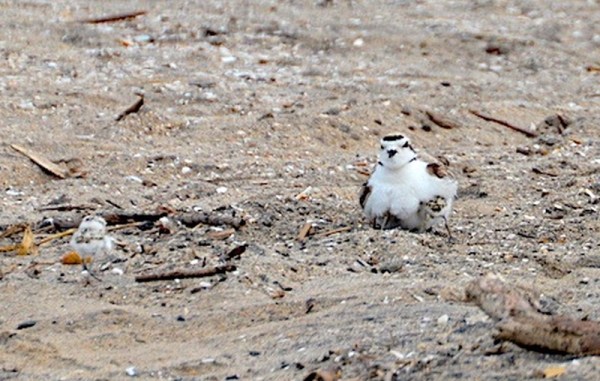
Dad & 3 chicks (2 are under dad) on Dockweiler Beach
(Grace Murayama 5-14-17)
Northern Dockweiler Beach
(L.A. Nest #2) A nest was discovered on April 27, 2017. On 5/12, two chicks hatched, and a third on 5/13/17. [As incubation usually takes 27-28 days, the eggs must have been laid around April 14-16.]
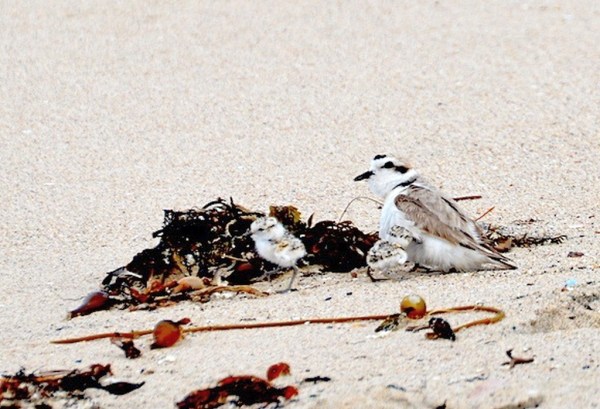
Dad & 3 chicks (1 is hidden under dad) on Dockweiler Beach
(Grace Murayama 5-14-17)
(L.A. Nest #5) A second nest was discovered by a volunteer SNPL monitor on 5/12/17. The parents are still incubating the eggs.
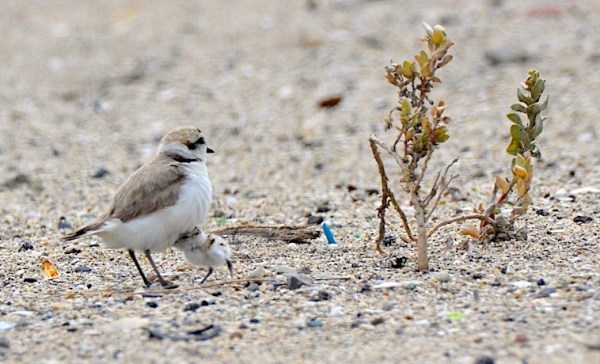
Dad & 1 of 3 chicks on Dockweiler Beach (Grace Murayama 5-14-17)
(L.A. Nest #2, a few days later) On 5/15/17, the three chicks, now three days old, were seen being eaten by a Ring-billed Gull, all within a 15-minute period. [It should be noted that 90-95% of birds of all species die within their first year, including while they were still in the egg.]

Gull eats 3-day old Snowy Plover chick as parent watches, Dockweiler Beach
(Robert Jeffers 5-15-17)
Malibu Lagoon (Surfrider Beach)
(L.A. Nest #3) A nest was discovered on April 28, 2017 within the area enclosed by the “virtual fence” – consisting of posts, rope and signs – among sticks, gravel, sand and a few plants. A protective metal enclosure was soon installed. On 5/5/17, Fish & Wildlife personnel found the nest to be abandoned, no sign of the eggs, and unexplained prying open of one corner of the metal enclosure.
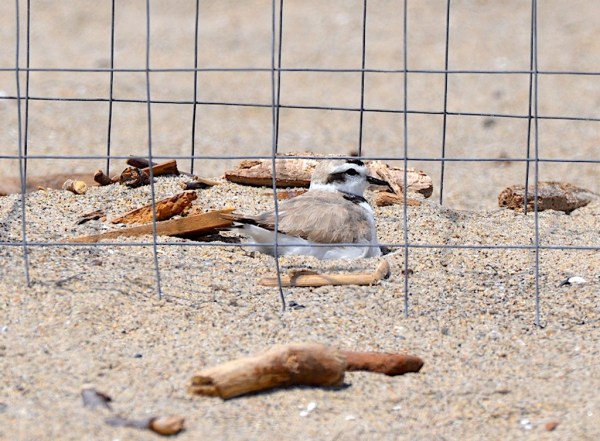
Male settling on nest, Malibu (Larry Loeher 5-12-17)
(L.A. Nest #4) A second nest containing two eggs, this time about 12-15 meters outside the the virtual fenced area, was discovered on 5/4/17 by SMBAS members Grace Murayama and Larry Loeher. The parent birds proved to be our long-term winter resident banded female rr:bb (banded at Oceano Dunes, CA central coast, summer’16), and an unbanded male. (See sighting history of rr;bb here by scrolling down). They contacted Stacey Vigallon of the L.A. County SNPL Conservation Project, then Danielle LeFer of California State Parks (CSP) while Stacey contacted biologist Tom Ryan. Danielle, Grace, Larry, Jamie King and one other person from CSP installed additional fencing around the nesting area. Jamie was elected to slog through the mucky lagoon bottom and pull up the previously placed virtual fence polls. The following day (5/5/17) a protective metal enclosure was installed around the nest by Fish & Wildlife personnel and SMBAS member Lu Plauzoles, and they reported the presence of two eggs. On 5/14/17, volunteer Laurel Hoctor Jones reported that the nest now contained three eggs; apparently the 3rd egg was laid between 5/4 and 5/14 (most likely, in my opinion, on 5/5 after the metal enclosure was placed). As of 5/19, the birds were still taking turns sitting on the eggs.
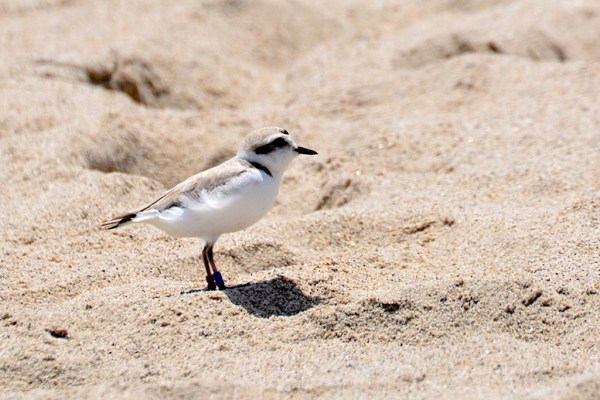
RR:BB out stretching her legs while male incubates eggs, Malibu
(Grace Murayama_5-12-17)
We hope that now that you know the Snowies are there, and why they’re there, you too will come to appreciate them and watch out for them. They need your concern.
[Chuck Almdale]
Click HERE for a slideshow of banded Snowy Plovers, then scroll down
to the slideshow located below the photo of the banded chick.
It may take some time to load.
Use the arrows to advance and reverse.
We continue with our reprint of this August, 2012 series to reacquaint
our readers with the local history of these birds.
For the first time in over seventy years,
Snowy Plovers have again nested on Los Angeles County beaches.
Part VI: The Plover Watchers
Over the years, many people have labored to study and save Western Snowy Plovers (WSP). Nest sites have been protected for decades; winter roosts are now known and their protection grows.

RR:BB, Malibu; 1 of 2 chicks banded at Oceano Dunes Spring’16
(G. Murayama 2-26-17)
It began in the 1970’s when John and Ricky Warriner, long-term residents of Pajaro Dunes area in coastal Santa Cruz County, noticed “those little black and white creatures in the sand,” wondered about them, then became concerned for their future. They introduced Gary Page (Point Reyes Bird Observatory (PRBO) employee since 1971) to them; he too became intrigued and alarmed. [Ed. – PRBO has been renamed Point Blue.] In 1977 Page began – and still heads – PRBO’s Snowy Plover Project; they produced the first scientific study of WSPs in 1980. [Ed. Page retired in early 2017.]
In 1979, Frances Bidstrup answered a PRBO ad for WSP monitors, joined Gary and never left. Over the decades she has been: statewide volunteer recruiter, Field Biologist, WSP bander, Research Associate in charge of all WSP banding and winter sighting records. SMBAS volunteers have reported their WSP data to her for over 20 years. She loves her job and the wonderful WSP enthusiasts she meets. [Ed. – Bidstrup retired in 2016.]
When Tom Ryan arrived in 2005, the LA County WSP study and protection effort really became organized. He produced two major reports with a third coming out soon. Hundreds of local volunteers were recruited, information is continually gathered, reports are regularly issued, and winter roosts are increasingly receiving protection.

Stacey hangs a plover information sign
(C. Almdale 3/15/12)
With Tom as consulting biologist,
Los Angeles Audubon Society took the WSP project under its wing in 2007, and Stacey Vigallon became the project’s Director of Interpretation. She wears many hats: biologist, educator, illustrator & designer, volunteer coordinator. She is always happy to welcome new monitoring volunteers! She says: “Plover conservation begins with public awareness. We love our beaches for summer fun, but in the off-season they are tremendous for watching wildlife. Family winter beach hikes are as enthralling as any hike in the Angeles National Forest.”
Santa Monica Bay Audubon Society (SMBAS) members have censused and searched for banded WSPs for over 20 years. In 2001, they organized the first Winter Window Census in L.A. County and kept it running until Tom Ryan arrived in 2005. Many SMBAS members work both within and outside the L.A. County WSP project, primarily at Zuma, Surfrider and Santa Monica roosts.
When Lucien (Lu) Plauzoles of SMBAS censused northern Santa Monica beaches for the first Winter Window Census in 2001, he found 14 Snowies huddled together on the sand. He has been intimately involved in this roost site ever since: censusing it regularly, doing volunteer training at the site, fending off creation of a dog park nearby, getting the City of Santa Monica to erect a fence around the roost and cease beach grooming in its vicinity. He yearly attends numerous WSP local coordinating committee and range-wide (Pacific Coast) meetings. In recent years he has also helped with the censusing at Malibu and Zuma.

Snowy Plover roost, cryptic in the sand (Grace Murayama 12-5-15)
Locally, most important and probably least known, is Mary Prismon, long-term Malibu resident and SMBAS member. Frances at PRBO recruited Mary when fellow SMBAS member Lee Oetzel needed to retire from the Zuma Beach census. On Mary’s first census in October 1992, she found 77 Snowies in the roost location they’ve used ever since. Flock size gradually increased but banded birds did not appear until 10/2/99, when PA:VO (banded Spring’99 near Moss Landing), and YB:YG (banded Spring’97 at Camp Pendleton) showed up. Banded birds have appeared regularly since then, the longest lasting being BB:OG (Oct’02 – Oct’07). In March 1994, Mary took over the Surfrider Beach/Malibu Lagoon census after Barbara Elliott had to quit. Surfrider’s first banded bird was RY:RB, appearing 1/21/05 and wintering for three years. Mary kept these censuses going for almost two decades before having to quit. Mary’s fascination and love for the little birds attracted other SMBAS members, including myself, out of which developed the significant and ongoing efforts we see today throughout the county. Mary never sought recognition of any sort for herself, only help for the Western Snowy Plovers. In that she succeeded greatly.
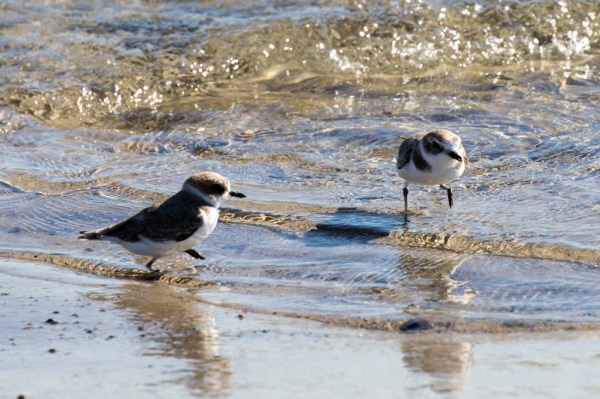
Snowy Plovers at sea’s edge for a change (R. Ehler 11/22/15)
More recently, SMBAS members and volunteers Grace Murayama, Larry Loeher, Laurel Hoctor Jones have become important contributors to our local Snowy Plover censusing, documentation and recovery effort. Grace and Larry monitor WSPs and Least Terns primarily at Malibu, but also help with efforts at Zuma and Santa Monica. Laurel censused birds at Zuma and Malibu, but Bill Crowe has recently taken over the Zuma censusing. Grace and Larry are the major contributors of photos of banded WSPs in Los Angeles County to Santa Monica Bay Audubon, Point Blue (PRBO) and the Snowy Plover Conservation Project of Los Angeles Audubon Society, but we have received WSP photos from many other people as well, especially Bill Crowe and Joyce Waterman.
In Los Angeles County alone, WSP volunteers number well into the hundreds; for the entire U.S. Pacific coast range, it’s in the thousands.

Kids make beautiful signs for the virtual fence (C. Almdale 3/15/12)
Part VII – The Future
In summer 2007, for unknown reasons, the breeding population of Western Snowy Plovers (WSPs) crashed 21% from the prior year high of 1719 birds. By four years later they had almost fully recovered to 1715 birds. Barring additional collapses, continued population recovery is promising. So far, Summer 2012 is looking to be even better than last year.
Taken without context, simply recovering back to the level attained five years earlier does not sound like great success. But compared to the Pt. Reyes Bird Observatory 1995 study, which found a 20% decrease from the 1980 level, simply treading water is a major success; rebounding 26% (from 1362 birds in 2007 to 1715 birds in 2011) is sufficient for exultation, with mugs of beer all around.

Western Snowy Plover adult pair on Surfrider Beach
(J. Kenney 3/26/10)
PRBO (Point Blue) is currently monitoring the breeding colonies and banding nestlings at Ocean Dunes State Vehicular Recreation Area in San Luis Obispo County, Vandenberg Air Force Base in Santa Barbara County, and the shores of Monterey Bay in Santa Cruz and Monterey counties. They work with government agencies in each area to promote the conservation of the plover and its habitat.
In Los Angeles County, protection at winter roosts is in place in three locations: Surfrider Beach, Santa Monica Beach and northern Dockweiler Beach. The fences have signs informing the public about the Snowies. As yet, we have not been able to establish winter roost protection at the Zuma, southern Dockweiler, Hermosa Beach or Cabrillo sites.
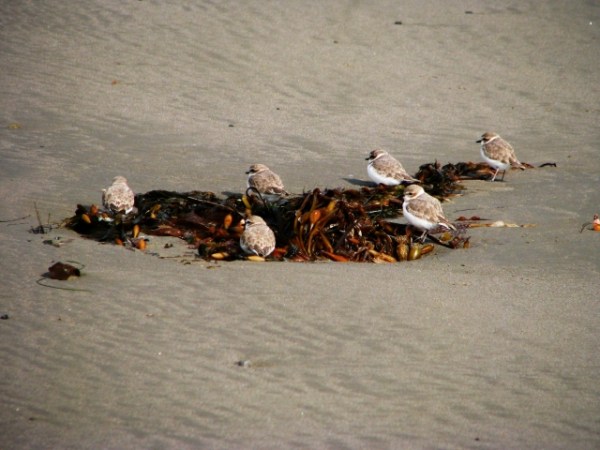
Six Snowy Plovers surround beach wrack (C. Almdale 12/23/12)
Gary Page, founder and head of PRBO’s WSP Project, puts his hopes for the future of the Western Snowy Plovers succinctly: “The Snowy Plover population recovers and no longer needs to be listed.”
For that to happen, the birds need the cooperation of the human population with whom they share the beach. We need to back off from them, just a little bit, and give them room to carry on their lives, to nest and raise their young, to forage for food, to rest and to sleep without the threat of being trampled at any moment. We need to stop removing the wrack (sea vegetation) lying on the beach near their nesting and roosting areas. We need to stop beach grooming in the vicinity of their winter roosts, and allow vegetation to reappear; from experience, such self-revegetation begins within a few months. We need to keep our dogs, our boisterous children, our vehicles and our trash away from them. If we can do that, most likely they’ll be able to bring off their own recovery without additional interference from us.

NO:PW, banded at Vandenberg AFB 2013; found on Zuma Beach, dead in a tire track, presumably run over by a beach vehicle (8-19-13)
These are the known nestings that have taken place this spring, 2017, in Los Angeles County.
Malibu Lagoon: Nest #1 failed, nest #2 has three eggs still in incubation.
Santa Monica Beach: Nest failed due to sandstorm.
Dockweiler Beach: Nest #1 three chicks hatched, but a gull ate them three days later. Nest #2 has eggs still in incubation.
Our fourth and final report will cover – with photos – these recent nestings in greater detail.
We hope that now that you know the Snowies are there, and why they’re there, you too will come to appreciate them and watch out for them. They need your concern.
Many thanks to the following people who answered questions and supplied background information: Gary Page and Frances Bidstrup, PRBO; Tom Ryan & Stacey Vigallon of Los Angeles Audubon Society Western Snowy Plover Project, Lu Plauzoles & Mary Prismon, Santa Monica Bay Audubon Society.
Sources and recommended sites for additional information
Western Snowy Plover – Tools and Resources for Recovery
http://www.westernsnowyplover.org/
Western Snowy Plover Natural History and Population Trends
http://www.westernsnowyplover.org/pdfs/plover_natural_history.pdf
Appendix B. Birds of Malibu Lagoon.
Dan Cooper, Cooper Ecological Monitoring, Inc.
http://www.cooperecological.com/birds_of_malibu_lagoon_8_06.htm
Los Angeles Audubon Society – Western Snowy Plover Conservation Page.
http://losangelesaudubon.org/conservation-a-restoration-mainmenu-82/154/268-snowy-plover
The Western Snowy Plover in Los Angeles County, California.
Ryan Ecological Consulting
http://losangelesaudubon.org/images/stories/pdf/westernsnowyploverin%20losangelescounty.pdf
The Western Snowy Plover in Los Angeles County, California: January to August 2010. Ryan Ecological Consulting
http://losangelesaudubon.org/images/stories/pdf/snplannualreport_2010finalweb.pdf
Pt. Reyes Bird Observatory (Excel Spreadsheets)
2010-11 California Winter Snowy Plover Survey.
2012 Summer Window Survey for Snowy Plovers on U.S. Pacific Coast with 2005-2011 Results for Comparison.
[Chuck Almdale]



 SANTA MONICA BAY AUDUBON SOCIETY BLOG