Free email delivery
Please sign up for email delivery in the subscription area to the right.
No salesman will call, at least not from us. Maybe from someone else.
Snowy Plovers of Malibu Lagoon – The Middle
Click HERE for a slideshow of banded Snowy Plovers, then scroll down
to the slideshow located below the photo of the banded chick.
It may take some time to load.
Use the arrows to advance and reverse.
We continue with our reprint of this August, 2012 series to reacquaint
our readers with the local history of these birds.
For the first time in over seventy years,
Snowy Plovers have again nested on Los Angeles County beaches.
Part III – Nesting and Wintering
Western Snowy Plovers (WSPs) are colonial nesters, up to 246 birds nesting in close proximity. Each nest is a bare scrape in beach sand, occasionally adorned with debris, twigs and pebbles. It might, but need not, have sparse vegetation nearby. The male often makes 1-2 false scrapes nearby. Three (occasionally two) eggs are laid, buff with black marks. Both parents incubate the eggs for 27-28 days. Hatchlings are precocial –the relatively long incubation period allows them to be born downy, mobile, ready to follow their parents and find their own food. In about a month they’re full size and able to fly.
Of the estimated 50 California nesting sites used in 1970, about half are used today. In 1949, the last active nest of a Snowy Plover on L.A. County beaches was reported at Manhattan Beach. There have been no documented cases of a Snowy Plover nesting within the county since then, although no systematic survey of suitable county beaches was done between 1970 and the mid 2000s. Kiff & Nakamura (1978) held that they “probably nested at Malibu Lagoon until the 1960s when increased human use of the area displaced the birds,” but provided no supporting evidence.

Snowy Plover in its sandy hollow home on Surfrider Beach (C. Bragg 9/25/11)
As part of the ongoing PRBO study, nestlings are banded each year. Each location/year has a unique band pattern. Currently, 13 colors are used on four bands, two per leg. GG:AR means: bird’s left leg Green above Green, bird’s right leg Aqua above Red. This particular pattern was found winter of 2011 in the Surfrider flock; the bird was one of three banded in Summer 2011 at Oceano Dunes near Pismo Beach.
As the result of the first Winter Window Census in January, 2001, we found that WSPs in Los Angeles County were concentrated into seven locations which were their winter roosting sites; outside those locations they were extremely uncommon. We found:
| Location | Jan ’01 | Jan ‘04 |
| Zuma Beach north | 106 | 130 |
| Surfrider Beach | 2 | 33 |
| Santa Monica north | 14 | 32 |
| N. Dockweiler/MDR | 16 | 12 |
| S. Dockweiler | 18 | 13 |
| Hermosa Beach | 23 | 38 |
| Cabrillo Beach | 0 | 7 |
| Other Areas | 0 | 0 |
| Totals | 179 | 265 |
Birds in 2001 at Surfrider (2) and Cabrillo (0), although seen in good numbers the previous day, were low on count day due to poor weather conditions (storm surge combined with high tide of the year).
To my knowledge, no one knew that Snowies stayed so close to their winter roosts. All later censuses proved that 2001 was not an anomaly. With few exceptions, the birds are just not found more than a few hundred yards – usually much less than that – from their roosting sites. Their seven roosting sites, with one exception, have not changed since then. The exception was on Dockweiler, where the roost at the foot of the hang-gliding slope disappeared when a site about ¼ mile north appeared.
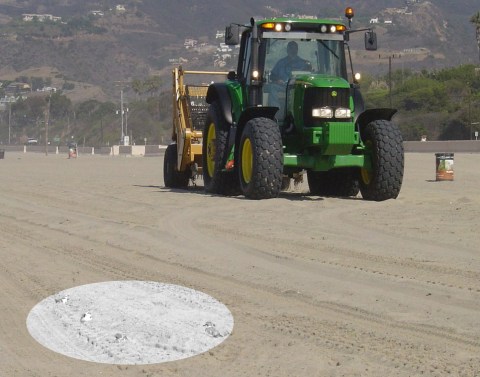
Beach groomer operators on Zuma can’t see the Snowies while they remove the wrack, their food source – a double whammy! (A. Albaisa 3/16/09)
Part IV – Population Fluctuations
As described previously, Western Snowy Plovers (WSP) wintering on Pacific beaches are extremely faithful to their roosting sites and are rarely seen outside their immediate vicinity, rarely more than a hundred yards down the beach. Northern Zuma Beach consistently has [Ed. – declined since 2012] the largest wintering flock of WSPs, averaging 46% of total county birds, followed by Surfrider and Santa Monica Beaches with 14% each.

Snowy Plover juvenile tooling down Surfrider Beach
(C. Almdale 10/24/09)
By recording bands, we discovered that there is some back-and-forth movement between Zuma, Surfrider and Santa Monica flocks. Of L.A. County’s approximately 75 miles of beach, Snowies confine themselves almost entirely to less than 1 mile, and closer to 800 yards, 0.6% of the total linear beachfront. Ryan Ecological Consulting (Feb. 2010 & Nov. 2010) suggested that conservation efforts be focused on these areas, an opinion with which I heartily concur.
California’s population of WSPs fluctuates significantly seasonally and yearly:
| Year | Summer Census |
Winter Census |
Increase in Birds | LA County Winter Census |
Surfrider Census |
| 2005 | 1680 | 4261 | 2581 | 334 | 12 |
| 2006 | 1719 | 3546 | 1827 | 196 | 34 |
| 2007 | 1362 | 3290 | 1928 | 200 | 37 |
| 2008 | 1394 | 3205 | 1811 | 233 | 36 |
| 2009 | 1405 | 3379 | 1974 | 244 | 37 |
| 2010 | 1591 | 3744 | 2153 | 211 | 47 |
| 2011 | 1715 | 3763 | 2048 | 326 | 78 |
| Avg. | 1552 | 3598 | 2046 | 249 | 40 |
Summer Census: Adult WSPs counted on the California breeding grounds.
Winter Census: Total Calif. birds found during the following January’s Winter Window Census.
Increase in Birds: Winter population minus Summer population of Snowy Plovers. The increase consists primarily of young WSPs fledged that summer on the coast, plus a few inland race Snowy Plovers spending winter on California beaches. Some Washington and Oregon WSPs winter in California (CA). Most CA WSPs winter in CA, a few winter out-of-state (Baja California). As more migrate into CA for the winter than migrate out, this net increase is included in the “Increase in Birds” numbers.
LA County Winter Census: Total birds counted in L.A. County on the Winter Window Census.
Surfrider Census: Total birds at Surfrider Beach on the Winter Window Census.
From this information, we can easily draw these conclusions:
- 2006-07 Winter population declined 17% from the prior winter
- 2007 breeding population declined 21% from the prior summer
- 2007-08 Winter population declined 7% from the prior winter
- 2008-09 Winter population declined 2.6% from prior winter
- 2011 breeding population has rebounded to its 2006 level
- 2011-12 Winter populations are still down 12% from 2005
No solid reason was ever determined for the declines. Some researchers think a Winter cold snap might have caused the initial decline in 2006-07; other researchers disagree, saying they’d already seen a decline in returning birds in Fall, 2006.
The Los Angeles County wintering population fluctuates between about 200-330 birds, averaging about 7% of the total California Snowy Plover Winter population. For the sake of comparison, this is about 2% of Malibu’s 2010 human population of 12,645.

Checking the plover virtual enclosure, Surfrider Beach (L. Johnson 5/27/12)
The highest count ever recorded for Surfrider Beach (Malibu Lagoon) was 81 birds on Jan. 22, 2012. This count included one banded bird GG:AR (previously mentioned), first appearing at Surfrider on Sep. 25, 2011 and reappearing on Christmas Day, Dec. 25, 2011. Upward trends are heartening to see, but unexpected downturns can always reoccur.
Part V – Back to Surfrider Beach
Western Snowy Plovers (WSPs) do not nest on Surfrider Beach [Ed. – two nests, the first in over seventy years, were found in 2017], they roost for the winter. They begin arriving in July, numbers peak Sept-Feb, the last one leaves by May. The 2012 post-breeding arrival was first noted on July 22 when 22 were found roosting just east of the virtual enclosure erected in March 2012.

Chuck drives a fence post
(C. Almdale 3/15/12)
Plover volunteers, including members of Santa Monica Bay Audubon Society (SMBAS), census Snowies and search for banded birds nine months of the year [Ed. – now year-round]. (SMBAS also does a monthly census of all birds in the lagoon vicinity. Link to April 2017 report.) If you see one or more people with binoculars, moving very slowly through the plover enclosure or nearby, frequently stopping and using binoculars to stare at the ground, they’re looking for banded birds.
The problem is that WSPs evolved to live on barren sandy beaches. California beaches get over 200 million visits by humans every year, humans involved in their own pursuits – surfing, swimming, sunning, walking, tossing Frisbees, letting dogs run free – humans oblivious to these tiny residents of the beach, residents who simply were not built for this. They have other problems: regular beach grooming which removes the wrack, vehicular traffic, predators attracted to human refuse. Dugan and Hubbard (2003) found that Snowy Plover abundance on southern California beaches was positively correlated with the mean cover of wrack and abundance of wrack-associated invertebrates. They also found (2009) that beach grooming increased beach erosion and the need for beach replenishment. Perhaps local beach authorities could help the plovers – which are, after all, a threatened species – as well as reduce cost for sand replenishment by ending large-scale grooming (see photo above) of the beach around plover roosting sites.
We’ve found that nearly everyone, once alerted to the presence of Snowies on the beach, will watch out for them and avoid them. Very few people enter the plover enclosures we’ve erected for them over the past few years. Unfortunately, the Snowies – despite our best efforts to teach them to read – have failed to grasp the concept and often sit outside the enclosure. We plan to move the enclosure as often as is feasible.

Jamie ties a knot in the Surfrider Beach virtual fence (C. Almdale 3/15/12)
Very recently, the U.S. Fish & Wildlife Service increased by 102% the official Critical Habitat for WSPs, from 12,145 acres up to 24,547 acres of Pacific sandy beach. Surfrider Beach/Malibu Lagoon Critical Habitat was increased to about 13 acres, extending from just northeast of the pier to the colony fence. Our experience of working with the Snowies is that they rarely go beyond the area between the two lifeguard stations and much prefer the beach directly between the lagoon and ocean (except when winter storms make this section too narrow). In one sense, the more designated Critical Habitat, the better. In another sense, the timing of this designation hampers the reconfiguration project [Ed. – June 2012 – May 2013] of the lagoon’s west channels. Snowies don’t use elevated or vegetated areas. They depend upon the open beach and the wrack. [Ed. – They seem to prefer nesting – as opposed to winter roosting – among live vegetation, sticks and stones.]
People ask us why we bother with such small creatures. They’re not big and flashy like pandas, lions or gorillas. Our answers are numerous: they’re adorable, they are so pathetically few, few people know or care, humans caused their decline, they need our help, they’re cute, empathy for fellow earthlings, they’re wonderfully interesting to watch and know, they have engaging personalities. Each and every one of us loves these little birds.
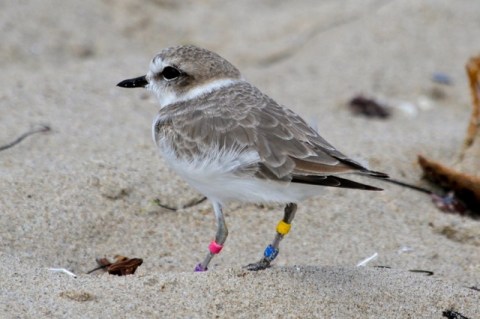
Snowy Plover PV:YB on Surfrider Beach, banded summer 2012 at Oceano Dunes, previously sighted at Guadalupe Dunes in Aug. and at Malibu in Sept. (J. Waterman 10/22/12)
We will continue with Part VI tomorrow.
[Chuck Almdale]
Snowy Plovers of Malibu Lagoon – The Beginning
The following seven-part article, written in August, 2012,
first appeared on Malibu Patch, a local blogsite.
It focused on the Snowy Plover winter roosting colony
on Surfrider Beach, adjacent to Malibu Lagoon.
We reprint it now to reacquaint our readers with the local history of these birds, because for the first time in over seventy years,
Snowy Plovers have again nested on Los Angeles County beaches.
Part I – The Birds Themselves
Few people know it, but some very rare birds live on Surfrider Beach. They spend most of their time resting in little hollows in the sand, like the ones your heel makes. Countless people saunter through their flock, never noticing them until they scurry away from underfoot.
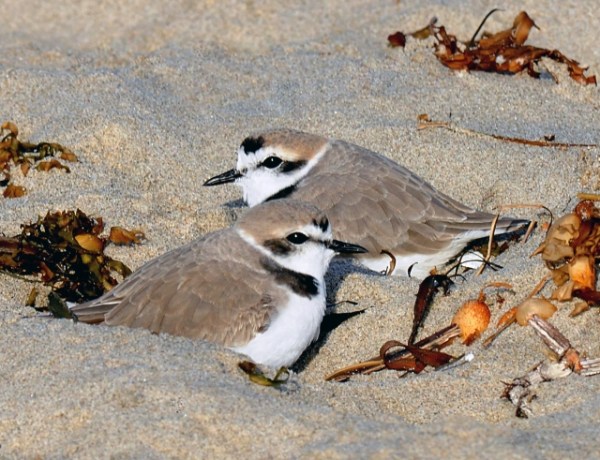
Western Snowy Plover adult pair on Surfrider Beach (J. Kenney 3/26/10)
Western Snowy Plovers are small, even for a bird, only 6 ¼” long, much smaller than your foot. Their cryptic gray, brown, white and black plumage blends perfectly into the sandy beach. They’ll crouch for hours, motionless in sandy hollows. They’re hard to see even when searching for them.
Snowies, like all shorebirds, are carnivores; more accurately, insectivores, eating any invertebrate or tiny fish they can find. Their preferred foraging area is wrack (washed-up sea vegetation) left at the high-tide line, often abundant with kelp flies and small invertebrates. Their short stubby

1st winter Western Snowy Plover & wrack, Surfrider Beach
(Jim Kenney 1/31/10)
bills, typical of plovers, are unlike the long and thin bills of sandpipers, who often probe – even underwater – for prey in sand and mud. Snowies don’t; they pick their food from the wrack or sand.
Because they prefer to forage in wrack, the best feeding time is just after high tide when waves are retreating; wrack is fresh and full of living invertebrates. They will go onto wet sand to forage, but they avoid waves, however small.
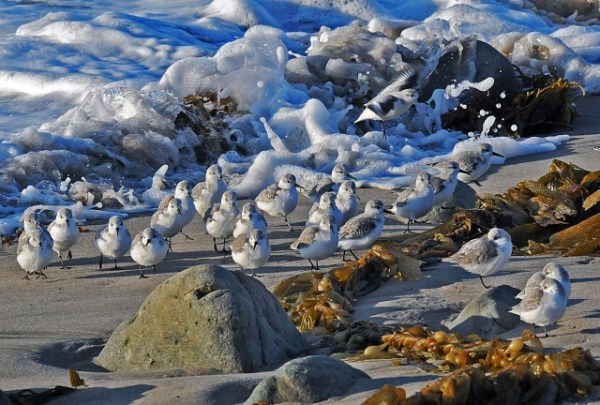
Sanderling flock on Surfrider Beach
(J. Kenney 11/29/09)
The flocks of small gray-white-brown birds which rapidly scurry on little black legs, following and fleeing the wavelets as they wash in and out, will almost certainly be Sanderlings. They are slightly larger than Snowies, with long, pointed black bills. They run a lot. They resemble Snowies, feed with Snowies, even roost within Snowy flocks. It takes experience to reliably tell them apart in the field. Found nearly worldwide, Sanderlings are abundant.
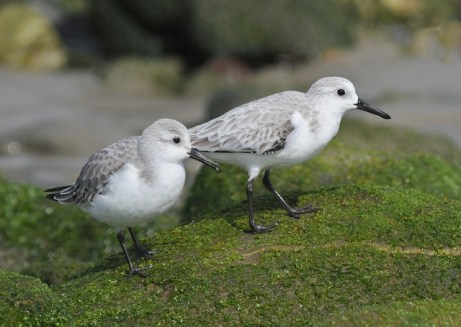
Sanderling duo in nonbreeding plumage (J. Kenney 11/19/09)
Snowy Plovers are far from abundant. We’ll discuss that in a later part.
Unlike the “I’m late, I’m late” scurrying of the Sanderlings, Snowies move in a pensive, hesitant, almost thoughtful manner. They take a few steps, 3–15 perhaps, and pause, often with one leg cocked, ready for their next step, whenever they decide to take it. All of the world’s 67 Plover species walk this way.
Click HERE for a slideshow of banded Snowy Plovers, then scroll down
to the slideshow located below the photo of the banded chick.
It may take some time to load.
Use the arrows to advance and reverse.
By the time the tide begins to rise, they’ve stopped foraging. They rest together in a small area, their roost, slightly inland of the beach berm (high ridge) between the lagoon and ocean, separated by a few inches to a few feet from one another, in small sand hollows they make, find, or improve upon. When it’s quiet with no predators or noisy humans nearby, they may sleep, although at least one lookout stays awake. When feeling frisky, they’ll chase one other around, jumping in and out of each other’s hollows.
Like you and me, Snowies need to rest and recharge their batteries. For millions of years, their lonely, windswept, barren beaches were sufficiently safe and undisturbed places to live, forage and breed. Times have changed.

How many Snowies can you find in this picture?
(C. Almdale 3/28/10)
Part II – History and Problems
The Plover family goes back a long way. Their oldest fossils, found in Colorado and Belgium, date from about thirty million years ago, but some scientists say they’re at least ten million years older. The Plover family is currently comprised of about 67 species (debate continues) and found on all continents and many islands except Antarctica. Nine species breed in the continental U.S. and Canada; six species appear regularly in California, four at Surfrider. The Snowy is the smallest.

1st winter Snowy Plover among exposed rocks at low tide, Surfrider Beach
(J. Kenney 11/12/09)
The entire world population of Western Snowy Plover (WSP) – about 4,000 birds – breeds exclusively on Pacific coastal beaches: about half in the U.S. from San Francisco southward, a few farther north, the rest in Baja California. After breeding they spread out in a post-breeding dispersal to winter on sandy beaches from Puget Sound south to Central America. There is also an inland group of Snowies numbering about 18,000 birds. Many of this group winter with the WSPs in mixed flocks on western beaches but most winter on the gulf coast.
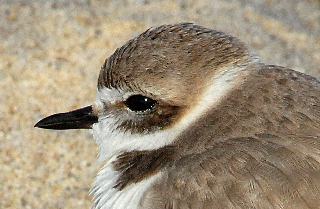
Close-up of wintering Snowy Plover, Surfrider Beach ( J. Kenney 2/15/07)
Population decline of WSPs was noticed many decades ago. Little was done until Pt. Reyes Bird Observatory (PRBO) became involved and did its first study of WSPs in 1977-80; results suggested that the birds had already disappeared from significant parts of their coastal California breeding range. Further studies were made. In 1993 WSPs were federally listed as threatened, and later listed as a Species of Special Concern by California. PRBO’s 1995 study showed a further 20% population decline since 1980.

Snowy Plover in tire track, Surfrider Beach (L. Plauzoles 11/2/08)
In the early 1990’s local Malibu resident Mary Prismon, long-time member of Santa Monica Bay Audubon Society (SMBAS), began censusing the local WSP flocks at Zuma and Surfrider Beaches and reporting the results to PRBO. Her love for the birds enticed other SMBAS members to join her, until counting the birds and looking for bands became a regular part of the chapter’s activities.
In 2000, PRBO announced the first Winter Window Census of the California West Coast, set for mid-January 2001, coinciding with censuses in Washington and Oregon. Mary asked Chuck Almdale to help and, because no one else volunteered to do it, he organized the Los Angeles County portion. He designed a protocol, divided the coastline into short segments, and recruited experienced birders to walk their segments on the same day at the same time. The weather was not good: the monthly high tide coincided with a storm surge. Nevertheless, the entire sandy beach of LA County, about 75 miles, was walked. The results were surprising.

Western Snowy Plover NO:WW, banded at Vandenberg AFB Summer 2009; wintering on Surfrider Beach
(C. Almdale 11/22/09)
As the result of that first Winter Window Census in January, 2001, we found that Western Snowy Plovers in Los Angeles County were concentrated into only seven locations which were their winter roosting sites; outside those locations they were extremely uncommon. These segments were, from north to south: Zuma Beach, Malibu Surfrider Beach (next to Malibu Lagoon), northern Santa Monica Beach, Northern Dockweiler Beach, Southern Dockweiler Beach, Redondo Beach and Cabrillo Beach. Each of these seven segments was less than 100 yards long. All of the volunteers knew the appearance and something about the behavior of these birds. A few of us knew that they were easier to find at certain locations such as Malibu Lagoon and Redondo Beach. But none of us knew that they were nearly impossible to find outside of a 100-yard circle around these few winter roosting spots. For all practical purposes, out of seventy-five miles of L.A. County coastline, Snowy Plovers restricted themselves to a total of 700 yards of beach.
We will continue with Part III tomorrow.
[Chuck Almdale]
Conceived in the open sea, tiny spaceship-shaped sea urchin larvae search the vast ocean to find a home. After this incredible odyssey, they undergo one of the most remarkable transformations in nature.
This is another installment of the PBS Deep Look series. If no film or link appears in this email, go to the blog to view it by clicking on the blog title above. If the film stops & starts in an annoying manner, press pause (lower left double bars ||) to let it buffer and get ahead of you. [Chuck Almdale]
Why Do We Have To Sleep? | PBS Science Video
Why do we sleep? We spend a third of our lives in slumber, but science has yet to determine exactly why we have do it. Here’s a look at how sleep works, why we’re not getting enough sleep, what happens if you DON’T sleep, and an idea about where sleep came from in the first place.
This is an installment of the PBS – It’s OK to be Smart series. If no film or link appears in this email, go to the blog to view it by clicking on the blog title above. If the film stops & starts in an annoying manner, press pause (lower left double bars ||) to let it buffer and get ahead of you. [Chuck Almdale]
The News Keeps Pouring In!
 Check out the front page of the L.A. Times California section for a big story on yesterday’s opening of the Dune Restoration Area on Santa Monica Beach where the plovers first nesting attempt occurred. We were among the first organizations to write in support of this Bay Foundation project nearly three years ago. Lu Plauzoles



 SANTA MONICA BAY AUDUBON SOCIETY BLOG