Free email delivery
Please sign up for email delivery in the subscription area to the right.
No salesman will call, at least not from us. Maybe from someone else.
Plover Update: Now national news
A number of news organizations have picked up the USFWS, LA Times, ABC News, NBC News, NPR news releases today about our Snowy Plovers on L.A. County beaches. See the impressive list of (real) news sources at the end of our earlier post, below.
https://smbasblog.wordpress.com
Lu Plauzoles
A Stunning Event for Local Audubon Volunteers
Two weeks ago, Western Snowy Plovers nested on Los Angeles County Beaches for the first time in nearly 70 years. The first nest was on the Santa Monica North beach I regularly monitor. It was spotted by Dan Cooper of Cooper Ecological, who is well known to local birders. The 3-egg nest was found in a recently installed Dune Restoration site established by The Bay Foundation in December. The three-day windstorm April 27th-29th proved to be too much for the male plover incubating the nest, however, and the nest was abandoned. I was monitoring the area on Friday the 28th and experienced what I estimate to be 40 mph gusts–hard enough for us to stand up in that wind with sand blowing up to 6 feet high!
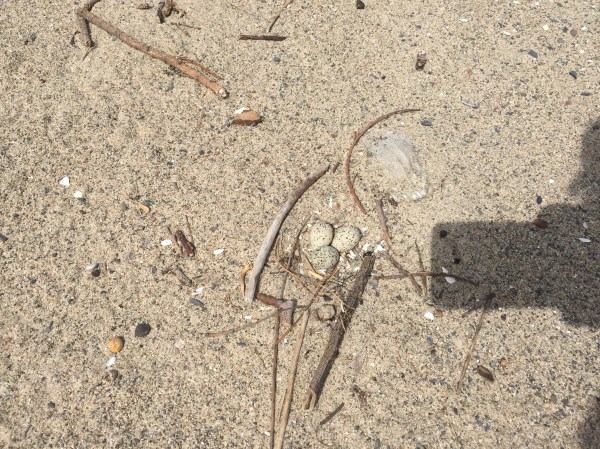
Within days of the Santa Monica nest, two more nests were found. One on Dockweiler Beach, and one on Malibu Lagoon Beach. The second was eventual abandoned or predated, but another nest was soon found just 10 yards away. Both of these nests were still viable as of this morning. Mini-exclosures and symbolic fencing have been erected to protect the birds and the nest from predation. Incubation is expected to last nearly another week, and if all goes well, there should be chicks on those beaches for another four weeks till they can fly on their own. Remember, these are precocial birds. They are not fed by their parents and must fend for themselves from birth.
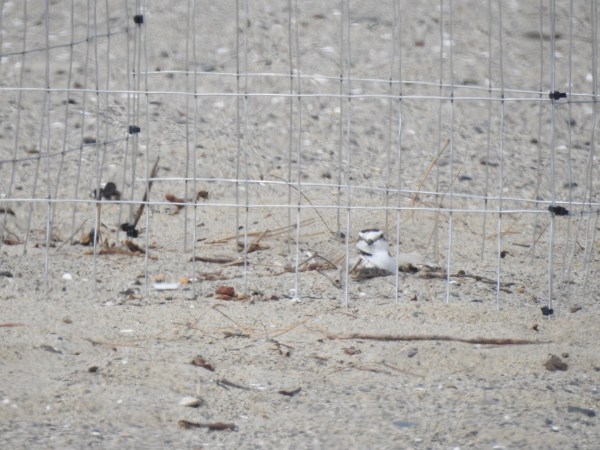
Tom Ryan, biologist with the L.A. and Orange Counties Snowy Plover recovery project warns us to be careful. “All nests are on public beaches, but we would like to request that if anyone goes to view or photograph the nests that they remain outside of the protected areas and not disturb the birds in any way. Walking up to the nest can provide a very clear trail that potential predators can follow. Flushing the the incubating adult can lead to nest abandonment and failure. Thank you and a big thank you to the many people who have volunteered their time for many years monitoring our roosting plovers!”
Want to help watch for the birds and help them survive? Contact Stacey Vigallon, volunteer coordinator at L.A. Audubon: svigallon@hotmail.com
More information on the nesting event from US Fish and Wildlife: https://www.fws.gov/ventura/newsroom/release.cfm?item=410
Helping the plovers will require more biologist and coordinator time in the near future. To contribute, go to http://losangelesaudubon.org The plover is on the home page now.
Photos above courtesy of and © Thomas Ryan. Nest on Santa Monica Beach 4/24/2017
Lu Plauzoles
Added note May 9th 10PM: The presence of these birds is well noted through major news organizations:
(You may have to search on the site using the keyword “plover”)
http://www.latimes.com/local/california/la-me-ln-snowy-plovers-20170508-story.html
http://www.canyon-news.com/rare-shorebirds-appear-l-beaches-nearly-70-years/67590
http://www.seattletimes.com/nation-world/threatened-bird-nesting-again-on-los-angeles-area-beaches/
http://www.scpr.org/news/2017/05/09/71663/western-snowy-plovers-endangered-beach-birds-make/
http://www.kswo.com/story/35384912/threatened-bird-nesting-again-on-los-angeles-area-beaches
http://www.wbrc.com/story/35384912/threatened-bird-nesting-again-on-los-angeles-area-beaches
http://www.newswest9.com/story/35384912/threatened-bird-nesting-again-on-los-angeles-area-beaches
Most flowering plants are more than willing to spread their pollen around. But some flowers hold out for just the right partner. Bumblebees and other buzz pollinators know just how to handle these stubborn flowers. They vibrate the blooms, shaking them until they give up the nutritious pollen.
This is another installment of the PBS Deep Look series. If no film or link appears in this email, go to the blog to view it by clicking on the blog title above. If the film stops & starts in an annoying manner, press pause (lower left double bars ||) to let it buffer and get ahead of you. [Chuck Almdale]
Watch Senior Curator Hein van Grouw as he prepares a corncrake (Crex crex) specimen for the Museum’s bird collections. The art of taxidermy has become fashionable again in recent years. But it has always been scientifically useful, as Hein explains.
This comes from the Natural History Museum of Los Angeles County. If no film or link appears in this email, go to the blog to view it by clicking on the blog title above. If the film stops & starts in an annoying manner, press pause (lower left double bars ||) to let it buffer and get ahead of you. [Chuck Almdale]
The glow worm colonies of New Zealand’s Waitomo Caves imitate stars to confuse flying insects, then trap them in sticky snares and eat them alive.
This is another installment of the PBS Deep Look series. If no film or link appears in this email, go to the blog to view it by clicking on the blog title above. If the film stops & starts in an annoying manner, press pause (lower left double bars ||) to let it buffer and get ahead of you. [Chuck Almdale]



 SANTA MONICA BAY AUDUBON SOCIETY BLOG