Free email delivery
Please sign up for email delivery in the subscription area to the right.
No salesman will call, at least not from us. Maybe from someone else.
This year we report on that other large object in the sky,
known as the sun.
Vernal Festivals
The vernal equinox, by any name, has been a major cultural event around the world for millennia. Of course, the farther one lives from the equator, the more noticeable are seasonal variations in daylight and warmth, and the more important these events become. Cultures from around the world – including Japan, China, Iran, Russia, Egypt, Scandinavia, Scotland and throughout the Americas – developed their own festivals celebrating the vernal equinox and the onset of springtime.
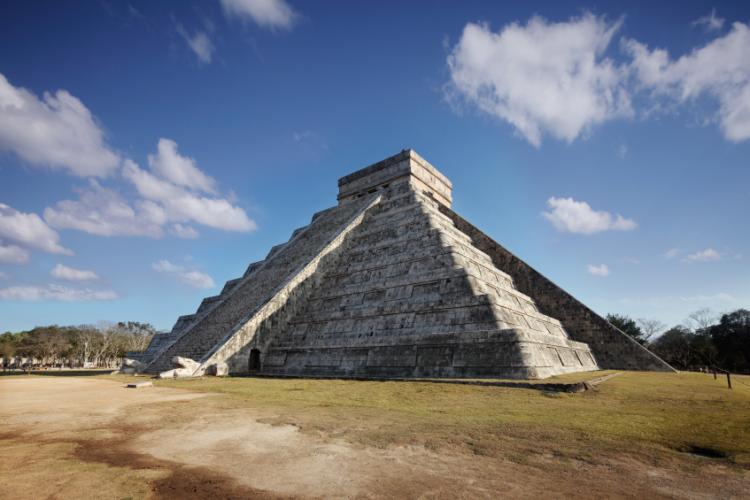
The Snake of Sunlight — Main pyramid at Chichen Itza, Yucatan, Mexico
(CostinT from Timeanddate.com)
Easter is the best known vernal festival in the western world.
Goddess of the Dawn to the Greeks was Eos (Aurora to the Romans), born of Titan parents, sister to sun-god Helios (Roman Sol Invictus) and moon-goddess Selene (Roman Luna), and mother of the four winds. The name originates in the ancient Indo-European language, predecessor to nearly all European, Indian and Persian languages, and was Ostara (later Ostern) to the Germans, and Eastre in Old English and Ester in Middle English, from whence we get both East and Easter. The early Christian church was good at co-opting festivals from other religions and peoples. So, the spring festival of Eos (by whatever local name variation) became Easter, re-configured to memorialize the death and resurrection of Jesus. Spring festivals typically mark the end of the wintery season of death and the rebirth into spring, when plants bloom and animals bear their young. The origin of the
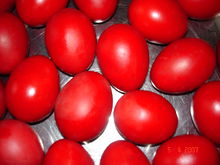
Red Easter Eggs symbolize the blood of Jesus
(Wikipedia – Easter Eggs)
Easter Egg custom is complex: part obvious fertility symbol, part recognition of the end of Christian Lent (during which eggs were forbidden), part early Mesopotamian Christian symbol for the death of Jesus, and part empty-shell symbol of the empty tomb of Jesus. Easter is scheduled for the first Sunday after the first full moon on or after the vernal equinox, a formula which indirectly led to Western Europe’s replacement of the Julian Calendar with the Gregorian calendar in 1752.
Sunspot Cycles
The sunspot cycle is driven by cyclic fluctuations in both polarity and strength of the solar magnetic field. On average, these magnetic poles reverse polarity – north magnetic pole becomes south magnetic pole and vice versa – every 11.1 years, then does it again, for an average total of 22.2 years. The Sunspot minimum period surrounds this polar flip: for example, current Cycle 24 began 1/4/2008 when at solar 30° north a sunspot appeared with polarity magnetically reversed from existing sunspots, the sign of a polar flip. That year was later ‘voted’ the “blankest year of the space age” – 266 days without a single sunspot, exceeding 1954’s 241 spotless days. However, solar minima in the late 19th-early 20th centuries often had 200-300 spotless days per year. Farther back, during the ‘Maunder Minimum’ (cause of Europe’s ‘Little Ice Age”of 1645-1715), only 30 sunspots appeared during one 30-year period. Sunspot maximums occur roughly midway between minimums. Current Cycle 24, expected to end in 2019, experienced a ‘double peak’ of spot maximum – 67 sunspots in Sep. 2012, then dropping, only to again peak at 82 spots in Apr. 2014.
For comparison, the earth’s magnetic field flips – not just slide around, but flips north to south – over a wildly varying cycle ranging from 10,000 to 25 million years according to current knowledge. It takes an estimated 5000 years for the magnetic field to wane, flip, and wax, and – we are told – we may be in such a period right now. So keep an eye on your compass – if the needle point suddenly shifts to ‘south,’ or if your car’s GPS system suddenly becomes unreliable, well…don’t say you weren’t warned. And stay out of that ensuing influx of cosmic rays.
Just in case you thought you might escape this without seeing a chart, here’s your chart.
| Sunspots – Last 10 cycles | |||||
| Solar | Start at | Spots at | Years of | Date of | Spots at |
| Cycle No. | Minimum | Minimum | Cycle | Maximum | Maximum |
| 15 | Dec 1913 | 5.6 | 10.0 | Aug 1917 | 105.4 |
| 16 | May 1923 | 3.5 | 10.1 | Apr 1928 | 78.1 |
| 17 | Sep 1933 | 7.7 | 10.4 | Apr 1937 | 119.2 |
| 18 | Jan 1944 | 3.4 | 10.2 | May 1947 | 151.8 |
| 19 | Feb 1954 | 9.6 | 10.5 | Mar 1958 | 201.3 |
| 20 | Oct 1964 | 12.2 | 11.7 | Nov 1968 | 110.6 |
| 21 | May 1976 | 12.3 | 10.3 | Dec 1979 | 164.5 |
| 22 | Mar 1986 | 8.0 | 9.7 | Jul 1989 | 158.5 |
| 23 | Jun 1996 | 1.7 | 11.7 | Mar 2000 | 120.8 |
| 24 | Jan 2008 | Apr 2014 | 81.9 | ||
| All 24 Cycles | |||||
| 1755-2014 Mean | 5.8 | 11.1 | 114.1 | ||
A total eclipse of the sun, visible over all of North America, occurs August 21, 2017. Partial eclipse on the center line begins on the mainland in Oregon at 16:04 universal time (UT) (9:04 AM PDT) and begins on the South Carolina coast at 17:17 UT (1:17 PM EDT). It takes about 2 hours, 50 minutes from beginning to end, with a maximum of 2 minutes, 40.2 seconds of total eclipse in the middle of two periods of partial eclipse. Length of totality at the Oregon coast is short at 1:58, longest at Carbondale, Ill at 2:40, and is 2:33 when it leaves the South Carolina coast.
Eclipse Links:
NASA
Eclipse2017.org
Astronomy.com – 25 Facts you should know
Earth & Sky – Solar Eclipse Path
Space.com – Where, when & how to see the eclipse
A total solar eclipse is something everyone should see at least once in their lifetime. It’s not often that you can see the Moon Dragon swallow and disgorge the Sun God. I’ve seen it four times. In my book, a partial eclipse is barely worth the effort of getting out of bed. Go for the centerline of shadow, where totality is maximized, or forget it. If you miss this one, another will be along on April 8, 2024, ranging from 3:22 on the east coast of Maine to 4:27 in southwestern Texas. The next one after that eclipse is on August 23, 2044. [Chuck Almdale]
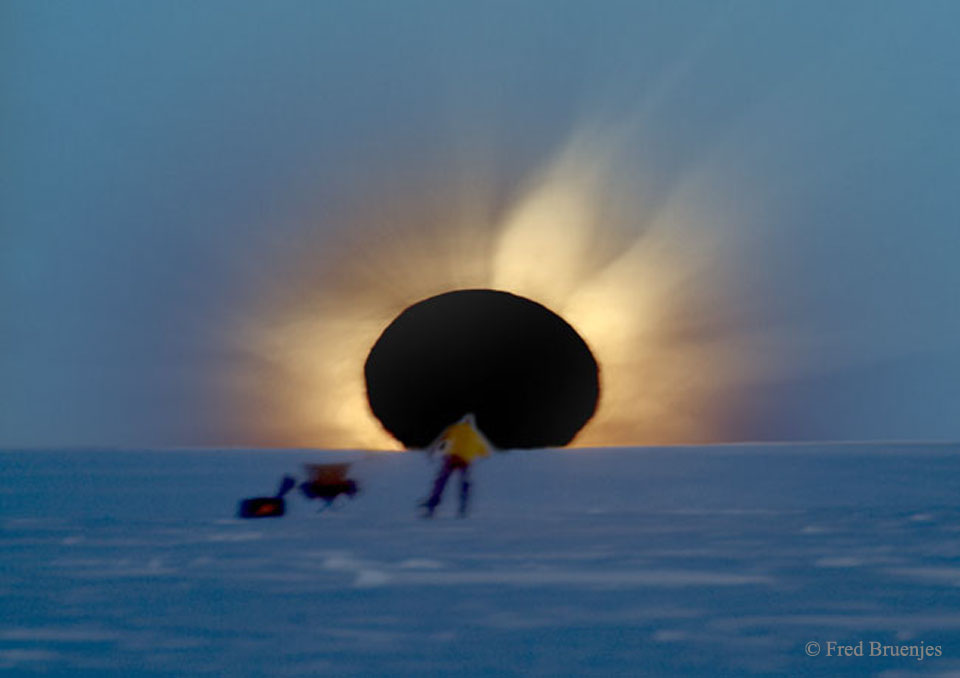
Total Solar Eclipse in Antarctica (Fred Bruenjes 11/23/03)
Vernal Equinox March 20, 2017, 3:29 AM, PDT — Part I
This year we report on that other large object in the sky, known as the sun.

Not a bad peach, but our Sun – 860,000 miles in diameter, 8 light-minutes away (Alan Friedman ~ 4/22/14, on NASA site)
The first event is the Vernal Equinox, scheduled in Los Angeles for March 20, 2017 at 3:29 AM PDT. Sunrise: 6:56 am at 89° East, 1 degree north of due east.
Sunset: 7:04 pm at 271 ° West, 1° north of due west
The sum will pass the meridian (north-south line) at 1 pm, at an angle of 56° above due south. Daylight will last 12 hours, 8 minutes and 43 seconds (12:08:43); nighttime is 11:51:17 long. You will note that these periods of day and night are not equal. Day and night were nearly equal on March 16, with 12:00:11 of daylight.
Definition of the term
Vernal: Of or pertaining to Spring [Latin vernal(is)]
Equinox: When the sun crosses the plane of the earth’s equator [from Latin aequinoctium, the time of equal days and nights].
Equinoctial daytime exceeds nighttime for two reasons
First: Sunrise occurs when the leading (upper) edge of the rising sun first becomes visible above the horizon. Sunset is when the trailing (not the lower) edge drops below the horizon. The width of the sun adds about six minutes of daylight.
Second: Refraction of the sun’s rays by the earth’s atmosphere permits us to see the sun both before it has actually risen and after it has actually set, adding several minutes each to sunrise and sunset. In total, day exceeds night on March 20, 2017 by 17 minutes , 26 seconds.
Spring is Arriving Earlier and Earlier
This is not due to climate change, but to fluctuations in earth’s elliptical orbit, the gravitational pull of the other planets, and the precession of the equinoxes (google that). Although we traditionally expect spring to start on March 21, the last time that happened in the entire United States was in 1980. From 1981 to 2102, the vernal equinox will occur no later than March 20. In 2020, it will start on March 19 for the entire United States. The length of the seasons are changing as well. Spring is currently losing one minute per year to Summer, and Winter is losing 1/2 minute to Autumn. Winter is currently the shortest season at 88.99 days, and is expected to reach its minimum length of 88.71 days around the year 3500. (From Joe Rao)
Seasonal Fluctuation
Because the two equinoxes (vernal and autumnal) mark when the sun crosses the plane of the earth’s equator, these are also the only days of the year when the sun rises exactly in the east and sets exactly in the west. The earth’s axis (and equatorial plane) is tilted 23.4° with respect to the plane of the earth’s orbit around

Northern Summer (famous artist – name withheld by request)
the sun. In the northern summer the earth’s north axial pole tilts towards the sun, the sun’s rays have less insulating atmosphere to filter them, and the northern hemisphere warms up. In the northern winter, the north pole tilts away from

Northern Winter (same famous artist)
the sun whose warming rays now must penetrate more atmosphere, and the northern hemisphere cools down. Seasons are opposite south of the equator. The closer you are to the equator, the more equal are day and night, summer and winter, warmth and cold. The temperature extremes of winter and summer are replaced by rainy and dry seasons.

At equinox: right diagram shows view past top of sun towards earth.
Eastern Sunrise, Western Sunset
Throughout the northern winter and spring, the points of sunrise and sunset move farther and farther north. The extremes are the Winter Solstice (around December 21), when the sun rises and sets farthest to the south, and the Summer Solstice (around June 21) when they are farthest to the north. The equinoxes mark the halfway point, when sunrise and sunset are exactly east and west. Well, not exactly. On March 18, 2017, the sun rises at 90° – exactly east – at 6:58 AM, and sets at 270° – exactly west – at 7:03 PM. It also rises and sets exactly east and west on March 19. Well…not exactly, perhaps on either day but a fraction of a degree off from exactly 90° and 270°. But still closer to exact than on March 20.
So make sure you run outside at 3:29 AM on March 20 to witness the vernal equinox, despite the fact that you won’t be able to see anything. Why? Because the sun will be currently eclipsed (by the earth). By the way – the sun doesn’t rise and set. The earth revolves on its axis. But you knew that. [Chuck Almdale]
Part II to follow: Vernal Equinox Festivals, Goddesses, Sunspot Cycles and an Eclipse
Interesting Links
Space Weather Radio – Meteor echoes & other live sounds from space
TimeandDate.com – March Equinox
TimeandDate.com – Los Angeles sunrise, sunset & day length for March 2017
InfoPlease – A Tale of Two Easters
TimeandDate.com – Current Day and Night map
Heliophysics – A Universal Science
Los Angeles Equinoxes and solstices for 2010–2020
When attacked, this beetle sets off a rapid chemical reaction inside its body, sending predators scrambling. This amazing chemical defense has some people scratching their heads: How could such a complex system evolve gradually—without killing the beetle too?
This is another installment of the PBS Deep Look series. If no film or link appears in this email, go to the blog to view it by clicking on the blog title above. If the film stops & starts in an annoying manner, press pause (lower left double bars ||) to let it buffer and get ahead of you. [Chuck Almdale]
There’s a chemical arms race going on in the Sonoran Desert between a highly venomous scorpion and a particularly ferocious mouse. The outcome of their battle may one day change the way doctors treat pain in people.
This is another installment of the PBS Deep Look series. If no film or link appears in this email, go to the blog to view it by clicking on the blog title above. If the film stops & starts in an annoying manner, press pause (lower left double bars ||) to let it buffer and get ahead of you. [Chuck Almdale]
Piper – Oscar winner | You Tube Video
Sent in by Ellen. At 4:45 minutes length, I don’t know if this is the whole Piper, or a short portion, but it was an Oscar winner and it’s not costing us anything, so enjoy. Produced by Pixar Disney.
This is a YouTube video. If no film or link appears in this email, go to the blog to view it by clicking on the blog title above. If the film stops & starts in an annoying manner, press pause (lower left double bars ||) to let it buffer and get ahead of you. [Chuck Almdale]



 SANTA MONICA BAY AUDUBON SOCIETY BLOG