Free email delivery
Please sign up for email delivery in the subscription area to the right.
No salesman will call, at least not from us. Maybe from someone else.
Great Backyard Bird Count starts Friday, Feb. 17, 2017
Count birds for the Great Backyard Bird Count

Gambel’s Quail couple
(Andy Byerly, Tucson AZ – Cornell GBBC 2016 photos)
Similar to Project FeederWatch, the Great Backyard Bird Count (GBBC) helps scientists learn about the distribution and abundance of birds. But the GBBC works a little differently and takes place over only four days—from February 17 through 20, 2017.
For the GBBC, you count the number of individuals of each species you see during a single counting session, and you submit a checklist for each counting session (not a two-day tally like you do for FeederWatch). You can count in more than one location—just submit a separate checklist for each location each time you count. You can report the same birds to GBBC that you are reporting to Project FeederWatch as well as any other birds you see, even those birds flying overhead that don’t count for FeederWatch.
With the El Niño weather phenomenon warming Pacific waters to temperatures matching the highest ever recorded, participants in the 2017 GBBC may be in for a few surprises. Information gathered and reported online at birdcount.org will help scientists track changes in bird distribution, some of which may be traced to El Niño storms and unusual weather patterns.
Though rarities and out-of-range species are exciting, it’s important to keep track of more common birds, too. Many species around the world are in steep decline and tracking changes in distribution and numbers over time is vital to determine if conservation measures are needed. Everyone can play a role.
Learn more about how to take part in the Great Backyard Bird Count at birdcount.org. The GBBC is a joint project of the Cornell Lab of Ornithology and the National Audubon Society with partner Bird Studies Canada and is made possible in part by sponsor Wild Birds Unlimited.
| Project FeederWatch is a joint project of the Cornell Lab of Ornithology and Bird Studies Canada.
The Cornell Lab of Ornithology is a nonprofit organization supported by friends and members. Our mission is to interpret and conserve the earth’s biological diversity through research, education, and citizen science focused on birds. Bird Studies Canada is our country’s leading national charitable organization dedicated to bird research and conservation. Our mission is to conserve wild birds of Canada through sound sicience, on-the-ground actions, innovative partnerships, public engagement, and science based advocacy.
[Posted by Chuck “Rip ‘n’ Read” Almdale]
|
Project FeederWatch Contact Information
For U.S. participants: For Canadian participants: P.O. Box 160, |
The Sex Lives of Christmas Trees | Deep Look Video
The humble pine cone is more than a holiday decoration. It’s an ancient form of tree sex. Flowers may be faster and showier, but the largest living things in the world? The oldest? They all reproduce with cones.
This is another installment of the PBS Deep Look series. If no film or link appears in this email, go to the blog to view it by clicking on the blog title above. If the film stops & starts in an annoying manner, press pause (lower left double bars ||) to let it buffer and get ahead of you. [Chuck Almdale]
Birdy Morning at Sepulveda Basin Wildlife Reserve Area: 11 Feb., 2017

Green Heron (Grace Murayama 2-11-17)
As often happens these days, what rain there would be had already fallen, and the morning was cool and pleasant. Yellow-chevroned Parakeets perched in their favorite tree by the archery range fence, and seemed satisfied to stay there. The first surprise was 500+ Canada Geese on the northern cricket field. We searched through them but could find no Cackling Geese. The resident pair of Egyptian Geese attracted a lot of attention from those who had never before seen these golf course-loving waterfowl.
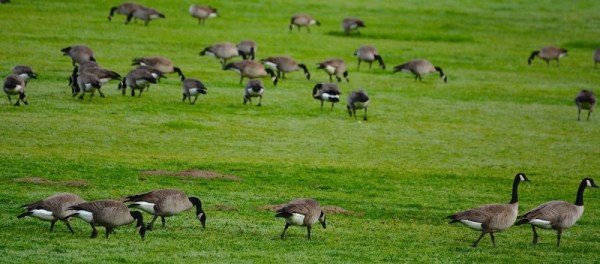
Canada Geese on the cricket pitch (Grace Murayama 2-11-17)
The nesting Great Horned Owls weren’t nesting, or had changed locations, so we wandered over to the ponds. Most of the ducks were American Wigeon, with a scattering of Mallards and Pied-billed Grebes. One Belted Kingfisher flew across the pond, rattle-cackling. All the herons and egrets were present: Great Blue and Green Herons, Great and Snowy Egrets; five Black-crowned Night-Herons hiding in the reeds fringing the pond. Black Phoebes caught insects over the water, then returned to their perches in the brush and reeds. Red-winged Blackbirds also hid among the reeds. The island trees were full of Double-crested Cormorants, Turkey Vultures and one Osprey. White Pelicans, who do not like the ocean or Malibu Lagoon, floated across the pond. One caught a fish.
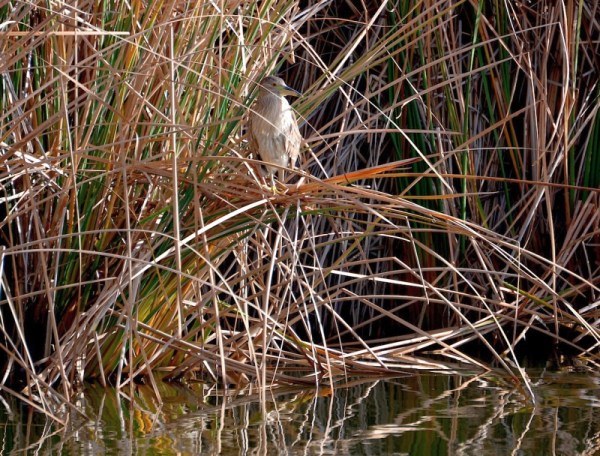
Immature Black-crowned Night-Heron (Grace Murayama 2-11-17)
A bit of an argument arose when a particularly large duck was see among the Mallards. What was it? A goose? It, of course, looked nothing like any bird in the field book. Another exotic like the Egyptian Geese? Had anyone reported it on the L.A. County Bird Hotline?
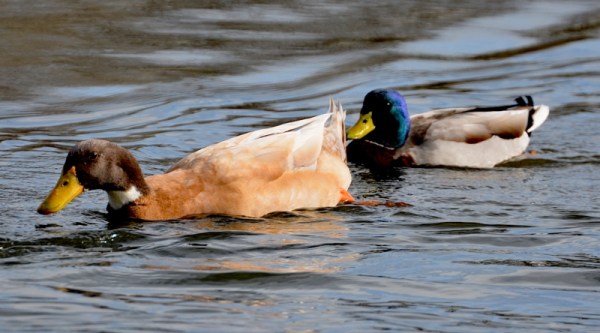
Mallards (Grace Murayama 2-11-17)
Our white domestic ducks are all mallards, modified by human selective breeding for size and white plumage. They and the regular wild Mallards do not recognize these differences as significant, and they freely interbreed. You can get many variations as the genes for white plumage mix with the genes for typical Mallard plumage. In the bird above, bill and leg color and the partial white neck ring is about all that’s left of the ancestral plumage displayed by the wild male Mallard behind it. Even the little tail curl which all male Mallards have is almost absent.

Birders scoping a hummingbird nest (Grace Murayama 2-11-17)
Brush birds were easily found along the main path: Mourning Doves, Anna’s and Allen’s Hummingbirds, Nuttall’s and Downy Woodpeckers, Scrub-Jays, Bushtits, Bewick’s Wrens, Ruby-crowned Kinglets, Mockingbirds, Orange-crowned and Yellow-rumped Warblers, Spotted and California Towhees, Song and White-crowned Sparrows, House Finches and Lesser Goldfinches. A pair of Red-tailed Hawks rested in nearby trees. Sepulveda Basin can be quite birdy.

Last year’s oriole nest made of plastic strips (Grace Murayama 2-11-17)
We made it to the Los Angeles River which was quite scoured by recent rains. In fact, we saw signs that the water level had recently been at least six feet higher. At the river were more Wigeons and Mallards, plus Coots, Black-necked Stilts in the shade of the Balboa Blvd. bridge and a single Greater Yellowlegs. The day was warming: Red-tailed and Cooper’s Hawks soared as Turkey Vultures floated away on thermals into the misty sky.

Osprey over the pond (Grace Murayama 2-11-17)
Previous Sepulveda Area trips: Feb. 2016 Dec. 2015 Nov. 2013
Sepulveda Basin Wildlife Reserve website. The first page has a nice slideshow of changes over time, taken from the same vantage point on the Burbank Blvd. overpass.
Note: For 2016 & 2017, R = L.A. River; this count is included in the total count for each species.
Thus: Mallard 40 10R = total 40 Mallards includes 10 seen at the L.A. River
| Sepulveda Basin Trip List | 11/9/13 | 12/12/15 | 2/13/16 | 2/11/17 |
| Canada Goose | 7 | 45 | 13 | 500+ |
| Egyptian Goose | 2 | 2 | ||
| Wood Duck | 2 | |||
| Gadwall | 2 | 8 | 6R | |
| American Wigeon | 8 | 60 | 100R | 150R |
| Mallard | 50 | 50 | 40 10R | 50 30R |
| Ring-neck Duck | 1 | |||
| Bufflehead | 4 | |||
| Hooded Merganser | 2 | |||
| Pied-billed Grebe | 20 | 18 | 20 | 10 |
| Eared Grebe | 6 | |||
| Western Grebe | 1 | |||
| Double-crested Cormorant | 30 | 35 | 40 | 20 |
| American White Pelican | 12 | 28 | 5 | |
| Great Blue Heron | 4 | 3 | 3 | 5 |
| Great Egret | 4 | 3 | 3 | 34 1R |
| Snowy Egret | 2 | 2 | 1 | 8 2R |
| Green Heron | 3 | 5 | 4 | |
| Black-crowned Night-Heron | 5 | 5 | 7 | 5 |
| White-faced Ibis | 2 | |||
| Turkey Vulture | 8 | 12 | 20 | 20 |
| Osprey | 2 | 1 | 1 | 1 |
| Cooper’s Hawk | 1 | 1 | 3 | |
| Red-tailed Hawk | 2 | 4 | 5 1R | 4 1R |
| American Coot | 10 | 35 | 30 10R | 36 4R |
| Black-necked Stilt | 9R | |||
| Killdeer | 3 | 2 | ||
| Spotted Sandpiper | 2 | 2 | 1R | |
| Greater Yellowlegs | 2 | 1R | ||
| Least Sandpiper | 15 | 40 | ||
| Western Gull | 4 | 3 | ||
| California Gull | 10 | 4 | ||
| Rock Pigeon | 15 | 10 | 10 | |
| Mourning Dove | 8 | 30 | 20 | 30 10R |
| Great Horned Owl | 2 | |||
| White-throated Swift | 2 | |||
| Anna’s Hummingbird | 3 | 2 | 5 | 5 |
| Allen’s Hummingbird | 10 | 3 | 6 | 8 |
| Belted Kingfisher | 1 | 2 | 1 | 1 |
| Red-breasted Sapsucker | 1 | |||
| Nuttall’s Woodpecker | 2 | 1 | 4 | |
| Downy Woodpecker | 1 | 1 | ||
| Northern Flicker | 4 | 1 | 1 | 1 |
| Merlin | 1 | 1 | ||
| Yellow-chevroned Parakeet | 8 | 6 | 20 | |
| Black Phoebe | 20 | 18 | 6 1R | 7 1R |
| Say’s Phoebe | 4 | 2 | ||
| Ash-throated Kingbird | 1 | |||
| Cassin’s Kingbird | 3 | 3 | ||
| California Scrub-Jay | 2 | 1 | 2 | |
| American Crow | 10 | 2 | ||
| Northern Rough-winged Swallow | 24 | 2 | ||
| Barn Swallow | 6 | |||
| Bushtit | 8 | 16 | ||
| Bewick’s Wren | 1 | 4 2R | 3 1r | |
| Blue-gray Gnatcatcher | 2 | 10 | 1 | |
| Ruby-crowned Kinglet | 6 | 15 | 3 | 10 2r |
| Western Bluebird | 3 | 8 | ||
| Hermit Thrush | 1 | |||
| American Robin | 1 | |||
| California Thrasher | 1 | 1 | 5 | |
| Northern Mockingbird | 5 | 2 | 2 | |
| European Starling | 30 | 10 | ||
| American Pipit | 12 | 4 | 1R | |
| Orange-crowned Warbler | 1 | |||
| Common Yellowthroat | 6 | 4 | 5 2R | 2H |
| Yellow-rumped Warbler | 40 | 35 | 20 | 30 |
| Spotted Towhee | 2 | 2 | 1 | 2 |
| California Towhee | 8 | 15 | 10 | 6 |
| Chipping Sparrow | 10 | 8 | 5 | |
| Lark Sparrow | 5 | 6 | 15 | |
| Savannah Sparrow | 10 | 2 | 15 | 10 |
| Song Sparrow | 10 | 5 | 4 | 20 |
| White-crowned Sparrow | 30 | 50 | 60 | 20 5r |
| Dark-eyed Junco | 8 | 2 | ||
| Red-winged Blackbird | 4 | 8 | 8 | |
| Western Meadowlark | 15 | 40 | ||
| Great-tailed Grackle | 2 | |||
| House Finch | 30 | 15 | 25 | 17 3r |
| Lesser Goldfinch | 4 | 30 | 4 | |
| American Goldfinch | 30 | 25 | 5 | |
| House Sparrow | 6 | |||
| Total Species – 82 | 62 | 50 | 55 | 54 |
a
YOU Can Help Our Local Sandy Beach Birds Survive for Valentine’s Day
SANTA MONICA BAY’S SNOWY PLOVERS AND LEAST TERNS COULD USE YOUR HELP
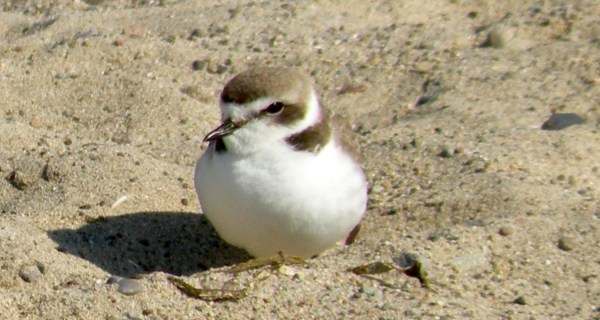
Our partners in protecting Snowy Plovers and Least Terns have mounted a special Valentines Day Campaign to raise crucial funds in order to continue protecting, monitoring, and providing education about these threatened and endangered shorebirds. Without financial support–this program is in peril. Los Angeles Audubon has established a place to give a Valentine’s gift of love to our favorite birds:
From Los Angeles Audubon : This Valentine’s Day show some love for Snowy Plovers and Least Terns – threatened and endangered species found along our California coastline. Los Angeles Audubon greatly needs your help to continue Plover and Tern conservation efforts.Honor your loved one with a donation at our Wall of LOVE: How can you resist helping this adorable creature!
https://www.givinggrid.com/snowyplover/
Photo: Snowy Plover at Zuma Beach, Malibu (Laurel Jones)
Jellyfish don’t have a heart, or blood, or even a brain. They’ve survived five mass extinctions. And you can find them in every ocean, from pole to pole. What’s their secret? Keeping it simple, but with a few dangerous tricks.
This is another installment of the PBS Deep Look series. If no film or link appears in this email, go to the blog to view it by clicking on the blog title above. If the film stops & starts in an annoying manner, press pause (lower left double bars ||) to let it buffer and get ahead of you. [Chuck Almdale]



 SANTA MONICA BAY AUDUBON SOCIETY BLOG