Free email delivery
Please sign up for email delivery in the subscription area to the right.
No salesman will call, at least not from us. Maybe from someone else.
Is This a New Species? | PBS Science Video
This is the first-ever video of what we’re calling the “hermit crab caterpillar”! We’re pretty sure this strange caterpillar is a NEW SPECIES. We went to the Peruvian Amazon to see amazing things, but we never expected this 🙂
But that makes me wonder: What *is* a species anyway? And how do you know if you’ve found a new species?
This is an installment of the PBS – It’s OK to be Smart series. If no film or link appears in this email, go to the blog to view it by clicking on the blog title above. If the film stops & starts in an annoying manner, press pause (lower left double bars ||) to let it buffer and get ahead of you. [Chuck Almdale]
World WHAT Day?
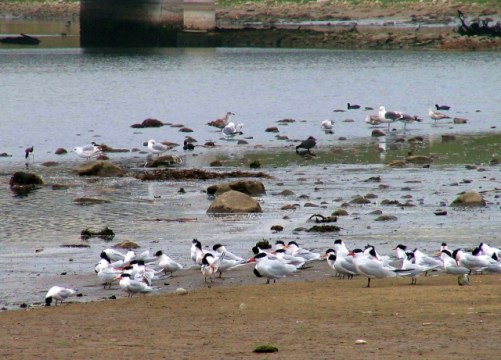
Lagoon flock front to rear: Elegant & Caspian Terns, California & Western Gulls, American Coot, & Black-necked Stilt in left center. (Lee Huniu 4/22/12)
I’m sure you’ve all sent out your ‘Happy World Wetlands Day’ cards and booked your dinner reservations to celebrate… No? Only me? Well, today is in fact World Wetlands Day and the United States is signatory to the Ramsar Convention (named for the city in which the global wetlands conservation agreement was signed).
If you live in Los Angeles, you might have noticed we don’t have a lot of wetlands anymore; California has destroyed 90% of its to development, but locally on Santa Monica Bay we do have the Ballona Wetlands and the smaller Malibu lagoon. These sites are of vital importance to migrating shorebirds. Bird migration, the seasonal movement of birds from their breeding grounds to their wintering grounds, is one of the most spectacular, physically demanding, and mysterious wildlife events. Wetlands are one of the only places these birds can stop and refuel on their epic journeys.
For the third year, Santa Monica Bay Audubon has participated in the Point Blue Pacific Flyway Shorebird Survey and Migratory Shorebird Project at Malibu Lagoon to track and monitor birds stopping at our local wetlands.
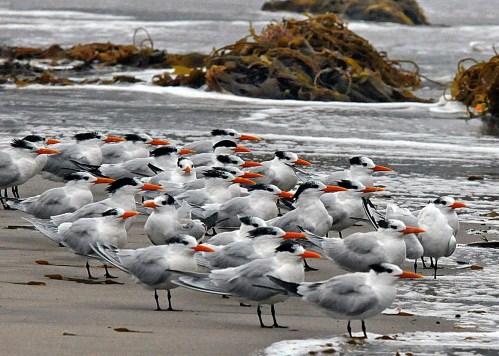
Royal Tern flock (J. Kenney 1/20/10)
Check out these links:
World Wetlands Day – February 2, 2017
Migratory Shorebird Project
Point Blue – Pacific Flyway Shorebird Survey
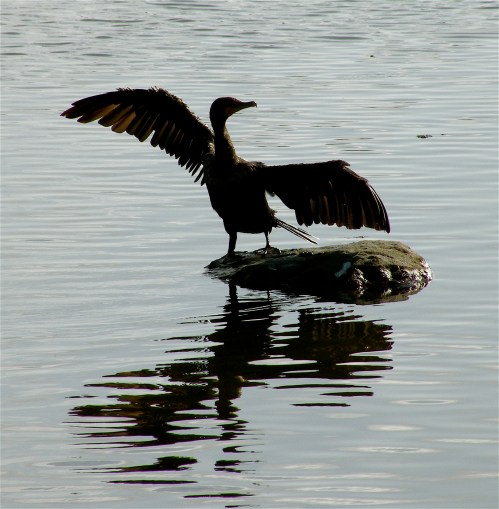
“It was this big,” claimed the Comorant, “but he got away.”
(L. Jones, Malibu Lagoon)
Here are some record-setters that make migrations and wetland stops so amazing according to a National Audubon list:
■ THE LARGEST CONGREGATION OF SHOREBIRDS Over one million shorebirds, mostly Western Sandpipers and Dunlins have been recorded in a single spring day on Alaska’s Copper River Delta. In fact, practically the entire North American population of Western Sandpipers stops thereto rest and refuel on a diet that consists almost entirely of tiny clams.
■ THE LONGEST NONSTOP FLYER Bar-tailed Godwits make the longest nonstop migration of any shorebird species traveling 6500 miles from Alaska to New Zealand, one way, without stopping.
■ THE FARTHEST TRAVELER Pectoral Sandpipers make the longest migratory flights of all birds They winter in southern South America but breed as far North as Central Siberia.
■ THE FASTEST FLYERS When migrating with good tail winds, shorebirds can fly up to 60 miles per hour.
■ TIMED TO DINE Eighty-percent of Red Knots in the Western Hemisphere time their arrival at the Delaware Bay, from the southern tip of Argentina, just in time to dine on millions of horseshoe crab eggs. The eggs have been stirred up to the beach surface by tides and the masses of egg-laying horseshoe crabs.
■ RAVENOUS EATERS In order to gain enough weight to continue their migration to the Arctic, Sanderlings eat one horseshoe crab egg every 5 seconds for 14 hours each day until they have rested and fed enough to continue migrating.
[Laurel Hoctor Jones]
You’re Not Hallucinating. That’s Just Squid Skin. | Deep Look Video
Octopuses and cuttlefish are masters of underwater camouflage, blending in seamlessly against a rock or coral. But squid have to hide in the open ocean, mimicking the subtle interplay of light, water, and waves. How do they do it?
This is another installment of the PBS Deep Look series. If no film or link appears in this email, go to the blog to view it by clicking on the blog title above. If the film stops & starts in an annoying manner, press pause (lower left double bars ||) to let it buffer and get ahead of you. [Chuck Almdale]
Parrotlets flying through a field of lasers and microparticles helped test three popular models that predict the lift generated by flying animals. The parrotlet confounds all predictions, and mathematical modelers are forced back to their equations. The work could help develop better flying robots.
Read all about on the Stanford News. [suggested by Ellen Vahan]
[Chuck Almdale]
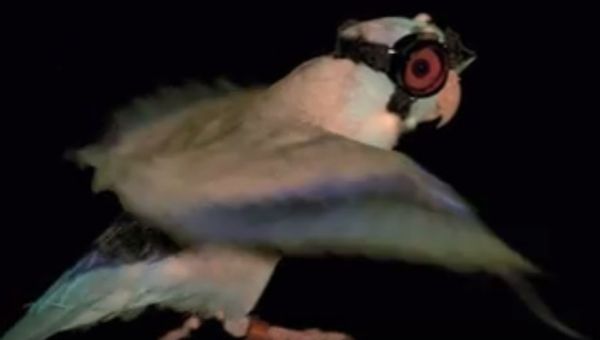
Stanford Ground Control to Major Tom
The Snowy Plover and You | Video
This is a great video, entertaining and informative and only ten minutes long , about our favorite shorebird, the Snowy Plover. It was filmed locally by Michael Love, at Coal Oil Point Natural Reserve in Santa Barbara County. The author gives this brief description:
The threatened Western Snowy Plover lives on our west coast beaches nesting on the open sand. This beautiful film introduces us to the natural history of the bird and invites the public to play a part in the recovery of the species by simply learning to share its habitat.
If no film or link appears in this email, go to the blog to view it by clicking on the blog title above. If the film stops & starts in an annoying manner, press pause (lower left double bars ||) to let it buffer and get ahead of you.
This video has also been placed on our permanent Snowy Plover Page.
[Chuck Almdale]



 SANTA MONICA BAY AUDUBON SOCIETY BLOG