Free email delivery
Please sign up for email delivery in the subscription area to the right.
No salesman will call, at least not from us. Maybe from someone else.
[Posted by Chuck Almdale]
Femi Faminu, who frequently birds with (and without) us at Malibu Lagoon and elsewhere, recently returned from Ecuador where she birded (rain-birded, sometimes) on the upper and lower slopes of the Andes and in the northwestern Amazon basin. (Hint: you don’t have to be within 500 miles of the Amazon to be within the Amazon Basin.) One way to know this is where you are in case you get knocked on the head? You’re likely to see over forty species of flycatcher and thirty of tanager in a week, not to mention toucans and cotingas.
And – for the food aficionados – I don’t know what chicha is, but when the locals drink it, they drink vast quantities of it, and apparently expect that you will want to as well. Recalling the Amazonian basin heat and humidity of eastern Ecuador, it’s probably a Very Wise Thing To Do.
Enjoyable and colorful as always.
If you go here https://www.youtube.com/@femif9792 you can see her many other films.
La Selva Ecolodge & Retreat, where Femi stayed at least part of the time, is located in northeastern Ecuador, on Heron Lake near Rio Napo, downriver from the city of Coca and the town of Limoncocha. Yeah, there, just where you thought it was. (See below.)
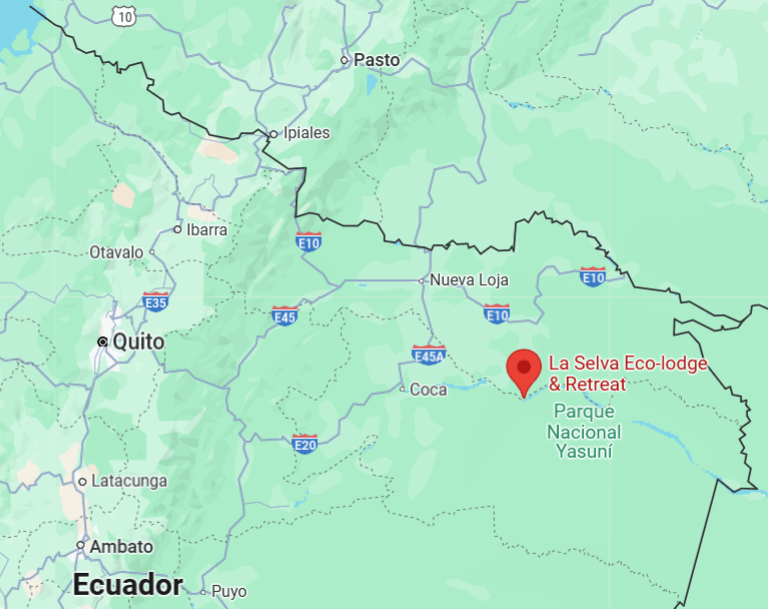

Did you know there are bird species endemic to the sandy islands of Amazonian Basin rivers?
Franklin’s Gull at Malibu Lagoon | Grace Murayama
[By Chuck Almdale, photos by Grace Murayama]

Grace and Larry have been censusing Western Snowy Plovers at Malibu Lagoon (Surfrider Beach) and Zuma Beach and watching them run around for longer than I can recall — I’d guess about 20 years. Of course they see lots of other interesting things from salps to By-the-Wind Sailors to Western Gulls playing tennis to Osprey catching fish to Botta’s Pocket Gopher out for a swim to the occasional odd sandpiper or gull.
This time it was a Franklin’s Gull, not a particularly common gull at the lagoon. According to my lagoon census spreadsheet, I’ve seen it there a grand total of…ta da!…twice. Wow. On 4/24/88 and on 3/25/90. That’s over 35 years since the last one, and out of 421 total visits to the lagoon, or a whopping 0.475% of visits.
Like I said — not particularly common. Too bad, as it is a very attractive gull in breeding plumage, as you can see. If you want a good chance of seeing one, I suggest the lakes and marshes on the southern Canadian prairie or Montana or North Dakota in May or June.

You can see by their migration map below that they normally stick to the central flyway and avoid California altogether, not that there’s anything wrong with California; it’s just not on the route. It does show up more often in SoCal than I implied above, but it’s usually on our inland lakes or reservoirs (which in SoCal are generally the same thing).

It’s a small gull, typically 14.5″ long, wing span 36″. Compare that to the Western Gulls surrounding it below, which are 25″ long, wingspan 58″. The Franklin’s is only 10.5″ shorter, but it appears so diminutive that the Western Gull behind it could swallow it and barely burp. Among the common SoCal gulls, only the 13.5″ Bonaparte’s is smaller. Among all North American gulls – and don’t hold your breath waiting for any of these to show up at the lagoon – only the Sabine’s (13.5″), Ross’s (13.5″) and Little (11″) are smaller.

According to eBird (below) it’s been reported at Malibu Lagoon only 27 times, mostly in April-May, which makes sense as that’s when it’s migrating northward, and only a couple of times July – October when its migrating south. However, historically, it has shown up at dozens of different SoCal spots.

The photo below reveals that the bird has some oil on the right side of its breast. I don’t see it on the wing itself. As the bird is even more uncommon over the Pacific Ocean than over SoCal, it’s anybody’s guess where it got oiled. Perhaps in southern San Joaquin Valley where there are still oil wells pumping away.

All photos above were taken by Grace Murayama on 26 June 2025.
[Posted by Chuck Almdale]
Link to 2024 National Audubon Society winners.
The 125th anniversary of Audubon magazine, the 15th installment of this competition, 2,300 entrants and over 8,500 submissions.
As before: All winners are clear, sharp, well-framed, interesting, unusual views, unusual behaviors, unusual angles.
Local photographer Trish Oster strikes again at NAS, this time at #37 with four Peregrine Falcons. Trish, who occasionally joins us on our Malibu Lagoon bird walks, gave me some background information on her photo, on the birds themselves and some additional photos.

Trish writes:
This particular female (Maxine) is around 10 years old now.
She arrived quite a few years ago and killed the resident female. We do not know where she came from.
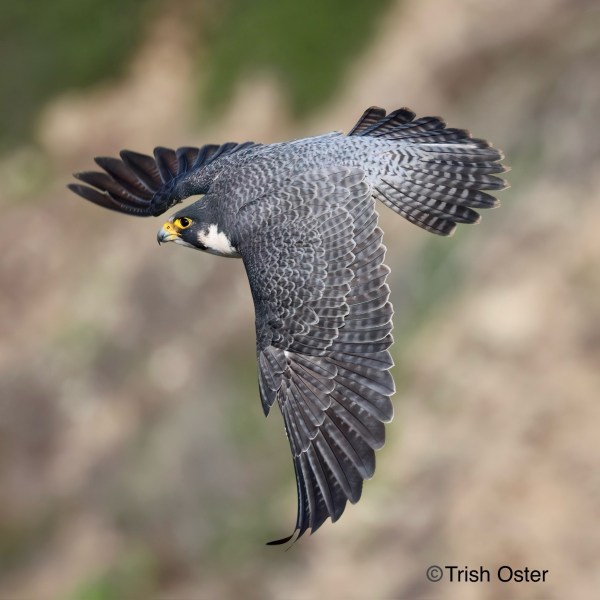
[Her previous mate 02Z or “Tuzee”] disappeared last year while the 2 new chicks had just gotten old enough to fly around a little. He never returned and was determined to have died. There have also been reports that he was found dead and had been attacked and killed.
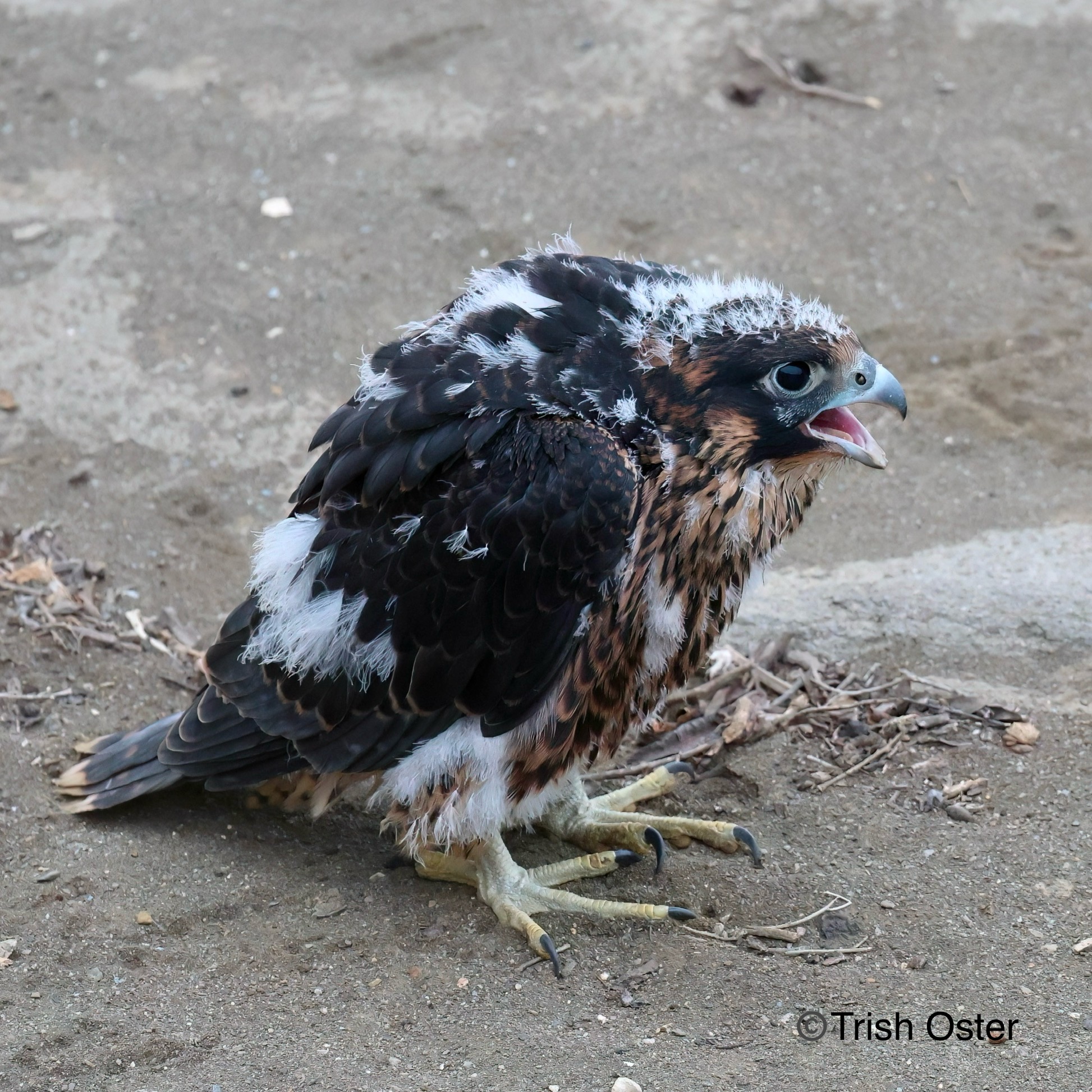
A new male (named Odin and thought to be around 3 years old) was finally accepted by her and they have three chicks this season. I went to visit the falcons this morning and as luck would have it, two of the three eyass walked up the cliff and it was the first time we got to see them out of the nest.


Maxine [now] looks very tired and not her usual self.
I think she has had to teach Odin how to be a good father! LOL
The NAS website has the following photo information:
Category: Amateur
Location: San Pedro, California
Camera: Canon EOS R6 with a Canon RF 100-500mm F/4.5-7.1 L IS USM lens;
1/3200 second at f/7.1; ISO 2000
Behind the Shot: This past year, this Peregrine Falcon couple welcomed four eyases. The busy parents worked hard to keep the youngsters fed. The female in my photo was feeding one of the smaller eyases, which caused the two larger siblings, who had already had their share of the meal, to become agitated. One loudly begged, and the other sibling looked down with what seemed like an annoyed expression. I was handholding my camera, and the birds were moving quite erratically, so I used a higher shutter speed to obtain a sharp focus. The subtle colors of the ground cover, along with the muted background, gave the image a softer look and made the falcons stand out.
The 2025 NAS contest winners will be announced in late September.
Breeding Bonanza: Malibu Creek State Park, 14 June 2025
[Text & 6/14/25 trip list by Jean Garrett, photos by Jay Juncosa, posted by Chuck Almdale]
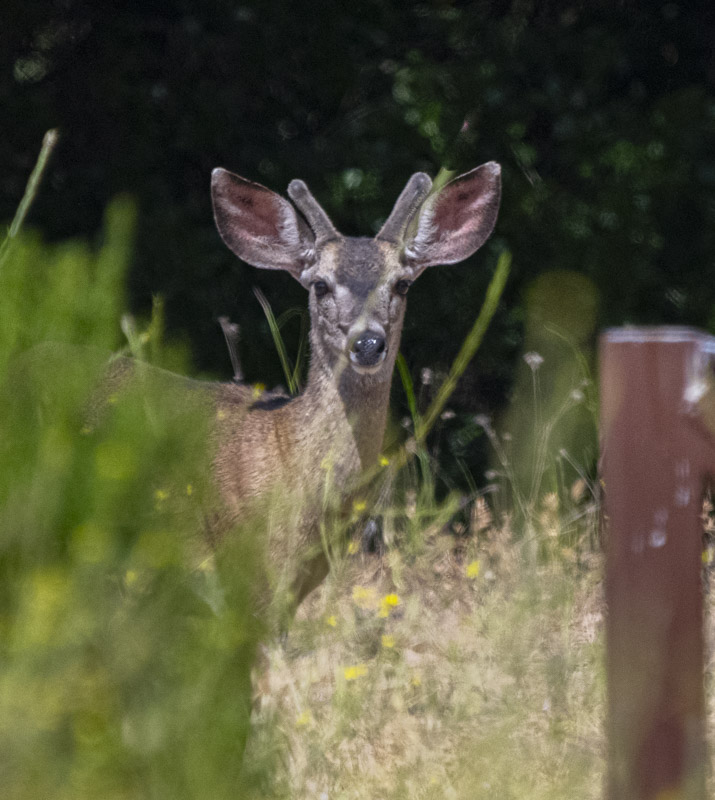
It was a lovely day with a surprising amount of birds considering (in some areas) the sparsity possibly caused by the fires. Over by the parking lot, the meadow was filled with Western Bluebirds, Lazuli Buntings, and some Blue Grosbeaks and California Scrub-Jays.

The lighting perfectly enhanced the colors giving us a vibrant range of blue. Best of all, the month of June still has the sounds of Spring. The occasional Allen’s Hummingbird, and later on several Anna’s Hummingbirds had plenty of flowers for nourishment. Of course there was the sound of the Common Yellowthroat teasing us before we could actually see one. Also, along the meadow were the swallows, mostly Violet-green and Tree but sometimes a Cliff, and with a careful look a White-throated Swift.
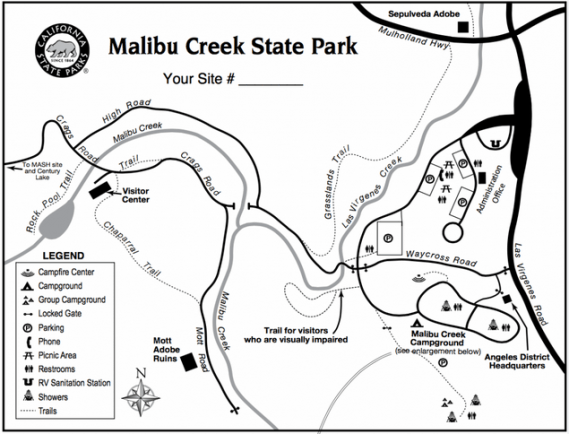

Across the street, the huge, ancient Valley Oak had the clamor of chattering Acorn Woodpeckers and the occasional Nuttall’s. In the mountains surrounding the meadow, a young Red-shouldered Hawk sat on a nest. As we walked towards the trees, Hooded and Bullock’s Orioles were showing up. It seems we would always see the female first but there were some mature males that had a lot of orange-yellow. Overhead, Nanday Parakeets would flicker and squawk every once in a while. Chris was pointing out the Spanish clover showing how much it attracts the Acmon Blue Butterfly.
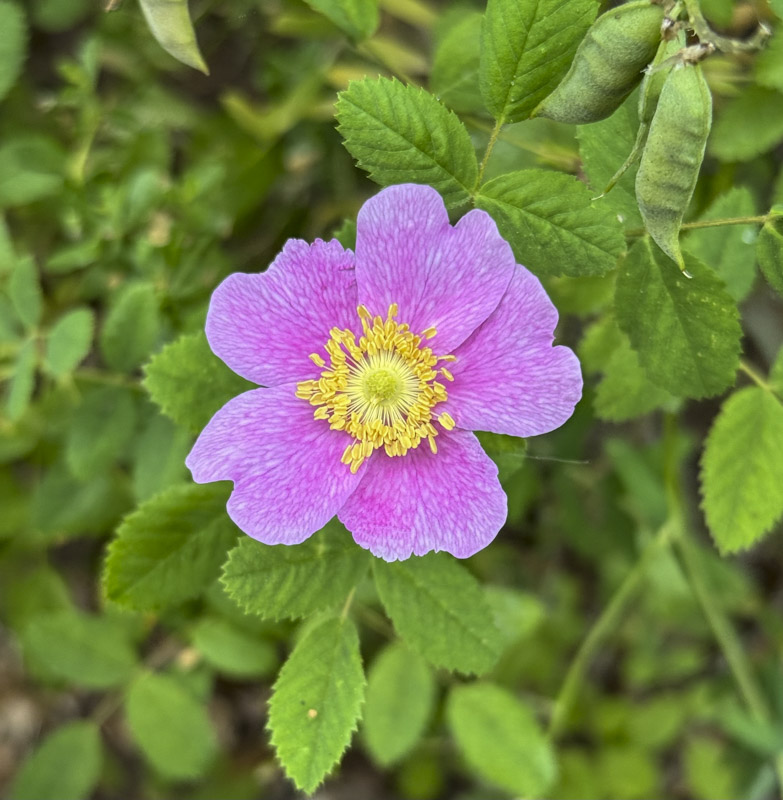
As we walked towards the forest, Spotted Towhees were singing. In an opening of the trees a House Wren was on a snag, giving us a recital and letting us see him. Then on the cliff overhanging the river we could hear two Yellow-breasted Chats. With patience and with the sound fading then getting louder, we finally saw the bird and it was a lifer for one person.
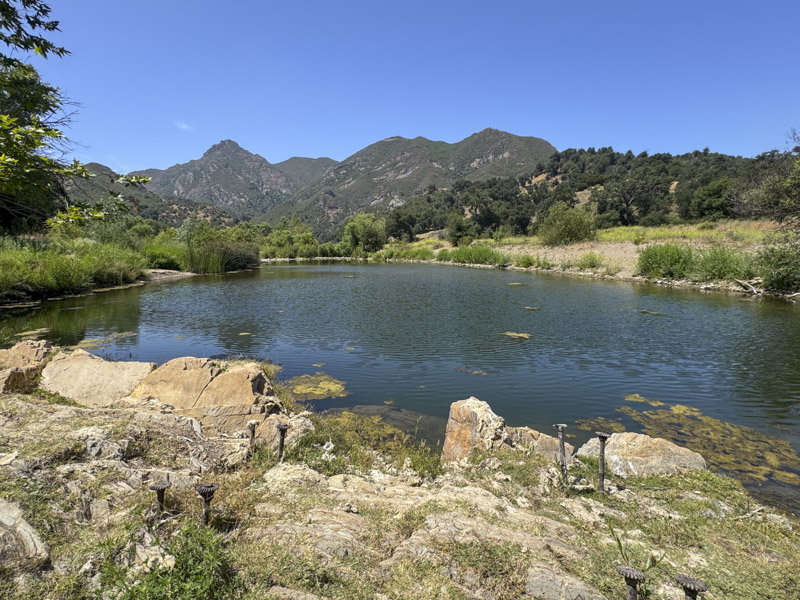
The river gave us a chance to see the Great Egret and the Great Blue Heron and a good look at some Turkey Vultures and a Kestrel blending so well against the snag he was perched on. Even a few Northern Rough-winged Swallows were circling around. When coming out of the forest, that clucking sound of the California Quail could be heard. Of course we got the usual Red-tailed Hawks, Crows and Ravens but also a Band-tailed Pigeon. All in all, we got 48 species — no record but we had such great views. The sun was just right, you could see the colors well and the birds still singing.

The list below is the only record we have for our Malibu Creek SP bird walks. The total for all four trips is now 80 species. Today’s trip turned up 15 species not seen on the three prior trips. Lots of sharp eyes. You never know what you’ll get.
| Malibu Creek | State | Park | ||
| Field Trips | 6/14/25 | 5/11/24 | 11/12/11 | 11/13/10 |
| Mallard | 10 | 5 | 20 | 15 |
| Ring-necked Duck | 1 | |||
| Bufflehead | 2 | |||
| California Quail | 20 | |||
| Pied-billed Grebe | 1 | |||
| Band-tailed Pigeon | 4 | 6 | 80 | 12 |
| Mourning Dove | 19 | 5 | 2 | 2 |
| White-throated Swift | 5 | 20 | ||
| Black-chinned Hummer | 2 | |||
| Anna’s Hummingbird | 5 | 3 | 1 | 2 |
| Allen’s Hummingbird | 1 | 2 | 1 | |
| American Coot | 20 | 15 | ||
| Killdeer | 1 | |||
| Dble-crested Cormorant | 1 | 1 | ||
| Snowy Egret | 6 | |||
| Green Heron | 2 | |||
| Great Egret | 1 | |||
| Great Blue Heron | 2 | 2 | 1 | 1 |
| Turkey Vulture | 10 | 10 | ||
| White-tailed Kite | 2 | 2 | ||
| Cooper’s Hawk | 2 | 1 | ||
| Red-shouldered Hawk | 4 | 2 | 3 | 1 |
| Red-tailed Hawk | 4 | 6 | 4 | 3 |
| Belted Kingfisher | 1 | |||
| Red-naped Sapsucker | 1 | |||
| Red-breasted Sapsucker | 2 | 1 | ||
| Acorn Woodpecker | 20 | 15 | 8 | 15 |
| Downy Woodpecker | 1 | 2 | ||
| Nuttall’s Woodpecker | 10 | 4 | 4 | 1 |
| Northern Flicker | 1 | 5 | 2 | |
| American Kestrel | 1 | 2 | 4 | 1 |
| Nanday Parakeet | 11 | 8 | H | |
| Cassin’s Kingbird | 2 | |||
| Western Wood-Pewee | X | |||
| Western Flycatcher | 3 | 4 | ||
| Black Phoebe | 4 | 2 | 6 | 6 |
| Say’s Phoebe | 3 | 2 | ||
| Ash-throated Flycatcher | 9 | 5 | ||
| Cassin’s Kingbird | 4 | 2 | ||
| Hutton’s Vireo | 2 | 1 | ||
| Loggerhead Shrike | 2 | 1 | ||
| California Scrub-Jay | 12 | 6 | 2 | 6 |
| American Crow | 6 | 10 | 30 | 30 |
| Common Raven | 6 | 4 | 8 | 10 |
| Oak Titmouse | 22 | 10 | 20 | 12 |
| Tree Swallow | X | |||
| Violet-green Swallow | 6 | 1 | ||
| No. Rough-winged Swallow | 20 | 5 | ||
| Barn Swallow | 3 | |||
| Cliff Swallow | 10 | 20 | ||
| Bushtit | 50 | 10 | 15 | 15 |
| Wrentit | 8 | 2 | 3 | 1 |
| Ruby-crowned Kinglet | 4 | 3 | ||
| White-breasted Nuthatch | 9 | 3 | 6 | 6 |
| Blue-gray Gnatcatcher | 7 | 3 | ||
| Canyon Wren | 3 | 1 | ||
| No. House Wren | 11 | 12 | 1 | 3 |
| Bewick’s Wren | 1 | 2 | 2 | |
| California Thrasher | 2 | |||
| Western Bluebird | 8 | 2 | 20 | 1 |
| American Robin | 1 | |||
| Phainopepla | 4 | 1 | 2 | |
| House Finch | 10 | 10 | 30 | 4 |
| Purple Finch | 6 | 2 | ||
| Pine Siskin | 5 | |||
| Lesser Goldfinch | 10 | 10 | 1 | |
| Lark Sparrow | 20 | |||
| Dark-eyed Junco | 4 | 8 | 30 | 12 |
| White-crowned Sparrow | 40 | 20 | ||
| Song Sparrow | 5 | 6 | 4 | 1 |
| California Towhee | 8 | 9 | 12 | 4 |
| Spotted Towhee | 6 | 8 | 8 | 4 |
| Yellow-breasted Chat | 2 | 1 | ||
| Hooded Oriole | 2 | |||
| Bullock’s Oriole | 4 | |||
| Red-winged Blackbird | 10 | 1 | ||
| Brown-headed Cowbird | 4 | 3 | ||
| Orange-crowned Warbler | 8 | 5 | ||
| Common Yellowthroat | 10 | 6 | 2 | 1 |
| Yellow Warbler | 8 | 12 | ||
| Yellow-rumped Warbler | X | 40 | 40 | |
| Townsend’s Warbler | X | |||
| Wilson’s Warbler | X | |||
| Western Tanager | 2 | |||
| Black-headed Grosbeak | 2 | |||
| Blue Grosbeak | 2 | |||
| Lazuli Bunting | 6 | 1 | ||
| Total Species: 87 | 65 | 47 | 47 | 47 |
[Posted by Chuck Almdale]
We received this today and are passing it on to our readers.
Hello fellow birders!
My name is Dr. Olivia Sanderfoot, and I am a postdoc at the Natural History Museum of Los Angeles County studying impacts of wildfire smoke on the health and behavior of birds. I am also Program Director of Project Phoenix, a regional community science program to investigate bird responses to smoke.
Project Phoenix 2025 kicks off tomorrow, and we are looking forward to another summer of birding with our incredible volunteers. Will you join us to make 2025 our biggest year yet? Sign up today!
By participating in Project Phoenix, you are contributing to a vital dataset to help us understand how birds are impacted by wildfires in the American West. Together, we will discover how birds respond to smoke disturbance in real time and identify the places and resources birds need to thrive in the hotter and smokier summers to come.
Data collection will begin on Tuesday, July 1st and continue through the end of November. We are teaming up with Birds Connect Seattle to host an info session for both new and returning volunteers on Wednesday, July 2nd from 6:00 p.m. to 7:00 p.m. PST. Even if you have previously participated in Project Phoenix, we need you to register again this year. This helps us keep track of volunteer engagement and fine-tune our programming based on collective volunteer interests and previous birding experience. After you sign up, you will receive a confirmation email with more information about how to get started. If you have any questions, please reach out to me any time.
***Finally, a quick note to all the amazing eBird reviewers out there: Our team recognizes that by generating hundreds of additional eBird checklists, our program adds to the workload of local reviewers. We greatly appreciate all of the time and energy you invest in reviewing local checklists � our research is strengthened by your efforts. Although we work very hard to ensure that our volunteers are collecting high quality data (and we provide many resources and opportunities to support beginner birders), we do recognize that our volunteers sometimes make mistakes or rely too heavily on apps like Merlin Bird ID. If there are any common species identification errors you would like us to address among our volunteers or messages/tips and tricks you would like to pass on, please do reach out. I collaborated directly with eBird reviewers while running the COVID-19 lockdown birding study in Seattle, and that was enormously helpful.***
Wishing you all safe and happy birding this summer! Thank you for all you do for our feathered friends. 🙂
***
Olivia V. Sanderfoot, Ph.D.
Postdoctoral Researcher
Natural History Museum of Los Angeles County
Research Associate
La Kretz Center for California Conservation Science
Department of Ecology & Evolutionary Biology
University of California, Los Angeles
Email: osanderfoot@nhm.org
Website: https://ovsanderfoot.com/
Social: @osanderfoot
Phone: 608-692-4460



 SANTA MONICA BAY AUDUBON SOCIETY BLOG