Free email delivery
Please sign up for email delivery in the subscription area to the right.
No salesman will call, at least not from us. Maybe from someone else.
Hidden Perils of Permafrost – Video
For thousands of years, mysterious bacteria have remained dormant in the Arctic permafrost. Now, a warming climate threatens to bring them back to life. What does that mean for the rest of us?
This is another installment of the PBS Deep Look series. If no film or link appears in this email, go to the blog to view it by clicking on the blog title above. If the film stops & starts in an annoying manner, press pause (lower left double bars ||) to let it buffer and get ahead of you. [Chuck Almdale]
What Gall! The Crazy Cribs of Parasitic Wasps – Video
Plenty of animals build their homes in oak trees. But some very teeny, tricky wasps make the tree do all the work. And each miniature mansion the trees build for the wasps’ larvae is weirder and more flamboyant than the next.
This is another installment of the PBS Deep Look series. If no film or link appears in this email, go to the blog to view it by clicking on the blog title above. If the film stops & starts in an annoying manner, press pause (lower left double bars ||) to let it buffer and get ahead of you. [Chuck Almdale]
Fine birding in the fields of Madrona Marsh: 10 December, 2016

Orange-crowned Warbler, yellower in the west than in the east (J. Waterman 12-10-16)
Although many of our members regularly visit Madrona Marsh Preserve in nearby Torrance, we have not taken many chapter field trips there in recent years. Perhaps that’s because we do visit it individually, and because many of the unusual birds who visit there appear unpredictably. You can’t plan months ahead on irregularly-appearing and unreliable birds being present.
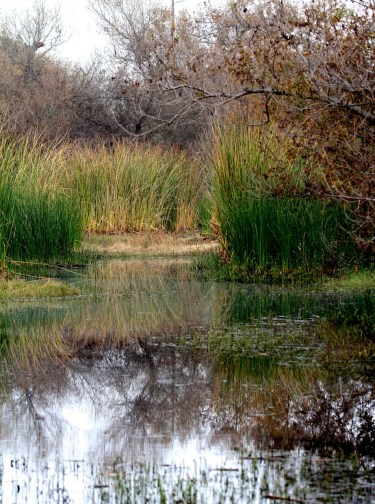
A vernal pool in winter (J. Waterman 12-10-16)
That said, Madrona Marsh, located a few miles south of I-405 and a mile west of Crenshaw Blvd., is a great spot to know about and visit. It regularly hosts odd birds attracted to this restored coastal scrub oasis amid the malls and housing tracts of South Bay. Spring rains, if and when they occur, fill vernal pool basins, and dragonflies and waterfowl proliferate. Before this area was domesticated by millions of people, it was part of an extensive coastal terrace lying just inland of the coastal dune system. There were innumerable potholes, cienegas and vernal pools, and early settlers report winter waterfowl numbering into the millions. That’s hard to imagine today. Madrona Marsh is a small remnant of this vanished habitat, and the Tongva people enjoyed its abundance for millennia.

American Kestrel female, a marsh resident (R. Ehler 12-10-16)
We hung out at the preserve’s front gate for a while, watching a large flock of beige-colored American Goldfinches work the sycamore seedballs and occasionally scattering when a Sharp-shinned Hawk ripped through. A few Lesser Goldfinches and House Finches were among them, and a flock of twenty Cedar Waxwings dropped out of the sky and into sycamore treetop, but we couldn’t find any red-faced European Goldfinches that often travel with this goldfinch flock. This latter species has successfully nested at the preserve for several years. We also couldn’t find the Eastern Phoebe which has been frequently seen there.
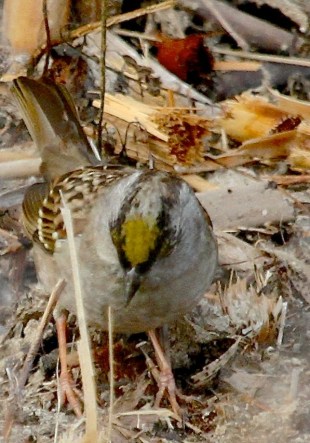
Golden-crowned Sparrow with an exceptionally golden crown (J. Waterman 12-10-16)
Preserve Manager Tracy Drake, who knows each bird and plant on a personal basis, showed us around the preserve, pointing out not just birds, but the larger insects, field mice, valued native plants and the towering trees. José, a handsome young man, assisted her, and pointed out highlights to those who straggled at the rear of the group. Water levels are currently low and ducks are few. Seeds are abundant, however, and sparrows and finches were numerous and not particularly shy. At one spot which replicates a medium-tall grass prairie, we found nine sparrow species, from the expected and abundant wintering White-crowned Sparrow, to the uncommon Brewer’s, Lincoln’s and Golden-crowned.
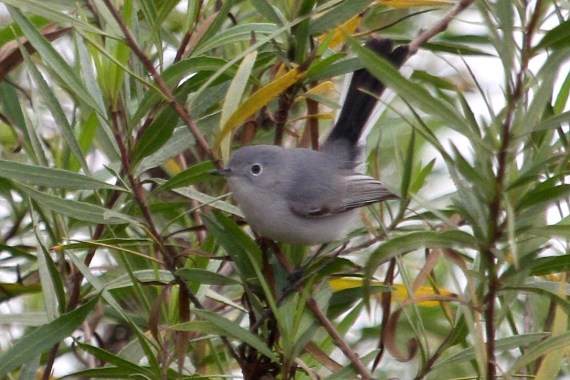
Blue-gray Gnatcatcher (J. Waterman 12-10-16)
Nearby, in the trees and brush, we found a mixed flock of Bushtit, Blue-gray Gnatcatcher, Ruby-crowned Kinglet, and five warbler species including one Black-and-white Warbler, a vagrant visiting from the east. As expected, the Black-and-white was gleaning the limbs and trunk of a small tree. Unlike most warblers, they are not leaf-gleaners.

Black & White Warbler, twirling on a twig (Randy Ehler 12-10-16)
Out in the fields the various flycatchers perched and shagged flies: Black and Say’s Phoebes and Cassin’s Kingbird. Ash-throated Flycatchers have normally left our area by mid-October, but one has taken up residence in the brushy area adjoining the large pool at the bottom of the “sump.” Ducks, Coots and two Red-winged Blackbirds were also living the low-life in the sump.

Everyone’s favorite sparrow – the female Red-winged Blackbird
(J. Waterman 12-10-16)

The large pool in the “sump”
(J. Waterman 12-10-16)
By 11am, the fog had dissipated, rain had failed to appear, and the day had warmed. We checked out a peculiar American Goldfinch with a mostly-white head, then made one more pass across the fields, coming across another perched American Kestral along the way.

American Goldfinch: the peculiar white face and crown feathers had the same pattern on the other side of his head (J. Waterman 12-10-16)
Western Meadowlarks prefer feeding in breast-high grass so they can pop their heads up and scan across the grass for predators. We lingered a few more minutes, taking last desperate scans for the uncooperative Eastern Phoebe, then thanked José and Tracy for their friendly and informative leadership and headed out.
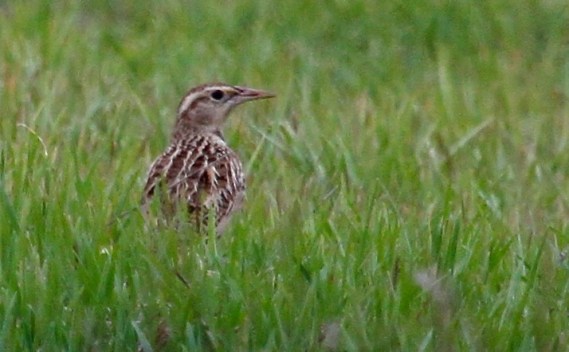
Western Meadowlard spyhopping over the grass (J. Waterman 12-10-16)
As always, many thanks to our photographers: Randy Ehler and Joyce Waterman.
Thanks again to Randy Ehler for his contributions to the following checklist totals.
[Chuck Almdale]
| Madrona Marsh Trip List | 12/10/16 |
| American Wigeon | 6 |
| Mallard | 6 |
| Ring-necked Duck | 1 |
| Sharp-shinned Hawk | 1 |
| Red-shouldered Hawk | 1 |
| Red-tailed Hawk | 2 |
| American Coot | 5 |
| Ring-billed Gull | 2 |
| Western Gull | 4 |
| California Gull | 2 |
| Rock Pigeon | 8 |
| Mourning Dove | 50 |
| Anna’s Hummingbird | 3 |
| Allen’s Hummingbird | 9 |
| Downy Woodpecker | 1 |
| Northern Flicker | 2 |
| American Kestrel | 3 |
| Black Phoebe | 6 |
| Say’s Phoebe | 1 |
| Ash-throated Flycatcher | 1 |
| Cassin’s Kingbird | 6 |
| American Crow | 4 |
| Common Raven | 2 |
| Bushtit | 50 |
| House Wren | 1 Heard |
| Blue-gray Gnatcatcher | 13 |
| Ruby-crowned Kinglet | 12 |
| Hermit Thrush | 1 Heard |
| European Starling | 8 |
| Cedar Waxwing | 20 |
| Black-and-white Warbler | 1 |
| Orange-crowned Warbler | 6 |
| Common Yellowthroat | 3 |
| Yellow-rumped Warbler | 10 |
| Townsend’s Warbler | 1 |
| California Towhee | 2 |
| Chipping Sparrow | 6 |
| Brewer’s Sparrow | 2 |
| Savannah Sparrow | 4 |
| Fox Sparrow | 1 |
| Song Sparrow | 2 |
| Lincoln’s Sparrow | 3 |
| White-crowned Sparrow | 60 |
| Golden-crowned Sparrow | 2 |
| Red-winged Blackbird | 2 |
| Western Meadowlark | 10 |
| House Finch | 20 |
| Lesser Goldfinch | 3 |
| American Goldfinch | 45 |
| Scaly-breasted Munia | 45 |
| Total Species | 50 |
a
Photographers: Help Train Merlin Photo ID
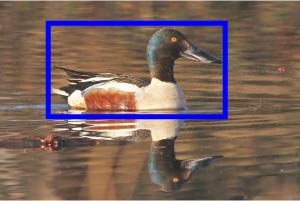
Photo: Macaulaylibrary.org
Cornell’s Merlin bird identification app has launched a new Photo ID feature, dubbed MerlinVision. The magic of this mobile app comes from the countless bird photos that eBird users have uploaded to help train Merlin. You can help as well. All you need to do is draw boxes around birds. Each box improves the computer vision algorithms—boosting the accuracy of the Photo ID tools.
MerlinVision is able to identify 650+ species of North American birds, but it needs more training images. View the current target list, and submit your photos via eBird. Who doesn’t like to view cool bird photos and contribute to cutting-edge research at the same time? Get Started!
The current target list contains hundreds of species whose photos they need. Here’s are some of our local species included in the list. The number of photos they need for each species follows the species name. [Jane Beseda]
| Chukar – 552 | Verdin – 237 |
| Surfbird – 137 | Pygmy Nuthatch – 203 |
| Flammulated Owl – 918 | Canyon Wren – 235 |
| Western Screech-Owl – 587 | Pacific Wren – 401 |
| Mexican Whip-poor-will – 978 | California Gnatcatcher – 682 |
| Black Swift – 725 | Black-tailed Gnatcatcher – 555 |
| Vaux’s Swift – 593 | Red-whiskered Bulbul – 588 |
| Costa’s Hummingbird – 176 | Wrentit – 473 |
| Calliope Hummingbird – 105 | California Thrasher – 83 |
| Lewis’s Woodpecker – 95 | Le Conte’s Thrasher – 830 |
| Hammond’s Flycatcher – 260 | Sage Thrasher – 99 |
| Gray Flycatcher – 241 | MacGillivray’s Warbler – 196 |
| Dusky Flycatcher – 462 | Black-chinned Sparrow – 651 |
| Bell’s Vireo – 104 | Brewer’s Sparrow – 156 |
| Gray Vireo – 802 | Bell’s Sparrow – 568 |
| Hutton’s Vireo – 271 | Abert’s Towhee – 686 |
| Cassin’s Vireo – 418 | Rufous-crowned Sparrow – 194 |
| Pinyon Jay – 733 | Green-tailed Towhee – 115 |
| Island Scrub-Jay – 870 | Tricolored Blackbird – 423 |
| Yellow-billed Magpie – 667 | Scott’s Oriole – 377 |
| Clark’s Nutcracker – 263 | Brown-capped Rosy-Finch – 839 |
| Violet-green Swallow – 29 | Cassin’s Finch – 279 |
| Oak Titmouse – 311 | Lawrence’s Goldfinch – 372 |
Full Cold Moon Update – December 13, 4:05 PM PST
Here’s another update from SMBAS Blog on that large, disc-like, shining object which has frequently and mysteriously appeared in our nighttime sky this year (furtively whispered of in dismal fens as…the moon).
Full Cold Moon (Revolutionary Raw Vegan Culinary Creators at Meetup.com)
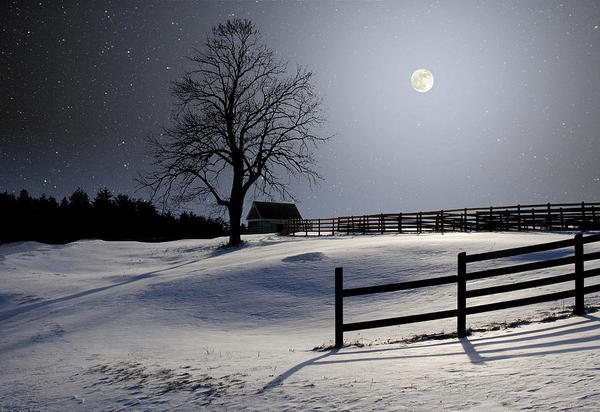
Dec. 13, 4:05 p.m. PST — Full Cold Moon. December is usually considered the month that the winter cold begins to fasten its grip. It is also called the Full Long Night Moon since nights are at their longest and darkest. The term “Long Night Moon” is a doubly appropriate name because the mid-winter night is indeed long and the moon hangs above the horizon for a long time. The mid-winter full moon takes a high trajectory across the sky because it is opposite to the low sun. This moon was also occasionally called the Moon before Yule. This particular full moon makes its highest arc across the sky because it’s diametrically opposite to the low sun.
[Video: Full Moon: Why Does It Happen? How Does It Affect Us?]
Month Moon Names from other cultures Courtesy of Keith Cooley):
Chinese: Bitter Moon; Choctaw: Peach Moon; English Medieval: Oak Moon
This month’s moon is, like last month’s, a supermoon, but slightly less super than last month’s super-duper supermoon. Watch out for high tides and flooding, especially if there is an oceanic storm surge.
A birding friend recently introduced me to his wife with: “This is our moon-obsessed blogger,” a humorous bit of overkill. I think people should look up at the sky more often; if birds are few, look at the sun, moon, stars or planets. Many people are astonishingly ignorant of what’s out there (“out” is more accurate than “up”). Apropos this, Discover Magazine’s Dan Hurley (Dec. 2016) had an interesting anecdote.
At 4:31 a.m. on 1/17/94, a 6.7-magnitude earthquake knocked out the electric power for much of Los Angeles. People looked up, saw something weird in the sky and called Griffith Observatory. “The lights of L.A. were out,” recalls E.C. Krupp, longtime observatory director, “so the night sky was dark for a change. People were puzzled and wondered if there was a connection between the earthquake and the strange sky. We figured out that they just weren’t used to seeing so many stars.”
That, in my opinion, is pretty sad, and demonstrates a widespread cultural disconnection with the real world. So we here at SMBAS blog are doing our little bit for education. Next year we shall keep you abreast of fast-breaking astronomical news by promoting solar equinoxes and solstices. Plus – big news – there is a total solar eclipse coming on August 21, 2017. If you’ve seen partial solar eclipses but never a total, the difference between them is the difference between night and day. Seriously. For most people, this is a once-in-a-lifetime event. Make plans and get proper eye-wear.
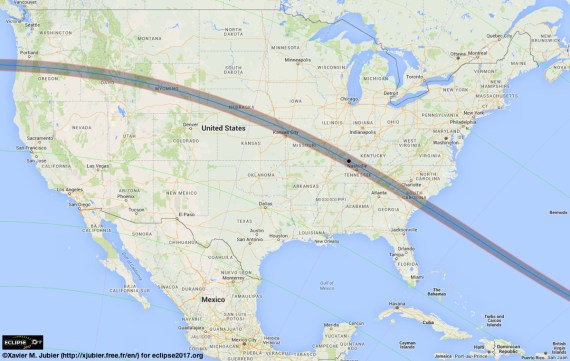
Eclipse path 8/21/17 approximately 9am – noon, PDT (Xavier Jubier)
Bob Gurfield reminds us that the latest (and earliest) sunrises do not occur on the solstices. For Los Angeles:
Earliest sunrise: 5:41 am PDT, 12 June, 2017 at 61°, or 29° N of due east.
Latest sunset: 8:08 pm PST, 28 June, 2017, at 299°, or 29° N of due west.
Earliest sunset: 4:43 pm PDT, 3 Dec, 2016, at 243°, or 27° S of due west.
Latest sunrise: 6:59 am PST, 7 Jan, 2017, 117°, or 27° S of due east.
Shortest day of the year: 20-21 Dec. 2016 at 9:53:03.
Longest day of the year: 20 Jun 2017 at 14:25:34.
Difference: shortest to longest, is 4 hours, 32 minutes, 31 seconds.
As we go further north the latest and earliest sunrises and sunsets still don’t occur on the solstices. Check the table for Anchorage, AK for December, 2016.
Earliest sunset: 3:40 pm PDT, 15-16 Dec, 2016, at 217°, or 37° W of due south.
Latest sunrise: 10:15 am PST, 25-26 Dec, 2016, 143°, or 37° E of due south.
Shortest day of the year: 21 Dec. 2016 at 5:27:44
The Old Farmer’s Almanac has a page for each full moon. A December tip: go fishing on 1st – 1th, 29th – 31st. Now you know, so you have no excuse.
The next significant full moon will occur on Jan. 12, 2017, 3:34 a.m. PST. Keep an eye on this spot for additional late-breaking news on this unprecedented event.
The moon name information comes to you courtesy of: http://www.space.com/31699-full-moon-names-2016-explained.html
written by Joe Rao. Joe Rao serves as an instructor and guest lecturer at New York’s Hayden Planetarium. He writes about astronomy for Natural History magazine, the Farmer’s Almanac and other publications, and he is also an on-camera meteorologist for News 12 Westchester, N.Y.
But that’s waaay too long to type in, and besides, you don’t need to go there because SMBAS has done the work for you!
[Chuck Almdale]



 SANTA MONICA BAY AUDUBON SOCIETY BLOG