Free email delivery
Please sign up for email delivery in the subscription area to the right.
No salesman will call, at least not from us. Maybe from someone else.
Full Cold Moon Update – December 13, 4:05 PM PST
Here’s another update from SMBAS Blog on that large, disc-like, shining object which has frequently and mysteriously appeared in our nighttime sky this year (furtively whispered of in dismal fens as…the moon).
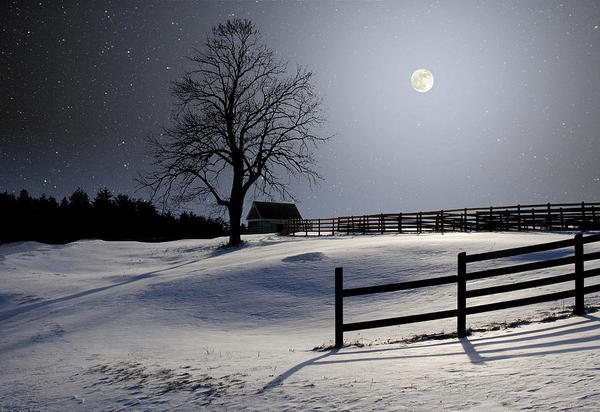
Full Cold Moon (Revolutionary Raw Vegan Culinary Creators at Meetup.com)
Dec. 13, 4:05 p.m. PST — Full Cold Moon. December is usually considered the month that the winter cold begins to fasten its grip. It is also called the Full Long Night Moon since nights are at their longest and darkest. The term “Long Night Moon” is a doubly appropriate name because the mid-winter night is indeed long and the moon hangs above the horizon for a long time. The mid-winter full moon takes a high trajectory across the sky because it is opposite to the low sun. This moon was also occasionally called the Moon before Yule. This particular full moon makes its highest arc across the sky because it’s diametrically opposite to the low sun.
[Video: Full Moon: Why Does It Happen? How Does It Affect Us?]
Month Moon Names from other cultures Courtesy of Keith Cooley):
Chinese: Bitter Moon; Choctaw: Peach Moon; English Medieval: Oak Moon
This month’s moon is, like last month’s, a supermoon, but slightly less super than last month’s super-duper supermoon. Watch out for high tides and flooding, especially if there is an oceanic storm surge.
A birding friend recently introduced me to his wife with: “This is our moon-obsessed blogger,” a humorous bit of overkill. I think people should look up at the sky more often; if birds are few, look at the sun, moon, stars or planets. Many people are astonishingly ignorant of what’s out there (“out” is more accurate than “up”). Apropos this, Discover Magazine’s Dan Hurley (Dec. 2016) had an interesting anecdote.
At 4:31 a.m. on 1/17/94, a 6.7-magnitude earthquake knocked out the electric power for much of Los Angeles. People looked up, saw something weird in the sky and called Griffith Observatory. “The lights of L.A. were out,” recalls E.C. Krupp, longtime observatory director, “so the night sky was dark for a change. People were puzzled and wondered if there was a connection between the earthquake and the strange sky. We figured out that they just weren’t used to seeing so many stars.”
That, in my opinion, is pretty sad, and demonstrates a widespread cultural disconnection with the real world. So we here at SMBAS blog are doing our little bit for education. Next year we shall keep you abreast of fast-breaking astronomical news by promoting solar equinoxes and solstices. Plus – big news – there is a total solar eclipse coming on August 21, 2017. If you’ve seen partial solar eclipses but never a total, the difference between them is the difference between night and day. Seriously. For most people, this is a once-in-a-lifetime event. Make plans and get proper eye-wear.
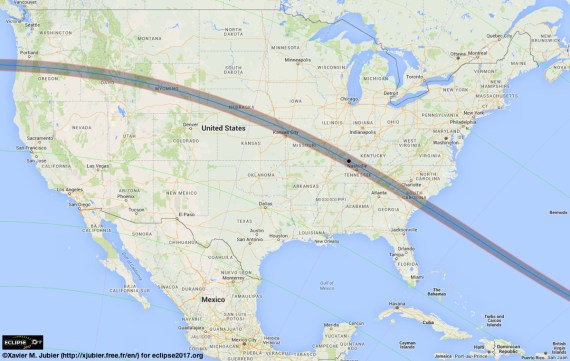
Eclipse path 8/21/17 approximately 9am – noon, PDT (Xavier Jubier)
Bob Gurfield reminds us that the latest (and earliest) sunrises do not occur on the solstices. For Los Angeles:
Earliest sunrise: 5:41 am PDT, 12 June, 2017 at 61°, or 29° N of due east.
Latest sunset: 8:08 pm PST, 28 June, 2017, at 299°, or 29° N of due west.
Earliest sunset: 4:43 pm PDT, 3 Dec, 2016, at 243°, or 27° S of due west.
Latest sunrise: 6:59 am PST, 7 Jan, 2017, 117°, or 27° S of due east.
Shortest day of the year: 20-21 Dec. 2016 at 9:53:03.
Longest day of the year: 20 Jun 2017 at 14:25:34.
Difference: shortest to longest, is 4 hours, 32 minutes, 31 seconds.
As we go further north the latest and earliest sunrises and sunsets still don’t occur on the solstices. Check the table for Anchorage, AK for December, 2016.
Earliest sunset: 3:40 pm PDT, 15-16 Dec, 2016, at 217°, or 37° W of due south.
Latest sunrise: 10:15 am PST, 25-26 Dec, 2016, 143°, or 37° E of due south.
Shortest day of the year: 21 Dec. 2016 at 5:27:44
The Old Farmer’s Almanac has a page for each full moon. A December tip: go fishing on 1st – 1th, 29th – 31st. Now you know, so you have no excuse.
The next significant full moon will occur on Jan. 12, 2017, 3:34 a.m. PST. Keep an eye on this spot for additional late-breaking news on this unprecedented event.
The moon name information comes to you courtesy of: http://www.space.com/31699-full-moon-names-2016-explained.html
written by Joe Rao. Joe Rao serves as an instructor and guest lecturer at New York’s Hayden Planetarium. He writes about astronomy for Natural History magazine, the Farmer’s Almanac and other publications, and he is also an on-camera meteorologist for News 12 Westchester, N.Y.
But that’s waaay too long to type in, and besides, you don’t need to go there because SMBAS has done the work for you!
[Chuck Almdale]
What Happens When You Put a Hummingbird in a Wind Tunnel? – Video
Scientists have used a high-speed camera to film hummingbirds’ aerial acrobatics at 1000 frames per second. They can see, frame by frame, how neither wind nor rain stop these tiniest of birds from fueling up.
This is another installment of the PBS Deep Look series. If no film or link appears in this email, go to the blog to view it by clicking on the blog title above. If the film stops & starts in an annoying manner, press pause (lower left double bars ||) to let it buffer and get ahead of you. [Chuck Almdale]
What Gives the Morpho Butterfly Its Magnificent Blue?
If you haven’t seen the PBS Deep Look series, now’s your chance.
What does it mean to be blue? The wings of a Morpho butterfly are some of the most brilliant structures in nature, and yet they contain no blue pigment — they harness the physics of light at the nanoscale. Structural colors create the brilliant gorget of a Hummingbird as well as the Morpho’s wing.
If no film or link appears in this email, go to the blog to view it by clicking on the blog title above.
If the film stops & starts in an annoying manner, press pause (lower left double bars ||) to let it buffer and get ahead of you. [Chuck Almdale]
Illustrated Checklist of the Birds of the World from Lynx Edicions
Lynx Edicions, located in Barcalona, Spain, has published many books about birds and mammals, including the enormous 17-volume Handbook of Birds of the World (HBW) (specially priced at 2,635 Euros).
[NOTE: This review contains five photos of the books and contents. If they don’t appear in your email, go to the blog.)

They have now produced a two-volume Illustrated Checklist of the Birds of the World.
Volume I – Non-Passerines, is already out: 904 pages, 357 plates, 8290 bird illustrations, 4428 distribution maps, 34 full-page maps, 2126 bibliographic references.
Volume II – Passerines, is to be released at the end of December (but it may take a month or two after that for all the orders to be delivered): 1,013 pages, 446 plates, 12,629 bird illustrations, 6,649 distribution maps.
For better views of the books’ contents click the above links to each volume. On Vol. 1, check the Sample Pages presented by ISSUU. The website has a lot of reviews and comments.
The two-volume set is specially priced at 350 Euros until December 15, after which – I assume – it will rise to the “marked-down-from” price of 410 Euros. Not cheap, but it contains a lot of information.
Like all books on birds, this cannot be more than a “snapshot in time,” presenting the current state of knowledge. Things will change, that is guaranteed.
What each species gets: Each species has the same full color painting they had in the larger HBW. In significantly sexually dimorphic species, both male and female are shown. Major subspecies are pictured. Names are given in scientific, English, French, German and Spanish. Taxonomic notes include the original specimen (date, location, describer), comments on subspecies, lumps and splits. Distribution of current subspecies is given. A map shows species range. For some species, the subspecies ranges are not differentiated. Volume and page number in HBW are given.

Additional Maps: Large full-page maps give the necessary detail to locate the ranges for species and subspecies you couldn’t quite figure out from the smaller species maps.
 The introductions give details on bird systematics (relationships of families) and other important information.

There are sections on extinct birds.

This is an illustrated checklist. If you want an ornithological textbook, this is not it. If you want in-depth analysis of families or of species behavior and appearance, this is not it. If you want the basic information on bird species, subspecies, appearance and locations of all the birds in the world, and can afford the approximately $375 cost (shipping is free until Dec. 15), this set will do the trick, and the books – artwork, text, print, paper, book assembly – will be of excellent quality. The price will likely rise immediately after Dec. 15, but will probably fall again some months or years down the line, as it has for the complete Handbook of Birds of the World.
[Chuck Almdale]
Caddis Fly Larva Video
Here’s an interesting film from Deep Look of a caddis fly larva building and hauling around his pebble home underwater. The home is built with something humans have not yet developed: “tape” that stays sticky underwater.
If no film or link appears in this email, go to the blog to view it by clicking on the blog title above.
If the film stops & starts in an annoying manner, press pause (lower left double bars ||) to let it buffer and get ahead of you.
[Chuck Almdale]



 SANTA MONICA BAY AUDUBON SOCIETY BLOG