Free email delivery
Please sign up for email delivery in the subscription area to the right.
No salesman will call, at least not from us. Maybe from someone else.
Don’t Eat That Bird, part 2! — Sunday Morning Bible Bird Study IX
This Week’s Lesson – Don’t Eat That Bird! Part 2
The ground begins to shift beneath our feet
Link to entire 10-blog Birds in the Bible series on one page

Eurasian Black Vulture or Cinerous Vulture Aegypius monarchus
(Juan Lacruz – Wikimedia Commons)
These are the birds that you shall regard as vermin, and for this reason they shall not be eaten: the griffon-vulture, the black vulture, and the bearded vulture; the kite and every kind of falcon; every kind of crow, the desert-owl, the short-eared owl, the long-eared owl, and every kind of hawk; the tawny owl, the fisher-owl, and the screech-owl; the little owl, the horned owl, the osprey, the stork, every kind of cormorant, the hoopoe, and the bat. Leviticus 11:13-19 New English Bible
Last time we looked at the owls and their noteworthy domination of this list, comprising eight of the nineteen listed birds, excluding the bat. This peculiar preponderance led me to check the footnotes in my New English Bible, where I found evidence for the translator(s) uncertainty, indicated by the following possible substitutions: eagle for griffon-vulture, ossifrage for bearded vulture, raven for crow, and heron for stork. These uncertainties are quite understandable to the experienced birder.

Juvenile Griffon Vulture Gyps fulvus, Haifa, Israel
(Avi Amiel – Wikimedia Commons)
The griffon-vulture, or Eurasian Vulture, or Eurasian Griffon as it is currently known, is superficially like an eagle. A very large carnivore, soaring on wide, flat wings, it is resident from northern India to Spain, including Palestine, where it nests in cliffside colonies. Many raptor species breeding in Eurasia, including Eurasian Griffons, migrate through Palestine to their wintering grounds in southern Egypt, Sudan, and across sub-Saharan Africa. [Israel is famous for springtime raptor migrations.] The Israelites would have been quite familiar with them. It’s not only translators who have a problem differentiating vultures from eagles, as the Wikipedia Commons title for the above Griffon Vulture photo is “An eagle near Haifa.” All Old-World vultures have a long, drooping neck, unlike any eagle, which have thick, short necks. This difference is quite obvious, even at great distances. [The short necks of the seven species of New World Vultures do not droop, one reason why they were recently classified into their own family, Cathartidae.] All vultures, with one exception, are exclusively carnivorous, eating only animals they have found already dead. (The exception is the Palm-nut Vulture of sub-Saharan Africa. Guess what it eats.) This habit is quite disgusting to most people. But consider this: when was the last time you ate a live animal? I prefer my food to have stopped thrashing about, at the very least, thank you.
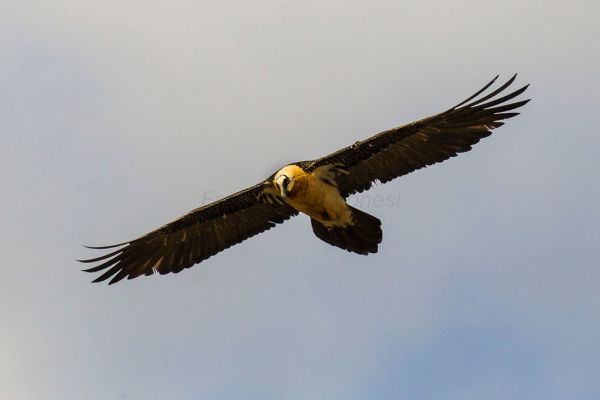
Bearded Vulture Gypaetus barbatus; Catalan, Pyrenees, Spain
(Francesco Veronesi – Wiki Commons)

Bearded Vulture (Ossifrage) Gypaetus barbatus, swallowing a big bone
(Francesco Veronesi – Wiki Commons)
Ossifrage (from Latin for “bone” + “break”is an archaic name for Bearded Vulture, also known as Lammergeier (German for “lamb vulture”). This unusual vulture ranges from South Africa to southern France to western China. For millennia, Tibetan and western Chinese “bonebreakers” relied upon vultures to eat the flesh of their corpses, and the “ossifrage” to carry away and devour the bones of their dead. In the Palestine area, they currently nest in Turkey, Jordan, Egypt and Arabia. They have the curious dining preference of carrying bones to great heights, dropping them on rocks, and then descending to eat both shattered bone and marrow. This seems like an odd way to get a meal, but they’re the only bird doing this, so they have the niche to themselves. At some unidentifiable time past, by the way, the fresh-fish-eating Osprey was confused with and misnamed for this bird. The name “Osprey” derives from “ossifrage.” Needless to say, Ospreys do not swallow large bones.
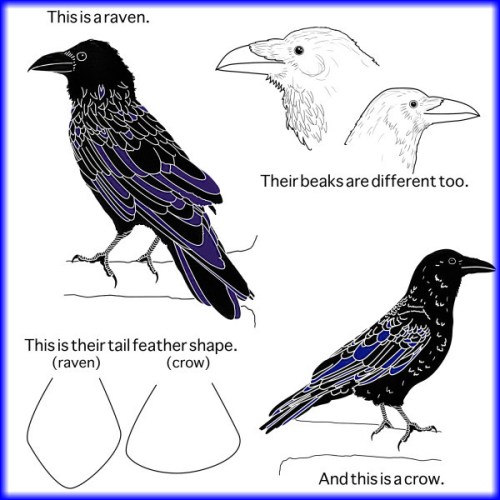
You need never be confused again
(Camara Miller – Highline Online)
Ravens are very closely related to crows, and share the genus Corvus. Indeed, ravens could be simply considered large crows, or crows small ravens. This genus has been very successful, and its 42 species have spread worldwide, excepting South and Central America, from its ancient Australasian origin. They are very intelligent and social, and a crow family may stay together many years. Omnivorous, they eat all kinds of plant and animal matter. They particularly love road kills and garbage. There are four species than likely lived in ancient Palestine, as discussed in lesson five: Jackdaw, Hooded Crow, Common Raven and Brown-necked Raven. The various jays, magpies and choughs, although also in the family Corvidae, are less likely to be confused with either raven or crow.

Purple Heron Ardea purpurea, Nagarhole NP, India (Yathin Krishnappa – Wiki Commons)
Herons are easily mistaken for storks, although they are only distantly related. They are an example of convergent evolution: similar living situations cause unrelated animals to evolve similar body styles and habits. Both are long-necked, long-legged wading birds. Of the 19 stork species only the Wood Stork lives in North America. The Black Stork and White Stork migrate through Palestine in spring and fall, but nest no closer than central Turkey. Storks eat many snails and other invertebrates, food items also forbidden to the Israelites. The White Stork is famous for nesting on chimneys and rooftops all across Europe. It was considered a sign of good fortune and especially good fertility, for a stork to nest on your rooftop; this gave rise to the popular image of the stork carrying a human baby in its bill. Herons are world-wide, and also eat many invertebrates, amphibians and other fare forbidden to the Israelites. In Palestine, herons are represented by Gray Heron (Ardea cinerea) Purple Heron (Ardea purpurea) and Black-crowned Night-Heron (Nycticorax nycticorax), the same species we have in America.
White Stork – Ciconia ciconia, with nesting material, Bingenheimer Reid, Germany (Christina Zientek) // Black Stork – Ciconia nigra (Marek Szczepanek) (Both from Wiki Commons)
But these small notations did not satisfy my curiosity. I decided to check a little further, and see how this passage might read in another translation of the Bible. What I found was pretty interesting, with far-reaching ramifications.
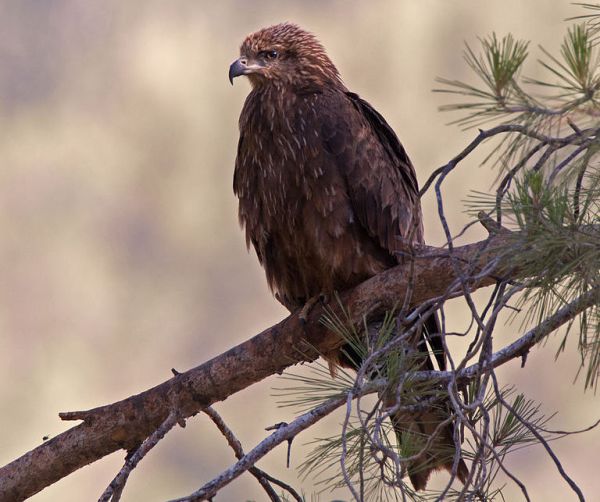
Black Kite Milvus migrans, Upper Galilee, Israel
(Artemy Voikhansky – Wiki Commons)
This is as good a time as any to cite, in passing, the verses immediately following those cited above. If you don’t understand why, check the picture below.
All teeming winged creatures that go on four legs shall be vermin to you, except those which have legs jointed above their feet for leaping on the ground. Of these you may eat every kind of great locust, every kind of long-headed locust, every kind of green locust, and every king of desert locust. Every other teeming winged creature that has four legs you shall regard as vermin… Leviticus 11:20-23
I hope you didn’t need me to point out that “teeming winged creatures,” aka insects, have six legs, not four, but if you did, there it is. The deity’s editor slips up again. Pegasus and a few griffons are the only creatures I know of with wings and four legs, and they don’t exist anyway.

Desert Locust Schistocerca gregaria, laying eggs, Mauritania
(Christiaan Kooyman – Wiki Commons)
To get you ready for our next lesson, here’s the translation from the Masoretic Text. Compare it to the version from the New English Bible, cited at the top.
And these ye shall have in detestation among the fowls; they shall not be eaten, they are a detestable thing; the great vulture, and the bearded vulture, and the ospray; and the kite, and the falcon after its kinds; every raven after its kinds; and the ostrich, and the night-hawk, and the sea-mew, and the hawk after its kinds; and the little owl, and the cormorant, and the great owl; and the horned owl, and the pelican, and the carrion-vulture; and the stork, and the heron after its kinds, and the hoopoe, and the bat. Leviticus 10:13-19
Bible Factoid #9 – Seeing “Red”
Did Moses lead the Children of Israel across a sea of red or a sea of reed? This argument has long raged well out of sight of the average Christian.

Exodus 13:18, original 1611 King James Version (OriginalBibles pg. 149)
The Changing Translation of ס֜וּף “sup” as “reed” or “red”
The word ס֜וּף “sup” (or “suph”) occurs 28 times in the Jewish scriptures. The first book, Genesis, does not use it, instead using the adjective אַדְמוֹנִ֔י ad-mo-nee, translated as “red” or “ruddy,” three times, first in Genesis 25:25 in reference to Abraham’s grandson Esau.
ס֜וּף sup first appears in reference to baby Moses, floating in his tiny boat among the reeds.
So she got a rush basket for him [baby Moses], made it watertight with clay and tar, laid him in it, and put it among the reeds (בַּסּ֖וּף – bas-sup “in/among the reeds”) by the banks of the Nile. Exodus 2:3 NEB
She [Pharoh’s daughter] noticed the basket among the reeds (הַסּ֔וּף – has-sup “the reeds”) and sent her slave-girl for it. Exo 2:5 NEB

Egypt, Sinai, Gulfs of Suez and Aqaba, north end of the Red Sea (AllFaith.com)
At Exodus 10:19, the first mention of the “sea of red,” the translation changes.
The Lord changed the wind into a westerly gale, which carried the locusts away and swept them into the Red Sea (יָ֣מָּה – yah-mah “into the sea” + סּ֑וּף – sup “”red”). Exo 10:19 NEB

Exodus 10:19, original 1611 King James Version (OriginalBibles pg. 145)
The Red Sea is next mentioned in connection to the Israelites fleeing Egypt, crossing the water and the drowning of Pharaoh’s army.
So God made them go round by way of the wilderness towards the Red Sea (יַם־ – yam “of the sea” + ס֑וּף sup “red”); and the fifth generation of Israelites departed from Egypt. Exo 13:18 New English Bible (NEB 1976)
The chariots of Pharaoh and his army he has cast into the sea; the flower of his officers are engulfed in the Red Sea (בְיַם־ – be-yam “sea” + סֽוּף׃ – sup “in the red”). The watery abyss has covered them, they sank into the depths like a stone. Exo 15:4-5 (NEB)
NEB footnotes Exo 13:18: “Red Sea: literally ‘Sea of Reeds,’ and hence a shallow papyrus marsh on the border of Egypt. The Red Sea is the name of the Gulf of Elath, much further east.” ff. pg 69. [I’m not sure the Elath part is correct. Elath is now Eilat, the city at the north end of the Gulf of Aqaba, the northeastern extension of the Red Sea which borders the east coast of the Sinai Peninsula. The Red Sea’s northwestern extension, the Gulf of Suez, lies between mainland Egypt and the Sinai west coast. Unfortunately, the NEB gives no further explanation.]
From this point through Jeremiah 49:21, whenever סּ֑וּף – sup modifies יַם־ – yam “sea,” it is translated as “red.”
The very last use of ס֔וּף – sup defines it as “weeds,” far closer to “reed” than to “red” in meaning:
The water about me rose up to my neck; the ocean was closing over me. Weeds (ס֖וּף – sup “the weeds”) twined about my head in the troughs of the mountains;… Jonah 2:5

Suez Canal, Great Bitter Lake midway, Gulf of Suez at bottom (Bible Journey)
Summarizing the ס֔וּף – sup translation problem:
1. ס֔וּף – sup occurs twenty-eight times, always classified as a noun; in the twenty-four occurrences where it modifies יַם־ – yam“sea” it is translated as “red.”
2. When it does not modify יַם־ – yam“sea,” it is translated as “reeds” (Exo 2:3 & 2:5); “reeds,” “rushes” or “flags;” (Isaiah 19:6), or “weeds” Jon 2:5)
3. If translation erred – intentionally or unintentionally – at the first usage of “red,” (Exo 10:19), probability is high that in all subsequent usage in the same context, “the __ sea,” would be similarly mistranslated.
4. Scholars’ commentaries on these verses usually indicate that “reed” or “weed” is correct, not “red”: Exo 2:3, Exo 10:19, Exo 13:18.
The Red Sea
Egypt’s current capital, Cairo, is ninety miles from the Gulf of Suez. Thebes, the capital around 1300 BCE, was one hundred miles from the Red Sea. That’s a very long way for locusts to be blown, as Exo 10:19 claims, using the first translation of ס֔וּף – sup as “red.” Crops were

Great Bitter Lake & Suez Canal; Ismalia (city) at north end of lake (Bible Journey)
grown primarily in the fertile alluvial soil of the Nile delta; the ancient “store-cities” of Pithom and Per-Rameses built by the Israelites (Exo 1:11) were nearby. From either Pithom (some say Tell el-Maskhusa, nine miles west of Ismaliya on the Suez Canal) or Per-Rameses (Qantir), it is thirty miles to the large lakes now bisected by the Suez Canal. Scattered lakes and ponds abound throughout the area. These distances are far more reasonable for the blowing of locusts. The fastest route to and through the Sinai would be through this area, and opportunities would abound for losing potential pursuers among the marshlands, lakes and wadis.

Papyrus on the Nile (Bible Land Pictures – Zev Radovan)
In ancient Egypt, papyrus (גֹּ֔מֶא – go-me) (reeds) were abundant along the Nile and in the delta, and harvested for both domestic and export use. People can travel and avoid detection among beds of towering papyrus. Water levels in shallow marshes can fluctuate, strong winds can raise waves. Whether one’s neighborhood consists of buildings, fences and alleys, or of wadis, marshes and reeds, there are always “locals” who know the fast and surreptitious routes. Moses, living east of Egypt, and his brother Aaron, living within Egypt, may have been such people. They could lead people on foot safely, quickly and secretly through areas which would mire horses and wheeled vehicles. Moses knew the Sinai – the water holes, the edible plants, when the Common Quail came through in the millions. In this scenario, Moses is less the God-struck prophet freeing his people and binding them to God, than the wily Mexican-style coyote, leading people, perhaps repeatedly, across a border to “the promised land,” and a better life of freedom and prosperity.

Nile Delta, ancient Egypt – Per-Rameses circled red, Pithom circled blue
(Ancient Near East – Just the Facts)
Whether “Israelites” ever lived in Egypt, fled Egypt for elsewhere, or were pursued by troops cannot be settled here. But the “Sea of Red” is too wide (150 miles) to be crossed in a few days, let alone a few hours, and too far from the hard-labor slaves located in the delta. But a “sea of reeds” near the delta fits what few details Exodus gives without forcing us to swallow unlikely translations which necessitate miracles.
The Septuagint (LXX)
According to numerous sources, such as Bible Archeology:
The “Red Sea” phrase came into the account with the third century BC translation of the Old Testament into Greek. Called the Septuagint (abbreviated as LXX), its translators made yam suph (“Sea of Reeds”) into [ἐρυθρὰν θάλασσαν] eruthrá thálassē (“Red Sea”). The Latin Vulgate followed their lead with mari Rubro (“Red Sea”) and most English versions continued that tradition.
The number of websites discussing this problem are legion. The reasons to choose “reed” seem rational and reasonable. The reasons to choose “red” are based on tradition and a faith-based need for miracles.
Additional sites arguing for “reed”: Additional sites arguing for “red”:
Christianity – Stack Exchange Orthodox Union
Ancient Near East – Just the Facts Religion Today
The Bible Journey United Church of God – Beyond Today
*********************************************************************
Part I – What About That Dove? & The Flood of the Gilgamesh
Part II – Sandgrouse or Quail? & YHVH [יְהוָ֖ה] [Yahweh]
Part III – Junglefowl in Judea! & New Testament Koine Greek
Part IV – Birds that Sow, Reap and Store & Whence Jesus (Ἰησοῦς)
Part V – The Friendly Raven & The Bar-Abbas Mystery
Part VI – The Humble Hoopoe & Catching “Forty” Winks
Part VII – The Wise Hoopoe & On “On”
Part VIII –Don’t Eat That Bird! Part 1 & Of “Of”
Part X – Don’t Eat that Bird! The Last Bite & The Problems of Translation
[Chuck Almdale]
Additional Sources:
1. Birds of Europe. Mullarney, K., Svensson, L., Zetterström, D., Grant, P.J. (1999) Princeton University Press, Princeton, N.J.
2. Dictionary of American Bird Names. Choate, Ernest A. (1985) Harvard Common Press, Boston.
3. Handbook of Birds of the World (HBW), Vol. 2. del Hoyo, J., Elliott, A. & Sargatal, J. eds. (1994) Lynx Edicions, Barcelona. Vultures – Pgs 125-129.
4. Holy Scriptures: According to the Masoretic Text. (1955) The Jewish Publication Society of America. Philadelphia.
5. New English Bible with the Apocrypha, The: Oxford Study Edition. Sandmel, Samuel, Suggs, M. Jack, Tkacik, Arnold J.; eds. (1976) Oxford University Press, New York
Links With Notes:
Tree of Life To navigate Tree Of Life, click binoculars icon in upper right corner, enter bird name and press “next hit” until you get to your bird.
BibleHub.com An invaluable tool. Almost a “one-stop-shopping” bible research site.
BibleStudyTools.com A very useful site.
Full Hunter’s Moon Update – October 15, 9:23 PM PDT
Here’s another update from SMBAS Blog on that large, disc-like, shining object which has frequently and mysteriously appeared in our nighttime sky this year (some call it the moon).

Full Hunter’s Moon (Laura Stoeker, Daily Herald)
Oct. 15, 9:23 p.m. PDT — Full Hunter’s Moon. With the leaves falling and the deer fattened, it is time to hunt. Since the fields have been reaped, hunters can ride over the stubble, and can more easily see the foxes and other animals that have come out to glean and can be caught for a Thanksgiving banquet after the harvest.
Month Moon Names from other cultures (Courtesy of Keith Cooley):
Chinese: Kindly Moon; Celtic: Harvest Moon; English Medieval: Blood Moon
Eclipses: Their will be no more lunar eclipses in North America until Feb. 10, 2017. Don’t miss the upcoming total solar eclipse, passing through Oregon on August 21, 2017, 9:45 AM, and lasting about 2 minutes, 40 seconds. This is the first North American total solar eclipse since 1979.
A Man in the Moon? – We in the west see a human face in the full moon, but the Chinese see a rabbit. If you gaze at the moon for a while , you can replace the face with a rabbit. Once you can do that, switch it back and forth between rabbit and man. See how quickly you can do it. No, it will not turn you into a lunatic. Pareidolia is the term for “perceiving familiar patterns where none actually exists.” We all do this when we see elephants in clouds, the Virgin Mary in a wall stain, rocks that look like heads, or hear voices when wind rustles the leaves. It’s when you begin believing it’s actually there and it’s a message meant for you, that the trouble begins.
Note: Pacific Daylight Time ends November 2, 2014 at 2 AM (becoming 1 AM).
The Old Farmer’s Almanac has a page for each full moon. One tip: harvest your belowground crops on the 25th and 26th. Now you know, so you have no excuse.
The next significant full moon will occur on Nov. 14, 5:52 a.m. PST. Keep an eye on this spot for additional late-breaking news on this unprecedented event.
The moon name information comes to you courtesy of: http://www.space.com/31699-full-moon-names-2016-explained.html written by Joe Rao. Joe Rao serves as an instructor and guest lecturer at New York’s Hayden Planetarium. He writes about astronomy for Natural History magazine, the Farmer’s Almanac and other publications, and he is also an on-camera meteorologist for News 12 Westchester, N.Y.
But that’s waaay too long to type in, and besides, you don’t need to go there because SMBAS has done the work for you!
[Chuck Almdale]
Red-hot Egrets: Bolsa Chica trip report, 8 October, 2016
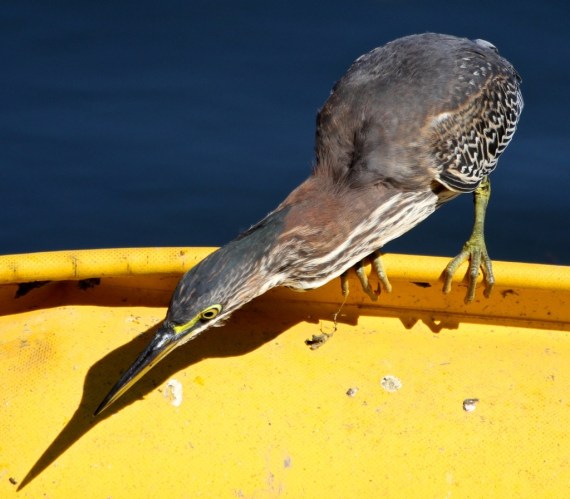
Green Heron (J. Waterman 10-8-16)
Contrary to widespread expectation, the weather was simply lovely, sunny with a nice breeze at Bolsa Chica. Only 6 of us were there to enjoy a very rich scene. The birds were in fine form, diving for fish, which in turn were jumping all over the place. An unusual sight were White Pelicans in the harbor who have no need for the kamikaze dives of their brown brethren, but placidly swim around, scooping up what they need into their shopping bag bills.

Forster’s Tern (J. Waterman 10-8-16)
There were shore birds galore, occasioning discussions of the distinctive qualities of Greater versus Lesser Yellowlegs ( we saw 2 Greater). A fine, elegant bird, if you ask me. Many Royal and Caspian Terns were swooping and diving. The Savannah Sparrows were creeping in the low growth by the trail, occasioning more discussions about the field marks of the Belding’s Sparrow.
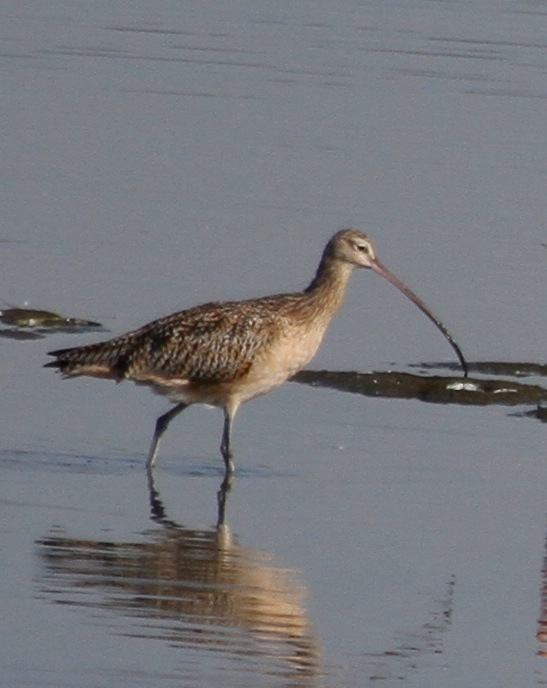
Long-billed Curlew (J. Waterman 10-8-16)
We had a great opportunity to see Least and Western Sandpipers side by side. Egrets and herons did not disappoint. Snowy Egrets were almost too numerous to count, and were quite talkative; one time one landed close and squawked at me (that might have been a “hello” but who knows).

Reddish Egret (J. Waterman 10-8-16)
Bolsa Chica is an Ecological Reserve in Orange County, separated from the beach by Pacific Coast Highway. We looked for the Ridgway’s Rail we saw last year but had no luck, although some other people had seen one earlier.

White Pelican (J. Waterman 10-8-16)
Great Blue Herons strutted around, a Green Heron was spied, as were 2 juvenile Black-crowned Night Heron and our target bird, the Reddish Egret, was represented by 4 individuals, one of whom did a lovely dance.

Blue-gray Gnatcatcher (J. Waterman 10-8-16)
A magnificent aerial display by a Says Phoebe, chasing what must have been an obstinate insect, impressed me greatly. An Osprey, American Kestrel (Chris Lord corrected from the opinion of a Peregrine Falcon) and a Red-tailed Hawk comprised the raptors. Once again we saw some Dowitchers bringing up the old question “Short-billed or Long-billed?” (we concluded short-billed), Willets, and Savannah Sparrows (Belding’s).

Savannah Sparrow adult (beldingi)—darkest subspecies, found in coastal marshes of SoCal (J. Waterman 10-8-16)
| BOLSA CHICA TRIP LIST | 10/08/16 |
| American Wigeon | 50 |
| Blue-winged Teal | 12 |
| Northern Pintail | 8 |
| Ruddy Duck | 12 |
| Pied-billed Grebe | 7 |
| Horned Grebe | 2 |
| Eared Grebe | 12 |
| Western Grebe | 1 |
| Double-crested Cormorant | 45 |
| American White Pelican | 11 |
| Brown Pelican | 5 |
| Great Blue Heron | 10 |
| Great Egret | 3 |
| Snowy Egret | 30 |
| Reddish Egret | 4 |
| Green Heron | 1 |
| Black-crowned Night-Heron | 2 |
| Turkey Vulture | 2 |
| Osprey | 1 |
| Red-tailed Hawk | 1 |
| American Coot | 3 |
| Black-bellied Plover | 40 |
| Semipalmated Plover | 2 |
| Killdeer | 8 |
| Greater Yellowlegs | 3 |
| Willet | 30 |
| Long-billed Curlew | 10 |
| Marbled Godwit | 14 |
| Ruddy Turnstone | 2 |
| Sanderling | 1 |
| Least Sandpiper | 12 |
| Western Sandpiper | 6 |
| Short-billed Dowitcher | 7 |
| Ring-billed Gull | 1 |
| Western Gull | 12 |
| California Gull | 6 |
| Forster’s Tern | 18 |
| Royal Tern | 12 |
| Rock Pigeon | 4 |
| Anna’s Hummingbird | 1 |
| Belted Kingfisher | 1 |
| American Kestrel | 1 |
| Black Phoebe | 2 |
| Say’s Phoebe | 2 |
| American Crow | 2 |
| Barn Swallow | 15 |
| Bushtit | 10 |
| California Gnatcatcher | 2 |
| European Starling | H |
| Yellow-rumped Warbler | 3 |
| California Towhee | 1 |
| Savannah Sparrow | 7 |
| Song Sparrow | 1 |
| White-crowned Sparrow | H |
| Western Meadowlark | 1 |
| House Finch | 15 |
| TOTAL SPECIES | 56 |
It took a bit of walking to find the ducks, but we were rewarded by Northern Pintails, Blue Winged Teals and American Wigeons. A California Gnatcatcher skulked in the bushes. The only disappointment: not a single rail. We hope for a correction of this lack next year.
[Liz Galton]
Cool Interactive Satellite View of Earth
You can see winds at various altitudes, temperature, relative humidity, hurricanes, typhoons, view it in various map projection styles – all sorts of things. Right now, hurricane Matthew is east of the Bahamas. Just follow the link and click the “Earth” control panel in the lower left of the screen. Unlike the screen shot below, it all moves.
https://earth.nullschool.net/
[Chuck Almdale]

Don’t Eat That Bird! — Sunday Morning Bible Bird Study VIII
This Week’s Lesson – Don’t Eat That Bird!
Don’t miss the entire series all on one page
We now begin a look at the birds considered unclean and not to be eaten by the children of Israel.
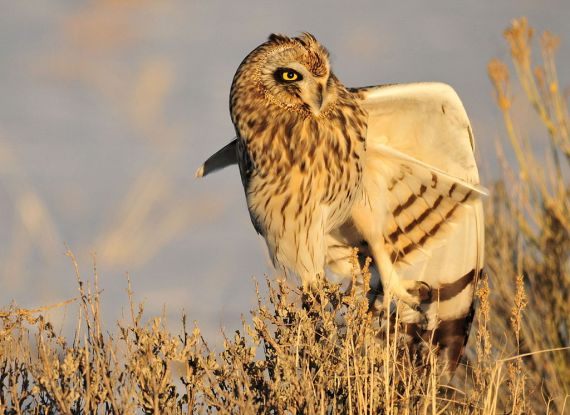
Short-eared Owl Asio flammeus – Seedskadee NWR, WY
(Tom Koerner – Wikimedia Commons)
These are the birds that you shall regard as vermin, and for this reason they shall not be eaten: the griffon-vulture, the black vulture, and the bearded vulture; the kite and every kind of falcon; every kind of crow, the desert-owl, the short-eared owl, the long-eared owl, and every kind of hawk; the tawny owl, the fisher-owl, and the screech-owl; the little owl, the horned owl, the osprey, the stork, every kind of cormorant, the hoopoe, and the bat.
Leviticus 11:13-19 New English Bible
Bearded Vulture (or Lammergeier) Gypaetus barbatus scarfs down a big bone (Francesco Veronesi, Italy – Wikimedia Commons)
My first impression of this list is that I wouldn’t want to eat any of these birds myself. Some of their dietary habits are rather repugnant. If you are what you eat, I don’t want to eat them! Others I am quite fond of and – as with most people – I refrain from eating my friends. While the rationale, if any, behind these biblical dietary injunctions is not really well understood, and theologians and scholars have argued about them for millennia, it seems that these bird’s choices in cuisine are as good a reason as any for putting them off-limits. If something eats garbage, dung, or dead and rotting insect-infested meat, you might be wise to leave it alone.
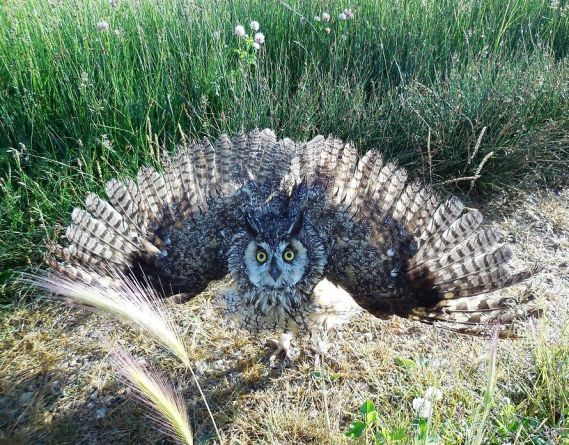
Long-eared Owl Asio otus, USFWS Mountain-Prairie
(Nicole Hornslein – Wikimedia Commons)
The second thing that strikes me about this list of forbidden flying food, is what an odd assortment of birds it is. In total, twenty species or families are named. The bat, of course, is not a bird (so we’ll ignore it.) It’s not that the infinite deity, or even
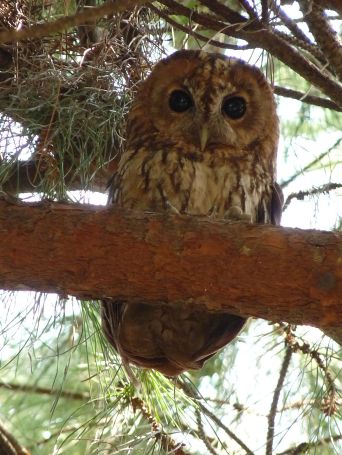
Tawny Owl Strix aluco; Beldibi, Marmaris Mugla, Turkey (Nottsexminer – Wikimedia Commons)
the ancient Israelites, goofed up and mistook it for a bird – no feathers, for starters – but that their word עוֹף oph meant “flying creatures,” excepting insects which were pestiferous and plentiful enough to warrant their own names.
Of the nineteen remaining named birds, eight are owls. As of October 1, 2016, there are 10,514 avian species in the world, of which 228 are owls, or 2.2% of the total. Yet owls comprise 42% of the deity’s Do Not Eat list. This seems peculiar. I can’t think of any owl I’d wish to eat; their eating habits are all pretty much the same; why didn’t the deity just say “every kind of owl” and be done with it, as was done with falcons, hawks and cormorants? Does this mean it’s OK to eat those owls not named? That doesn’t seem reasonable.
Ten owl species live in our target area of Israel and environs. In current phylogenetic order they are: Barn Owl Tyto tyto; European Scops-Owl Otus scops; Pallid Scops-Owl Otus brucei; Eurasian Eagle-Owl Bubo bubo; Brown Fish-Owl Ketupa zeylonensis; Little Owl Athene noctua; Tawny Owl Strix aluco; Desert Owl Strix hadorami; Long-eared Owl Asio otus; and Short-eared Owl Asio flammeus. Our Unclean Birds list totals eight. Assuming that the English names given in my bible translation are valid – a very big assumption – the Little, Tawny, Long-eared and Short-eared Owls match. Of seven species of Fish-Owl, the Brown is the only one in the area. The “horned” owl has to be Eagle Owl; it has large horns and is the largest owl in the area, impossible to overlook. The “screech” owl is likely the Scops-Owl, a small widespread owl closely related to screech owls; the European O. scops is widespread and common, whereas the range of the Pallid O. brucei is farther east, only occasionally reaching Israel. They are very similar in appearance.
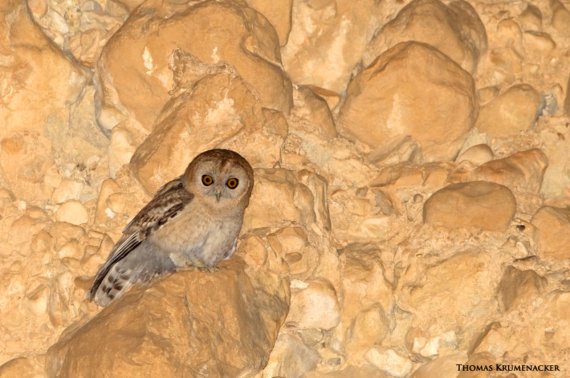
Desert Owl Strix hadorami, Israel
AKA Desert Tawny Owl, formerly known as Hume’s Owl, Strix butleri
(Thomas Krumenacker – Science News)
The “desert owl” is problematic, although there actually is a Desert Owl Strix hadorami, also called Desert Tawny Owl. Its predecessor species, Hume’s Owl Strix butleri, was split in 2015 when the widespread form was recognized as different from the Omani Owl, endemic to Oman. The widespread form became S. hadorami, the Omani form became Omani Owl, retaining S. butleri. However, because Desert Owl closely resembles Tawny Owl S. aluco, it’s likely the ancient Israelites saw them as the same bird. This leaves Barn Owl Tyto tyto – a scattered and widespread resident throughout the region – as the possible “desert” owl.
Barn Owls are relatively large, often noisy, nest and roost in both trees and human-build structures, and delight in devouring small rodents noxious to humans and their crops. It seems unlikely they would not be noticed.

If we accept the above analysis – taking Barn Owl as “desert” owl, and eliminating the Pallid Scops-Owl and Desert Owl as too similar, respectively, to European Scops-Owl and Tawny Owl, for ancient Israelites – who lacked binoculars – to distinguish, we are left with a total of eight owls in the area. Eight owls available, eight owls individually labeled “unclean.” Which returns us to the unanswerable question: why not just say “every kind of owl” and be done with it? The deity works in mysterious ways, apparently without an editor.
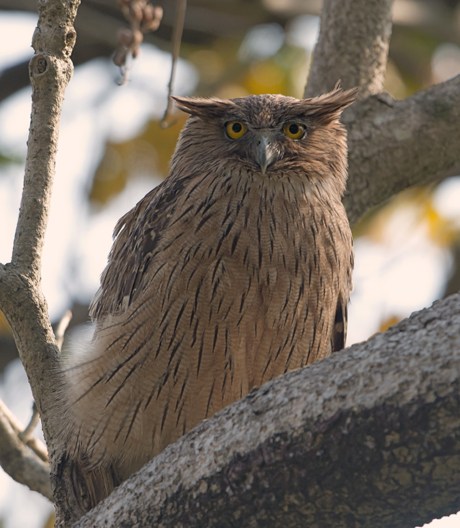
Brown Fish Owl Ketupa zeylonensis;
Corbett National Park, Uttarakhand, India
Their feet are specially adapted to catching slippery fish
(Koshy Kosny – Wikimedia Commons)
To single out owls like this as unclean is a bit unfair. This worldwide family of birds has a lot of charisma – even many non-birders admire and appreciate owls, and owls are very useful to humans. Except for the seven Old-World species of fishing-owls, they feed primarily on small rodents and large insects which in turn prey on our crops, infest our buildings, and carry diseases like bubonic plague. Because their extremely large night-adapted eyes are fixed immovably in the skull, they need to move their head to look around. As a result, they evolved the ability to rotate their head as much as 270 degrees to either side, for a total rotation of 540°. Barn Owls can hear a mouse rustling in the grass over 100 yards away. Because one ear hole is slightly higher on the skull than the other, Barn Owls can locate such faint sounds in three dimensions, and can find and seize that mouse in absolute pitch darkness. (Humans are good at locating sounds to either side (horizontal axis), but locate sounds on the vertical axis only with difficulty.) From thirty yards away, the Great Gray Owls of the far north can hear the movement of voles beneath two feet of snow. These are abilities unique in the world of birds.

Brown Fish Owl Ketupa zeylonensis; Tamil Nadu, India
The “fisher” owl (D Momaya – Wikimedia Commons)
On the other hand, divine removal from humanity’s menu was, for Owls, fortuitous. It obviates the typical fate befalling animals we find edible: either eaten into extinction or enslaved to feed humanity. Perhaps the deity was really protecting a wonderful family of birds, rather than saving humans from possible illness. Now there’s a thought!

Fanatick Madg (British Museum) &
Hindu Goddess of fortune Lakshmi with her owl (Wikipedia)
Because most owls are nocturnal, they are often feared. Night is the time of evil spirits in many cultures, when ghosts, demons, and “things that go bump in the night” roam about, killing and devouring us, or infesting our bodies with their evil
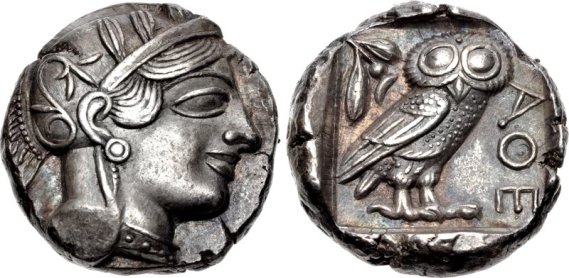
Athenian tetradrachm, 454-404 BCE; goddess Athena and her wisdom-owl who sees into the darkness of men’s souls
(Wikipedia – Classical Numismatic Group)
powers. Owls have been thought to be a witch’s demonic “familiar”, abettors in their nefarious deeds. Even today, there are people in America who believe a “hoot-owl” call to be an omen of death. Out in the country, particularly in the south, there is an owl calling
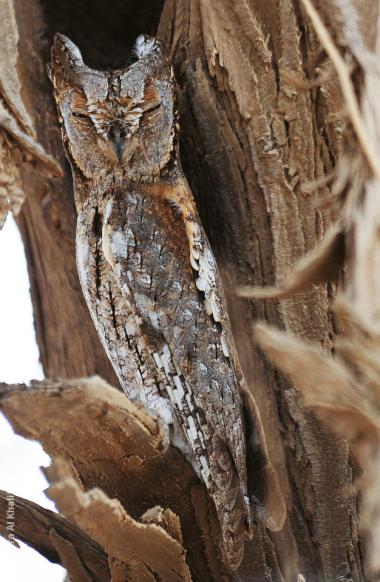
Eurasian Scops Owl Otus scops; Kuwait
The “screech” owl (Samera Al Kalifah – Kuwait Birds.org)
within earshot just about everywhere, throughout the year. Owls call, people die, but assuming that one causes or predicts the other is an example of the common logical fallacy post hoc ergo propter hoc (Latin – “after this, therefore because of this”).
God’s injunction against owls reminds me of a famous and mostly-true story about JBS Haldane, British biologist of the middle 20th century, which goes something like this:
Reverend Whoozit: Will you tell me, Professor Haldane, what your study of nature has taught you about the mind of God?
Dr. Haldane: Certainly. God is inordinately fond of beetles.
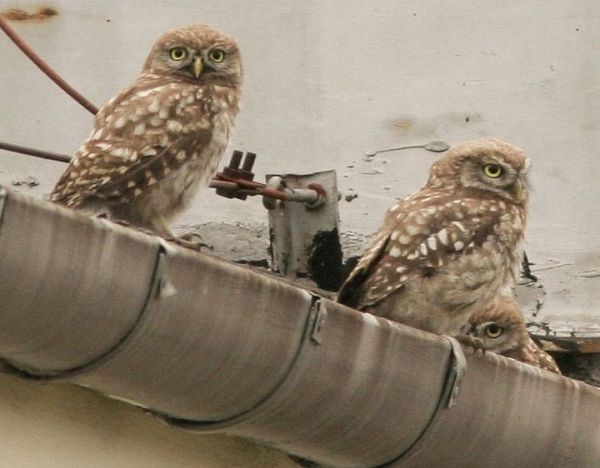
Three Little Owls Athene noctua, in a rain gutter; Warsaw, Poland
(Artur Mikolajewski – Wikimedia Commons)
Scientists now estimate that perhaps half of all the 10-30 million species of animal life on earth are beetles, so Haldane was by no means merely being flippant. Consider for a moment: if variety is the spice of life, and repetition is boring, what are we to make of 5-15 million members of the beetle family versus 10,500 of birds and less than 5000 species of mammals. Perhaps we can modify Haldane’s observation with the deity’s injunction, and say:
God is inordinately fond of beetles and abhorrent of owls.
But perhaps I’m overstating the case. It’s food for thought.
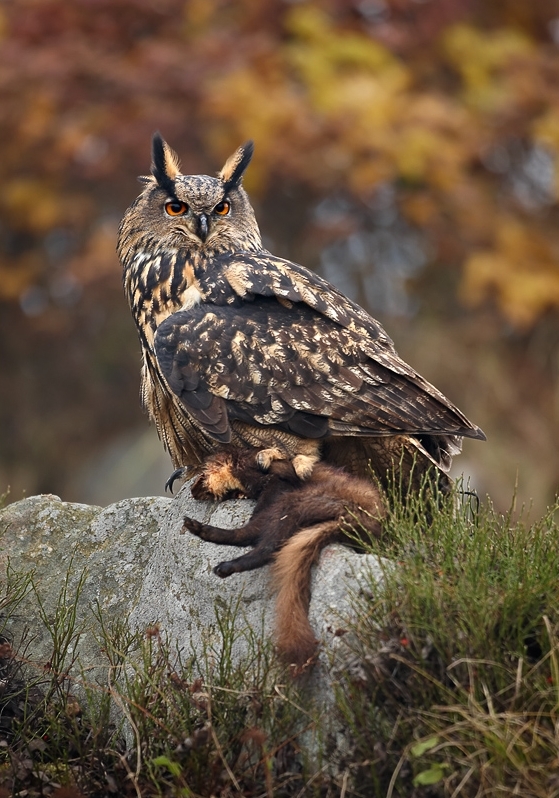
Eurasian Eagle Owl Bubo bubo – The “horned” owl
Zdarsle vrchy, Czechoslovakia
(Martin Mecnarowski – Wikimedia Commons)
Bible Factoid #8: Of “Of”
“Of” is another of those irritating prepositions with numerous senses. The Oxford English Dictionary (OED) entry for “of” covers six pages, with sixty-two senses grouped into seventeen branches. Although the phrase annoys a great many sincere and devout Christians, it is currently fashionable to speak of the Bible (combined Jewish and Christian scriptures) as the “Word of God,” as if God himself hoisted His mighty pen and inscribed the words in eternal ink. But with sixty-two possibilities, what does “of” really mean?
The phrase “word of God” appears forty-eight times in the Jewish and Christian scriptures. None of the authors of the eighty-one books comprising the Christian Bible would have used this phrase to refer to their own writings or those by another, or to a not-yet-existing collection of such works. At least, none did. They wrote about God, or what they felt God was saying to them, but lacked the impudence to suggest that God actually wrote the words they penned. Those who feel inspired by God – witness the mystics of all major religions – always insist how ineffable is the experience, how meager their ability to express it. Their writings are God-inspired, perhaps; God-written, no.

Two eternal questions: Who wrote the Bible or the Book of Love (The Monotones wrote #2:
Lyrics – Photo: Grub.ws)
In their various usages, “Word of God” refers to something spoken by a human about their deity, or a spiritual word “spoken” or “thought” by that deity, most often when it has entered into someone’s mind. For example:
But the word of God came unto Shemaiah the man of God, saying… 1 Kings 12:22
…as the people pressed upon him to hear the word of God… Luke 5:1
…and they spake the word of God with boldness… Acts 4:30
But the word of God grew and multiplied… Acts 12:24
Now when the apostles…heard that Samaria had received the word of God… Acts 8:14
…and his name is called The Word of God. Revelation 19:13
If “of” in “Word of God” carried the same sense as in “John of London” or “Duke of Earl,” then we would mean the “word” from “God” or the “word” that lives or resides in “God.” But consider this.
The King James Version of the Christian Bible was published in 1611, when English usage was significantly different than it is today. Then it was common to say something like, “You are returned from London. Have you brought any word of my brother?” In this sense, “of” means “concerning” or “about.”
The appropriate OED sense for this usage is:
Branch VIII: Indicating the subject-matter of thought, feeling or action, i.e. that about which it is exercised.
26. In sense: Concerning, about, with regard to, in reference to.
Some examples:
1542 Udall – Of these games is afore mentioned.
1590 Spenser – To sing of knights and ladies gentle.
1697 Dryden – The learned Leaches…shake their Head, desponding of their Art.
1859 Dickens – A Tale of Two Cities
2010 The Economist – Recession…[has] put paid to most thoughts of further EU enlargement.
The proper interpretation of “reading the word of God” is “reading about God,” or “reading words about God,” without the implication that God somehow wrote the words you are reading. Again: Inspired by, perhaps; written by, no.
Part I – What About That Dove? & The Flood of the Gilgamesh
Part II – Sandgrouse or Quail? & YHVH [יְהוָ֖ה] [Yahweh]
Part III – Junglefowl in Judea! & New Testament Koine Greek
Part IV – Birds that Sow, Reap and Store & Whence Jesus (Ἰησοῦς)
Part V – The Friendly Ravens & The Bar-Abbas Mystery
Part VI – The Humble Hoopoe & Catching “Forty” Winks
Part VII – The Wise Hoopoe & On “On”
Part IX – Don’t Eat that Bird! Part 2 & Seeing “Red”
Part X – Don’t Eat that Bird! The Last Bite & The Problems of Translation
Next installment: More on birds too nasty to eat, when the ground shifts beneath our feet.
[Chuck Almdale]
Additional Sources:
1. Audubon Society Encyclopedia of North American Birds. Terres, John K. (1980) Alfred A. Knopf, New York. Pgs 664-673.
2. Birds of Europe. Mullarney, K., Svensson, L., Zetterström, D., Grant, P.J. (1999) Princeton University Press, Princeton, N.J. – Owls, Pgs 206-214.
3. New English Bible with the Apocrypha, The, Oxford Study Edition. Sandmel, Samuel, Suggs, M. Jack, Tkacik, Arnold J.; eds. (1976) Oxford University Press, New York
4. Oxford English Dictionary. (1971) Oxford University Press, New York
Links With Notes:
Tree of Life To navigate Tree Of Life, click binoculars icon in upper right corner, enter bird name and press “next hit” until you get to your bird.
Cornel Lab of Ornithology Clements Downloadable Checklist of Birds of the World, updated August, 2016.
BibleHub.com An invaluable tool. Almost a “one-stop-shopping” research site for the bible. Watch out for the occasional fundamentalist bias.



 SANTA MONICA BAY AUDUBON SOCIETY BLOG