Free email delivery
Please sign up for email delivery in the subscription area to the right.
No salesman will call, at least not from us. Maybe from someone else.
News keeps pouring in…
| The LA times keeps us up to date on major bird life developments this week. | ||
| In today’s (Sunday 4 Sept.) paper the California section has an article on bird deaths and prevention efforts at the Ivanpah solar power station.
http://www.latimes.com/local/california/la-me-solar-bird-deaths-20160831-snap-story.html |
||
| In section 1 there are two bird stories: “Cormorants to die for salmon” relating a court decision to allow the Army Corps of Engineers to continue killing Double-crested Cormorant near the mouth of the Columbia River in order to save outgoing salmon. http://www.pressreader.com/usa/los-angeles-times/20160904/281685434285099 | ||
| Also of note on page 8, an AP story by Dan Elliott “New guidelines to protect Sage Grouse”. http://bigstory.ap.org/article/885712770a9c4ef8981006aa11d8ffc0/us-takes-key-step-implement-sage-grouse-conservation-plan | ||
| Enjoy the attention the LA Times is giving birds? Tell the editors: letters@latimes.com |
Birds that Sow, Reap and Store: Sunday Morning Bible Bird Study IV
This Week’s Lesson – Birds that Sow, Reap and Store
Link to entire 10-blog Birds in the Bible series on one page
This week’s topic is not a particular bird, but stems from a general comment about birds. This well-known and oft-quoted verse appears near the end of Jesus’ sermon on the mount, a long oration in which he offers the mass of listeners advice for living a better life.
‘Therefore I bid you put away anxious thoughts about food and drink to keep you alive, and clothes to cover your body. Surely life is more than food, the body more than clothes. Look at the birds (πετεινὰ – peteina, plural of bird) of the air; they do not sow and reap and store in barns, yet your heavenly Father feeds them. You are worth more than the birds! Is there a man of you who by anxious thought can add a foot to his height?’
Matt. 6:25-27 New English Bible

Stained glass of Jesus, birds and foxes
(Glass Angel)
Put into a modern context, we are being told that if we let go of our never-ending fears, we’ll fuss and fret less and be happier. Endless anxiety does not make us taller or live longer. Birds do fine without such needless fretting. We are greater than they; we can live better that we do.
The bible is full of poetic and literary devices: similes, metaphors, rhyme schemes, and repetition for emphasis are only a few. However, there are many people who interpret literally passages such as the above and who, knowing little about birds or other animals, might think they actually lead lives of perpetual ease and frolic. As with humans, birds have their own agendas; entertaining humans is very low on their list. Their lives are filled with peril; they need all their courage, wits, and a lot of luck to survive long enough to raise young of their own. 80-90% of all birds die in their first year.
To illustrate some of the survival strategies birds use, I’ve selected three species which anyone in Southern California can see without much difficulty.

Clark’s Nutcracker, Aspendell, Inyo Co, CA (Joyce Waterman)
High in the mountains of western America, including our local San Gabriel Mountains, lives the Clark’s Nutcracker. Discovered by William Clark of the Lewis and Clark Expedition near the north fork of the Salmon River (near modern-day Kamiah, Idaho) on August 22, 1805, they were later named for him.
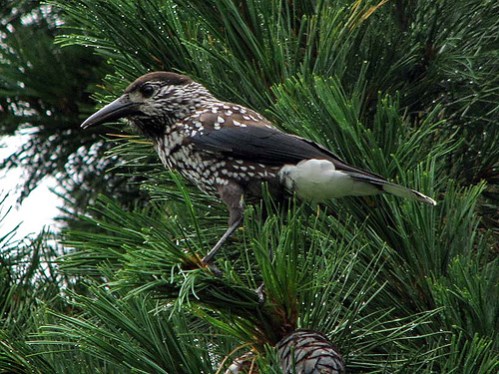
Eurasian Nutcracker, Manzushir Khiid, Mongolia
(Dreaming of Danzan Ravjaa, January 2009)
The family Corvidae (Crows and allies) has 125 species, grouped into 25 genera. The three nutcracker species are in the Nucifraga genus: Eurasian (previously Spotted) N. caryocatactes, Kashmir N. multipunctata, and Clark’s N. columbiana. Kashmir Nutcracker is restricted to Pakistan and northwest India;

Kashmir Nutcracker
(painting by John Gould, 1849)
Eurasian ranges widely from central Europe to the eastern Himalayas and far eastern Siberia, getting no closer to Judea than northern Greece; Clark’s ranges across western U.S. and Canada, from northern Baja to British Columbia and down the Rocky Mountains to New Mexico. All three species live on conifer-covered alpine slopes, ranging between 3500 ft. and tree line, usually between 10,000 and 12,000 ft.
A close relative of crows and jays, Clark’s Nutcracker is twelve inches long, a bit larger and stouter than our local California Scrub-Jay. It does not migrate, but remains resident in its alpine coniferous habitat throughout the windy, bitter cold of the mountain winters, occasionally descending to lower slopes. Trees and shrubs provide no food for it at that season, yet it survives, despite winter’s high energy demands. How it does this is quite amazing.

Clark’s Nutcracker pulls a nut (Greg Bergquist, 10-15-04)
The Clark’s Nutcracker survives the winter primarily by eating pine nuts. The nuts, however, are not on the cones which may have blown away in the high velocity winds, but are safely stored in the ground. Like squirrels, nutcrackers spend the autumn extracting pine nuts from cones. Their long, pointed and stout bill is perfect for hammering on cones and plucking out nuts. But they don’t store the nuts in a few large close-at-hand caches like the squirrel. What they do is far more interesting and ecologically beneficial.
The nutcracker packs a mass of seeds into its sublingual (below the tongue) pouch and carries them, as much as ten miles, to its storage area in deep woods or on a windswept ridge. There, where the coming winter’s snow will lie less deep, it makes a hole in the soil with its sharp bill, pushes in one or more seeds, and covers the hole with soil or ground litter. More holes are made for the other seeds. Then it flies back to the ripe-seed ground to repeat the whole process. Individual nutcrackers may store 100,000 seeds in a single season, creating many tens of thousands of holes. And it remembers where the holes are. In natural and experimental situations, nutcrackers have recovered 50 to 99 percent of stored seeds. Experiments show that they remember each hole’s positions relative to local landmarks such as trees and rocks. If such landmarks are moved, say by a meddling scientist, the bird seeks for holes where they ought to be (relative to the moved landmarks) but are no longer.

Clark’s Nutcracker caching nuts, Mt. Baldy, CA (“Bob” – July 2013)
Choosing areas for storage where snow will lie less deep ensures easier retrieval of the seeds. Pine nuts are nutritious, loaded with energy-packed oil, and can sustain the birds through winter. But no nutcracker retrieves all their nuts. Some remain in the ground, sprout, and grow into new trees. Windswept, barren slopes provide young trees with more sunlight and less competition from mature trees. Thus the forest is replenished.

Juvenile Clark’s Nutcracker, Colorado (Joyce Waterman)
Studies have shown that the vast coniferous forests of (pre-European occupied) western North America were created largely through the activities of squirrels, nutcrackers and several of their Jay relatives. Heavy cones and nuts do not travel far without animal transport, and nuts in unopened cones frequently fail to germinate. The trees feed the squirrels and birds, and they in turn enable the forests to spread. In a sense the nutcrackers are “sowing” the forests; this shelter and food is reaped by itself and later generations of nutcrackers.
So, when considering the Clark’s Nutcracker, we must agree that they sow the coniferous forest, reap the nuts and have their own personal “barns” of which they memorize every nook and cranny! Think about that the next time you can’t find your car keys.

An alert female Acorn Woodpecker. Placerita Canyon State Park
(Chuck Bragg 4-7-12)
The Acorn Woodpecker (Melanerpes formicivorus) ranges from southern Washington State down to the western slope of the Colombian Andes Mountains. Except for the southern populations in Central and South America, they have the unusual behavior of collecting tens of thousands of acorns and storing them in granary trees. The granary is not a large cavity containing many nuts, instead it is one – sometimes more – entire tree with tens of thousands of small holes drilled by the woodpeckers into the trunk and large limbs. Each hole takes one-third to one
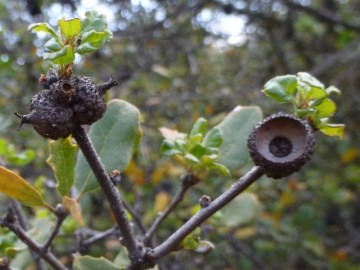
Acorn Caps. Malibu Creek State Park
(Chuck Almdale 4-12-14)
woodpecker-hours to drill, and into each hole one acorn, still in its shell, is pounded. The woodpeckers gather the acorns in the fall, when they’re ripe, and store them in their granary. Throughout the winter the nuts are extracted, as needed, to feed the colony. The acorns fit tightly and are very difficult for other birds and squirrels to steal them; anyone trying will be discovered and driven off by the granary owners. A granary tree can look like Swiss cheese. Telephone poles have collapsed after years of use as a granary.

Male Acorn Woodpecker with acorn, CA
(Joyce Waterman)
A granary of 50,000 holes will take 15,000 – 50,000 hours to create – far too much time for a single bird or mated pair to create. These are multi-generational projects, begun by a single pair of birds, and continued from one generation to the next. Because acorn shells shrink while stored, they become loose in their holes and must be moved to a new hole, so new holes are constantly added. In order to create and maintain such a huge project, Acorn Woodpeckers developed several unusual breeding strategies, one of which is called helpers-at-the-nest.
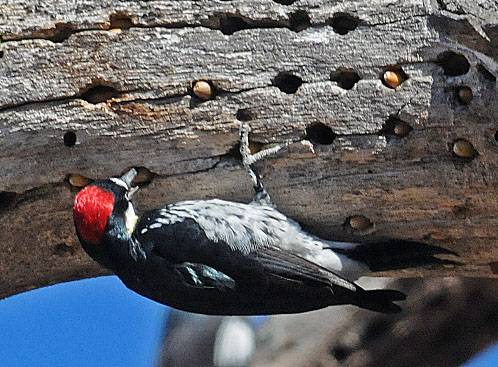
Acorn Woodpecker at her granary. Malibu Creek State Park
(Jim Kenney 11-10-12)
Unlike most species of birds, young Acorn Woodpeckers often do not leave their parents to find a mate, build their own nest and start their own families. This species does not migrate to find warmer climes and abundant food in winter. They are resident and stay in their territory throughout the winter. A well-stocked granary enables them to survive the winter but, conversely, it is very difficult for a resident pair to survive the winter without a well-stocked granary. The best way for an Acorn Woodpecker to survive and propagate is to inherit the family granary. So the young of previous years may stick around for many years, helping their parents to feed and protect this year’s crop of nestlings. This enables them to “learn the ropes,”, and be ready to take over the nest holes and granary when the parents eventually die.
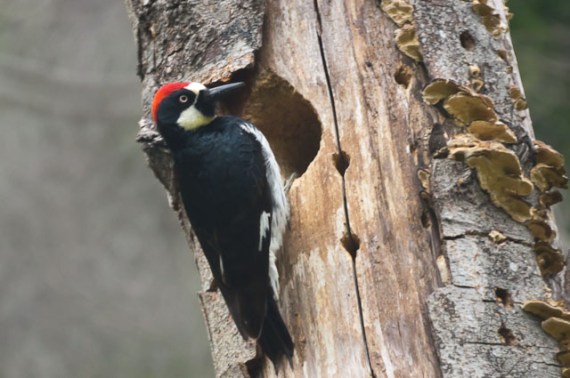
Male Acorn Woodpecker at the nest-hole. Solstice Canyon State Park
(Chuck Bragg 5-7-11)
Colonies can begin nesting earlier in the season when they have stored acorns. Studies have shown that colonies with a granary have larger clutches and fledge up to five times more young than colonies or pairs without granaries. Acorn Woodpeckers are great flycatchers, and during the breeding months, the chicks are fed insects, supplemented by fruit and granary acorns. As with humans, inheriting the “family farm” is a tremendous advantage. But not all breeding-age birds can wait that long.
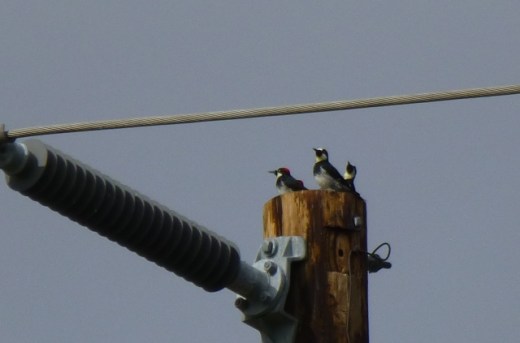
Acorn Woodpecker trio. Malibu Creek State Park, Reagan Ranch section
(Chuck Almdale 4-12-14)
Young female helpers often lay eggs in their mother’s nest. While the dominant female is good at preventing non-family birds from “dumping” eggs into her nest, she is unable to stop her own children from doing so, and cannot pick out and eject eggs not her own. So the helpers have a second reason to hang around. Colonies may even have multiple nest holes and multiple pairs of related birds simultaneously nesting.
Acorn woodpeckers don’t “sow” but they reap and they most definitely store their crop. Their complex and variable breeding strategies have evolved around their dependence on their granaries.

Long-tailed Shrike ready to swoop down on prey. Ambua Lodge, Papua New Guinea highlands (Chuck Almdale, August 2008)
Not all food stored by birds consists of nuts and grain. Shrikes store meat. The Shrike family Laniidae, distributed worldwide excepting Australia and South America, has thirty-two species. All feed primarily with a sit-and-wait method: perch upright on a bare twig or post or wire watching for movement, fly out to capture the prey, bring it back to eat it or store it in the “larder.” Prey can be large insects and small birds, reptiles or mammals, but they are known to kill prey 3-5 times as large as their own body mass. Two examples from Southern Grey Shrike larders: In India, one contained a 10-inch saw-scaled viper; in Israel, another held both a fat Sand Rat and a dead Southern Grey Shrike, an unwary intruder.
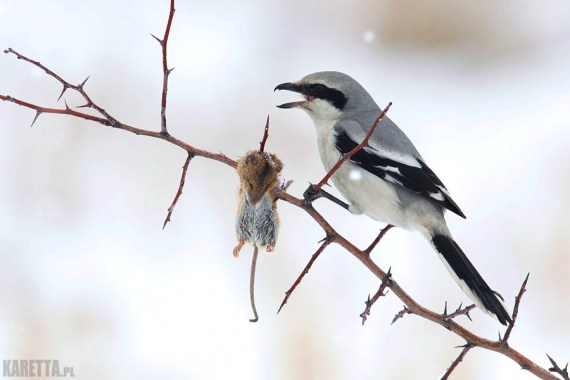
Great Grey Shrike and his impaled mouse.
(Aves et ales Animales 6-Mar-2015)
Their larder consists of thorns, sharp twigs or barbed wire, upon which they impale their dead prey; busy shrike may have many corpses thus impaled, for which habit they are also colloquially called “butcher birds.”
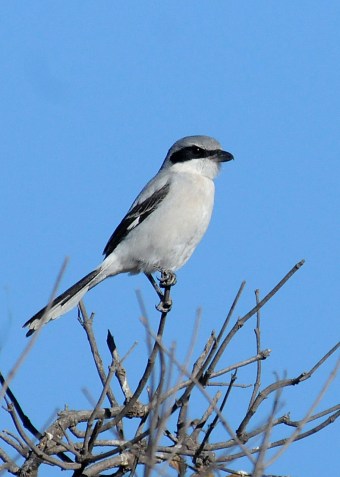
Loggerhead Shrike sits-and-waits on his bare twig perch. Malibu Creek State Park
(Jim Kenney 11-20-12)
Our local Loggerhead Shrike (Lanius Ludovicianus) is a 12-inch long passerine, looking much like a Mockingbird but with a thicker, hooked black bill. Lacking the talons of a true raptor, it kills its prey by crushing it in its bill or bashing it to death. They have figured out how to eat poisonous Monarch Butterflies: impale them on a thorn for up to three days until the poison breaks down. Shrikes, endemic to North America, have recently suffered an enormous population decline of 76% between 1966 and 2015, primarily due to eating pesticide-laden prey, it is suspected.
Clark’s Nutcracker, Acorn Woodpecker and Loggerhead Shrike – three local examples of the world’s hundreds, if not thousands, of examples of birds that sow or reap or store their food.
Bible Factoid #4 – Whence Jesus? (Ἰησοῦς –Ihsous)
Since we just finished nitpicking one of Jesus’ sayings, let’s take a look at the name itself. In modern America, many people pronounce it “Geezuz,” which would have been unrecognizable to Jesus’ family and friends. We’ll work backwards to see how it got this way.
The hard “J” that sounds like “G” (as in George) became permanently affixed to “Jesus” in 1611 CE by the King James Version of the bible, by which time the letter “J” had finally entered English. Since the Norman Conquest in 1066, the hard “J” had slowly evolved out of the much softer “IA,” primarily because people thought the hardness sounded more masculine: Iames became James, Ian and Iain became John (except in Scotland), Iestin became Justin, Ieremias became Jeremiah, and Iesus (ee-ay-soos) became Jesus (Gee-sus).
The 1384 CE translation by John Wycliffe from the Latin Vulgate bible into English had retained the earlier Latin “Iesus” (“ee-ay-soos”), which dated back to 382 CE, when Jerome completed the translation of the bible from Koine Greek into common (or “vulgar”) Latin. The Vulgate codified “Iesus” in Latin as the transliteration of Ἰησοῦς (Ihsous, pronounced “ee-ay-soos”) from the Koine Greek of the original New Testament books.
Koine Greek was the written language of the New Testament, but was not the only language spoken in first century Judea – Hebrew, Aramaic and Latin were also spoken; Aramaic was the predominant language around Galilee, whence came Jesus, the man. His Aramaic name was masculinized into New Testament Greek by adding “–s” to the end. [Think of Diogenes, Orestes, Herodotus, Ulysses.] Greek had neither the letter nor the sound of “Y;” “IH” was the closest approximation.

Joshua fittin’ the battle of Jericho, which sat on an earthquake fault (Noise Curmudgeon)
So the actual name of Jesus the person would have been “Y’shua” (Yod-Shin-Vav-Ayin) Y’-Sh-U-A. This spelling had evolved over centuries from “Yeshua”, which had, by the fifth century BCE, evolved from Yehoshu’a (“Yahweh is salvation” or “Yahweh will deliver”). Thus Y’shua, Yeshua and Yehoshu’a have all come down to us as “Joshua.” The name “Joshua” appears in seven books of the Jewish testament, most notably as the one who “fit the battle of Jericho,” as the song goes.
Jesus = Joshua = Yeshua = Yehoshu’a. But there’s more. Yeshua’s father was Joseph, which through similar changes was transliterated from Aramaic Yôsēp̄ and Hebrew Yossif (יוֹסֵף֙ – Yoseph “he will add”) . In Hebrew “ben” was added to indicate “son of,” as in Ben-Hur (“son of Hur”) or Ben-Gurion; this became “bar” in Aramaic, as in “Bar-Abba[-s]” or “Barabbas” (“son of Abba[-s]”) Matt 27-16
We can conclude that Jesus would have answered to the name Yeshua (or Y’shua) Bar-Yôsēp̄, a good Jewish Aramaic name. This brings us to a mystery, to be addressed in next week’s bible factoid.
Part I – What About That Dove? & The Flood of the Gilgamesh
Part II – Sandgrouse or Quail? & YHVH [יְהוָ֖ה] [Yahweh]
Part III – Junglefowl in Judea! & New Testament Koine Greek
Part V – The Friendly Raven & The Bar-Abbas Mystery
Part VI – The Humble Hoopoe & Catching “Forty” Winks
Part VII – The Wise Hoopoe & On “On”
Part VIII –Don’t Eat That Bird! Part 1 & Of “Of”
Part IX – Don’t Eat that Bird! Part 2 & Seeing “Red”
Part X – Don’t Eat that Bird! The Last Bite & The Problems of Translation
[Chuck Almdale]
Additional Sources:
Handbook of Birds of the World (HBW), Vol. 7. del Hoyo, J., Elliott, A. & Sargatal, J. eds. (2002) Lynx Edicions, Barcelona. Acorn Woodpecker – Pgs 441-442.
Handbook of Birds of the World (HBW), Vol. 13. del Hoyo, J., Elliott, A. & Christie, D.A. eds. (2008) Lynx Edicions, Barcelona. Shrikes, Loggerhead Shrike – Pgs 744-747, 785-786.
Handbook of Birds of the World (HBW), Vol. 14. del Hoyo, J., Elliott, A. & Christie, D.A. eds. (2009) Lynx Edicions, Barcelona. Nutcrackers, Clark’s Nutcracker – Pgs 611-613.
Birder’s Handbook. Ehrlich, Paul R., Dobkin, David S. & Wheye, Darryl. (1988) Simon & Schuster, New York. Pgs 344, 410, 466.
New English Bible with the Apocrypha, The, Oxford Study Edition. Sandmel, Samuel, Suggs, M. Jack, Tkacik, Arnold J.; eds. (1972) Oxford University Press, New York
World Shorebirds Day Reminder: 2 – 6 September, 2016

Red Knot – World Shorebirds Day Bird of the Year
Photographer: Mario Suárez Porras, Spain
Here’s a message from one of our farther-flung SMBAS Blog readers,
Gyorgy Szimuly, from his home in Milton Keynes, United Kingdom.
********************************************************
https://worldshorebirdsday.wordpress.com/2016/08/18/raffle-prizes-for-global-shorebird-counting-participants/
Should you have any question, please feel free to contact me.
Good news for the Gnatcatcher, bad news for coastal developers
The Labor Day weekend will be happier for birders this year. According to a front page article in the Los Angeles Times California Section, the USFWS has upheld endangered species protection for the California Gnatcatcher. Well-written article by Louis Sahagun with pertinent quotes.
http://www.latimes.com/local/california/la-me-ln-gnatcatcher-genes-20160830-snap-story.html
(Note: this article was published under different headlines electronically August 31st and in print edition September 3rd.)
Post-breeding migrants return: Malibu Lagoon, August 28, 2016

Royal Tern – Hey! Tryin’ to sleep here!
(Joyce Waterman 8-28-16)
Lillian and I didn’t feel comfortable with the identification; back home, Sunday night, we checked some additional references. Kirsten Wahlquist had a few photos and after peering at them on Monday morning, we sent them off to Kimball Garrett at the L.A. County Museum of Natural History.
Kimball’s reply: “These are Baird’s Sandpipers. Note the very long wingtips, quite unlike short-winged Least and Western [Sandpipers]. Also, the strong buffy tones to the plumage, and the neatly fringed upperparts.”
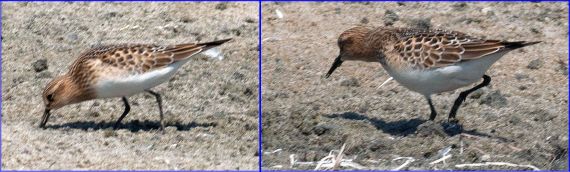
Baird’s Sandpipers (Kirsten Wahlquist, both photos 8-28-16)
Well…now that he points it out, I can see that the wings do look long, and I think I can see the tail (barely), a bit shorter than the wingtips. The strong buffy tone is

For comparison – pair of Baird’s.
Malibu Lagoon (Jim Kenney 2-10-07)
what was so noticeable on the beach. Actually, they looked almost rusty-red, much more so than any pictures we could find in our field guides. I’m not sure what “neatly fringed” means – maybe the finely detailed rusty and black pattern on the back and shoulders. The bird had dark legs, but not quite black as with Western Sandpiper and Sanderling, and often the shadow cast by the bird’s torso makes legs
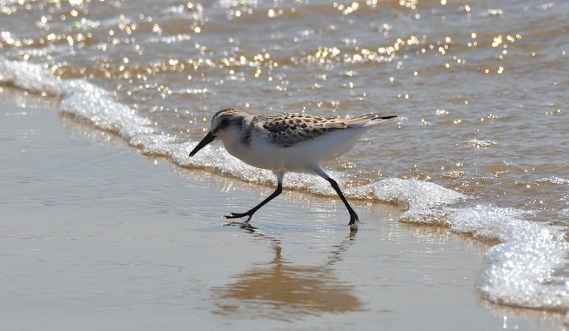
Sanderling scoots away from the foam. Compared to Baird’s above, Sanderlings have thicker bill with small end-knob, blacker legs, shorter wings , less buffy head-neck-breast and different back pattern. (Larry Loeher 8-28-16)
look much darker than they really are. The bill wasn’t right for Sanderling – too thin and no little “bulge” at the tip, nor for Western Sandpiper – a little too short and straight. Least Sandpiper didn’t seem quite right, but it seemed the least objectionable choice. So I thought they were Least; Lillian thought they could be Baird’s, and Kimball agreed. I really ought to know a Baird’s when I see one, but this was only the second time we’d seen them on our lagoon walk in over 35 years.

Brandt’s Cormorant cruises the surf zone (Joyce Waterman 8-28-16)
Shorebirds, or gulls, or terns, or flycatchers and warblers and sparrows for that matter, can be tough to figure out, especially during late summer, when young birds show up in juvenile plumage and adults may be in various stages of molting from breeding to non-breeding plumage. All sorts of weird-looking birds pop up.

Osprey about to snag a meal from the lagoon (Jeffrey Davidson 7-10-16)
Welcome to the many new faces this month, including eighteen parents and children on our 10am family walk. The birds only gets better, as their number and variety continues to increase through the winter until next April. Our extensive promotion staff – Grace Murayama – was very busy this month, getting the word out to local newspapers, organizations and bulletin boards. Many thanks, Grace!

One Royal Tern envies another’s beautiful fish (Larry Loeher 8-28-16)
We did our usual “sort-through” of the terns – Royal and Elegant. Some of the Royals were juveniles, still begging food from adults. Several of the juvvies had relatively short and very pale yellow bills, almost “bone” color. Chris “the Brit” alerted me to the presence of an uncommon Common Tern which we had missed when picking out the very similar Forster’s Terns. Of course as soon as we located it and took our eyes off it, it crouched down behind a low sand ridge and all we could see was 1/5th of an inch of its forehead. So we got closer until we could see the full head with its black nape, and the black carpel bar on the shoulder. This mark is formed by black feathers in the upper leading edge of the wing between the torso and “wrist.” Common Terns are common just about everywhere in the world except the North American west coast.
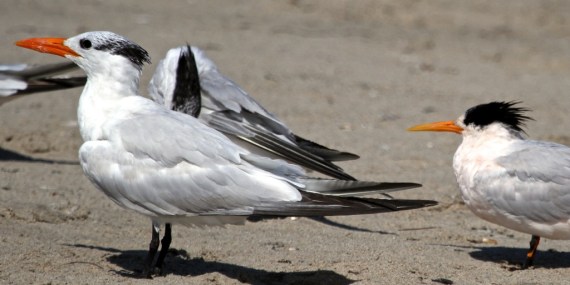
Royal Tern adult (L), Elegant Tern (R) (Joyce Waterman 8-28-16)
Study the photo above for the most useful Royal to Elegant differences. The Elegant will lose perhaps the frontal 1/3rd of the black cap, but otherwise little will change through the winter. The overall size, the bill shape, and placement of the eye within or not within the black feathers are ID keys.

Royal Tern adult & begging juvenile (Larry Loeher 8-28-16)
The ducks have not yet returned; lagoon breeders Mallard and Gadwall were present, as was one Brant. Brant has been present six of the last seven months. For some reason, over the past 10 years Brant have often been around during the summer. The peak of their presence was in 2010: from April through September, their numbers varied from three to eleven. In 2013, from February through October, they were present seven out of nine months.
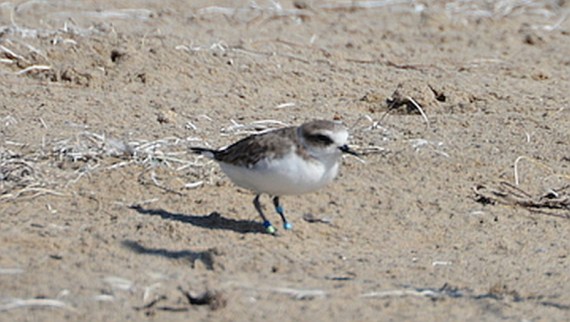
Snowy Plover AA:BL, ringed Fort Ord Summer’16 (Grace Murayama 8-28-16)
The Snowy Plover winter roosting colony continues to grow – 24 this time, with two ringed birds: GA:OY whom we’ve seen many times previously, and newcomer AA:BL (left leg Aqua over Aqua, right leg Blue over Lime), who received his or her rings this summer at Fort Ord.
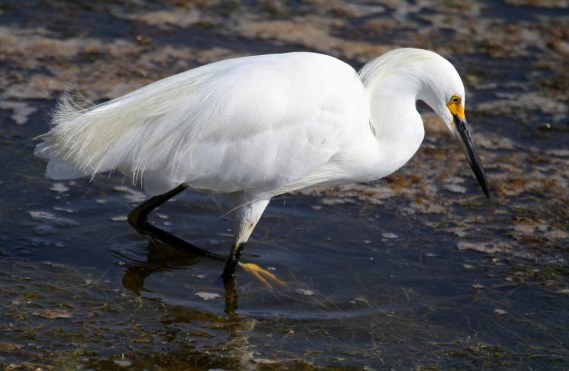
Snowy Egret (Joyce Waterman 8-28-16)
On my way to Adamson House, I spotted two Pelagic Cormorants below the end of Malibu Pier. One seemed to be hooked by a fisherman. I could see the line and fish on the end, with the apparently hooked cormorant attached to the fish. As the line was reeled in and the fish hoisted up, the cormorant went with them and I feared the worst had happened. At five feet above the water, the bird let go, plopped back into the water, and swam away with his compatriot. I suppose that he, or she, really wanted that fish and wasn’t giving up easily.
Birds new for the season were: Brandt’s and Pelagic Cormorants, Greater Yellowlegs, Marbled Godwit, Sanderling, Baird’s Sandpiper, Common Tern, Belted Kingfisher (male and female), Ash-throated Flycatcher, Western Kingbird, Orange-crowned Warbler, California Towhee, Hooded Oriole.
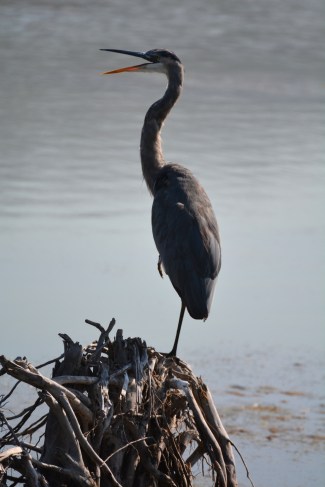
Great Blue Heron – is he laughing?
(Grace Murayama 8-28-16)
Also new (sort of) is the California Scrub-Jay. This is our regular scrub-jay, which many people insist on calling “Blue Jay” – they’re Jays that are blue, but they’re not “Blue Jays” – which are common east of the Rocky Mountains, but very uncommon in California. Our scrub-jay recently underwent a taxonomic split – Western Scrub-Jay was split into California Scrub-Jay and Woodhouse Scrub-Jay, which is a Great Basin bird. So if you’ve seen Western Scrub-Jay in New Mexico, western Colorado or eastern Utah, it almost certainly was a Woodhouse.
As always, many thanks to our photographers: Chuck Bragg, Larry Loeher, Grace Murayama, Kirsten Wahlquist and Joyce Waterman.
Our next four scheduled field trips: Coastal Cleanup Day – Malibu Lagoon 9am, 17 Sep; Malibu Lagoon 8:30 & 10am, 25 Sep; Bolsa Chica, 8 Oct 8:30am; Malibu Lagoon 8:30 & 10am, 23 Oct.

Common Yellowthroat singing
(Chuck Bragg 2-28-16)
Our next program: Roadrunners with Mark Mendelsohn, Tuesday, 4 Oct, 7:30 pm; Chris Reed Park, 1133 7th St., NE corner of 7th and Wilshire Blvd. in Santa Monica.
NOTE: Our 10 a.m. Parent’s & Kids Birdwalk meets at the shaded viewpoint just south of the parking area. Watch for Willie the Weasel. He’ll be watching for you and your big floppy feet.
Links: Unusual birds at Malibu Lagoon
9/23/02 Aerial photo of Malibu Lagoon
Prior checklists:
2016: Jan-June 2015: Jan-May, July-Dec
2014: Jan-July, July-Dec 2013: Jan-June, July-Dec
2012: Jan-June, July-Dec 2011: Jan-June, July-Dec
2010: Jan-June, July-Dec 2009: Jan-June, July-Dec
The 10-year comparison summaries created during the project period, despite numerous complaints, remain available on our Lagoon Project Bird Census Page. Very briefly summarized, the results unexpectedly indicate that avian species diversification and numbers improved slightly during the period Jun’12-June’14. [Chuck Almdale]
| Malibu Census 2016 | 3/27 | 4/24 | 5/22 | 6/26 | 7/24 | 8/28 |
| Temperature | 55-65 | 60-67 | 61-66 | 68-72 | 68-76 | 65-73 |
| Tide Lo/Hi Height | H+3.43 | H+3.63 | H+3.69 | L+0.32 | L+0.20 | H+4.28 |
| Tide Time | 1228 | 1143 | 1101 | 0831 | 0707 | 0810 |
| Brant | 2 | 1 | 2 | 1 | 1 | |
| Gadwall | 14 | 4 | 8 | 18 | 10 | |
| American Wigeon | 10 | |||||
| Mallard | 16 | 18 | 4 | 30 | 25 | 24 |
| Northern Shoveler | 14 | |||||
| Surf Scoter | 16 | |||||
| Red-breasted Merganser | 2 | 1 | 1 | |||
| Pacific Loon | 2 | |||||
| Common Loon | 1 | |||||
| Pied-billed Grebe | 3 | 1 | 2 | 4 | ||
| Eared Grebe | 2 | |||||
| Western Grebe | 1 | 1 | ||||
| Black-vented Shearwater | 200 | |||||
| Brandt’s Cormorant | 4 | 2 | 3 | |||
| Double-crested Cormorant | 6 | 23 | 7 | 35 | 18 | 34 |
| Pelagic Cormorant | 2 | |||||
| Brown Pelican | 28 | 77 | 14 | 94 | 39 | 9 |
| Great Blue Heron | 3 | 2 | 3 | 3 | 3 | |
| Great Egret | 5 | 2 | 1 | 7 | 4 | 1 |
| Snowy Egret | 7 | 4 | 2 | 6 | 8 | 3 |
| Black-crowned Night-Heron | 2 | |||||
| Turkey Vulture | 2 | |||||
| Osprey | 1 | 1 | 2 | 1 | ||
| Cooper’s Hawk | 1 | 2 | ||||
| Red-shouldered Hawk | 1 | |||||
| Red-tailed Hawk | 1 | |||||
| American Coot | 53 | 4 | 2 | 10 | ||
| Black-necked Stilt | 19 | |||||
| Blk-bellied Plover | 8 | 20 | 6 | 6 | 60 | 70 |
| Snowy Plover | 3 | 12 | 24 | |||
| Semipalmated Plover | 8 | 4 | 8 | |||
| Killdeer | 3 | 2 | 6 | 8 | 6 | 9 |
| Spotted Sandpiper | 1 | 1 | 3 | 5 | ||
| Greater Yellowlegs | 1 | |||||
| Willet | 12 | 10 | 16 | 11 | 30 | 2 |
| Whimbrel | 21 | 2 | 16 | 2 | ||
| Marbled Godwit | 15 | 6 | 1 | |||
| Ruddy Turnstone | 1 | 5 | 9 | |||
| Surfbird | 1 | |||||
| Sanderling | 5 | |||||
| Baird’s Sandpiper | 5 | |||||
| Least Sandpiper | 13 | 7 | 15 | 2 | ||
| Western Sandpiper | 35 | 1 | 1 | 7 | 6 | |
| Common Murre | 3 | |||||
| Bonaparte’s Gull | 3 | |||||
| Heermann’s Gull | 2 | 8 | 130 | 12 | 4 | |
| Ring-billed Gull | 15 | 1 | 26 | 1 | ||
| Western Gull | 45 | 60 | 23 | 120 | 45 | 118 |
| California Gull | 130 | 15 | 3 | 3 | 1 | |
| Glaucous-winged Gull | 1 | 1 | ||||
| Least Tern | 2 | |||||
| Caspian Tern | 3 | 19 | 9 | 11 | 2 | 2 |
| Common Tern | 1 | |||||
| Forster’s Tern | 1 | 3 | ||||
| Royal Tern | 18 | 2 | 48 | 5 | 3 | 10 |
| Elegant Tern | 5 | 1800 | 10 | 110 | 10 | 67 |
| Rock Pigeon | 6 | 6 | 1 | 23 | 4 | 8 |
| Mourning Dove | 2 | 1 | 2 | 2 | 2 | |
| Anna’s Hummingbird | 1 | 3 | ||||
| Allen’s Hummingbird | 4 | 4 | 2 | 1 | 5 | 5 |
| Belted Kingfisher | 1 | 2 | ||||
| American Kestrel | 1 | 1 | ||||
| Nanday Parakeet | 2 | |||||
| Black Phoebe | 6 | 4 | 1 | 2 | 7 | 3 |
| Ash-throated Flycatcher | 2 | |||||
| Cassin’s Kingbird | 1 | |||||
| Western Kingbird | 1 | |||||
| Calif. Scrub-Jay | 1 | 2 | 1 | 1 | 3 | |
| American Crow | 6 | 4 | 4 | 6 | 3 | 5 |
| Common Raven | 1 | 1 | ||||
| Violet-green Swallow | 1 | |||||
| Rough-winged Swallow | 10 | 10 | 6 | 6 | 4 | 4 |
| Cliff Swallow | 1 | 6 | 4 | 7 | 15 | 4 |
| Barn Swallow | 6 | 4 | 4 | 20 | 20 | 20 |
| Oak Titmouse | 1 | |||||
| Bushtit | 5 | 4 | 2 | 15 | 5 | |
| Bewick’s Wren | 1 | |||||
| Western Bluebird | 1 | |||||
| Hermit Thrush | 1 | |||||
| American Robin | 2 | 1 | 1 | |||
| Northern Mockingbird | 4 | 6 | 2 | 2 | 2 | 2 |
| European Starling | 1 | 2 | 2 | 10 | 40 | 20 |
| Orange-crowned Warbler | 1 | |||||
| Common Yellowthroat | 5 | 1 | 1 | 4 | 3 | |
| Spotted Towhee | 1 | |||||
| California Towhee | 5 | 3 | 1 | |||
| Song Sparrow | 12 | 14 | 2 | 3 | 3 | 2 |
| White-crowned Sparrow | 5 | |||||
| Black-headed Grosbeak | 1 | |||||
| Red-winged Blackbird | 5 | 4 | 15 | 12 | 30 | |
| Western Meadowlark | 2 | |||||
| Brewer’s Blackbird | 6 | 12 | ||||
| Great-tailed Grackle | 9 | 3 | 3 | 4 | 20 | 3 |
| Brwn-headed Cowbird | 2 | |||||
| Hooded Oriole | 1 | 3 | ||||
| Bullock’s Oriole | 2 | 1 | ||||
| House Finch | 21 | 16 | 7 | 6 | 25 | 6 |
| Lesser Goldfinch | 1 | |||||
| House Sparrow | 3 | |||||
| Totals by Type | Mar | Apr | May | Jun | Jul | Aug |
| Waterfowl | 74 | 22 | 14 | 33 | 44 | 35 |
| Water Birds – Other | 100 | 106 | 22 | 129 | 262 | 62 |
| Herons, Egrets & Ibis | 15 | 6 | 5 | 18 | 15 | 7 |
| Quail & Raptors | 2 | 1 | 1 | 3 | 5 | 2 |
| Shorebirds | 113 | 76 | 28 | 26 | 158 | 149 |
| Gulls & Terns | 219 | 1903 | 127 | 382 | 74 | 206 |
| Doves | 8 | 7 | 3 | 23 | 6 | 10 |
| Other Non-Passerines | 7 | 5 | 2 | 4 | 5 | 7 |
| Passerines | 105 | 95 | 60 | 86 | 174 | 118 |
| Totals Birds | 643 | 2221 | 262 | 704 | 743 | 596 |
| Total Species | Mar | Apr | May | Jun | Jul | Aug |
| Waterfowl | 7 | 2 | 4 | 3 | 3 | 3 |
| Water Birds – Other | 9 | 4 | 3 | 2 | 6 | 6 |
| Herons, Egrets & Ibis | 3 | 2 | 3 | 4 | 3 | 3 |
| Quail & Raptors | 2 | 1 | 1 | 2 | 3 | 2 |
| Shorebirds | 11 | 10 | 3 | 4 | 10 | 14 |
| Gulls & Terns | 8 | 8 | 7 | 9 | 6 | 8 |
| Doves | 2 | 2 | 2 | 1 | 2 | 2 |
| Other Non-Passerines | 3 | 2 | 1 | 2 | 1 | 2 |
| Passerines | 22 | 20 | 17 | 15 | 17 | 19 |
| Totals Species – 99 | 67 | 51 | 41 | 42 | 51 | 59 |



 SANTA MONICA BAY AUDUBON SOCIETY BLOG