Free email delivery
Please sign up for email delivery in the subscription area to the right.
No salesman will call, at least not from us. Maybe from someone else.
L.A. River Field Trip Report: Aug. 27, 2016
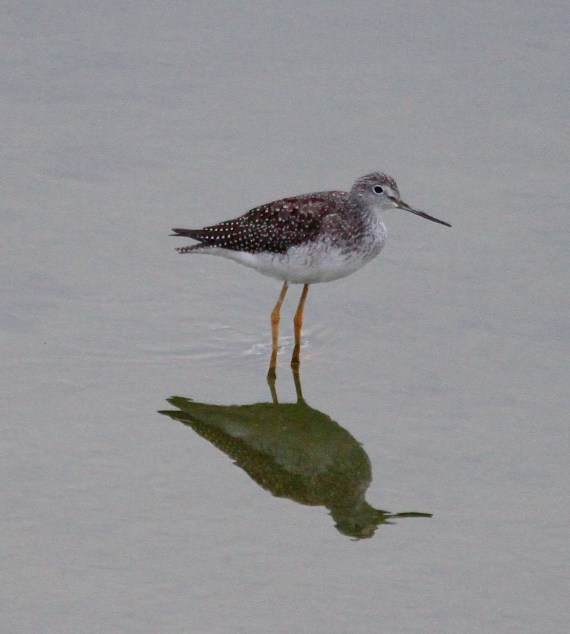
Greater Yellowlegs, Lower Los Angeles River. Joyce Waterman 8/27/2016
For the second year in a row we enjoyed a “Coastal Eddie” overcast as we birded the lower Los Angeles River area for rarities and early migrants. Dick Barth, who regularly scouts the area starting mid-summer, was our guide to the latest arrivals and the encyclopedic resource to the history since he started perusing the long-legged species of the concrete channel in the 90’s. We started at the Willow Street bridge over the I-710 with 18 participants at 7 AM. This is the non-concreted area where we can see some ducks, and this year a White Pelican!

American White Pelican, Lower Los Angeles River.
Joyce Waterman 8/27/2016
We also had comparative looks at Lesser and Greater Yellowlegs. This reporter/leader will not reveal his ignorance about the ID of eclipse plumage Blue-winged Teal vs. Cinnamon Teal, nor, of course, Northern Shoveler. (And this, despite a careful lesson from Dick Barth at Malibu Lagoon in 1996!)
After an hour-plus of walking up and down the riverbank we drove to DeForest Park upriver, where we concentrated on the quick-moving warblers et al. in the tall trees adjacent to the riverbank walkway.
Having gulped down an early lunch, some of the hardiest transited upstream to Firestone Blvd and down a bit to Southern Avenue where the Baird’s Sandpiper made its “obligatory” appearance only 100 feet below us. However, the excitement quotient was possibly exceeded by the close-UUUUUPPP! arrival of a Peregrine Falcon on a telephone pole directly above our cars as we arrived at the bank parking spot.

Baird’s Sandpiper and 3 Least Sandpipers, Lower Los Angeles River
Thomas Hinnebusch 8/27/2016
It was another exceptional outing with Dick Barth’s expertise and more species than one is likely to see anywhere else in a morning in L.A. County in the middle of summer. I have posted the species results on eBird for each of the three sites. Email me if you cannot find the lists. plauzoles@me.com
Request from a number of birders to CalTrans: No more surprise-closed off-ramps!
[Lucien Plauzoles]
Trip List 8/27/16 – 3 Locations
Mallard (Anas platyrhynchos) 12
Blue-winged Teal (Anas discors) 2
Cinnamon Teal (Anas cyanoptera) 6
Pied-billed Grebe (Podilymbus podiceps) 1
Double-crested Cormorant (Phalacrocorax auritus) 3
American White Pelican (Pelecanus erythrorhynchos) 1
Great Blue Heron (Ardea hernias) 2
Snowy Egret (Egret thula) 3
Green Heron (Butorides virescens) 1
Black-crowned Night-Heron (Nycticorax nycticorax) 1
Turkey vulture (Catharses aura) 1
Osprey (Pandion haliaetus) 3
American Coot (Fulica americana) 5
Black-necked Stilt (Himantopus mexicanus) 80
American Avocet (Recurvirostra americana) 15
Semipalmated Plover (Charadrius semipalmatus) 13
Killdeer (Charadrius vociferus) 8
Baird’s Sandpiper (Calidris bairdii) 3
Least Sandpiper (Calidris minutia) 20
Western Sandpiper (Calidris mauri) 60
Short-billed Dowitcher (Limnodromus griseus) 4
Long-billed Dowitcher (Limnodromus scolopaceus) 30
Greater Yellowlegs (Tringa melanoleuca) 13
Willet (Tringa semipalmata) 2
Spotted Sandpiper (Actitis macularius ) 1
Lesser Yellowlegs (Tringa flavipes) 7
Bonaparte’s Gull (Chroicocephalus philadelphia) 1
Ring-billed Gull (Larus delawarensis) 7
Western Gull (Larus occidentalis) 24
California Gull (Larus californicus) 20
Caspian Tern (Hydroprogne cassia) 2
Rock Pigeon (Feral Pigeon) (Columba livia (Feral Pigeon)) 8
Eurasian Collared-Dove (Streptopelia decaocto) 2
Mourning Dove (Zenaida macroura) 2
Vaux’s Swift (Chaetura vauxi) 3
Anna’s Hummingbird (Calypte anna) 1
Allen’s Hummingbird (Selasphorus satin) 1
Peregrine Falcon (Falco peregrinus) 1
Black Phoebe (Sayornis nigricans) 6
Warbling Vireo (Vireo gilvus) 1
American Crow (Corvus brachyrhynchos) 4
Northern Rough-winged Swallow (Stelgidopteryx serripennis) 9
Barn Swallow (Hirundo rustica) 11
Cliff Swallow (Petrochelidon pyrrhonota) 20
Bushtit (Psaltriparus minimus) 18
Orange-crowned Warbler (Oreothlypis celata) 2
Black-throated Gray Warbler (Setophaga nigrescens) 1
Townsend’s Warbler (Setophaga townsendi) 1
California Towhee (Melozone crissalis) 1
Red-winged Blackbird (Agelaius phoeniceus) 14
Yellow-headed Blackbird (Xanthocephalus xanthocephalus) 3
Brewer’s Blackbird (Euphagus cyanocephalus) 11
Great-tailed Grackle (Quiscalus mexicanus) 3
House Finch (Haemorhous mexicanus) 4
Lesser Goldfinch (Spinus psaltria) 3
Northern Red Bishop (Euplectes franciscanus) 1
Scaly-breasted Munia (Lonchura punctulata) 8
57 species at three locations
Junglefowl in Judea: Sunday Morning Bible Bird Study III
This Week’s Lesson – Junglefowl in Judea?
Link to entire 10-blog Birds in the Bible series on one page
Flood-pigeons, desert-quail – what could be next? Our topic this week is arguably the second most famous bird in the bible, following the pigeon and his Noah. We speak, of course, of the chicken, or more specifically, the male of the species, the cock.

Cock Red Junglefowl in all his glory, Corbett Nat. Park. northeast India (Rahul Pratti)
Peter replied, ‘Everyone else may fall away on your account, but I never will.’ Jesus said to him, ‘I tell you, tonight before the cock crows you will disown me three times.’ Matt. 26:33-34 New English Bible

Methinks the man doth protest too much. (Tatcog School)
Shortly afterwards the bystanders came up and said to Peter, ‘Surely you are another of them; your accent gives you away!’ At this he broke into curses and declared with an oath: ‘I do not know the man.’ At that moment a cock (ἀλέκτωρ – alektor) crew; and Peter remembered how Jesus had said, ‘Before the cock crows you will disown me three times.’ He went outside, and wept bitterly. Matt. 26.73-75 New English Bible
The third time is the charm, as they say. All Christians ought to know of this story, as will many non-Christians. Who cannot feel both pity for poor Simon “Peter” (Πέτρος – Petros: Greek** for rock), and embarrassed empathy with him in his cowardice and fear. How many of us would be courageous and foolish enough to declare faith and allegiance to Jesus, when he’d just been hauled off, probably to be executed, along with any followers who didn’t slip away.
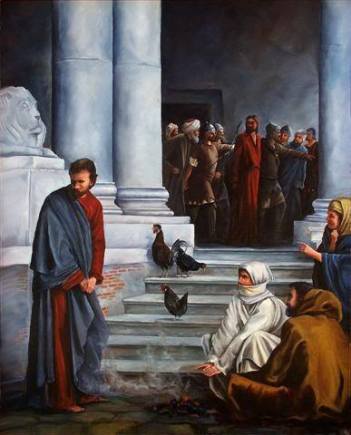
Peter, the rooster and Jesus; Copy of painting by Carl Heinrich Bloch 1834-90 (RonCarol205)
The story tells us that Jesus – well aware of Simon’s rash and boastful tendencies – told him that despite his protestations of faithfulness unto death, Simon wouldn’t even make it until the next dawn before “chickening out” three times. Yet, Jesus forgives Simon his weakness in advance.
This is one of the few tales found in all four Gospels. After the troops arrest Jesus, Simon follows them to see what will happen. Perhaps he will rescue Jesus! In three versions, Simon is alone; in John 18:15 he is accompanied by another disciple. He (or they), end up at the High Priest’s house, where he mingled with others in the courtyard around a fire, trying to stay warm, (see picture above) yet still keep a low profile. But his northerner’s accent gave him away as one of the Galilean followers of Jesus.
Mark 14:72 has the cock crowing twice; the other three passages agree on once. But we’ll now leave Simon and Jesus to follow our own trail, which is to examine the third actor in this play, that crowing rooster, and see how he got to first century Judea and why he was crowing.
Anyone who has ever slept near a farmyard, anywhere around the world, knows that roosters (or cocks, as the male of the chicken and allied species are called, as in Peacock), call at dawn, waking us up whether we want to or not. Actually, nearly all birds with any kind of voice and who maintain personal territories, call around dawn during their breeding season, largely to let their avian neighbors know that they lived through the night and they’d better stay out of his territory. Most aren’t as loud as the rooster, for whom it seems to be always breeding season.
Travelers to the tropics are often enchanted by the rainforest “dawn chorus’. Birds begin murmuring their nearly inaudible ‘whisper songs’ around first light, as if still groggy, get really loud around dawn, and dwindle away by ½ – 1 hour after dawn, when it’s light enough for them to begin finding their first meal of the day. In fact this happens everywhere; but it’s more noticeable when 500 species of birds sing within a mile of your bed. Cocks are no exception; his territory may consist of only a few bare square feet of ground, but it’s his and he will fight to the death to protect it and his mating rights with any hens therein. In Muslim countries, cocks first crow at first light, when the Muezzin first calls the faithful to prayer, when the still-unseen sun tints, however slightly, the eastern sky.)
About one-third of the 174 members of the Phasianidae (Pheasant & Partridge family) are non-monogamous, including the Red Junglefowl (Gallus gallus), the official English name for our chicken species. Red Junglefowl are very sexually dimorphic, and the male has larger tail and fleshy comb, with overall brighter and more colorful plumage. The male maintains his territory by crowing and fighting with male intruders, using his bony spurs as weapons, and he gathers as many females as he can. Crowing, especially at dawn, is essential to the his survival, to fulfill his evolutionary imperative to get his genes into the next generation as often and as successfully as possible. Within his territory, the rooster “rules the roost.”
According to the Oxford English Dictionary, the English name “cock” for the male chicken is from “kokke” in Old English, “coq” in 12th century French, and kokkr in Old Norse. All these names are likely echoic, imitative of its voice, as in “cock-a-doodle-doo.” The name “rooster” comes from “one who roosts;” both males and females of many Phasianidae species spend the night safely roosting on tree limbs.

Home range of Red Junglefowl
(Handbook of Birds of the World)
All domesticated animals originated somewhere; they haven’t always lived in our backyards. Cattle originated in Europe, where wild cattle are long extinct; Ring-necked Pheasants ranged from western Georgia, east of the Black Sea, to east China; Guinea Pigs began in Peru, where they were a favorite food of the Incas. Red Junglefowl originated in Southeast Asia, where they still range from Nepal and central India eastward through Burma, Vietnam, and Malaysia to the Indonesian Lesser Sunda Islands. Their traditional range likely stopped at Bali, just west of the Wallace Line dividing Asian fauna from Austronesian fauna, but they now live throughout Sulawesi and the Philippines
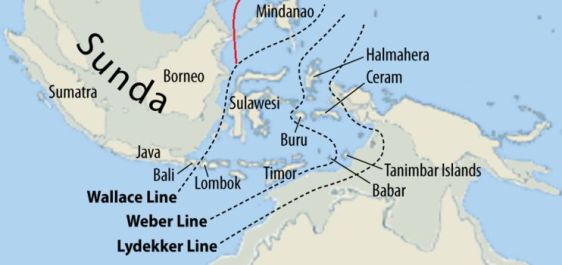
Wallace Line – Bali is eastern end of Red Junglefowl range, excluding introductions by humans. (Wikimedia)
where they were introduced millennia ago. Their official English name, Red Junglefowl, comes from their original color and preferred habitat. Even now, they regally stalk silently through the forest undergrowth, scratching the soil for seeds, grubs, and grit, leading their precocial chicks on their daily search for food. It is a wonderful thing to hear the dawn territorial call of a cock Red Junglefowl in the dripping ink-black rainforest of Malaysia, and know that this bird has escaped the doom befallen so many of his brethren. It’s even more wonderful to see them; both sexes are beautiful, magnificently plumaged birds. This pair, at least, will never suffer that most humiliating of all fates, to become a McNugget.
According to recent genetic studies, the clade of Red Junglefowl living at the western end of their range, in India, are the ancestors of all domestic chickens now found throughout the New World, Europe and the Middle East.

Location of chicken fossils, Yellow River area, China (Daily Mail)
In northern China, fossilized Chicken bones dating back 10,500 years were recently discovered in the Yellow River area, which DNA analysis determined to be Gallus gallus. This area is well outside the known historical range of the species and they are likely the oldest examples of domesticated chickens in the world. It is thought that the ancestors of this group were from southeast Asia – Vietnam for example – rather than from the Indian clade.
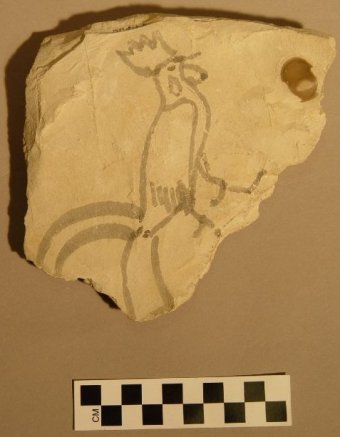
Ostracon of rooster c.1500 BCE, discovered by Howard Carter, 1923, while searching for King Tut’s tomb. (British Museum)
An ostracon (inscription on potsherd) from fifteenth century Egypt depicts a cock. The Annals of Thutmose III (1558-1538 BCE), describing his battles in Babylonia, mentions bringing back to Egypt the “bird that gives birth every day.” By the fifth century BCE they appeared in Lydia (Western Turkey) and Greece.
A Greek legend tells us that western civilization was saved by chickens! In 480 BCE, Athenian general Themistocles, leading his troops to fight Persian invaders stopped to watch two cocks fighting by the side of the road. He gathered his men to watch and said, “Behold, these do not fight for their household gods, for the monuments of their ancestors, for glory, for liberty or the safety of their children, but only because one will not give way to the other.” The soldiers took heart from this – perhaps they didn’t want to seem less courageous than chickens – and marched on to defeat the Persians, thereby saving Athens, Greece, Democracy and Western Civilization. Score one for the chickens, the very models of bravery.
Nowadays, chickens are found by the billions wherever humans live. We are surrounded by these fowl in so-called egg or chicken “factories,” living lives that make our lives of quiet desperation (as Thoreau said) seem in comparison like ecstasy in paradise. We have thoroughly, remorselessly, and unremittingly domesticated them, but it wasn’t always so.
Chickens then, as now, were common trade goods between peoples. These useful and easily maintained animals produce eggs, feathers and flesh; they’re great predators of annoying pests in your garden; the males, equipped with sharp spurs on the back of their feet, are the central attraction of one of the world’s oldest blood “sports” and gambling attractions. Such an animal would spread rapidly among all people who encountered them. Evidence suggests that the residents of Harappa in the Indus Valley not only had chickens, but they traded with the Middle East. Directly or indirectly, chickens were traded hand to hand, village to village, tribe to tribe, nation to nation, until they made their way to Persia, Syria, Egypt, Lydia, Greece and Judea, where they were common as dirt long before the birth of Jesus. Jesus and Simon may have walked from the Galilee to Jerusalem, but that rooster and his ancestors came a whole lot farther. They were so common in Judea that they were hardly worth mentioning, and wouldn’t have been, if first century Jews couldn’t reliably count on them as heralds of the coming dawn, when the new sun shines on us all.

Rooster on top of First Presbyterian Church, Wilmington, NC (MyReporter)
There is one – and only one – additional mention of chickens in the entire bible.
“O, Jerusalem, Jerusalem the city that murders the prophets and stones the messengers sent to her! How often have I longed to gather your children, as a hen (ὄρνις – ornis) gathers her brood under her wings, but you would not let me.” Matthew 23:37
Had this image caught on, rather than that of the good shepherd with his lambs, it might have completely changed the course of Christian iconography. Imagine, if you can, Jesus as the “Hen of God,” and all people as his chicks.
But chickens weren’t completely overlooked by the new religion. Pope Nicholas I (858-867 CE) decreed that a figure of a rooster should be placed atop every church as a reminder of our story—which is why many churches still have rooster-shaped weather vanes.
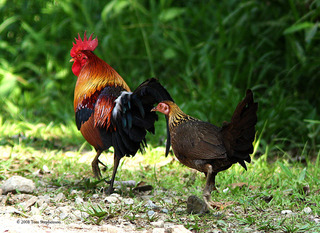
Red Junglefowl pair in forest, where they belong.
(DiscoverLife – Tom Stephenson)
I’ll leave you with one final thought. People today often assume that commerce of goods and ideas between the Orient and the Occident was nearly nonexistent in ancient days. But we now see that chickens, tangible, living animals subject to loss, escape and death, were transported by humans through forests, deserts and rugged mountains, at least 2500 miles by land, well before the time of Jesus. What about intangible things? Our so-called “Arabic numerals” originated in India, where Persians discovered them and popularized them in the Middle East around 825 CE. We know that chickens preceded Arabic numerals by 2300 years. Might not ideas, ethics, philosophies, religious values and theological tenets have made their way back and forth even more easily? Perhaps the origins of the religions and philosophies of the Mediterranean and Middle East – the philosophy of Greece, the polytheism of Egypt, Greece, and Rome, the monotheism of Jews, Christians and Muslims – are not so local and insular as they appear on first glance.
For much more on the history of Red Junglefowl: Smithsonian – How the Chicken Conquered the World
And…just to shake the ground beneath our feet, here’s another view which posits that the cock in our story was not a bird at all, but a horn!
**Bible Factoid #3 – New Testament Greek
You may have noticed that we are now translating from Greek, not Hebrew. The New Testament was written in Greek – not Hebrew, Aramaic, Latin and definitely not the English of the King James Version (1611). The language was not classical Greek, but Koine (street, common or vulgar) Greek. Koine, also called Hellenistic Greek, developed from the various classical Greek dialects and was the main spoken form from the time of Alexander the Great (died 323 BCE) until about the time of Tiberius II Constantine, circa 580 CE. New Testament Koine Greek was filled with local semiticisms, not used elsewhere in the Greek-speaking world. [Imagine if the King James Version had been written in modern Jamaican patois rather than Elizabethan English.]
After Alexander’s conquest, the Middle East was ruled by Greeks (Hellenistic Period) until the Romans conquered the Middle-Eastern empire of the Seleucids in 63 BCE. Greek was the dominant cultural language, so much so that the Jewish Scriptures (the Christian Old Testament) were translated from the original Hebrew into Koine Greek, beginning in the third century BCE and finished in 132 BCE. This translation, called the Septuagint (frequently abbreviated LXX) for the 70 (or 72) scholars reportedly involved in the translation, is believed to have been commissioned by Egyptian King Ptolemy II Philadelphus and intended for the Library at Alexandria. In 1st century CE Judea, Hebrew was still spoken alongside Greek and Aramaic. Aramaic was dominant in Galilee and was probably spoken by Jesus and his followers. A few of the words of Jesus quoted in the Gospels are in Aramaic – abba (familiar form of father – “papa”) and ephphatha (“be opened”) for example.
Part I – What About That Dove? & The Flood of the Gilgamesh
Part II – Sandgrouse or Quail? & YHVH [יְהוָ֖ה] [Yahweh]
Part IV – Birds that Sow, Reap and Store & Whence Jesus (Ἰησοῦς)
Part V – The Friendly Raven & The Bar-Abbas Mystery
Part VI – The Humble Hoopoe & Catching “Forty” Winks
Part VII – The Wise Hoopoe & On “On”
Part VIII –Don’t Eat That Bird! Part 1 & Of “Of”
Part IX – Don’t Eat that Bird! Part 2 & Seeing “Red”
Part X – Don’t Eat that Bird! The Last Bite & The Problems of Translation
[Chuck Almdale]
References not linked above
Handbook of Birds of the World (HBW), Vol. 2. del Hoyo, J., Elliott, A. & Sargatal, J. eds. (1994) Lynx Edicions, Barcelona. Pgs 452, 529-30.
New English Bible with the Apocrypha, The, Oxford Study Edition. Sandmel, Samuel, Suggs, M. Jack, Tkacik, Arnold J.; eds. (1972) Oxford University Press, New York
Oxford Companion to the Bible. Metzger, Bruce M. & Coogan, Michael D. eds. (1993) Oxford University Press, New York.
Additional Reading
How the Chicken Conquered the World. Adler, Jerry & Lawler, Andrew. Smithsonian Magazine, June 2012.
Sandgrouse or Quail?: Sunday Morning Bible Bird Study II
This Week’s Lesson – Sandgrouse or Quail?
Link to entire 10-blog Birds in the Bible series on one page
This week’s topic comes from Exodus and Numbers, books two and four of the Pentateuch, when the Israelites, fearing starvation in the barren Sinai desert wastes, pine for the “fleshpots of Egypt,” and Yahweh promises to bring them manna and flesh to eat. [I’ll use Yahweh**, the commonly accepted name for the deity, as it’s the closest transliteration of the Hebrew YHVH, spelled without vowels, written in these passages.]

Climbing Mt. Sinai (Rough Guides)
The Lord [יְהוָ֖ה – Yahweh] spoke to Moses and said: “I have heard the complaints of the Israelites. Say to them, “Between dusk and dark you will have flesh to eat and in the morning bread in plenty.”.…That evening a flock of quails (שְׂלָו – selav) flew in and settled all over the camp…
Exod. 16.11-13 New English Bible
Then a wind from the Lord sprang up; it drove quails (שְׂלָו – selav) in from the west, and they were flying all round the camp for the distance of a day’s journey, three feet above the ground. The people were busy gathering quails all that day, all night, and all next day, and even the man who got least gathered ten homers. [10 homers = 890 gallons!] They spread them out to dry all about the camp. But the meat was scarcely between their teeth, and they had not so much as bitten it, when the Lord’s anger broke out against the people and he struck them with a deadly plague. Num. 11.31-33 New English Bible

Cartoon by Jeff Larson
The careful reader of these two passages, with their surrounding passages, will notice that in Exodus the quail and manna are simply sustenance as promised by Yahweh, whereas in Numbers, the quail are a punishment for the Israelite’s complaints about having only manna to eat; many of the people sicken and die from eating the quail. I’ll set aside this inconsistency and address our birder’s issues: what kind of birds are these, where did they come from, and what are they doing in the Sinai desert? Are numbers as enormous as described possible?
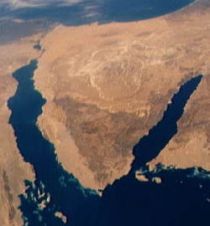
Sinai Peninsula satellite view from southeast (New World Encyclopedia)
Descriptions of birds given by non-birders are notoriously insufficient and inaccurate, as are what they think is the bird’s name. What birder has not been asked to identify a bird based on a verbal description which fits either hundreds of species (“It was dark and small…”), or no species at all? (“…with long legs and a green crest.”) One learns to be skeptical and to closely question in order to gather useful information. When I first read the above passages, the sandgrouse came immediately to mind. It’s not a quail, but an inexperienced, unconcerned or naked-eye observer might think it a quail, and binoculars were certainly lacking in the ancient Middle East.
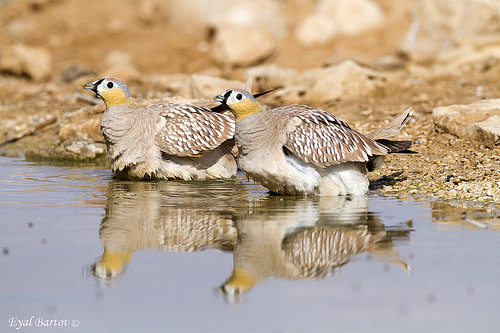
Crowned Sandgrouse soaking their breast feathers
(HotspotBirding.com)
Sandgrouse are an interesting family of sixteen species, grouped into two genera. [Video] They are currently classified in their own order, Pterocliformes (notable wing), but they were previously placed in the order of Pigeons (Columbiformes) to whom they are remarkably similar. Sandgrouse habitats are typically described as “inhospitable,” “barren,” or “sere,” and includes wastes, plains, savanna and thorn scrub from western and southern Africa to India and Manchuria. [In a hot and unbelievably barren waste in South Africa, I once nearly stepped on a beautifully camouflaged sandgrouse, whom I did not see until it flushed from its nest and eggs, a foot from my feet.] Because they typically nest far from any water, they must swiftly fly (60 mph is common) long distances for water and carry it back to their nestlings. A unique adaptation enables them to do this: breast feathers which absorb water like a sponge and retain it well enough to allow their returning it to their young, who lap the moisture from their breast.
Birders know the most certain way to spot sandgrouse is to hide by a desert waterhole. Sandgrouse, usually in groups, visit waterholes in the morning and especially in the evening, first drinking, then wading into water to saturate their breast feathers, then flying back home. It seems that sandgrouse might be the answer to our question: they resemble a grouse (or quail), they live only in desert-like habitats, and they invariably come to waterholes in the evening.

Crowned Sandgrouse flock at pool in Israel (Eyal Bartov)
There are three species currently living in the Sinai desert and adjacent regions: Spotted (Pterocles senegallus), Black-bellied (P. orientalis), and Crowned (P. coronatus); the Pin-tailed (P. alchata) Sandgrouse lives nearby in Arabia and Mesopotamia.
However, one problem remains. Because they are non-migratory permanent residents in their respective ranges (except for altitudinal migration of the Tibetan Sandgrouse), sandgrouse don’t congregate in large flocks as do many birds during migration, and their arid, barren homes can not support large resident concentrations of them. Perhaps sandgrouse is not the bird after all.
The Common Quail, Coturnix coturnix, (also called European or Eurasian Quail) has been very well-known for a very long time in the old world. Egyptian hieroglyphics from 5000 BC picture them. Their northern breeding range runs from western Morocco, throughout Europe to the Baltic States, across Russia and the Middle East to Lake Baikal and India. The western Eurasian breeders winter in Egypt and down the Nile River to Sub-Saharan Africa, while central Asian breeders winter in India. Some far-western birds migrate past Gibraltar, but most avoid that enormous barrier to European avian migration, the Mediterranean Sea, by flying around the east end: through Egypt, the Sinai, Israel, Jordan, Lebanon, Syria, Turkey and onward to Europe and western Asia. Northbound flocks can be in the hundreds; southbound groups are usually much smaller.
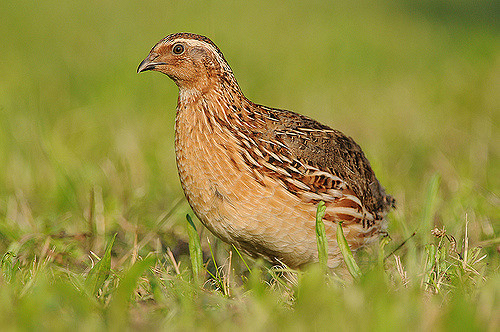
Common or European Quail (Ján Svetlík)
All other quail species are non-migratory residents and are poor flyers: fast and noisy on take-off but not adapted for sustained flight, and typically fly short and low. The Common Quail, adapted to migration, is longer-winged than other quail, and while able to fly swiftly, they also fly quite low, often nearly hugging the ground. Even today, many thousands of them are netted annually during migration in Sinai and other parts of Egypt; such annual netting used to number into the millions, but the population became dangerously reduced during 1970-1990.
Sinai net-hunting is like that elsewhere in Europe; nets are strung along valleys and mountain ridges where birds fly very close to the ground to conserve energy. It’s near-certain that for as long as humans have lived in this area, migrating Common Quail have provided a tasty and bountiful springtime repast. Flying, for quail, is thirsty work, and they try to find water before night falls, when they either go to roost or continue their migration in the dark. The mirror-like shine of desert water pools, visible for miles during daylight, become invisible ink blots at night, so stopping near sundown is best. Common Quail can and do migrate during the day and/or at night, but they also need to periodically stop, rest, drink and eat.
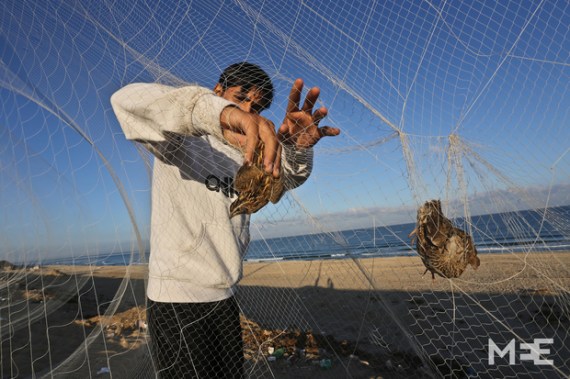
Common Quail netted in Gaza (Middle East Eye) [1]
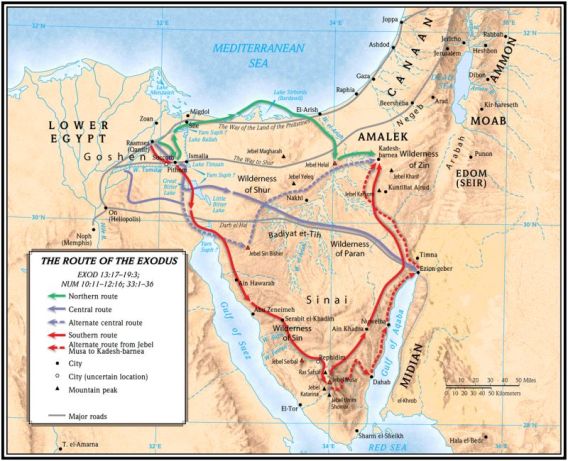
The solid red line (on this map) denotes their route from Egypt to Mount Sinai as presented in the Torah. According to the Torah, Mount Sinai can only be located at Jebel Musa, its traditionally accepted location. (All Faith.com)
The passage in Numbers 11.31-33 says that large numbers of people died almost immediately after eating the quail as a punishment for their greed. I can think of four possibilities to explain this. First, people who have not eaten meat for a long time can have a bad reaction to it. Second, sun-dried quail flesh may not be free of contamination. Third, birds, like people, can build up high levels of metabolites in their muscles during periods of sustained exertion. (Lactic acid buildup during anaerobic exercise creates that “burn” in your muscles.) Perhaps such metabolites could poison hungry, involuntary vegetarians who greedily gobble down their food (possibly sun-dried or insufficiently cooked). Fourth, many people today believe that quail migrating around the east end of the Mediterranean can accumulate toxins by eating hemlock or other poisonous plants. The term coternism (from Coturnix for “quail”) describes those who have been poisoned from eating quail. Aristotle, Philo, Galen and other ancients commented on such quail poisoning.
It has been reported that Common Quail are poisonous only during migration, and only those that fly around the eastern end of the Mediterranean; not those following other routes or while on their breeding or wintering grounds. Various food plants have been blamed: hellbore, henbane, hemlock, woundwart. Whatever the toxin, it appears to be stable, as cases have been reported of people poisoned by four-month-old pickled quail, and by potatoes fried in quail fat. Some quail eaters practicing such “dietary roulette” needed to have their stomachs pumped.
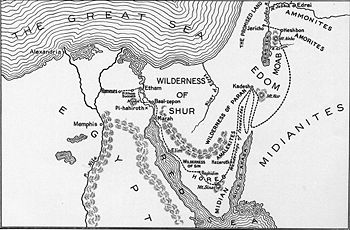
Probable Midian territories during Exodus era
(New World Encyclopedia)
In Exodus 2-4, Moses is described as fleeing Egypt to live for years in the “land of Midian,”, where he married Zipporah, the daughter of Jethro, a Midian priest, and spent time minding Jethro’s flocks of sheep, a task which took him into the wilderness, including the vicinity of Mt. Horeb. Such an occupation would quickly teach anyone how to find water and food both for himself and his sheep, and Moses would have become quite familiar with local water holes and the periodic passage of flocks of quail, knowledge that would come in handy if one found themselves leading a crowd of foreigners through this region. As usual, biblical scholars cannot agree on the location of “Midian,” “Mt. Horeb,” “Mt. Sinai,” whether Mt. Horeb is also Mt. Sinai or not, or if the mountain has two peaks – one called Sinai, the other Horeb – the route of the Exodus, the number of people, the length of time, and just about every other detail in this entire story.
But whether these events in Exodus and Numbers actually occurred as described is, frankly, irrelevant for the purposes of this essay. We’re simply looking at what birds are mentioned, and what was written about them. The facts pertaining to Common Quail behavior as described in these passages (exaggerations excepted), actually did, and still do, occur. The events could have happened to anyone traveling through the Sinai Peninsula during quail migration season(s), and the mere fact that the description was written down in Exodus (whenever and by whomever it was written), means that they had previously occurred to some people, and were probably common knowledge. Such local knowledge concerning water and food would be essential to merchants, caravan leaders, shepherds, and anyone traveling through such a difficult and barren region.
** Bible Factoid #2: YHVH [יְהוָ֖ה] [Yahweh]: When Moses asks – in Exodus 3:13-14 – the deity for his name so he can tell the Israelites who is sending him, YHVH (letters = yod-he-waw-he) is the answer. This is usually translated as “I AM.” The longer passage is “YHVH [I AM]; that is who I am. Tell them that I AM has sent you to them.” The Hebrew form YHVH is actually third person – “He is” – but as the deity is depicted as explaining his own name in the first person, the explanation becomes “I am.” [New English Bible, footnote Ex. 3:12] This explanation is expanded in Ex. 3:14-15 to “I will be what I will be.” Since this was written, scholars and theologians have argued about this name, its meaning(s) and implications. It should be noted that “I AM” – in numerous languages – is widely used in Hindu and Buddhist religions as a mantra and an object of meditation; many consider it to be the briefest, truest expression of the mystical presence of the deity – or nirvana – within each human consciousness. As such, it is also being examined in the recently developing field of Neurotheology.
Note: The link to an article on Grouse netting in Gaza is placed below, rather than embedded in the text, because I decided to not leave our website permanently linked to that site.
[1] middleeasteye . net/in-depth/features/common-quail-feeds-poor-gaza-594657522
Part I – What About That Dove? & The Flood of the Gilgamesh
Part III – Junglefowl in Judea! & New Testament Koine Greek
Part IV – Birds that Sow, Reap and Store & Whence Jesus (Ἰησοῦς)
Part V – The Friendly Raven & The Bar-Abbas Mystery
Part VI – The Humble Hoopoe & Catching “Forty” Winks
Part VII – The Wise Hoopoe & On “On”
Part VIII –Don’t Eat That Bird! Part 1 & Of “Of”
Part IX – Don’t Eat that Bird! Part 2 & Seeing “Red”
Part X – Don’t Eat that Bird! The Last Bite & The Problems of Translation
[Chuck Almdale]
Additional Sources:
1. Handbook of Birds of the World (HBW), Vol. 4. del Hoyo, J., Elliott, A. & Sargatal, J. eds. (1997) Lynx Edicions, Barcelona. Pg 55.
2. HBW Vol. 2. (1994) Pg. 509
3. New English Bible with the Apocrypha, Oxford Study Edition (NEB), Sandmel, Samuel General Editor, (1976) Oxford University Press, New York.
4. Birds of Europe. Mullarney, K., Svensson, L., Zetterström, D., Grant, P.J. (1999) Princeton University Press, Princeton, N.J.
Full Sturgeon Moon Update – August 18, 2:26 AM PDT
Here’s another update from SMBAS Blog on that large, disc-like, shining object which has frequently and mysteriously appeared in our nighttime sky this year (some call it the moon).
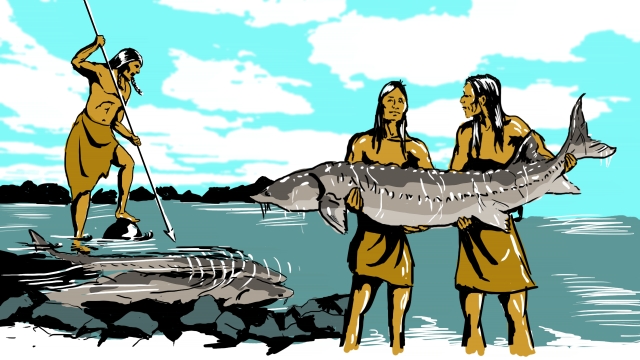
Sturgeon fishing in days of old (google images)
Aug. 18, 2:26 a.m. PDT — Full Sturgeon Moon, when this large fish of the Great Lakes and other major bodies of water, such as Lake Champlain, is most readily caught. Other variations include the Green Corn Moon or Grain Moon. No supermoon this year: the moon arrives at perigee — its closest approach to Earth — on Aug. 22, 9:22 AM PDT. Sturgeon, by the way, are very ancient and very cool fish. Hiawatha, that pestiferous egomaniac, called him the “King of Fishes,” but his treatment of Nahma the sturgeon was unsuitably disloyal.
August Moon Names from other cultures Courtesy of Keith Cooley):
Chinese: Harvest Moon; Celtic: Dispute Moon; English Medieval: Corn Moon

A dizzying monthly lunation cycle
(Antonio Cidadfo, apod.NASA.gov)
The annual performance of the Perseid meteor shower was on the 12th-13th, but you probably missed it.
Speaking of moons, you must certainly know that Jupiter has a new man-made moon, Juno. Appropriately named for the wife of Jupiter, king of the Roman pantheon of gods (Hera and Zeus are the equivalent Greek goddess and god), Juno will make it’s first close pass around Jupiter on August 27. The successful orbit insertion on July 4 sent it into the first of two planned 53-day-long loops around Jupiter, but on this close loop around the gas giant, it will have all instruments turned on as it passes more closely than human instruments have ever been. Juno will loop down over the planet’s north pole and back up over the south pole, entering and exiting through the “doughnut hole” of Jupiter’s enormous magnetic field, 20,000 times stronger than the earth’s. Scientists hope that the 1-cm-thick casing of titanium will protect the electronics from the field’s radiation, which over the 14-month course of the mission is estimated to be equivalent to 20 million dental X-rays, but they won’t know until after this pass the accuracy of their calculations. The whole thing may get fried.
Back to earth’s moon (cue crackle of space static):
The Old Farmer’s Almanac has a page for each full moon. One tip for September: Best days for harvesting belowground crops are 19th, 20th. 28th or 29th. Now you know, so you have no excuse.
The next significant full moon will occur on Sept. 16, 12:05 p.m. PDT. Keep an eye on this spot for additional late-breaking news on this unprecedented event.
The moon name information comes to you courtesy of: http://www.space.com/31699-full-moon-names-2016-explained.html
written by Joe Rao. Joe Rao serves as an instructor and guest lecturer at New York’s Hayden Planetarium. He writes about astronomy for Natural History magazine, the Farmer’s Almanac and other publications, and he is also an on-camera meteorologist for News 12, Westchester, N.Y.
But that’s waaay too long to type in, and besides, you don’t need to go there because SMBAS has done the work for you!
[Chuck Almdale]
Quick, let’s raise awareness…
…for the Snowy Plover. What a magnificent opportunity Steve Lopez has given us. On the front page of the California section (Sun. Aug. 14,’16) he dedicates his column on the conflict at Sand City near Monterey where plovers are threatened by adjacent big-time development. This is a good opportunity to post on your Facebook, instagram, twitter and say “thank you, Steve Lopez”. steve.lopez@latimes.com

Western Snowy Plovers on Santa Monica Beach. L.Plauzoles 2014
While he talks about scurrying little plovers at Sand City, I was surveying the Santa Monica site where the City had erected a fence for the past 13 years…and there wasn’t a single plover in sight! However, I found fresh dog tracks and tire tracks…Your post will help educate a few more people, and hopefully they will respect the beach as habitat at least for the rest of this summer.



 SANTA MONICA BAY AUDUBON SOCIETY BLOG